
On This Day in 1857: The Mountain Meadows Massacre took place and is still one of the most violent acts of terrorism committed by Americans against Americans. Members of a local military surrounded and killed 121 people traveling from Arkansas to California. Their actions were a result of poor leadership and war hysteria gripping the Utah territory during the summer of 1857.
While the Civil War dominates most discussions of mid-19th century American conflict, the Utah War of 1857-1858 was a significant, yet often overlooked event. Its causes, battles (or lack thereof), and long-term consequences shaped the development of the American West.
What Caused the Utah War?
The Utah War arose from escalating tensions between the growing community of Latter-day Saints (LDS, also known as Mormons) in the Utah Territory and the US government. Key points of friction included:
- Governance and Power: The LDS Church, led by Brigham Young, held substantial power in Utah, leading many in the federal government to fear the creation of a Mormon theocracy.
- Polygamy: The LDS Church’s practice of polygamy was highly controversial in the United States and seen by some as immoral and antithetical to American values.
- Rumors and Misinformation: Exaggerated reports of rebellion, violence, and anti-American sentiment among the Mormons fueled fear and mistrust back East.
- Past conflicts with local and state governements in NY, Illinois, and Missouri made the leaders of the LDS church weary of an government actions.
The War Itself
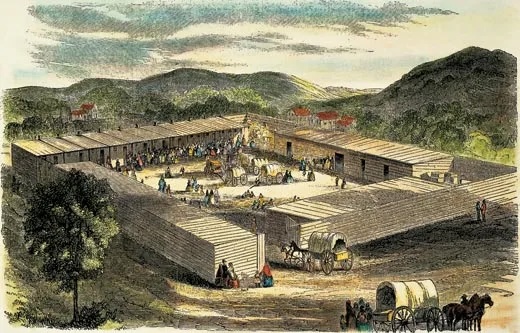
Anticipating a bloody conflict, the Mormons prepared to defend themselves. They engaged in delaying tactics, stockpiled provisions, and harassed the Army’s supply lines. However, significant combat was largely avoided. This lithograph shows the enjoyment at Provo in 1857.
President James Buchanan fueled the crisis by replacing Brigham Young with a non-Mormon governor. He also dispatched a large US Army force to install the new governor – viewed by Mormons as an invading army.
While the conflict was mostly bloodless, a tragic event tainted its legacy: the Mountain Meadows Massacre. A group of Mormon militiamen and some Paiute allies attacked a wagon train of emigrants from Arkansas, killing over 120 people. The exact circumstances and motivations are still debated, but the horrific event remains a scar on this period of history.
Resolution and Impact of the War
The Utah War ended with a negotiated settlement. Brigham Young accepted the new federal governor, and the US Army established Camp Floyd in Utah, maintaining a federal presence for years. Here’s why this conflict mattered:
- LDS Church & Federal Power: While the LDS Church retained significant influence, the war signaled its limits. It solidified federal authority over the Utah Territory.
- The State of Deseret: the territory is effectively disolved by the federal government and an new collection of territories are created thus ending a Mormon dominated corridor between Colorado and San Diego.
- Western Development: The Army’s presence spurred infrastructure and economic development in the region and provided funds and supplies for Utah communities.
- Discovery of silver in western parts of the territory would allow prospectors and the US government to split the territory and make Nevada a state in 1864 and delaying Utah statehood until 1896.
- Native American Relations: The conflict exacerbated tensions between Native American tribes and both the US government and the LDS settlers. Disputes over land and resources led to increased violence. The Bear River Massacre of 1863, in which US forces killed hundreds of Shoshone men, women, and children, is a particularly tragic example.
The Utah War is a complex chapter in US history. It exemplifies the clash of cultures, religious differences, and power struggles that shaped the expanding nation. Its repercussions on both the LDS Church’s role in the West and the fraught relations with Native American tribes continue to resonate today.
Additional Resources:
- Utah War – Utah History Encyclopedia: https://www.uen.org/utah_history_encyclopedia/u/UTAH_WAR.shtml
- The Mountain Meadows Massacre: https://en.wikipedia.org/wiki/Mountain_Meadows_Massacre
- PBS American Experience – The Mormons: https://www.pbs.org/wgbh/americanexperience/films/mormons/
- Smithsonian Magazine – The Brink of War: https://www.smithsonianmag.com/history/the-brink-of-war-48447228/
This is part of my Readings In History series. Where I try to collect resources from historical events and pop culture to talk about and discuss in my classes. To see more of these entries click here.
This is one of several articles in my brief history series about the US Civil War and its ever evolving place in American history. What began in 2010 as a blog series about the 150th anniversary has evolved into so much more.

 BFWClassroom
You must be logged in to post a comment.