
This post is in response to my comments about using vocabulary in better and more intentional ways. You may access the links for entire list here.
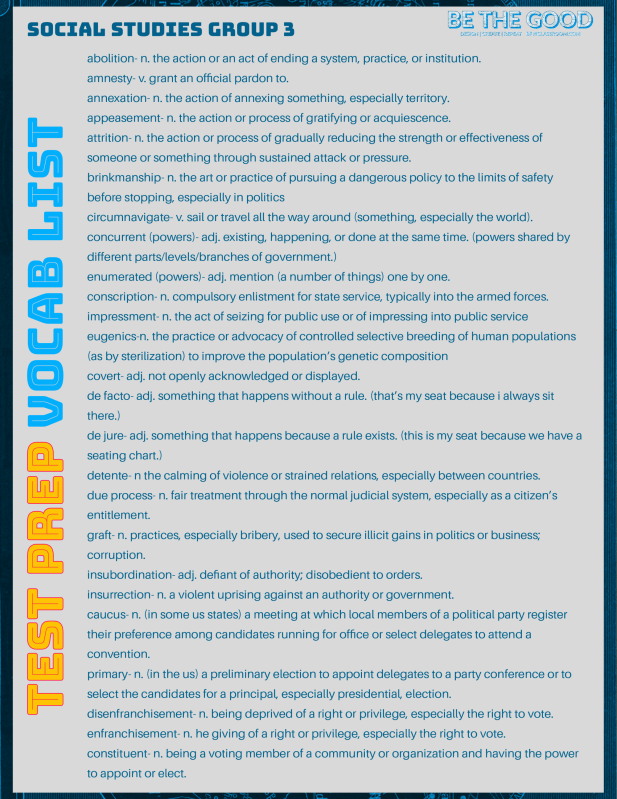
Social Studies GROUP Three
abolition- n. the action or an act of ending a system, practice, or institution.
amnesty- v. grant an official pardon to.
annexation- n. the action of annexing something, especially territory.
appeasement- n. the action or process of gratifying or acquiescence.
attrition- n. the action or process of gradually reducing the strength or effectiveness of someone or something through sustained attack or pressure.
brinkmanship- n. the art or practice of pursuing a dangerous policy to the limits of safety before stopping, especially in politics
circumnavigate- v. sail or travel all the way around (something, especially the world).
concurrent (powers)- adj. existing, happening, or done at the same time. (powers shared by different parts/levels/branches of government.)
enumerated (powers)- adj. mention (a number of things) one by one.
conscription- n. compulsory enlistment for state service, typically into the armed forces.
impressment- n. the act of seizing for public use or of impressing into public service
eugenics- n. the practice or advocacy of controlled selective breeding of human populations (as by sterilization) to improve the population’s genetic composition
covert- adj. not openly acknowledged or displayed.
de facto- adj. something that happens without a rule. (that’s my seat because i always sit there.)
de jure- adj. something that happens because a rule exists. (this is my seat because we have a seating chart.)
detente- n the calming of violence or strained relations, especially between countries.
due process- n. fair treatment through the normal judicial system, especially as a citizen’s entitlement.
graft- n. practices, especially bribery, used to secure illicit gains in politics or business; corruption.
insubordination- adj. defiant of authority; disobedient to orders.
insurrection- n. a violent uprising against an authority or government.
caucus- n. (in some us states) a meeting at which local members of a political party register their preference among candidates running for office or select delegates to attend a convention.
primary- n. (in the us) a preliminary election to appoint delegates to a party conference or to select the candidates for a principal, especially presidential, election.
disenfranchisement- n. being deprived of a right or privilege, especially the right to vote.
enfranchisement- n. he giving of a right or privilege, especially the right to vote.
constituent- n. being a voting member of a community or organization and having the power to appoint or elect.

 BFWClassroom
You must be logged in to post a comment.