
When most Americans think of Civil War heroes, they envision generals like Grant and Sherman, or politicians like Lincoln and Douglas. But the war’s most profound victory may have belonged to a girl born into slavery who would transform American education forever.
The Forgotten Dimension of Civil War Victory
The Civil War ended slavery, but what came next? How do four million newly freed people, denied education by law for centuries, suddenly become full participants in American democracy? The conventional narrative focuses on Reconstruction politics and military occupation, but the real story of emancipation’s promise lies in dusty schoolrooms across the South—and nowhere more dramatically than in the life of Mary McLeod Bethune.
Born just ten years after Appomattox, Bethune embodied both the Civil War’s unfinished business and its ultimate triumph. While politicians debated the Fourteenth and Fifteenth Amendments, she was building the infrastructure that would make those constitutional promises meaningful. Her story reveals that the Civil War’s most important battles were fought not with rifles, but with textbooks.
From Cotton Fields to Classroom Dreams
Mary Jane McLeod was born on July 10, 1875, in Mayesville, South Carolina, the fifteenth of seventeen children. Her parents, Sam and Patsy McLeod, had been enslaved on the same plantation where Mary was born free—a living bridge between slavery and freedom. The contrast defined her childhood: while older siblings bore the scars of bondage, Mary grew up with possibilities they could barely imagine.
The family worked as sharecroppers, and young Mary spent her days picking cotton alongside her parents. But everything changed when a Presbyterian missionary, Emma Jane Wilson, opened a school for African American children in Mayesville. At age nine, Mary became the first in her family to attend school—a moment as revolutionary in its way as any battlefield victory.
“The whole world opened to me when I learned to read,” Bethune later recalled. This wasn’t mere nostalgia; it was literal truth. In the antebellum South, teaching enslaved people to read had been illegal, punishable by fine or imprisonment. For generations of African Americans, literacy had been forbidden fruit. Mary’s ability to decipher words on a page represented the Civil War’s most personal victory.


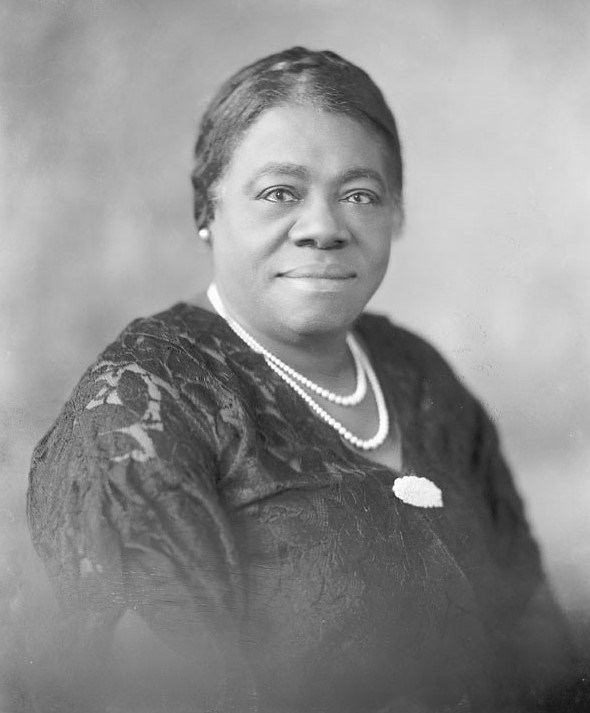
The Mission Takes Shape
Mary’s academic gifts earned her a scholarship to Scotia Seminary (now Barber-Scotia College) in North Carolina, where she encountered the radical idea that education was both a right and a responsibility. The school’s integrated faculty—black and white teachers working together—showed her what post-Civil War America could become.
After graduating in 1894, she attended Dwight L. Moody’s Institute for Home and Foreign Missions in Chicago, hoping to become a missionary to Africa. When that opportunity was denied—the Presbyterian Church didn’t send African American missionaries to Africa—Mary experienced a profound realization. America’s own formerly enslaved population needed missionaries just as desperately as any foreign field.
She returned South with a revolutionary vision: education as the pathway from slavery to full citizenship. This wasn’t simply about teaching reading and arithmetic; it was about preparing an entire generation to claim their Civil War inheritance.
Building a School from Faith and $1.50
In 1904, Bethune arrived in Daytona Beach, Florida, with $1.50 in her pocket and an audacious dream. The small beach town was experiencing a construction boom, drawing African American workers who had few educational opportunities for their children. Bethune saw this as her mission field.
She rented a small cottage for $11 a month and opened the Daytona Educational and Industrial Training School for Negro Girls with five students—four girls and her own son. The school’s “campus” consisted of a two-story cottage, but Bethune’s vision encompassed far more than the building could contain.
Like other Civil War heroes, Bethune understood that victory required resourcefulness and determination. When she needed school supplies, she made them: elderberry juice became ink, charcoal served as pencils, and packing crates were transformed into desks. Students grew vegetables to eat and raised funds by baking and selling sweet potato pies to tourists.
“I founded the school on faith and prayer,” Bethune later wrote. “I frankly told the students that we had no money, no equipment, and no buildings, but we had faith in ourselves and in God.”
The Strategic Alliance: Merging with Cookman Institute
Bethune’s school grew rapidly, but she faced the same challenge that confronted all Civil War-era reformers: how to build lasting institutions without adequate resources. Her solution demonstrated the political acumen that made her one of America’s most influential educators.
In 1923, she negotiated a merger between her school and the all-male Cookman Institute of Jacksonville, creating Bethune-Cookman College. The merger was controversial—some questioned whether a woman could lead a coeducational institution—but Bethune understood that survival required adaptation. By combining resources and constituencies, she created something larger than either institution could achieve alone.
The merged school represented everything the Civil War had been fought to achieve: integrated leadership (the board included both black and white members), educational opportunity regardless of economic background, and preparation for full citizenship. Students studied traditional academic subjects alongside practical skills, emerging ready to become teachers, business owners, and community leaders.
Beyond the Campus: National Influence
While building her college, Bethune recognized that educational progress required political engagement. She became a master of what we might call “strategic coalition building”—working with both black and white leaders to advance African American interests.
Her approach reflected hard-won wisdom from the Civil War era. Radical Reconstruction had failed partly because it relied too heavily on federal enforcement without building sustainable local coalitions. Bethune succeeded by creating networks that could survive political changes.
She founded the National Council of Negro Women in 1935, uniting women’s organizations across the country. During the Roosevelt administration, she served as Director of Negro Affairs in the National Youth Administration, becoming the highest-ranking African American woman in government. Her informal “Black Cabinet” advised the president on racial issues, creating an institutional voice for African American concerns.
The Tuskegee Alternative: A Different Vision of Progress
Bethune’s approach to education differed significantly from her contemporary Booker T. Washington, founder of Tuskegee Institute. Washington emphasized industrial training and accommodation to segregation; Bethune insisted on both practical skills and liberal arts education, along with direct political engagement.
This wasn’t mere philosophical difference—it reflected competing visions of what Civil War emancipation meant. Washington’s approach accepted temporary limitations in exchange for economic progress. Bethune demanded immediate preparation for full citizenship, refusing to defer constitutional rights.
Her students studied literature alongside agriculture, philosophy alongside home economics. They were prepared to be teachers and leaders, not just skilled workers. This comprehensive approach proved prescient: many Bethune-Cookman graduates became key figures in the Civil Rights Movement of the 1950s and 1960s.
The Roosevelt Partnership: Education Meets Policy
Bethune’s relationship with Eleanor Roosevelt transformed both women’s approaches to civil rights. Their friendship, begun in the early 1930s, created an unprecedented partnership between a former slave’s daughter and the nation’s First Lady.
Through this relationship, Bethune gained access to the highest levels of government, while Roosevelt learned about racial discrimination from someone with lived experience. Their correspondence reveals two reformers pushing each other toward greater understanding and more effective action.
When Roosevelt resigned from the Daughters of the American Revolution after they refused to let Marian Anderson perform at Constitution Hall, Bethune helped orchestrate Anderson’s Lincoln Memorial concert. The event drew 75,000 people and demonstrated the power of strategic alliances across racial lines.
The Long Arc of Victory
By the time of her death in 1955, Bethune had witnessed remarkable changes. The girl born into slavery’s aftermath had advised four presidents, founded a college, and built institutional networks that would prove crucial to the Civil Rights Movement. Her students had become teachers, spreading education throughout the South. Her organizational work had created platforms for political engagement.
Most importantly, she had proved that the Civil War’s promise could be fulfilled through sustained effort and strategic thinking. Education, she demonstrated, was both a right worth fighting for and a weapon against injustice.
When the Supreme Court declared segregated schools unconstitutional in Brown v. Board of Education, the decision built on foundations that educators like Bethune had spent decades constructing. The schools she founded, the teachers she trained, and the networks she built became the infrastructure for integration.
Lessons for Contemporary Educators
Bethune’s approach to institutional building offers timeless lessons for educators and reformers. First, she understood that lasting change requires institutional foundations, not just individual heroism. Second, she recognized that education must prepare students for the world they will inhabit, not just the world that currently exists.
Her strategic vision also demonstrates the importance of building coalitions across difference. Bethune worked with white philanthropists, black community leaders, government officials, and grassroots activists. She understood that sustainable progress requires multiple constituencies and diverse forms of support.
Finally, her life illustrates how individual determination can create opportunities for future generations. The students she taught became teachers themselves, multiplying her impact exponentially. The institutions she built outlasted her lifetime, continuing to educate leaders decades after her death.
The Unfinished Revolution
When we celebrate Civil War heroes, we typically focus on the military and political figures who ended slavery. But emancipation was only the beginning. The harder work of building a truly equal society fell to educators like Mary McLeod Bethune, who understood that freedom meant more than the absence of chains.
Her life reminds us that the Civil War’s deepest victory wasn’t won at Gettysburg or Appomattox, but in classrooms across the South where formerly enslaved people and their children learned to read, write, and claim their full citizenship. In a very real sense, Mary McLeod Bethune completed what Lincoln began—the transformation of America from a nation where slavery was legal to one where freedom was meaningful.
Today, as we continue to grapple with educational inequality and racial injustice, Bethune’s example remains relevant. She showed that lasting change requires both vision and pragmatism, both individual courage and institutional building. Most importantly, she proved that education is not just about transmitting knowledge—it’s about transforming lives and communities.
The girl who was born in slavery’s shadow grew up to cast her own light, illuminating the path from bondage to freedom for countless others. In doing so, she became one of the Civil War’s greatest heroes—not because she fought on any battlefield, but because she won the peace that followed.
Teaching Resources and Extensions
Primary Sources for Further Exploration
- Bethune’s “My Last Will and Testament” (1955) – her philosophical legacy
- Correspondence between Bethune and Eleanor Roosevelt (FDR Presidential Library)
- Speeches from National Council of Negro Women conventions
- Early catalogs and photographs from Bethune-Cookman College
Discussion Questions
- Analysis: How did Bethune’s approach to education differ from Booker T. Washington’s, and why were these differences significant?
- Evaluation: What were the most significant obstacles Bethune faced, and which strategies were most effective in overcoming them?
- Synthesis: How did Bethune’s work connect to broader themes of Reconstruction and post-Civil War American development?
- Application: What modern educational leaders or movements remind you of Bethune’s approach and challenges?
Cross-Curricular Connections
- Literature: Read selections from African American authors Bethune promoted
- Government: Examine the role of federal agencies like the National Youth Administration
- Economics: Analyze the economic challenges facing African Americans in the early 20th century
- Geography: Map the Great Migration and its impact on educational opportunities
Research Extensions
- Local connections: How did post-Civil War educational efforts affect your region?
- Comparative biography: Compare Bethune with other educational reformers of the era
- Legacy project: Trace Bethune-Cookman graduates’ contributions to the Civil Rights Movement
- Modern parallels: Research contemporary efforts to address educational inequality
This biography draws from Bethune’s extensive correspondence, institutional records from Bethune-Cookman University, and contemporary accounts of her educational and political work. For educators seeking additional primary sources, the Bethune Foundation and the National Archives provide rich documentary evidence of her impact on American education and civil rights.
This is part of my Inspirational Leaders series that tries to give a positive reflective biography every month.

 BFWClassroom
You must be logged in to post a comment.