
Introduction: A City That Transformed Civilizations
In 1085, when King Alfonso VI of Castile captured the city of Toledo from its Muslim rulers, he unknowingly opened the most important intellectual gateway in European history. For the next century, this Spanish city became the bridge between two worlds—serving as the primary channel through which the accumulated wisdom of the Islamic world entered medieval Europe and sparked the intellectual revolution that would lead to the Renaissance, the rise of universities, and the Scientific Revolution.
Toledo’s unique position as a recently conquered Islamic city with vast libraries, diverse populations, and royal support created the perfect conditions for one of history’s greatest knowledge transfers. The translation schools that flourished here didn’t just move books from one language to another—they transmitted entire civilizations’ worth of learning that transformed European thought forever.
Toledo’s Perfect Storm: Why This City Changed Everything
The Multicultural Advantage
When Alfonso VI conquered Toledo, he made a crucial decision that changed European history: instead of expelling or converting the Muslim population, he actively encouraged the preservation of their intellectual heritage. This created an extraordinarily diverse city where Muslims, Christians, Jews, and Mozarabs (Christians who wrote in Arabic) lived and worked together.
This diversity was Toledo’s secret weapon. While other European cities were homogeneous Christian communities with limited linguistic skills, Toledo contained scholars fluent in Arabic, Latin, Hebrew, and local Romance languages. This multilingual environment made sophisticated translation work possible on a scale never before seen in medieval Europe.
The Treasure Trove: Toledo’s Islamic Libraries
Toledo’s Islamic period had left the city with extraordinary intellectual resources. The city’s libraries contained thousands of Arabic manuscripts covering every field of knowledge: Greek philosophy translated into Arabic with Islamic commentary, original Islamic works on mathematics and science, medical treatises, and astronomical texts that were centuries ahead of anything available in Christian Europe.
These weren’t just religious texts—they represented the accumulated scientific and philosophical knowledge of the entire Islamic world, from Spain to Baghdad. When Alfonso VI gained control of these libraries, he essentially acquired Europe’s first major research university.
Royal Patronage: Making Translation a Priority
Alfonso VI and his successors, particularly Alfonso VII and Alfonso VIII, understood the strategic value of this knowledge. They provided financial support, legal protection, and royal prestige to translation projects that attracted scholars from across Europe. This wasn’t just academic curiosity—these kings recognized that access to Islamic learning gave them significant advantages in military technology, administration, and international diplomacy.
The Translation Revolution: How It Actually Worked
The Toledo Method: Collaborative Translation
Toledo developed a sophisticated translation process that became the model for intellectual exchange across medieval Europe:
- Stage One: A Muslim or Jewish scholar would translate the Arabic text into the local Romance dialect
- Stage Two: A Christian scholar would translate from Romance into formal Latin
- Stage Three: Multiple reviewers would check the translation for accuracy and clarity
This collaborative method ensured both linguistic accuracy and cultural understanding. Unlike simple word-for-word translation, Toledo’s scholars worked to convey complex philosophical and scientific concepts across radically different intellectual traditions.
The International Attraction
Toledo’s reputation spread rapidly across Europe, drawing scholars from England, France, Italy, and Germany. Key figures like Gerard of Cremona (from Italy), Michael Scot (from Scotland), and Hermann of Carinthia (from Austria) traveled hundreds of miles specifically to access Toledo’s Arabic libraries and translation expertise.
These weren’t just individual adventurers—they were part of an organized intellectual movement that recognized Toledo as Europe’s best source for advanced learning. Many stayed for years, some for decades, systematically translating entire libraries of Islamic texts.
The Texts That Transformed Europe
Scientific Revolution Foundations
Through Toledo’s translation schools, Europe gained access to:
- Advanced Mathematics: Algebra, trigonometry, and the decimal system that revolutionized European calculation
- Astronomy: Detailed star charts, improved astrolabes, and mathematical models that corrected errors in European astronomy
- Medicine: Surgical techniques, pharmaceutical knowledge, and diagnostic methods that transformed European medical practice
- Technology: Engineering treatises, agricultural innovations, and manufacturing techniques
The Aristotle Revolution
Perhaps most importantly, Toledo’s translators made available the complete works of Aristotle, along with Islamic commentaries by scholars like Averroes and Avicenna. European scholars had lost most of Aristotle’s works during the early medieval period, possessing only fragments of his logical writings.
The recovery of Aristotelian philosophy through Toledo completely transformed European intellectual life.Universities restructured their curricula around Aristotelian thought, leading to the development of scholasticism and fundamentally changing how Europeans approached questions of science, politics, and theology.
The European Impact: From Toledo to Renaissance
University Revolution
The knowledge flowing through Toledo directly contributed to the establishment of Europe’s first universities. The University of Paris (founded around 1150) and other early European institutions were built upon the foundation of Arabic learning made available through Toledo’s translation movement.
European scholars like Thomas Aquinas and Roger Bacon constructed their entire intellectual systems using concepts and methods learned from Arabic sources. Without Toledo’s translations, the great achievements of medieval European philosophy and science would have been impossible.
Scientific Advancement
European advances in mathematics, astronomy, medicine, and natural philosophy throughout the later Middle Ages can be directly traced to knowledge acquired through Toledo. The scientific revolution of the 16th and 17th centuries built upon foundations laid by Islamic scholars and transmitted through Toledo’s translation schools.
Economic and Political Changes
The practical knowledge gained through Toledo also had immediate effects:
- Military Technology: Improved siege engines, fortification designs, and metallurgy
- Navigation: Better maps, navigational instruments, and mathematical techniques that enabled the Age of Exploration
- Agriculture: New crops, irrigation methods, and farming techniques that increased European productivity
- Commerce: Mathematical tools for banking, accounting systems, and trade calculations
The Broader Historical Significance
East Meets West
Toledo represented something unprecedented in medieval history: a sustained, systematic effort to transfer knowledge between civilizations. While conquest usually meant destruction of the defeated culture’s intellectual achievements, Toledo preserved and transmitted this knowledge, creating a model for cross-cultural intellectual exchange.
The Bridge Between Worlds
Toledo functioned as more than just a translation center—it was a bridge between the Islamic and Christian worlds during a period when those civilizations were often in conflict. The city demonstrated that collaboration could be more valuable than conquest, and that preserving enemy knowledge could benefit the victor more than destroying it.
Timing and Historical Consequences
Toledo’s translation movement occurred at exactly the right moment in European history. The 12th century was when European civilization was ready to absorb and build upon this knowledge. Earlier, Europe lacked the institutional framework to use this learning effectively. Later, the knowledge might have been lost or scattered.
The timing was also crucial because Islamic Spain was fragmenting politically, making scholars and manuscripts available just as Christian rulers were gaining the stability and resources to support large-scale translation projects.
Conclusion: Toledo’s Lasting Legacy
Toledo’s century as Europe’s translation capital (roughly 1085-1200) represents one of history’s most successful examples of knowledge transfer between civilizations. By serving as the primary gateway through which Islamic learning entered medieval Europe, Toledo sparked the intellectual transformation that led to the Renaissance, the Scientific Revolution, and the emergence of modern European civilization.
The city’s unique combination of multicultural population, vast libraries, and royal support created conditions that allowed unprecedented collaboration between scholars from different religious and cultural backgrounds. Toledo proved that intellectual exchange could be more powerful than military conquest in shaping the course of history.
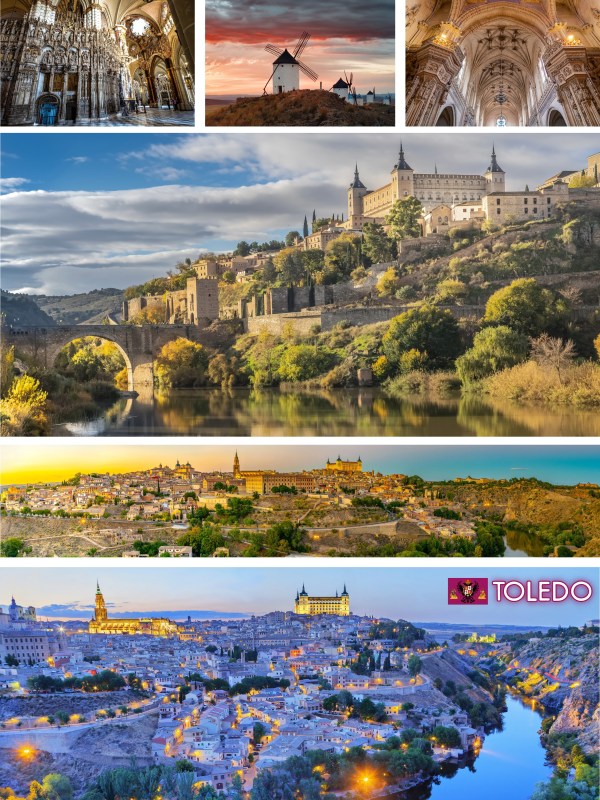
Perhaps most importantly, Toledo demonstrated that civilization’s greatest achievements often occur not in isolation but through the meeting and mixing of different cultural traditions. The European Renaissance might never have occurred without the Islamic knowledge that flowed through Toledo’s translation schools, just as Islamic civilization had earlier been enriched by preserving and expanding upon Greek learning.
Toledo’s legacy reminds us that the boundaries between civilizations are often more porous than they appear, and that humanity’s intellectual progress depends on the willingness of different cultures to learn from one another rather than simply to dominate or destroy.
Image created using Adobe Express
Key Terms and Concepts
Mozarabs: Christians living under Muslim rule who maintained Arabic language and cultural practices
Scholasticism: The medieval European intellectual movement that synthesized Aristotelian philosophy with Christian theology
Translation Movement: The systematic effort to translate Greek and Islamic texts into Latin in medieval Europe
Convivencia: The period of relative tolerance and coexistence between Christians, Muslims, and Jews in medieval Iberia
Alfonso VI (1065-1109): The Castilian king who conquered Toledo and established policies encouraging intellectual preservation and exchange
Discussion Questions for Further Exploration
- How did Toledo’s multicultural population contribute to its success as a translation center?
- What specific advantages did access to Islamic learning give to European civilization?
- How might European history have developed differently without the knowledge transmitted through Toledo?
- What similarities and differences can we identify between Toledo’s translation movement and modern international academic exchange?
- How did political factors (conquest, royal patronage, international conflict) shape intellectual development in medieval Toledo?
Sources and Further Reading
This account draws upon extensive scholarship in medieval European, Islamic, and Iberian history, with particular focus on the Toledo translation schools and their impact on European intellectual development.
Key Primary Sources
- Translation prefaces by Gerard of Cremona and other Toledo translators
- Royal charters and documents supporting translation activities
- Contemporary chronicles describing Toledo’s cultural transformation
- Surviving manuscripts that show the translation process
Modern Scholarly Research
- Studies of individual translators and their contributions to European learning
- Analysis of how specific texts influenced European intellectual development
- Research on the multicultural society that made Toledo’s achievements possible
- Economic and political histories explaining the context for Toledo’s translation movement
For Students Seeking Additional Information
Students interested in exploring this topic further can find translated excerpts from medieval sources, detailed studies of specific translation projects, and comparative analysis of other medieval centers of learning and cultural exchange.
This post is one of my Diversity in the Classroom readings. Their main purpose is to share the stories and history from people of diverse backgrounds. To Read More follow this Link.

 BFWClassroom
You must be logged in to post a comment.