This fall semester, I took a deliberate approach to using comic books as teaching tools to explore critical social and historical issues that resonate with my high school students. Rather than treating comics as simple entertainment, I leveraged their visual storytelling power and cultural relevance to create engaging entry points for discussions about representation, identity, and the ongoing struggle for justice in America. Through monthly thematic posters featuring diverse superhero characters displayed outside my classroom door, I created visible commitments to inclusivity while providing educational content that sparked curiosity and conversation among students passing in the hallways.
September: Hispanic Heritage Through Blue Beetle and White Tiger
I launched the semester during Hispanic Heritage Month by highlighting the growing prominence of Hispanic superheroes in modern comics and media. Using characters like Jaime Reyes (Blue Beetle) and Ava Ayala (White Tiger), the September poster explored how representation in popular culture validates experiences and creates possibilities for young people. The 2023 “Blue Beetle” film provided a perfect contemporary touchstone; students could see how Jaime navigates family expectations, cultural traditions, and superheroic responsibilities simultaneously. The poster emphasized a crucial message: when Hispanic students see heroes who speak their language, honor their family dynamics, and draw strength from their cultural heritage, it demonstrates that their identity isn’t an obstacle to overcome but a source of power. We examined how Blue Beetle’s bilingual conversations with his family and White Tiger’s connection to ancestral traditions represent authentic Hispanic experiences, challenging long-standing stereotypes by giving these characters rich, complex narratives rather than relegating them to side characters or one-dimensional portrayals.

For teachers looking to create similar resources, September offers an ideal opportunity to introduce diverse representation through characters students may already recognize from recent films and television shows. Start by researching which characters have cultural connections to the heritage month you’re celebrating, then look for recent media appearances that make those characters accessible to students unfamiliar with comics. The key is connecting the fictional narrative to real cultural values and experiences; don’t just show diverse faces but explore how cultural identity shapes the character’s worldview, decision-making, and relationships. When creating posters for hallway display, include both striking visuals and concise text that passersby can read quickly while moving between classes. Consider adding “Think About It” questions that invite reflection without requiring extensive background knowledge. This approach transforms your classroom entrance into a teaching space that reaches beyond your enrolled students, creating school-wide conversations about representation and identity.
October: Digital Citizenship in the Comic Book Universe
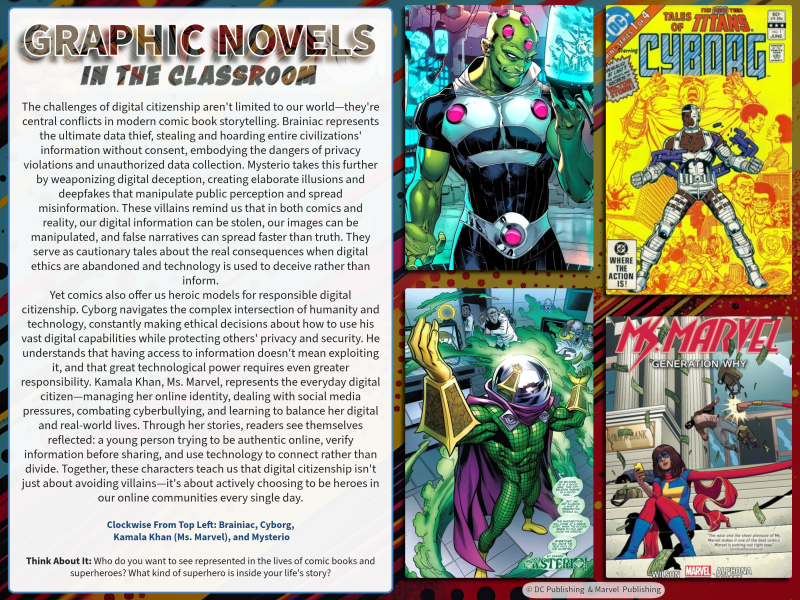
October brought focus to digital citizenship, and I discovered that comic book characters provide excellent frameworks for discussing online safety, ethics, privacy, and digital literacy. Rather than approaching these topics through abstract lectures, the poster used characters students already knew to illustrate both the dangers and responsibilities of our connected world. Brainiac represented the ultimate data thief, embodying privacy violations and unauthorized information collection. Mysterio became the cautionary tale about digital deception, deepfakes, and the weaponization of misinformation. On the heroic side, Cyborg offered a model for ethical technology use (someone with vast digital capabilities who constantly makes responsible choices about protecting others’ privacy and security). Most importantly, Kamala Khan (Ms. Marvel) resonated deeply with students as she represents their everyday experiences: managing online identity, dealing with social media pressures, combating cyberbullying, and balancing digital and real-world lives. Students quickly grasped that digital citizenship isn’t just about avoiding villains; it’s about actively choosing to be heroes in online communities every day.
Teachers can adapt this approach to digital citizenship education by identifying characters whose powers or storylines directly parallel online behaviors and consequences. Cybersecurity lessons become more engaging when framed through Oracle’s data protection skills or Iron Man’s AI ethics dilemmas. Discussions about misinformation gain traction when students analyze how Mysterio’s illusions mirror deepfakes and manipulated media. The beauty of using established characters is that students already understand their motivations and methods, allowing you to skip extensive backstory and jump directly into applying those fictional scenarios to real-world digital challenges. When creating these resources, explicitly connect each character to specific digital citizenship standards your school or district follows; this demonstrates that you’re teaching required curriculum through innovative methods rather than replacing standards with entertainment. Consider timing this poster for October (Cybersecurity Awareness Month) or whenever your school focuses on digital citizenship, and coordinate with your media specialist or technology teachers to reinforce consistent messages across different classes.
November: Beyond Stereotypes (Native American Representation)
Native American Heritage Month provided an opportunity to examine how modern comics have moved beyond harmful “cowboys and Indians” stereotypes to create authentic Indigenous representation. The November poster featured Maya Lopez (Echo) and Forge prominently, celebrating how these characters have gained visibility through the MCU and “X-Men ’97” respectively. Echo’s Disney+ series became a focal point; the poster highlighted how it celebrates Choctaw culture, family traditions, and ancestral connections rather than reducing Native identity to mystical tropes or historical relics. We explored how Forge bridges traditional Cheyenne spirituality with cutting-edge technology, demonstrating that Indigenous wisdom and modern innovation can coexist and strengthen each other. The poster also referenced other Native American heroes like Danielle Moonstar, Shaman, and American Eagle, noting the diversity within Indigenous communities (different tribes, different powers, different perspectives, all unified by resilience and cultural pride). These authentic portrayals validate Native American students’ experiences, educate non-Native readers about Indigenous cultures and contemporary realities, and challenge harmful misconceptions perpetuated by decades of one-dimensional storytelling.

Creating resources around Native American representation requires particular sensitivity and research. Teachers should invest time learning about specific tribal nations rather than treating all Indigenous peoples as a monolithic group; notice how the poster specified Echo as Choctaw and Forge as Cheyenne rather than using generic “Native American” descriptors. Consult resources from Native educators and cultural centers to ensure accuracy and avoid perpetuating stereotypes even while attempting to counter them. When selecting characters to feature, prioritize those created or co-created by Native writers and artists when possible, and look for storylines that treat Indigenous identity as multifaceted rather than purely mystical or historical. The timing of this poster in November aligns with Native American Heritage Month, but these conversations shouldn’t be confined to a single month; consider how to integrate authentic Native representation throughout your curriculum. If your school has Native students or is located near tribal lands, consider inviting community members to review your materials before display to ensure cultural appropriateness and accuracy.
December: Jack Kirby’s Jewish Heritage and Fighting Oppression
As we approached winter break, the December poster introduced students to Jack Kirby (born Jacob Kurtzberg) and how his Jewish heritage profoundly influenced his approach to creating characters who fight oppression. Students were fascinated to learn that Kirby’s family had fled Eastern European pogroms and that he witnessed antisemitism firsthand growing up in Depression-era New York. This personal experience with hatred and marginalization shaped his legendary career and gave depth to his most iconic creations. The poster explored two of Kirby’s most significant characters through a Jewish cultural lens. First, we examined Ben Grimm (The Thing) as a modern interpretation of the golem, the protective clay figure from Jewish folklore created to defend communities from persecution. Students made connections between the legendary golem of Prague and Ben’s transformation from ordinary man to unstoppable protector, both remade from earthen elements, noting how Kirby explicitly made Ben Grimm Jewish. Second, we analyzed Darkseid as Kirby’s artistic response to the fascism that threatened his people and his world. Students recognized how Darkseid’s quest to crush free will through his “Anti-Life Equation” directly reflected totalitarian oppression and Nazi ideology, understanding how Kirby transformed ancient Jewish wisdom and modern Jewish trauma into universal narratives about the eternal struggle between freedom and oppression.

Teachers developing similar resources should recognize that exploring creators’ backgrounds offers powerful insights into why certain stories get told and how personal experience shapes artistic vision. When creating posters about comic creators rather than just characters, include biographical context that connects the creator’s life experiences to their creative choices; this demonstrates to students that art doesn’t emerge from a vacuum but reflects the artist’s worldview, struggles, and values. December provides natural opportunities to explore diverse cultural and religious traditions during winter holidays, but avoid treating Jewish representation as purely seasonal; Kirby’s Jewish identity influenced his work year-round, and discussions about antisemitism, persecution, and resistance remain relevant throughout the school year. This poster also opens conversations about how marginalized creators use popular media to process trauma and fight oppression through metaphor and myth. Consider pairing creator-focused posters with character-focused ones to help students understand both the “what” (which diverse characters exist) and the “why” (what cultural contexts produced them). These resources work particularly well in schools teaching media literacy or creative writing, as they demonstrate how personal identity inevitably influences storytelling choices.
Reflections and Practical Implementation
Throughout fall semester, displaying these monthly posters outside my classroom door served multiple purposes beyond my enrolled students’ education. The hallway location meant every student, teacher, and visitor passing by encountered messages about representation, digital citizenship, and cultural heritage multiple times daily. Several students not in my classes stopped to read the posters, with some asking follow-up questions or sharing how they’d never realized certain characters had cultural significance beyond their superpowers. Teachers from other departments mentioned using the posters as conversation starters with their own students, and administrators appreciated visible demonstrations of our school’s commitment to inclusive education and culturally responsive teaching.
For educators interested in creating similar monthly resources, I recommend starting small with just one or two posters rather than committing to an entire year immediately. Choose heritage months or themes that align with your curriculum and expertise, then research characters whose stories authentically represent those themes rather than tokenizing them. Invest in high-quality printing (I use poster-size prints, approximately 24×36 inches) so the visuals capture attention from a distance, and laminate them for durability if you plan to reuse or archive them. Display posters prominently in high-traffic areas rather than inside classrooms where only your students benefit; hallways, cafeteria entrances, or library spaces maximize visibility and impact. Consider creating a consistent visual template so students recognize your monthly posters as a series rather than random decorations. Most importantly, connect the posters to actual classroom instruction rather than treating them as standalone decorations; reference them in lessons, use them as discussion prompts, and encourage students to suggest future poster topics. This approach transforms monthly posters from performative diversity displays into genuine educational tools that foster ongoing conversations about representation, justice, and the power of storytelling to shape how we see ourselves and others.
Be sure to check out my posts in January for the spring semester resources.
This is part of my Comics in the Classroom series where I look at the importance of the comic book industry and how to use them as resources in the classroom. To read more check out my other posts. (Link)

 BFWClassroom
You must be logged in to post a comment.