
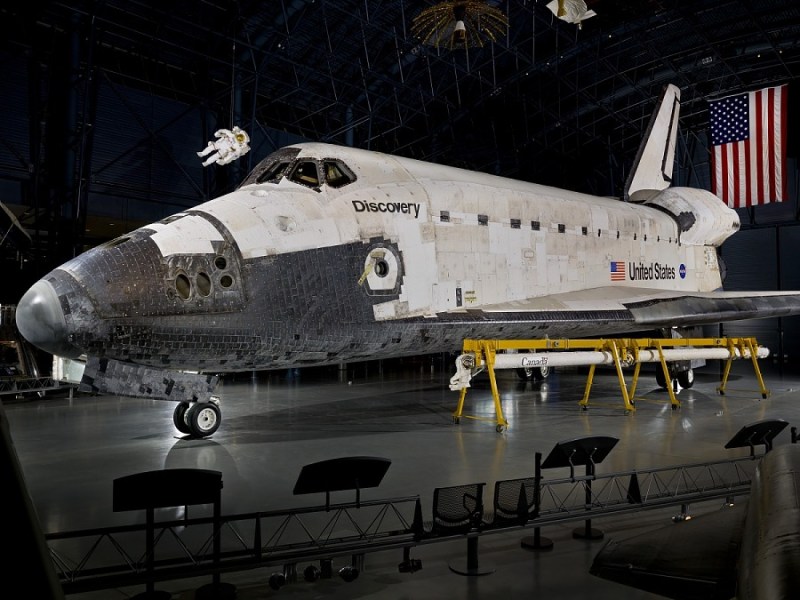
There’s been talk recently about moving Space Shuttle Discovery from the Smithsonian’s Udvar-Hazy Center in Virginia to Houston’s Space Center. As someone who teaches history and civics to high schoolers, I need to push back on this idea—not because Houston doesn’t deserve celebration of its space heritage, but because uprooting Discovery fundamentally misunderstands how we should preserve and present history.
Discovery belongs at Udvar-Hazy. But Houston deserves something better than a political trophy relocated from someone else’s museum.
Why Discovery Should Stay
First, let’s talk about context. Discovery sits in a purpose-built facility designed specifically to showcase aerospace history comprehensively. When students visit Udvar-Hazy (and I’ve taken groups there), they don’t just see a shuttle—they see the evolution of human flight from the Wright Brothers through the space age. Discovery isn’t an isolated artifact; it’s the culmination of a century-long story told through carefully curated exhibits.
Moving Discovery to Houston would be like moving the original Constitution from the National Archives to Independence Hall because “that’s where it was debated.” Yes, there’s a connection, but you’ve broken something valuable in the move.
Second, accessibility matters. Udvar-Hazy serves the massive population corridor of the mid-Atlantic and is a destination for school groups from across the country. The infrastructure is already there. The educational programming is established. Discovery has become integrated into countless curriculum units, field trip itineraries, and STEM education initiatives.
What Houston Should Get Instead
Here’s where this gets interesting for those of us who teach about space exploration: Houston is being shortchanged by this conversation.
Rather than fight over Discovery, Houston should leverage its unique position to tell stories no one else can tell—specifically, the stories of right now and the immediate future of spaceflight.
SpaceX materials from the commercial space revolution: We’re living through a fundamental transformation in space access. SpaceX has landed orbital-class boosters, launched the world’s most powerful operational rocket, and returned American orbital human spaceflight capability. These aren’t historical curiosities—they’re the foundation of what comes next. Houston, as home to Mission Control and astronaut training, is the perfect place to contextualize this commercial space revolution.
Military aircraft from the Davis-Monthan boneyard: Here’s something most people don’t realize: hundreds of aircraft with space-related histories sit in the Arizona desert, slowly deteriorating. Reconnaissance aircraft that supported space missions. Modified military planes used for astronaut training. Aircraft that recovered space capsules. Some of these planes have genuine Houston connections through their service to the space program, and many could be restored and displayed rather than left to decay.
Recent ISS artifacts: As the International Space Station approaches retirement, Houston should be first in line for modules, equipment, and materials that tell the story of humanity’s longest continuous presence in space. This is Houston’s story in a way Discovery never was.
The Educational Argument
When I teach my students about how we preserve history, I emphasize that museums make arguments through their choices. What we save, where we put it, and what we place next to it all communicate meaning.
Discovery at Udvar-Hazy argues that space exploration represents the apex of human aerospace achievement, building on everything that came before. It’s positioned as the answer to a question the whole museum asks: “How did we get here?”
Discovery in Houston would argue… what, exactly? That Houston deserves it more? That’s not a historical argument; it’s a political one. And using artifacts as political prizes teaches students exactly the wrong lesson about why we preserve history.
But a Houston museum centered on SpaceX, commercial spaceflight, and the transition from government-led to commercial space operations? That argues something genuinely important: that the story isn’t over. That what Houston represents—Mission Control, astronaut training, the operational heart of American spaceflight—is as relevant today as it was in the Apollo era.
A Better Vision
Instead of fighting over Discovery, Houston should become the premier museum of contemporary and future spaceflight. This serves students and the public better than recycling cold war artifacts that are already well-preserved elsewhere.
Imagine a Houston space museum where students can see:
- A landed Falcon 9 booster next to explanations of reusability economics
- Military reconnaissance aircraft that contributed to space missions
- Actual ISS modules where astronauts lived and worked
- Dragon capsules that have flown to station
- Starship development hardware
This tells a story only Houston can tell. It complements rather than duplicates other space museums. And critically, it gives students something Udvar-Hazy can’t: a vision of the future rather than just reverence for the past.
The Lesson for Students
When my students study how we commemorate history, they learn that the best museums don’t just warehouse artifacts—they make arguments about meaning and relevance. Moving Discovery isn’t about improving how we tell the story of space exploration; it’s about institutional pride and political posturing.
Houston deserves better. Discovery deserves better. And our students, who will inherit whatever space future we build, deserve museums that help them understand where we’re going, not just where we’ve been.
Keep Discovery at Udvar-Hazy. But give Houston the tools to build something unprecedented: a museum that documents humanity’s transformation into a truly spacefaring civilization, happening right now, with Mission Control still at its heart.
That’s a story worth preserving. And it’s one that Houston—and only Houston—can tell.
Opinions expressed are solely my own and do not represent the views or opinions of my employer.

 BFWClassroom
You must be logged in to post a comment.