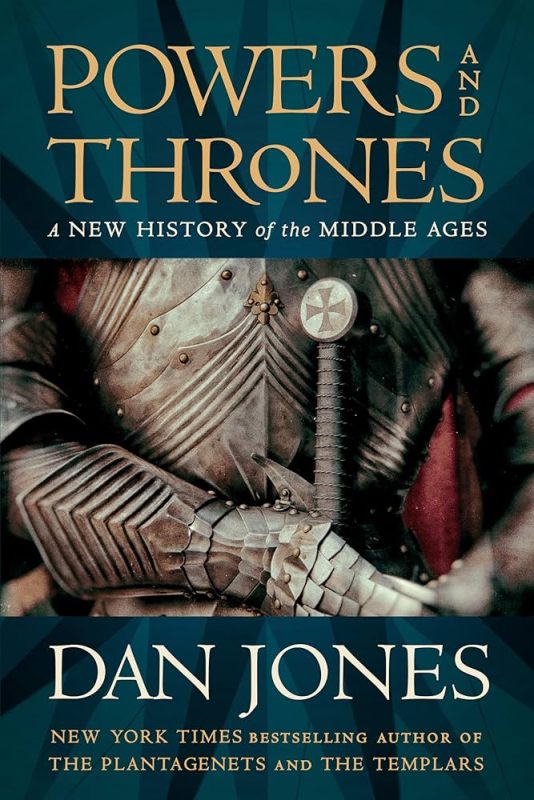
Book Review: Power and Thrones by Dan Jones
Book Reviewed: Power and Thrones: A New History of the Middle Ages Author: Dan Jones Genre: Medieval History / Popular History Reading Level: Grade 10 to Adult Recommended for: World History, European History, AP World History, History Methods
Overview
⭐⭐⭐⭐⭐ (5/5)
I will be honest with you: I went into Power and Thrones expecting a competent survey history. What I got was something closer to a revelation; and by the time I finished the final chapter, I had already decided that one word was quietly leaving my classroom vocabulary for good. That word is “medieval.”
Dan Jones has written something genuinely different here. On the surface, Power and Thrones looks like what it is: a sweeping account of roughly a thousand years of European history, from the collapse of Roman imperial authority around 400 A.D. through the world of the 1500s. But Jones is after something bigger than a timeline. He is making an argument, and he makes it beautifully.
The Fall of Rome (or, the Birth of Something New)
Jones does not frame the end of Roman power as simple collapse or catastrophe. Instead, he builds a portrait of transformation; Rome does not so much fall as it dissolves into something decentralized, something regional, something that will eventually become recognizable as Europe. That reframing alone is worth the price of the book. It asks the reader (or listener, in my case) to stop thinking about the post-Roman world as a void waiting to be filled and start seeing it as a creative, chaotic, genuinely interesting experiment in how people organize themselves when the empire stops telling them how.
The Anecdotes Are the Point
One of the things Jones does better than almost any historian writing for a general audience is the deployment of the individual story. He brings in famous figures and obscure ones, saints and soldiers, merchants and monarchs, and he uses each of them not as decoration but as evidence. The anecdotes he chooses illuminate the texture of daily life, the logic of medieval institutions, and the broader sweep of what was actually happening across an entire continent across a thousand years. It never feels like a textbook; it reads (and listens) like a story that happens to be true.
The Mongols Changed Everything
If there is a single section of the book I would pull out and hand to every history teacher I know, it is the chapters on the Mongols. Jones captures both the staggering scale of Mongol expansion and its civilizational consequences with a clarity that I found genuinely startling. The Mongol story is not a sidebar in European history; Jones shows you why it belongs at the center of any honest account of this period. I found myself pausing the audiobook more than once just to sit with what I had just heard.
Redefining the Renaissance (and Why It Matters for Teachers)
Here is the argument that will stick with me the longest: Jones pushes back firmly against the idea that the Renaissance represents a clean break from the Middle Ages, a sudden rediscovery of reason and beauty after a thousand years of darkness. His reading is that the Renaissance is not a departure from the medieval world but its highest expression; the culmination of everything that had been slowly, painfully, brilliantly built across those ten centuries. The so-called “medieval” world did not end when the Renaissance began. The Renaissance is where it was always going.
That reframing has real implications for how we teach. If we keep presenting the Middle Ages as the gap between Rome and modernity, we are doing our students a disservice. Jones gives us a better story, and a truer one.
The Bottom Line
Power and Thrones is the book I will recommend first to any colleague planning a unit on European history, world history, or any course that touches the period from the fall of Rome to the doorstep of early modernity. It is compulsively listenable on Audible, intellectually serious without being inaccessible, and genuinely fun in a way that good history should always be but rarely is.
I do not think I will use the word “medieval” in my classroom again. The Middle Ages deserve better than a label that treats them as merely the time between two things that actually mattered. Dan Jones has written the book that makes that case; and he has made it so well that I am not sure I could argue with him even if I wanted to.
Highly, highly recommended.
Runs approximately 700 words, formatted for an educator blog audience. Want me to adjust the tone, trim any section, or add a note about the audiobook narration specifically?

 BFWClassroom
You must be logged in to post a comment.