
Spoilers: If you have not already watched Andor Season 2 , this blog post contains specific elements of the story that are spoilers. be warned be fore reading this resource.
A New Trilogy for the Classroom
Educators have long recognized the pedagogical value of the original Star Wars trilogy, using its archetypal hero’s journey and clear moral dichotomies to explore themes of good versus evil, coming of age, and the power of belief. However, a new viewing sequence has emerged that offers far richer opportunities for critical analysis in high school social studies and English language arts classrooms: Andor Season 2, Rogue One, and A New Hope viewed as a trilogy.
This sequence fundamentally shifts our understanding of the Rebellion from a mystical quest driven by the Force to a grounded examination of resistance movements, colonial oppression, and the moral complexities of armed struggle against authoritarian regimes.

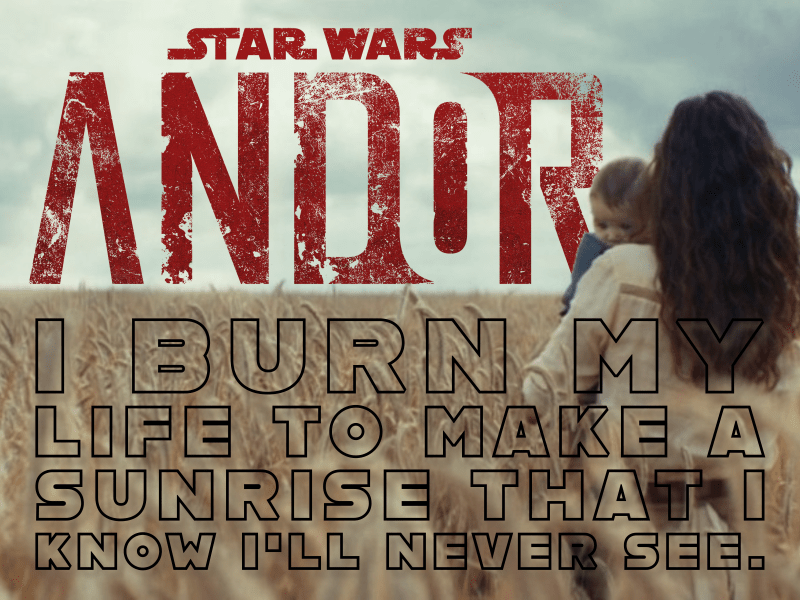
The artwork for both seasons of Andor is simply beautiful. Tony Gilroy’s vision for a much bigger universe gave way to a dynamic gallery of characters and events.
The Ideological Shift: From Mysticism to Material Resistance
The original trilogy centers Luke Skywalker’s spiritual journey and the mystical power of the Force. While compelling, this framework can inadvertently suggest that resistance to oppression requires supernatural intervention or chosen heroes. The Andor-Rogue One-New Hope sequence inverts this narrative entirely.
Andor strips away the mystical elements almost completely, grounding the Rebellion in material conditions: economic exploitation, cultural suppression, and state violence. Cassian Andor’s radicalization doesn’t stem from Force sensitivity or prophetic visions, but from witnessing his community’s destruction and experiencing firsthand the Empire’s systematic oppression of non-human species and peripheral worlds.
This shift allows students to examine how real-world resistance movements emerge from concrete grievances rather than abstract ideals. The series demonstrates how ordinary people—mechanics, pilots, senators, and shopkeepers—can become revolutionaries when faced with systems that deny their basic humanity and autonomy.
Imperial Fascism vs. Eclectic Freedoms
Andor presents the Empire’s fascist hegemony with unprecedented detail and sophistication. The Imperial Security Bureau’s surveillance apparatus, the corporate-state partnerships exploiting prison labor, and the bureaucratic machinery that reduces entire populations to statistics all mirror historical fascist regimes with uncomfortable accuracy.
Students can analyze how the Empire maintains control through:
- Surveillance and informants that destroy community trust
- Economic exploitation that reduces worlds to resource extraction sites
- Cultural homogenization that erases local identities and languages
- Bureaucratic dehumanization that enables systematic violence
In contrast, the Rebellion emerges not as a unified ideology but as an eclectic coalition of freedoms. Each rebel cell fights for different reasons: Aldhani rebels seek to reclaim their sacred sites, Ferrix residents resist cultural erasure, and Mon Mothma’s parliamentary faction works within legal channels until the system’s corruption becomes undeniable.
This eclecticism reflects how historical resistance movements often unite diverse groups with varying motivations, strategies, and visions of liberation. The Rebellion’s strength lies not in ideological purity but in its ability to coordinate multiple forms of resistance while respecting local autonomy.
The Moral Complexity of Prolonged Struggle
Perhaps most significantly for classroom discussion, this trilogy doesn’t shy away from the moral costs of resistance. Andor forces viewers to confront uncomfortable questions: When does sabotage become terrorism? How do we maintain our humanity while fighting inhuman systems? What happens to movements when survival requires compromising founding principles?
Cassian’s evolution from reluctant participant to committed revolutionary involves increasingly morally ambiguous choices. The Aldhani heist results in civilian casualties that fuel Imperial crackdowns. Rebels must choose between saving individuals and advancing the larger cause. These dilemmas mirror those faced by historical resistance movements and contemporary social justice campaigns.
When students then watch Rogue One, Cassian’s willingness to assassinate informants gains new context. His actions aren’t presented as heroic but as the tragic necessity of someone who has witnessed the Empire’s total war against civilian populations. The film’s final act becomes not just an exciting heist but a meditation on sacrifice, showing how the rebellion’s “small” victory enables Luke’s later triumph.
Luthen Rael was the leader the rebellion never wanted but always needed. His ability to see the larger picture of necessity for rebellious action is what propelled the story and the rebellion forward.
Addressing What the Original Trilogy Couldn’t
The original trilogy, constrained by its 1970s production context and focus on Luke’s individual journey, couldn’t fully explore the systemic nature of Imperial oppression or the collective character of resistance. This new sequence fills those gaps:
Colonial and Racial Dynamics: Andor explicitly addresses how the Empire targets non-human species and peripheral worlds for exploitation, making clear connections to colonial extraction and racialized oppression that the original films only implied.
Economic Foundations of Oppression: The series shows how Imperial control operates through corporations, forced labor, and resource extraction—material conditions largely absent from the original trilogy’s focus on political and spiritual conflict.
Women’s Leadership: Mon Mothma’s and Kleya’s storylines reveal how resistance movements depend on coalition-building, resource networks, and political maneuvering that occur far from the battlefield, highlighting forms of leadership the original trilogy couldn’t accommodate within its hero’s journey structure.
Class and Community: Andor centers working-class communities and shows how ordinary people become political actors when their material conditions become unbearable, moving beyond the original trilogy’s focus on individual destiny.
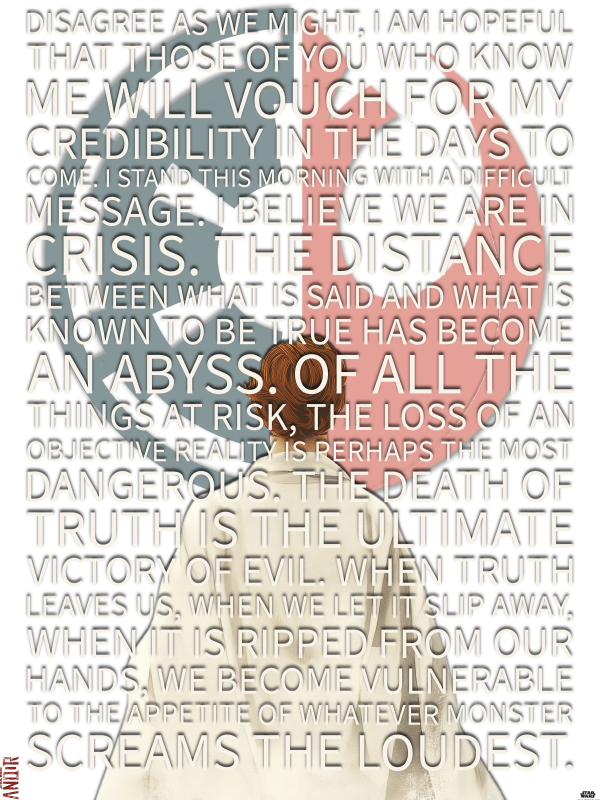
Political Resistance and Historical Memory: Mon Mothma’s references to the Ghorman Massacre demonstrate how resistance leaders must serve as keepers of historical memory, ensuring that Imperial atrocities are not forgotten or normalized. Her political speeches show students how resistance operates not just through armed struggle but through the preservation and articulation of moral outrage against systematic violence. This connects to how historical resistance movements have used testimony, documentation, and public speaking to maintain awareness of oppression even when direct action becomes impossible.
Pedagogical Applications
This trilogy offers rich opportunities for interdisciplinary learning:
History Classes can use these texts to examine:
- How authoritarian regimes maintain control through surveillance and propaganda
- The role of economic exploitation in sustaining oppressive systems
- How resistance movements build coalitions across different communities
- The moral complexities faced by historical resistance fighters
English Language Arts can explore:
- Character development across multiple texts and media
- How narrative perspective shapes audience understanding of political conflict
- The use of allegory and metaphor to address contemporary issues
- Visual storytelling techniques and their impact on meaning
Critical Media Literacy can investigate:
- How different historical contexts shape how stories are told and received
- The relationship between entertainment media and political discourse
- How serialized storytelling can develop themes differently than films
Conclusion: A More Complete Rebellion
Viewing Andor Season 2, Rogue One, and A New Hope as a trilogy doesn’t diminish the original films’ power but enriches our understanding of resistance, sacrifice, and hope. Students encounter a more complete picture of how liberation movements emerge, sustain themselves, and ultimately succeed not through individual heroism but through collective action across multiple fronts.
This sequence offers something increasingly rare in contemporary media: a nuanced exploration of political resistance that acknowledges both the necessity of struggle against oppression and the moral costs such struggles exact on those who undertake them. For educators seeking to help students understand both historical and contemporary movements for justice, this trilogy provides an invaluable resource that honors the complexity of these vital struggles.
Suggested Historical Text Pairings
Primary Sources for Resistance Movements
World War II Resistance
- Excerpts from Letters and Papers from Prison by Dietrich Bonhoeffer (moral complexity of resistance)
- White Rose leaflets by Sophie Scholl and Hans Scholl (youth resistance to fascism)
- Selected diary entries from Dutch resistance fighters (everyday acts of defiance)
Anti-Colonial Struggles
- Frantz Fanon’s The Wretched of the Earth (Chapter 1: “Concerning Violence”) – colonial psychology and resistance
- Kwame Nkrumah’s Ghana: The Autobiography of Kwame Nkrumah (selected chapters on organizing)
- The Battle of Algiers film excerpts paired with FLN communiques
American Civil Rights Movement
- Martin Luther King Jr.’s Letter from Birmingham Jail (moral justification for civil disobedience)
- Ella Baker’s speeches on grassroots organizing (parallels to Mon Mothma’s coalition-building)
- SNCC position papers on community organizing strategies
Labor and Economic Resistance
- Cesar Chavez’s speeches on the United Farm Workers movement
- Mother Jones’ autobiography excerpts (labor organizing under surveillance)
- Solidarity movement documents from 1980s Poland
Secondary Sources for Historical Context
Fascism and Authoritarianism
- Hannah Arendt’s The Origins of Totalitarianism (selected passages on bureaucracy and violence)
- Robert Paxton’s The Anatomy of Fascism (Chapter 3: “Taking Root”)
- Timothy Snyder’s On Tyranny (accessible lessons on recognizing authoritarian tactics)
Colonial and Imperial Studies
- Edward Said’s Orientalism (brief excerpts on cultural domination)
- Aimé Césaire’s Discourse on Colonialism (connecting fascism and colonialism)
- Achille Mbembe’s essay “Necropolitics” (adapted excerpts on state violence)
Resistance Theory
- James C. Scott’s Weapons of the Weak (everyday forms of resistance)
- Gene Sharp’s From Dictatorship to Democracy (strategic nonviolent resistance)
- bell hooks’ Teaching to Transgress (education as resistance practice)
Document Collections and Readers
Thematic Readers
- Voices of Freedom edited by Eric Foner (American resistance movements)
- The Price of Freedom edited by Henry Hampton (civil rights primary sources)
- Resistance in Europe edited by Stephen Hawes (WWII underground documents)
Specific Historical Moments
- Warsaw Ghetto Uprising: Emanuel Ringelblum’s Notes from the Warsaw Ghetto
- Hungarian Revolution 1956: Radio Free Europe transcripts and student manifestos
- Apartheid Resistance: Steve Biko’s writings and ANC strategic documents
- Velvet Revolution: Václav Havel’s essays on “living in truth”
Contemporary Connections
Modern Social Movements
- The New Jim Crow by Michelle Alexander (systemic oppression parallels)
- Standing Rock Sioux statements on pipeline resistance
- Hong Kong pro-democracy movement social media archives
- Climate activism manifestos from youth movements
Suggested Pairing Strategies
Thematic Pairings
- Surveillance and Control: Pair Andor’s ISB scenes with Stasi documents from East Germany
- Economic Exploitation: Connect Imperial prison labor with historical accounts of forced labor systems
- Coalition Building: Match Mon Mothma’s political maneuvering with accounts of Popular Front organizing in 1930s Spain
- Moral Complexity: Juxtapose Cassian’s assassination missions with debates over violence in anti-apartheid movement
Chronological Approaches
- Begin with historical context, then view episodes, followed by reflection essays
- Use primary sources as “intelligence briefings” before watching resistance operations
- End units with students creating their own resistance manifestos using historical models
Comparative Analysis Projects
- Students research historical resistance movement and compare strategies to Rebel Alliance tactics
- Create timeline showing how real resistance movements evolved alongside viewing character development
- Analyze propaganda techniques used by both historical authoritarian regimes and the Empire
These pairings allow students to see how the series draws from real historical patterns while developing critical thinking about resistance, power, and social change.
To see other movie and book recommendations and a list of resources, read more here.
This is part of my Politics in the Classroom series, where I look at the importance of political campaigns, pop culture, sports, music, and geopolitics of the last 50 years and how to use them as resources in the classroom. To read more, check out my other posts in the series. (Link)


You must be logged in to post a comment.