
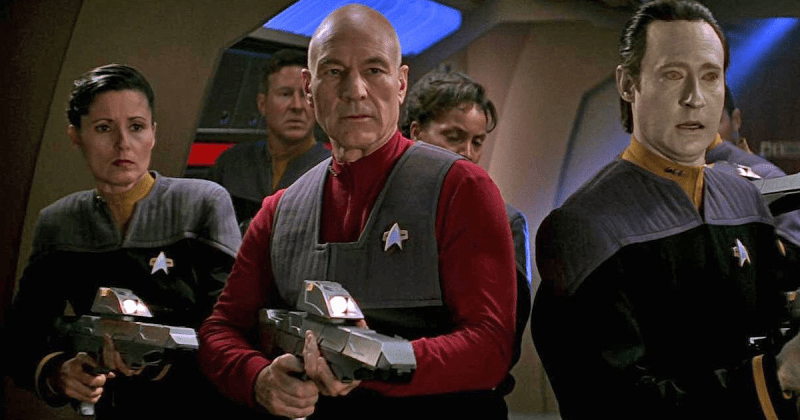
Thirty years ago this year, Star Trek: First Contact premiered in theaters and fundamentally changed what Star Trek could be. Released on November 22, 1996, Jonathan Frakes’ directorial debut took the optimistic crew of the Enterprise-D into darker territory than the franchise had dared to explore on television; it gave us a Star Trek film that was simultaneously a tense action thriller and a meditation on trauma, obsession, and what it means to hold onto humanity when everything tries to strip it away.
I’ve been thinking about this film a lot lately, rewatching it as part of my recent dive back into Star Trek: The Next Generation and the subsequent Picard series. What strikes me now, as both an educator and someone who has spent considerable time analyzing this film academically, is how First Contact refuses to let its hero be simply heroic. Captain Picard’s journey in this film is not about saving the day (though he does that too); it’s about confronting the parts of himself he would rather forget, the trauma he carries from his assimilation by the Borg years earlier.
The Film That Launched a Dozen Papers
During my undergraduate and graduate work, First Contact became something of an intellectual obsession. The film appeared in at least three major papers I wrote, each time revealing new layers of meaning. What began as a straightforward action film about preventing the Borg from assimilating Earth’s past became, through repeated viewings and academic analysis, a complex text about colonialism, memory, identity, and the violence we carry within ourselves.
In one paper, I explored how the film functions as a postcolonial narrative, with the Borg representing the ultimate colonizing force that doesn’t just conquer territory but consciousness itself. The Borg’s promise to “improve” humanity by assimilating it into their collective mirrors the rhetoric of historical imperialism; the “civilizing mission” dressed up in technological efficiency. Picard’s rage against the Borg, then, becomes not just personal vendetta but a confrontation with the logic of colonialism that has already marked him permanently.
Another paper examined the film through Joseph Conrad’s Heart of Darkness, arguing that Picard’s descent into the lower decks of the Enterprise to confront the Borg parallels Marlow’s journey up the Congo River. Both men travel into physical and psychological darkness, both encounter the horror of what civilization becomes when stripped of its restraints, and both return changed by what they’ve witnessed. The difference is that Picard has already made this journey once before when he was assimilated; First Contact forces him to make it again, to confront what Kurtz confronted, “the horror” of his own capacity for destruction.
A third exploration focused on the film’s treatment of memory and trauma. Picard’s flashbacks to his time as Locutus of Borg, the way the Borg Queen can trigger those memories with a touch, the visceral physical reaction he has to their presence—these aren’t just dramatic devices but accurate depictions of how trauma operates. The past isn’t past; it’s always present, always waiting to reassert itself when we encounter the right (or wrong) stimulus.
Why This Film Still Matters
First Contact remains the best Next Generation film (and arguably one of the best Star Trek films period) because it understands something fundamental: our heroes are interesting not because they’re perfect but because they’re damaged and struggling. The film gives us a Picard who is willing to sacrifice his ship and crew, who quotes Moby Dick without recognizing he’s become Ahab, who needs Lily Sloane (a woman from the past who knows nothing of Starfleet’s values) to hold up a mirror and show him what he’s become.
The scene where Lily confronts Picard in his ready room, calling him out for his obsession, remains one of Patrick Stewart’s finest moments in the franchise. “I am not Captain Ahab!” he shouts, smashing the display cases that hold models of previous ships named Enterprise. But of course, he is. He’s so consumed by his need to destroy the Borg that he’s forgotten everything else. Lily’s response cuts through all his rationalizations: “I’m not going to die in here, and I’m not going to die out there. Not for you, not for your ship.”
That exchange works because the film has earned it. We’ve watched Picard slowly unravel, watched him make increasingly irrational decisions, watched him project his trauma onto everyone around him. When he finally breaks down and quotes Ahab’s final speech about the white whale, we understand that he understands what he’s become, and that understanding is the first step toward choosing differently.
The Classroom Connection
As a high school teacher now, I think about First Contact differently than I did as a graduate student writing papers about postcolonial theory and Conrad. I see in it a teaching tool for discussing trauma, for talking about how we carry our past with us, for examining what it means to be “civilized” and who gets to decide. The film’s structure (a frame story set in the past intercut with the main narrative in the present) mirrors the way memory works; past and present aren’t separate but constantly informing each other.
When I teach students about frame narratives, about unreliable narrators, about how stories can be told from multiple perspectives simultaneously, First Contact offers a perfect example. We watch Zefram Cochrane discover that he becomes a legend, that history has sanitized and mythologized him into something he doesn’t recognize. “You’re a teacher?” he asks Troi incredulously. “Tell ’em the statue is a liar.” It’s a moment that could appear in any unit on historiography, on how we construct narratives about the past that serve present needs rather than past realities.
The film also provides entry points for discussing difficult topics with students. The Borg assimilation process, shown in disturbing detail as crew members are surgically altered against their will, offers a metaphor for talking about consent, bodily autonomy, and what it means to lose control of your own identity. The way Picard must literally enter the Borg collective consciousness to save Data parallels discussions we have about empathy, about understanding perspectives radically different from our own, about when violence is justified and when it simply perpetuates cycles of trauma.
Thirty Years Later
Watching First Contact now, after having seen Star Trek: Picard and its exploration of how that assimilation continues to haunt Picard decades later, the film takes on additional resonance. The trauma doesn’t end when the movie ends; it reverberates forward through time, shaping who Picard becomes, affecting his relationships, compromising his ability to trust even his own memories. Picard season three, in particular, reveals that Picard’s assimilation wasn’t just a personal violation but a genetic one that he passed on to his son without knowing it. The horror extends across generations.
But First Contact works even if you never watch another frame of Star Trek. It works because it tells a complete story about a man confronting his demons and choosing, at the last possible moment, to step back from the abyss. It works because it balances intimate character drama with spectacular action sequences. It works because it understands that the most interesting conflicts are internal even when there are Borg drones breaking down the doors.
The film taught me, as an undergraduate struggling to find my voice in academic writing, that popular culture could sustain serious critical analysis. It showed me that a “space movie” could engage with Conrad, with Melville, with postcolonial theory, with questions about memory and identity and what it means to be human. Those papers I wrote, working through the film’s symbolism and structure, taught me how to construct an argument, how to support claims with textual evidence, how to place a contemporary text in conversation with canonical literature.
More than that, First Contact demonstrated that genre fiction (science fiction in particular) often does the best work of interrogating the present by displacing it into the future or past. The Borg aren’t just scary aliens; they’re the logical endpoint of a certain kind of technological determinism, the nightmare of losing individuality to efficiency, the colonial impulse taken to its ultimate conclusion. By setting this story in space, the film gives us permission to think about these ideas without our contemporary defenses and prejudices getting in the way.
Looking Forward While Looking Back
As we mark thirty years since First Contact premiered, I’m struck by how the film’s concerns have only become more relevant. We live in an age of increasing connectivity that often feels like assimilation; social media platforms that promise to connect us while homogenizing our experiences and perspectives. We’re constantly confronting questions about what we’re willing to sacrifice for efficiency, for progress, for the promise that resistance is futile.
The film’s optimism, ultimately, is not that we can defeat every threat or overcome every trauma. It’s that we can choose, moment by moment, what kind of people we want to be. Picard chooses to activate the self-destruct rather than let the Borg have his ship; then he chooses to deactivate it when he realizes he’s about to sacrifice his crew for his vendetta. Both choices matter. Both define who he is.
For students struggling with their own challenges, facing their own moments where they must choose between the easy path and the right one, First Contact offers no easy answers but something better: a model of how even our heroes struggle, fail, and must constantly work to live up to their ideals. That’s a lesson worth teaching, and it’s a lesson I first learned by watching this film over and over, taking notes, writing papers, trying to understand why this story resonated so deeply.
Thirty years later, Star Trek: First Contact remains essential viewing, not just for Trek fans but for anyone interested in how stories help us understand ourselves. And for this teacher, it remains a touchstone, a reminder of when I first discovered that the things I loved could also be the things I studied, that passion and analysis weren’t opposites but partners in the work of making meaning.
The line must be drawn here. This far, no further. Thirty years on, the film still draws that line, still asks us where we stand, still refuses to let us look away from the darkness within ourselves. And that, more than the action sequences or the special effects or even the Borg Queen’s seductive whisper, is why it endures.
To see other movie and book recommendations and a list of resources, read more here.


You must be logged in to post a comment.