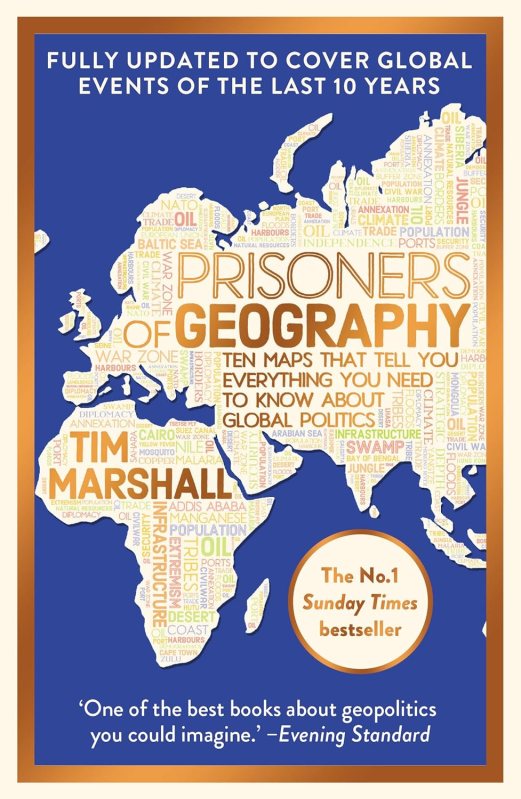
Author: Tim Marshall
Format: Audiobook (12.5 hours)
Rating: 4.25/5 Stars
Best For: High school and middle school educators teaching geography, world history, or current events
Tim Marshall’s updated edition of Prisoners of Geography offers educators a highly accessible entry point into understanding how physical geography shapes global politics and conflicts. As my first book of 2026, it proved to be an engaging listen that balances breadth with practical classroom application, though it occasionally sacrifices depth for accessibility.
Structure and Accessibility
The book’s regional organization is its greatest pedagogical strength. Marshall divides the world into distinct geographic sections (China, Russia, the United States, Western Europe, Africa, the Middle East, India and Pakistan, Korea and Japan, Latin America, and the Arctic/Antarctic), making it remarkably adaptable for classroom use. Teachers can assign individual chapters as standalone readings in human geography, world history, or current events courses without requiring students to consume the entire text. The modular structure allows for targeted instruction on specific regions while still providing connections across chapters when Marshall references earlier sections; for instance, the India-Pakistan chapter draws back to the earlier China discussion, and the Arctic section connects to Russia’s geographic challenges with frozen ports and limited warm-water access.
For educators managing packed curricula, this flexibility is invaluable. You can drop into the Middle East section without reading about Latin America first, though Marshall occasionally weaves cross-references that reward those who read more comprehensively.
Updates and Contemporary Relevance
The new edition’s most significant value lies in its updated geopolitical analysis, and the additional 3.5 hours of content compared to the original 9-hour audiobook demonstrates Marshall’s commitment to keeping the work current. Marshall addresses events that occurred after the original publication, including Russia’s invasion of Ukraine (with geographic explanations for why Russia pursued this course) and the October 2023 Hamas attacks on Israel. His analysis of the Middle East proves particularly insightful for current classroom discussions. Marshall makes a compelling argument that I’ve been emphasizing in my own teaching: we’re now so far removed from the Sykes-Picot Agreement’s arbitrary borders that the region’s conflicts have evolved beyond those colonial divisions. Contemporary leaders weaponize Zionism and anti-Israeli rhetoric to maintain power while simultaneously suppressing tribal and familial tensions within their own borders. The geography itself reinforces this dysfunction, as vast territories that appear substantial on maps serve virtually no strategic or economic purpose, creating strange incentives for leadership.
The audiobook runs 12.5 hours, making it a substantial but manageable listen for summer professional development or as background during commutes and planning periods. Marshall includes maps in PDF format through the Audible app (though the quality left something to be desired), and educators can easily supplement with maps from the CIA World Factbook or other sources.
Strengths for Classroom Application
Marshall excels at making complex geopolitical situations comprehensible through geographic lenses. His explanations of why certain conflicts persist or why nations make seemingly irrational decisions become clearer when viewed through terrain, resources, and physical barriers. For students reading at 8th-grade to college levels, this approach demystifies international relations without dumbing down the content.
The conversational tone of the audiobook (likely enhanced by the narrator’s delivery) makes dense material approachable. Marshall doesn’t assume extensive background knowledge, which serves both students new to geography and educators teaching outside their primary expertise. The text works equally well as teacher background reading or as assigned student material, depending on your class level and focus.
Notable Limitations
Despite its strengths, the book reveals the persistent gaps in Western English-language geography and history. The entire South American continent receives generic treatment in a single chapter. While Marshall addresses the geography competently, anyone seeking in-depth analysis of specific nations like Mexico or Brazil will need to supplement with additional sources. He paints in broad strokes where more granular examination would strengthen the work. If Marshall produces another update in five years, I hope he dedicates more space to Latin American diversity and complexity—the current treatment feels like an afterthought compared to the nuanced discussions of other regions.
Similarly, the Antarctica section feels tacked on, occupying merely the final six minutes of a 46-minute Arctic and Antarctic chapter. Given the increasing geopolitical significance of polar regions (something Marshall acknowledges when discussing resource extraction and shipping routes), this imbalance seems like a missed opportunity.
In the Middle East section, I found it puzzling that Marshall largely omits discussion of Saudi Arabia’s ambitious NEOM project and “The Line” megacity. For a book premised on how geography shapes human decisions, analyzing a nation’s attempt to build a futuristic linear city across desert terrain would seem like essential material. He touches on it briefly but doesn’t explore how this represents a deliberate attempt to overcome or work within geographic constraints.
Original Edition vs. New Edition
For those considering which version to purchase, I strongly recommend investing in the new edition rather than the original. The original audiobook clocked in at 9 hours, meaning the new edition includes approximately 3.5 additional hours of updated analysis and contemporary events. The Ukraine coverage alone justifies the update for anyone teaching contemporary European or Russian history, and the Israel-Palestine material provides current context that the original lacked.
If you’re an educator who prefers physical books for classroom use or personal study, the print version offers distinct advantages. You can dog-ear pages for quick reference, make marginal notes connecting Marshall’s arguments to your curriculum, and mark passages for potential student readings. The ability to annotate makes the physical book particularly valuable for lesson planning, as you can tag sections that align with specific units or standards. However, the audiobook format excels for professional development on the go, allowing you to absorb geographic concepts during commutes or exercise.
Bottom line: Don’t bother with the original edition unless you specifically want it for historical comparison purposes. The new version’s additional content and updated analysis make it the clear choice for educators.
Final Recommendation
Prisoners of Geography (New Edition) earns 4.25 stars as a versatile resource for social studies educators. It’s not comprehensive enough to serve as your only geography text, and its coverage remains uneven across regions. However, as an accessible introduction to geopolitical thinking or as supplementary material for units on specific regions, it punches well above its weight.
Middle school and high school teachers will find it most useful for:
- Building background knowledge on regions before teaching specific conflicts or events
- Providing students with geographic context for current events discussions
- Offering accessible reading for struggling students who find traditional textbooks impenetrable
- Creating comparative geography units that examine how terrain shapes national behavior
The 12.5-hour audiobook format requires a time investment, but the chapter structure means you can preview relevant sections before teaching related units without listening to the entire work. While I wish Marshall had given Latin America and Antarctica more substantial treatment, and while his omission of major projects like NEOM raises questions, the book succeeds at its primary goal: making geography matter in how we understand global politics.
For educators looking to help students move beyond simplistic “good guys versus bad guys” frameworks in international relations, Prisoners of Geography provides the geographic literacy foundation that makes more sophisticated analysis possible. It won’t replace specialized texts on individual regions, but it will make you a more informed teacher and give your students a framework for understanding why the world looks the way it does.
Everything reviewed here I have personally read, screened, or listened to, and many of these resources have been part of my classroom for years. This site exists because teachers deserve practical recommendations from someone who has been in the room. That said, every school community is different; please consult your district guidelines before using any book, film, or podcast with students.
To read more of my reviews follow the link.


You must be logged in to post a comment.