This month marks the 4 year anniversary of the Russia invasion of Ukraine in 2022 and the 16 year anniversary of the Russian annexation of Crimea and the Donbas Region. It made me think of when I read John Hersey’s book Hiroshima in 2009 as part of my Masters graduate studies and I wanted to re-visit that book and one of my favorite episodes of The West Wing.
Book Review: Hiroshima by John Hersey
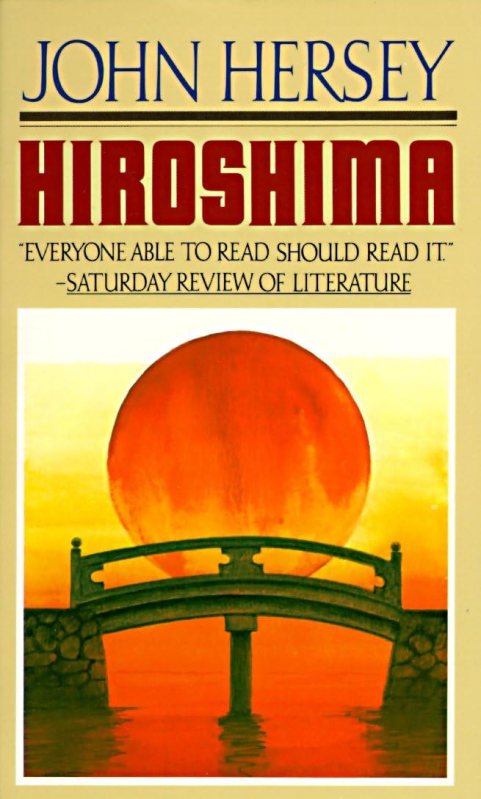
Book: Hiroshima by John Hersey
Originally published: The New Yorker, August 31, 1946; Alfred A. Knopf, 1946
Edition referenced: Vintage Books (with the 1985 epilogue, “Aftermath”)
Audience: High School to College Level
Recommended for: AP U.S. History, World History, English Language Arts, Contemporary Issues
My rating: ★★★★☆ (4 of 5 stars)
A Sixteen-Year Conversation with a Single Book
I first wrote about John Hersey’s Hiroshima sixteen years ago, drawing on a much older memory: the afternoon in my junior year of high school when I read it for the first time and felt something shift in my understanding of what war actually costs. That review was personal and a little impressionistic, written from the perspective of a reader who had been genuinely moved but was still working out the reasons why. I want to revisit it now, not to correct it exactly, but to say plainly that the world has changed around this book in ways that make it feel less like history and more like a standing warning.
We are living through a period in which nuclear rhetoric has returned to the foreground of geopolitical conversation with a casualness that ought to alarm anyone paying attention. Russia’s war in Ukraine has been accompanied by repeated suggestions, some explicit and some thinly coded, that tactical nuclear options remain available. North Korea continues to expand and test its arsenal. Tensions in the Middle East and the broader Indo-Pacific carry their own proliferation anxieties. And here in the United States, the political conversation about nuclear weapons has taken on qualities, a kind of detached strategic abstraction, that Hersey spent his career trying to make impossible. Hiroshima remains, after all this time, the single most effective literary antidote to that abstraction that I know of.
What the Book Does That Nothing Else Can
Hersey’s achievement is methodological before it is literary. He arrives in Hiroshima in the weeks following the bombing and conducts the interviews that will become his text, then writes the entire account in a spare, almost clinical third-person that refuses to editorialize. He does not describe the bomb as horror; he describes what six specific individuals experienced in the moments before, during, and after 8:15 a.m. on August 6, 1945, and allows the accumulation of detail to do what argument never could.
Father Kleinsorge, one of the book’s central figures, is a German Jesuit priest who is reading in the mission house when the bomb detonates. The prose simply records that for a few seconds or minutes, he went out of his mind, then returns to describe him wandering the ruined garden in his torn underwear without knowing how he got there. Hersey never explains what has happened, because Father Kleinsorge does not yet know. The reader understands before the character does, and that gap, between the enormity of the event and the survivor’s inability to comprehend it in real time, is where the book does its most profound pedagogical work. Students who struggle to connect with the abstraction of atomic warfare often find, to their own surprise, that this image is the one that stays with them.
The book’s journalism-derived fidelity to observed fact, rather than reported feeling, produces something that conventional war narrative rarely manages: civilian suffering rendered without sentimentality or propaganda. Hersey is not building toward an argument. He is building toward testimony. That distinction matters enormously in a classroom, because testimony invites the reader to form the argument for themselves, and the argument they form tends to be far more durably held than any they are handed.
Faith, Witness, and the Long Aftermath
The theological strand of the book, which I noticed as an adolescent but did not fully appreciate until I had taught it several times, runs through it more consistently than the surface narrative might suggest. Father Kleinsorge and the other German Jesuits who appear in the final pages are described as taking a relatively detached view of the bombing, often discussing the ethics of using such a weapon in philosophical terms.
Hersey quotes from a Catholic Church report circulating in Hiroshima in the weeks after the bomb, asking whether the weapon has material and spiritual evil as its consequences which far exceed whatever good may result.
This is not a throwaway detail. It places the bombing within a tradition of ethical inquiry that students in world history and comparative religion courses will recognize, a serious attempt to apply the framework of just war theory to an event that seemed to overwhelm every existing moral category. Miss Sasaki’s conversion to Catholicism in the presence of the priest’s faith and the bomb’s destruction, which I described in my original review as gaining redemptive traction, reads differently to me now; it seems less like a resolution and more like someone reaching for whatever framework of meaning remains available when every other structure has been destroyed. That is, in its way, a more honest portrayal of how people actually survive catastrophe.
The 1985 epilogue, Aftermath, which Hersey added to the Vintage Books edition after returning to find his six survivors forty years later, is essential classroom reading and should not be skipped. It documents what became of each person across four decades of cancer, chronic illness, political advocacy, and in some cases genuine flourishing. It also makes clear that the damage from a single nuclear weapon is not an event but a condition, something that unfolds across generations and does not resolve.
The West Wing Gets It Right: “The Warfare of Genghis Khan”
There is a scene in the fifth season of The West Wing, episode thirteen, called “The Warfare of Genghis Khan,” that I have come to use as a companion piece to Hiroshima in my classroom, and its relevance has only sharpened since I first encountered it. The episode centers on the detection of a nuclear detonation over the Indian Ocean. President Bartlet’s administration scrambles to determine which nation has just joined the nuclear club; North Korea is eventually ruled out, leaving Iran as the most likely suspect. The President orders B-2 bombers scrambled for potential simultaneous air strikes on five Iranian uranium enrichment facilities. Leo McGarry asks Toby Ziegler to have a statement ready. The bombers are in the air.
The detonation turns out to have been an Israeli nuclear test, a miniaturized weapon designed to fit on a submarine-based missile. The administration had been wrong about everything. Iran’s ambassador to the UN, grilled at the Swiss Embassy because the two countries do not maintain direct diplomatic relations, was telling the truth the entire time. The B-2s stand down. The crisis is averted not by intelligence or caution but by a piece of information that arrives almost by accident, delivered by a drunk Israeli official in a conversation with Vice President Russell.
The episode is based on a real historical event, the 1979 Vela incident, in which a satellite detected what appeared to be a nuclear detonation in the South Atlantic between South Africa and Antarctica. The event was never conclusively attributed; Israel remains the most frequently cited suspect. What the episode dramatizes, with considerable fidelity to the actual mechanics of nuclear crisis management, is how quickly a combination of institutional assumptions, incomplete intelligence, and diplomatic estrangement can push a nation past the point of careful deliberation. The administration was not reckless. They were doing their jobs as they understood them. And they came within a confirmation signal of bombing the wrong country over a nuclear test that had nothing to do with Iran.
President Bartlet, preparing for his meeting with the Israeli Prime Minister after the crisis passes, reads aloud from physicist Hans Bethe’s writing on nuclear weapons: if we fight a war and win it with H-bombs, what history will remember is not the ideas we were fighting for, but the methods we used to accomplish them. These methods will be compared to the warfare of Genghis Khan, who brutally killed every last inhabitant of Persia. This is the moment that gives the episode its title, and it is also the moment I want students to carry with them when they close Hersey’s book.
Teaching the Two Texts Together
What Hiroshima and this West Wing episode share, beyond their obvious subject matter, is a commitment to showing nuclear weapons as they actually operate on human beings and human institutions rather than as they exist in strategic abstraction. Hersey’s six survivors make the bomb specific and physical; the Bartlet administration’s near-miss makes the decision to use one specific and procedural. Together, they bracket the problem from both ends. The book asks students to understand what a nuclear weapon does to a city; the episode asks them to understand how close to that decision any government can get on the basis of incomplete and biased information.
I teach both to students who have grown up in a world where nuclear deterrence is background noise, a fact of the geopolitical landscape so familiar that it has lost its urgency. One of the most important things a history or ELA teacher can do, I have come to believe, is restore that urgency without either paralyzing students with fear or allowing them to retreat into the false comfort that these decisions belong to other people in other rooms. They do not. The rooms are closer than we think, and the information in them is always incomplete.
A classroom exercise I have found particularly effective is to ask students, after reading Hiroshima, to watch the West Wing episode and identify the specific moment at which the decision to strike Iran could no longer be reversed if Vice President Russell had not had that conversation. Then ask them to imagine what Hersey’s six survivors would say to Leo McGarry in the Situation Room, not as an argument against military action in all circumstances, but as a requirement that any person ordering the use of nuclear force be required to hold those six lives, and the hundreds of thousands they represent, in their minds at the moment of decision.
Why the Classroom Still Needs This Book
My original review noted that the shock of the dying has been lost over time, that readers in the early 2000s had been numbed by the volume of catastrophic imagery available to them. That observation has only become more accurate. Students now encounter footage of actual warfare, actual mass casualty events, actual destruction of cities, with a frequency and immediacy that would have been unimaginable to a reader in 1946. And yet Hiroshima still breaks through, because Hersey’s method bypasses the numbing. He is not showing you images; he is asking you to inhabit six particular people’s experience of a particular morning, and the particularity is what survives the saturation.
There is also the matter of what the book implicitly asks of its reader politically. Hersey was a journalist, and he understood that the most powerful political argument he could make was not an argument at all but a record. He trusted his readers to draw their own conclusions from six carefully documented lives, and that trust has been, across sixteen years of watching students encounter this book, almost universally rewarded. Students who would resist being told what to think about nuclear weapons find themselves thinking about nuclear weapons, seriously and with personal investment, because Hersey never told them what to think. He only showed them what happened.
That is a model for teaching as well as for writing. In a political and cultural environment where students are increasingly practiced at identifying and dismissing ideological framing, a book that refuses to frame, that simply places six human beings in front of you and asks you to pay attention, has an unusual power. Hiroshima is not a perfect book; my rating has not changed in sixteen years. But it is one of the most important books I have ever taught, and I return to it every year with the conviction that its moment is not past. If anything, its moment is now.
Final Assessment
Hiroshima belongs in every high school history and English classroom, not as a relic of a completed historical episode but as a living document of what nuclear weapons do to human beings and human societies. Paired with primary sources from the Manhattan Project, excerpts from the Atomic Bomb Casualty Commission reports, and companion texts like the West Wing episode discussed above, it gives students a framework for thinking about nuclear weapons that is grounded in physical and moral reality rather than strategic abstraction.
The book’s greatest strength remains what it has always been: it makes the unimaginable specific, and specificity is the only force I have found in thirty years of teaching that reliably breaks through the protective distance students maintain from history that frightens them. We should want them frightened, not paralyzed, but genuinely, usefully frightened. Hiroshima does that work, and the world we are living through makes that work more necessary than ever.
Recommended for: AP U.S. History (atomic age and Cold War), World History, English Language Arts (narrative nonfiction and ethical argument), Contemporary Issues and Government courses. Pair with: the 1985 “Aftermath” epilogue; the West Wing season 5, episode 13, “The Warfare of Genghis Khan”; and selected primary documents from the Manhattan Project decision-making record.

 BFWClassroom
You must be logged in to post a comment.