I teach in Fayette County. My colleagues teach in Jefferson County, in Madison County, in small rural districts across this state. And right now, in the spring of 2026, every one of us is watching the same thing happen from slightly different angles: the public school system we have given our professional lives to is being squeezed from multiple directions at once, and the people doing the squeezing do not always agree on the reasons, but they keep arriving at the same result. Less money. More obligations. And educators absorbing the gap.
This is not a post about partisan politics. It is a post about arithmetic and accountability. I want to walk through what is actually happening in Kentucky right now, connect it to the national forces driving it, and make the case that what looks like a series of separate local crises is in fact one structural problem playing out across multiple stages simultaneously. Understanding the structure is the first step toward doing anything about it.
Start With Kentucky: The SEEK Formula and Twenty Years of Managed Decline
Kentucky funds its public schools primarily through a formula called Support Education Excellence in Kentucky, or SEEK. The formula was established by the Kentucky Education Reform Act of 1990 and was, at the time, considered a national model for equitable school funding. The basic idea is sound: the state sets a per-pupil funding guarantee, accounts for local property wealth so that poorer districts receive more state support, and adds on amounts for transportation and students with additional needs.
In practice, it has been allowed to erode for two decades. The SEEK guaranteed base per pupil stood at $3,822 in 2008; adjusted for inflation, that figure would be approximately $6,197 in 2028 dollars. The Kentucky House budget introduced this session (HB 500) proposes to freeze the base at $4,586 for the full two-year biennium, with no increase for either year. That means by 2028, Kentucky will be funding its public schools at roughly 26 percent below what it was providing in real terms in 2008. The House budget compounds this by cutting transportation funding by $129 million per year, suspending a state law that requires 100 percent reimbursement of school transportation costs; a law, it is worth noting, that has been suspended in every budget since 2004.
This is not a sudden crisis. It is the accumulated result of a legislative philosophy that has consistently chosen to reduce the income tax rate, with an explicit goal among Republican legislative leaders and the Kentucky Chamber of Commerce of eventually eliminating the state income tax entirely, while treating education funding as a line item to be managed rather than an obligation to be met. When the revenue base shrinks and the funding formula is frozen, the consequences are not abstract. They are the bus routes that become unsustainable, the positions that go unfilled, and the programs that disappear quietly between budget cycles.
Jefferson County: A $188 Million Deficit and the ESSER Cliff
The largest school district in the state is facing what its own superintendent called an unprecedented budget deficit. Jefferson County Public Schools entered the 2025-26 school year grappling with a projected $188 million shortfall for the 2026-27 budget year. The district has already voted to cut $100 million from the current year budget, with an additional $50 million in reductions required for the following year.
The primary driver is the expiration of federal ESSER funds, the COVID-19 relief money that flowed into districts beginning in 2020. JCPS, like many urban districts, used those one-time funds to build recurring programs: a nurse in every school, stipends for bus drivers and teachers in hard-to-staff buildings, expanded mental health support, academic coaching. When the federal money ended, the programs did not; they were carried by the general fund, and the general fund eventually ran out of room. Investigative reporting found that JCPS ran a deficit nearly every year for a decade, with the one exception being 2022, when COVID relief funds temporarily filled the gap.
The proposed cuts tell you what is actually being lost. The plan includes $18 million cut from the Needs Index, the formula that directs extra resources to schools serving high concentrations of low-income students and students of color. It cuts $14 million in Academic Instructional Coaches, who support new and emergency-certified teachers and manage required testing cycles. It cuts more than $3 million in services for multilingual learners, one of the fastest-growing student populations in the district. A JCPS board member said plainly what others were thinking: the district cannot get through next year without a tax increase on the ballot. That conversation, and the political difficulty of having it in the current climate, captures the bind that urban districts across Kentucky face. The state is not providing adequate funding, the federal cushion has expired, and the political will to raise local revenue is tested at every turn.
Fayette County: Structural Pressure and Internal Accountability
Closer to home, Fayette County Public Schools has spent the better part of the past year navigating a budget shortfall that exposed both external funding pressures and serious internal management failures. The projected $16 million gap in the FY 2026 budget was real; so were the contributing causes, which included the ESSER cliff, a statewide SEEK shortfall, and rising costs that state support has not kept pace with.
But honesty requires acknowledging the full picture. An independent investigation released in late February 2026 found that FCPS administrators failed to clearly communicate the magnitude of projected salary shortfalls to the board, that the district’s contingency fund fell from approximately $83 million to $26 million over two years largely due to underbudgeted salary expenditures, and that multiple internal warnings were not escalated with appropriate urgency. State legislators pointed to these failures as evidence of mismanagement, and on that narrow point they are not wrong.
What I want to resist, however, is the sleight of hand that uses local management failures to dismiss the structural problem. Yes, FCPS administrators should have communicated the shortfall more clearly and earlier; that accountability matters. But the district was also navigating the same ESSER cliff as every other Kentucky district, the same frozen SEEK base, and the same federal funding uncertainty. The management failures made a difficult situation worse; they did not create the difficult situation from nothing. A district with adequate and stable state funding would have had considerably more margin to absorb a salary overage without a crisis. That margin was not there, in Fayette County or anywhere else in Kentucky, because the state has not provided it. Both things can be true simultaneously, and the honest conversation about FCPS requires holding both.
The Four Forces: A National Framework With Kentucky Roots
What is happening in Kentucky is not unique to Kentucky; it is the local expression of four structural pressures operating simultaneously across public education in the United States. Understanding them as a system, rather than as isolated local problems, is essential to understanding why the situation keeps getting worse even when individual districts try to manage it responsibly.
The first pressure is the federal retreat. The federal government has never been the primary funder of public education, but it has historically played a critical equalizing role, directing money toward high-poverty districts, students with disabilities, and English language learners through Title I, IDEA, and related programs. That role is shrinking. The Trump administration terminated hundreds of millions of dollars in congressionally mandated education programs in 2025 and withheld nearly $6.9 billion in K-12 funding that Congress had already appropriated and the president had already signed into law. In Kentucky specifically, $38 million in ESSER funds were rescinded mid-project from 14 districts, and $87 million in Department of Education grants were frozen during the summer of 2025. IDEA was authorized to cover 40 percent of the excess cost of special education; the federal contribution hovers around 13 to 15 percent, and the gap lands on local budgets every year.
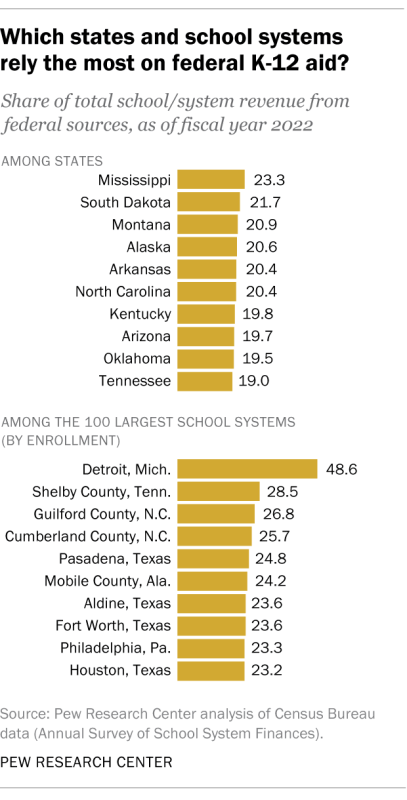
The second pressure is the unfunded mandate. Federal law and court rulings require schools to provide services without always providing the funding to deliver them. The IDEA gap is the clearest example, but the pattern runs through every compliance requirement attached to federal grants, every judicial ruling that creates new obligations without new resources, and every accountability structure that costs staff time and money to maintain. Districts must comply regardless of whether the revenue exists; the cost does not disappear, it simply transfers.
The third pressure is the tax ceiling. In Kentucky, the legislative goal of eliminating the state income tax is not a distant abstraction; it is the stated agenda of the Republican supermajority and the Chamber of Commerce, and the budget currently under consideration in Frankfort is structured to deliberately leave revenues unspent in order to trigger further income tax reductions under the legislature’s own formula. At the local level, the political difficulty of passing tax increases, the Attorney General’s rejection of FCPS’s occupational tax vote on procedural grounds, and persistent community resistance to new revenue measures all combine to keep the funding ceiling low even when the need is specific and documented.
The fourth pressure is the newest and, in terms of its trajectory, the most financially aggressive. The rapid expansion of publicly funded private school voucher programs, now accelerating at both the state and federal levels, is creating what budget analysts call a parallel school system, one where public money funds two separate education structures simultaneously without the total revenue base expanding to match. In July 2025, Congress passed and the president signed the Educational Choice for Children Act, the first federal private school voucher program in American history; it is permanent, uncapped, and projected to cost the federal government nearly $51 billion annually, nearly three times what the federal government currently spends on Title I and IDEA combined. Research across multiple states has found that the majority of voucher recipients in expanded programs were already enrolled in private schools before the programs launched, meaning states are subsidizing tuition for families who were already paying it without any corresponding reduction in public school enrollment or its costs. For Kentucky educators, especially those in rural districts without private school options nearby, the conversation about whether to expand state scholarship programs is one worth watching closely; in those communities, voucher dollars leave the local school system entirely without providing any meaningful alternative for the families most dependent on the public school at the end of the road.
What This Looks Like From a Classroom
I want to be specific about what it means when these four pressures converge inside schools across the Commonwealth, because budget figures can start to feel like abstractions and they are not.
It means the special education teacher who is legally required to provide services but cannot get adequate materials or planning time because the district exhausted its budget covering compliance costs the state was supposed to help fund. It means the school counselor with a caseload no mental health standard would consider manageable, because a second counselor was a pandemic-era position that could not be sustained when the federal money ended. It means the teacher spending personal money on classroom supplies because the supply line was cut to cover something higher on the priority list. It means the principal who knows exactly what her students need and cannot provide it; not because she lacks commitment or creativity, but because the money is simply not there and has not been there for a long time.
It also means something harder to quantify: the slow erosion of the professional culture that makes teaching sustainable over a career. When schools operate in chronic scarcity, educators spend their energy on workarounds rather than on the work itself. Experienced teachers leave for districts or states with better support. Newer teachers burn out faster. The institutional knowledge that makes a school genuinely excellent takes years to build and can disappear in a single budget cycle. We lose things we will not easily recover.
The Language Politicians Use and the Language We Should Use
One of the more frustrating features of this situation is how it gets described in public discourse. Funding cuts become efficiencies. Unfunded mandates become accountability measures. Tax reductions are presented as relief without any accounting of what the relief costs in classrooms. The freeze of the SEEK base is described as fiscal responsibility rather than what it actually is: the continuation of a 20-year trend of disinvestment in Kentucky’s public schools. Voucher programs are marketed as expanding choice without transparent acknowledgment that the research record on their fiscal and academic effects is, at best, mixed, and that the communities with the fewest alternatives bear the highest costs when public funding is redirected.
I am not arguing that every criticism of public education is bad faith. There are legitimate conversations to be had about how districts use resources, as the FCPS situation illustrates plainly. Accountability and transparency in public spending matter, and educators should be willing to say so without feeling we are conceding the broader argument to people who want to defund public schools. The two things can both be true: districts should manage public money responsibly, and the state has chronically failed to provide adequate public money for them to manage.
What I am saying is that the language of fiscal responsibility is being deployed selectively, applied aggressively to school districts while rarely being applied to the structural legislative choices that created the conditions those districts are struggling to survive. The legislature that freezes SEEK while pursuing income tax elimination is making a values choice about who bears the cost of public education in Kentucky. Educators and the public deserve to have that choice named plainly.
What Educators in Kentucky Should Know and Do
If you teach in this state, you are already living inside this argument. The frustration you feel about your supply budget, your caseload, your students’ unmet needs is not a personal failing or a local anomaly. It is the predictable result of 20 years of state disinvestment, compounded by federal retreat, compounded by the expiration of emergency relief funds that districts came to depend on because the baseline was never adequate in the first place.
The most useful thing educators can do with that frustration is to name it precisely, publicly, and without apology; not as partisan complaint but as professional testimony grounded in specific numbers. The SEEK base is 26 percent below its 2008 inflation-adjusted value. The state has suspended its own school transportation funding law in every budget since 2004. JCPS is cutting equity funding for its highest-need schools because the federal relief money that helped sustain those programs is gone and the state did not fill the gap. FCPS is navigating a structural funding squeeze alongside real internal accountability questions, and both deserve honest acknowledgment rather than selective citation.
The people making budget decisions in Frankfort need to hear from Kentucky educators specifically, consistently, and in terms that connect policy choices to classroom consequences. That is not a radical ask. It is the basic obligation of people who understand what is actually happening inside these buildings to make sure the people making decisions about them understand it too.
The school is still standing. Whether it remains the school Kentucky’s children deserve depends, in no small part, on whether the people inside it are willing to say clearly what is being done to it, and by whom, and why it matters.

 BFWClassroom
You must be logged in to post a comment.