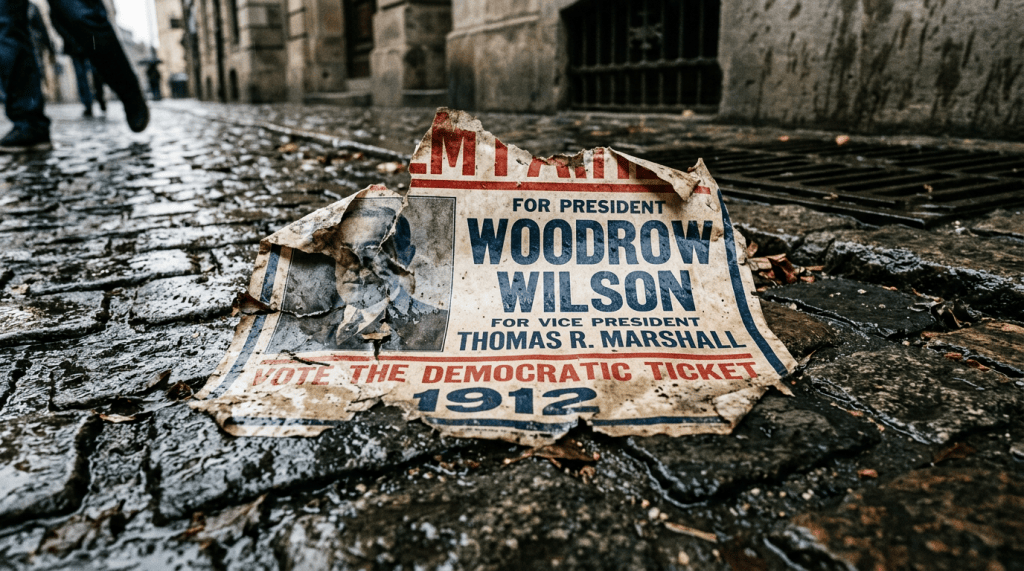
Taft, the German Machines, and the Fracturing of Urban Democracy
“What If?” Series — Milwaukee, Part II of III
On the evening of October 14, 1912, a former president of the United States stepped out of the Hotel Gilpatrick in Milwaukee and into the barrel of a revolver. John Schrank, a saloon keeper from New York who had trailed Theodore Roosevelt across six states, fired a single .38-caliber round at close range. In our actual history, a steel eyeglass case and a folded fifty-page manuscript absorbed enough of the bullet’s energy that it lodged against Roosevelt’s fourth rib without penetrating his lung. He survived. He campaigned through the rest of October. He finished second in November and returned to private life.
That outcome depended on the manuscript being there, folded the way it was, in a coat pocket positioned exactly as it was. Change any one of those variables and the evening ends differently — not with a wounded man delivering a defiant speech to a Milwaukee audience, but with a crowd in the street, a gunshot, and a former president dying on the sidewalk while the people around him slowly understand what they are seeing.
This post follows that version of the night. The consequences that radiate outward from it have less to do with Roosevelt’s politics than with a single biographical fact about the man who shot him — and with a Cincinnati Republican who understood what that fact meant before anyone else in the country did.
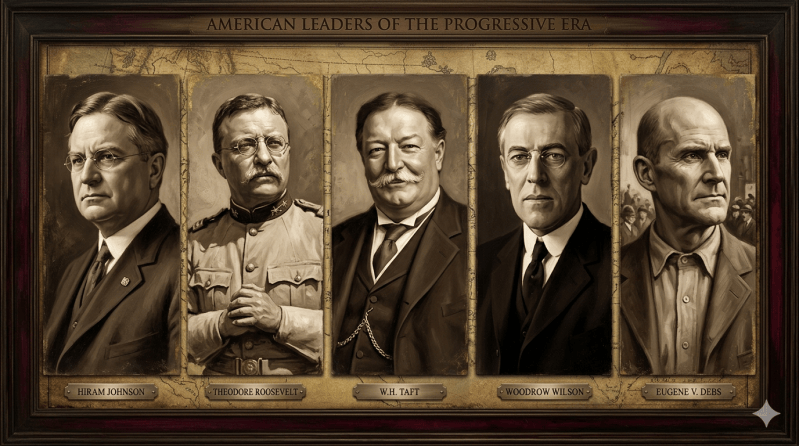
Historical Grounding: The Machine World of 1912
To understand what Roosevelt’s sudden death would have done to American politics, you need to understand the architecture of the urban Democratic machines that dominated city politics across the industrial Northeast and Midwest — and the fragile ethnic coalition that held those machines together.
The Democratic Party of 1912 was not the ideologically coherent organization that later generations associate with the New Deal. It was a coalition of mutual necessity: groups that shared little except their opposition to Republican governance and their access to the organizational machinery of urban politics. In the great industrial cities, the party ran on a system of ethnic patronage; jobs, contracts, legal assistance, and social services delivered through ward bosses and precinct captains to immigrant communities that had few other sources of institutional support. The machine asked for votes in return, and it generally received them.
Two immigrant communities anchored this system in most of the major cities, and they coexisted in the Democratic coalition with a friction that skilled politicians managed rather than resolved. The Irish Catholic communities of the Northeast had built the machines themselves, arriving in the 1840s and 1850s with nothing and spending two generations constructing, through patient organizational work, the most effective urban political apparatus the country had produced. Tammany Hall in New York, the Sullivan machine in Chicago, the ward organizations of Boston and Baltimore — these were Irish creations, and their leadership remained predominantly Irish even as the cities diversified around them.
The German-American communities were different in almost every respect. Protestant rather than Catholic in the majority, spread across the Midwest rather than concentrated in the Northeast, more economically established, and culturally committed to civic institutions — the Turner gymnastic societies, the singing clubs, the German-language press — that gave them organizational life independent of the machine. They had voted Democratic for two generations in many Midwestern cities, partly because of Democratic positions on the tariff, partly because the Republican Party’s increasingly nativist and temperance-oriented cultural tone felt inhospitable, and partly because the local machine had learned to deliver enough for their communities to make the relationship worth maintaining.
This coalition was not stable in any deep sense. Its two pillars were kept together by practical necessity and by skilled management of politicians who knew how to allocate patronage without triggering open competition between constituencies. What it could not survive was an external shock that put the two communities on opposite sides of a question the machine could not arbitrate.
Point of Departure: The Open Death
The bullet, unobstructed by manuscript or eyeglass case, enters Roosevelt’s chest and does what it was designed to do. He falls in the street in front of the Hotel Gilpatrick. There is no speech, no composed unbuttoning of the coat. There is a crowd, a gunshot, and a former president dying on a Milwaukee sidewalk while the bystanders around him slowly understand what they are witnessing.
Roosevelt is dead within the hour. The news reaches the telegraph wires before ten o’clock, and by midnight it is in every city in the country.
This is a different kind of political death than a slow dying-in-office. It has no narrative arc, no time to acquire meaning before it must be responded to. What it has is a crowd, and then many crowds, in many cities, all of them trying to understand what just happened before the newspapers can tell them what to think about it.
Who Was John Schrank?
The question that the next morning’s papers ask — and that the political class asks alongside them, with more urgent purpose — is who Schrank was and why he did it. Schrank was, in fact, a German-born immigrant, a naturalized citizen who had arrived in the United States as a child and spent his entire adult life in New York. He had no political organization behind him; he was, by most accounts, a troubled and isolated man who believed he had received visitations from the ghost of William McKinley instructing him to prevent Roosevelt from violating the two-term precedent. He was, in the clinical language of 1912, a lunatic.
None of this matters to what happens in the forty-eight hours following the shooting, because the information that spreads fastest — faster than any psychiatric assessment, faster than any careful journalism — is what appears in the first dispatches alongside his name: German-born. The country hears, in rapid sequence: Roosevelt is dead; the killer is a German immigrant.
The Nativist Firestorm
The nativist impulse in American politics in 1912 is not difficult to ignite. It has been building for three decades, fed by mass immigration, the social anxieties of industrialization, the organized campaigns of groups like the Immigration Restriction League, and a broader cultural conversation — carried in magazines, in political speeches, in the new academic discourse of eugenics — about whether the new arrivals from Southern and Eastern Europe were assimilable into American democratic life.
Progressive reformers had a complicated relationship with this conversation, one that is uncomfortable to examine but necessary to understand. Roosevelt himself had written about immigration restriction in terms that would today be recognizably eugenic; he worried about what he called “race suicide,” the dilution of Anglo-Saxon stock by less capable immigrant populations. Other progressives had made immigrant communities their primary constituency and argued forcefully against restriction. The progressive coalition was not unified on this question, and the tension within it was always closer to the surface than the party’s public positions acknowledged.
In the weeks following the assassination, that tension becomes a crisis. The nativist wing of American politics — running across party lines — uses the killing to demand immediate and dramatic restriction of immigration. Schrank’s German birth is foregrounded in editorial after editorial; the fact that he arrived as a small child and had no meaningful connection to Germany as an adult does nothing to dampen the argument that foreign-born radicalism poses an existential threat to American political life. The psychiatric evidence that he was acting out of private delusion rather than any political program is reported and then largely ignored. The simpler story — an immigrant killed an American president — is the story that travels.
The Democrats Fracture
The assassination lands in the Democratic coalition like a stone in still water, and the ripples reach every shore simultaneously. The Irish machine politicians who run the party’s urban organizations understand immediately what the nativist response means: their German-American coalition partners are going to be the target, and the machine’s response will define the coalition’s future.
Their instinct is to separate Schrank from any collective identity. Their editorial voices emphasize his individual madness and isolation; their political statements call for calm and due process and refuse the logic of collective guilt. This is the right argument, and it is also the argument that costs them in both directions simultaneously. The nativist press accuses them of protecting immigrant communities at the expense of American safety. Their German-American partners, watching the response, notice that the rhetoric of individual madness is deployed with a caution and a lawyerliness that feels like self-protection rather than solidarity. The machine is defending a principle; the German-American communities needed someone to defend them.
The German-language newspapers across the Midwest — from Milwaukee’s Germania to Cincinnati’s Volksblatt to Chicago’s Illinois Staats-Zeitung — catalog what is happening to their communities with a precision the English-language press does not match. Businesses vandalized in Cleveland and Detroit. A Turner hall in Milwaukee with broken windows and a crowd outside that the police arrived late to disperse. A German Lutheran church in Chicago’s north side where the pastor was told by his alderman, quietly and apologetically, that the ward organization could not be seen providing direct protection right now, not with the newspapers watching.
The Democratic machines, whose power rests on the ability to protect and deliver for constituent communities, find themselves unable to do either effectively for their German-American partners. The police forces in these cities are heavily Irish in their composition, built through decades of machine patronage; they are not, in the weeks after Milwaukee, reliable protectors of neighborhoods the nativist press has designated as the problem. The machine politicians who reach for their usual tools — a word to the commissioner, a quiet conversation with the ward captain — find those tools less effective than they once were, because the scale and publicity of the crisis have made quiet management impossible.
Wilson wins the White House in November, as the only candidate with a national coalition intact after the Progressive Party collapses without Roosevelt to hold it together. But he inherits a Democratic organization that is fracturing along ethnic lines his New Freedom philosophy had no framework to address.
A Third Claim on the Wreckage
While the Irish Democratic machines were struggling to manage the nativist firestorm without alienating either their German-American partners or their nativist-adjacent constituencies, and while William Howard Taft was beginning to recognize the political opening that his Cincinnati biography had handed him, Eugene Debs was making a different argument entirely — and making it to some of the same people both men were trying to reach.
Debs’s response to the assassination and its aftermath appears in Appeal to Reason within a week of Roosevelt’s death, and it is worth reconstructing in some detail because it represents a genuinely distinct analytical position rather than a variation on what the major parties were offering. Schrank’s German birth, Debs argues, is irrelevant to any serious understanding of what happened in Milwaukee. The relevant fact is not where Schrank was born but what kind of society produces men like Schrank: isolated, displaced, operating outside any collective framework of work or community, susceptible to the conspiratorial thinking that fills the vacuum left by genuine political engagement. The nativist press has identified the wrong cause because identifying the right one would require examining the economic system that the nativist press exists to protect.
The violence against German-American communities in the weeks following the assassination is, in Debs’s framing, a demonstration of how ethnic division functions within a capitalist political order. Working people of Irish descent attacking working people of German descent while the men who own the factories and the newspapers and the machine operations observe from a safe distance — this is not an aberration from normal American political life, Debs argues; it is its logical expression. The Democratic machines that failed to protect German-American neighborhoods failed because their organizational logic was never actually about protecting working people; it was about managing working people on behalf of a political economy that required their division.
This argument has obvious appeal within the German-American communities that the machines have just visibly failed. But it is in competition with Taft’s argument, which is also addressed to those communities and which offers something more immediately tangible: a prominent national Republican who has put his name and his remaining political credibility on the line to say that collective blame is wrong. Taft’s argument does not require German-American voters to become socialists, to abandon the ethnic and religious institutions that give their communities coherence, or to accept an analysis of American capitalism that many of them find alien to their own economic aspirations. It requires only that they recognize a man who showed up when the Democratic machine didn’t.
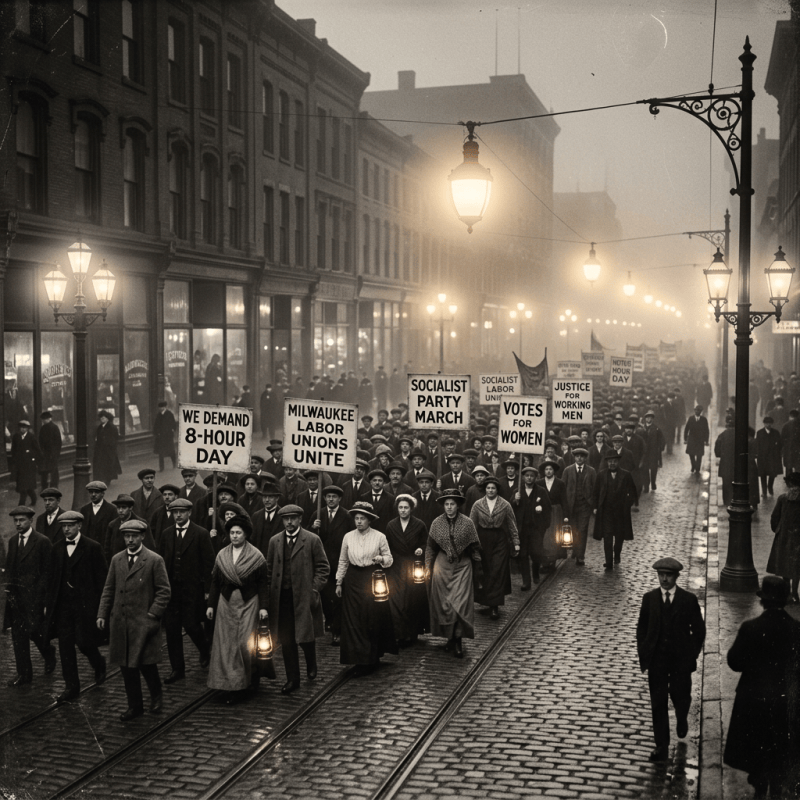
The contest between these two competing claims on the German-American working class — Taft’s ethnic solidarity argument and Debs’s class solidarity argument — plays out unevenly across the Midwest and tells you something important about why American socialism never consolidated the immigrant industrial working class the way European socialist parties did. In cities where the Socialist Party already had organizational infrastructure — Milwaukee most prominently, where the Social Democrats had been a significant political force since the 1890s and had elected a socialist mayor in 1910 — Debs’s argument finds a prepared audience and makes gains. Milwaukee’s German-American socialist community does not need Taft; it has its own institutions, its own press, its own framework for understanding what the machines’ failure means.
In cities where the Socialist Party is weaker — Cincinnati itself, Detroit, Cleveland’s near west side — Taft’s argument wins because it is delivered through existing community relationships rather than through the organizational work that socialist politics requires. The Turner society president who introduces Taft at the Over-the-Rhine memorial service is making a choice, perhaps without fully articulating it, between two available frameworks for responding to the Democratic machines’ failure; and he chooses the one that does not require dismantling his understanding of how American politics works.
The result, by the 1914 midterms, is a Midwest in which the Socialist Party has made genuine gains in cities where it was already organized, and in which the Republican Party has made gains in cities where Taft’s intervention gave German-American voters a reason to cross over. The Democratic machines have lost ground in both directions simultaneously — to the right in Cincinnati and Indianapolis, to the left in Milwaukee and parts of Chicago. The fracture that the Milwaukee bullet opened in the Democratic coalition is being filled, unevenly and incompletely, by two different political visions with almost nothing in common except their recognition that the machines had failed.
Debs does not win the 1912 election. He was not going to win the 1912 election under any circumstances. But the scenario in which Roosevelt is killed outright and the Democratic coalition fractures along ethnic lines is the scenario in which the Socialist Party’s 1912 showing — already the strongest in the party’s history — might have been somewhat stronger, concentrated more effectively in the industrial Midwest, and positioned better for the organizational gains that follow when an alternative political framework is validated by events. The machines failed; somebody was going to benefit. Taft took the German-American suburbs. Debs, where his party was organized enough to make the case, took the German-American factory floor.
The Man from Cincinnati
Into this fracture, from a direction no one had anticipated, steps William Howard Taft.
Taft’s campaign had been effectively finished before Schrank fired. He was carrying the humiliation of a sitting president reduced to a rump candidacy, and political observers assumed he would finish a distant third and then accept the Yale Law professorship waiting for him. The assassination changes his position in ways that take him several days to recognize.
Taft is a Cincinnatian — born and raised in the city’s uphill neighborhoods within easy walking distance of Over-the-Rhine, the dense German-American quarter whose beer halls, Turner societies, singing clubs, and German-language newspapers made it one of the most culturally cohesive immigrant communities in the country. His father, Alphonso Taft, a Republican founder in Ohio, had deliberately cultivated relationships with German-American community leaders throughout the 1870s and 1880s, understanding that German-American voters were the swing constituency in Ohio and that their support needed to be earned through personal relationship rather than assumed through party loyalty. William Howard grew up watching those relationships work. He had attended festivals in Over-the-Rhine, known the community’s editors and pastors and Vereins presidents by name, and carried into adult political life an ease with German-American civic culture that was entirely genuine and entirely unlike the performative ethnic outreach of most national politicians.
He speaks no German himself. That is almost beside the point. What Taft has, and what almost no other national political figure has in October 1912, is the credibility of a neighbor.
Taft Moves
In the days following Roosevelt’s death, as the nativist press whips itself into demands for immigration restriction and the Democratic machines struggle to manage the fallout without a workable strategy, Taft makes a series of decisions that his campaign staff initially resists and then recognizes as the most politically significant moves of the entire 1912 cycle.
He travels to Cincinnati. He meets with the editors of the Volksblatt and the Freie Presse, the two German-language daily papers that together reach most of the German-American reading public in the Ohio Valley. He attends a memorial service at one of Over-the-Rhine’s Lutheran churches — carefully framed as a personal act of mourning rather than a campaign event — and afterward he speaks briefly, without prepared remarks, to the crowd assembled outside. What he says is reported verbatim in the German-language press and in summary in the English-language papers: the man who killed Theodore Roosevelt was a disturbed individual, not a representative of any community; the German-American citizens of this country had built its industries, filled its armies, and enriched its civic life across generations; and anyone who attempted to use this tragedy to attack those communities would find that the Republican Party, under his leadership, would not countenance it.
The statement costs him in the nativist press, which accuses him of opportunism and of protecting the communities that harbored the assassin. It gains him, over the following two weeks, something considerably more valuable: the organized attention of German-American Republican networks across Ohio, Indiana, Illinois, and Missouri, networks that had been dormant or demoralized during the Roosevelt-dominated campaign season and that now have a specific reason to activate. The German-language newspapers that had been treating the Republican Party with at best qualified enthusiasm begin covering Taft’s Cincinnati statement as a significant political event, reprinting it and editorializing in its favor. The community organizations — the Turner societies, the Saengerbunds, the Catholic Central Verein — begin routing their political energy toward a Republican operation that has, for the first time in years, said something directly useful to them.
The Republican Machines Pull Against the Irish Democrats
The mechanism that follows is not a simple ethnic transfer of votes; it is more specific and more interesting than that. German-American communities in the industrial Midwest had never been uniformly Democratic. Many of their more prosperous and established members had voted Republican for decades; what had made them swing voters rather than reliable partisans was a set of specific grievances — temperance legislation, nativist cultural signaling from the Republican Protestant establishment, tariff policy — that had pushed a significant portion of the community toward Democratic machines that had the organizational capacity to deliver services and protection. The relationship was transactional on both sides.
The assassination and its aftermath scramble this transactional calculus entirely. The Democratic machines, whose Irish leadership cannot effectively protect German-American neighborhoods from violence and whose public statements read in the German-language press as too cautious and too lawyerly to constitute genuine solidarity, lose the credibility that made them worth voting for. The Republican networks that Taft is activating through his Cincinnati connections offer an alternative — imperfect, carrying its own history of nativist impulses, but with a specific named person at its head who has publicly and unambiguously staked his position.
Cincinnati, notably, is quieter than the other major German-American cities in the weeks following the assassination. The Taft networks, activated and visible, provide a kind of political insurance that Over-the-Rhine’s residents understand intuitively even if they cannot articulate it precisely: there is a prominent national figure who has committed his remaining political reputation to the argument that collective blame is wrong, and that figure grew up a few blocks away. The violence that touches German neighborhoods in Cleveland, Detroit, and Chicago’s near north side does not reach Cincinnati’s in the same way, and the German-language press covers the contrast explicitly, which only accelerates the community’s drift toward the Republican organization Taft is building.
Taft does not win the 1912 election. The electoral math is too badly broken; Wilson carries the White House as the only candidate with a national coalition still intact. But in Ohio, Indiana, and portions of Illinois, the German-American movement toward the Republican ticket is large enough to cost Wilson those states or dramatically narrow his margins. More importantly, the Republican networks Taft has activated do not dissolve after Election Day; they are now invested in a Republican politics that has — because of his specific intervention at a specific moment — a different relationship to immigrant communities than the nativist wing of the party had been building toward.

The Long Decline of the Machines
The violence that erupts in the weeks following the assassination is not organized or directed in any systematic way; it is the violence of crowds that have been given a target by newspaper coverage and political rhetoric and that find, when they reach for the target, that the usual institutional buffers are not functioning. German-American businesses face vandalism and threats in a dozen industrial cities. The German-language press catalogs the incidents with careful precision; the English-language press covers them with varying sympathy and a consistent tendency to report individual events without reporting the accumulating pattern.
The Democratic machines, having failed to protect a core constituency at the moment that constituency most needed protection, are not forgiven quickly. The Irish ward bosses who could not or would not use their police connections to secure German neighborhoods, the party leaders who offered principled rhetoric but not practical intervention — these men find that their relationships with German-American community organizations are damaged in ways that the usual machinery of patronage cannot repair. You cannot buy back trust with jobs and contracts when the failure has been one of physical safety; the transaction the machine offered was protection, and the machine did not deliver it.
By 1914, the Democratic coalition’s fracture in the industrial Midwest is visible and structural. The machines are not dead — too deeply embedded in their cities’ institutional life to collapse in two years — but they are weaker, and weaker in ways that Taft’s Republican networks are specifically positioned to exploit. The realignment of German-American voters toward the Republican Party that the First World War would have produced anyway, through the anti-German hysteria of 1917 and 1918, now begins five years earlier and with different emotional content: not shame at ethnic association with an enemy nation, but the memory of being abandoned by a coalition partner at a moment of crisis and protected by a Cincinnati Republican who showed up when it mattered.
The political machines of the Progressive Era were never as stable as their opponents feared. In our actual timeline, they declined gradually over decades as immigrant communities assimilated, as federal social programs took over the welfare functions the machines had performed, and as the middle-class reform tradition built institutional alternatives. In this alternate timeline, the Milwaukee bullet starts their decline with a hammer rather than an erosion — and the man who does the most to shape what replaces them is the one who had already lost the election before the shooting began.
Discussion Questions:
1. Taft’s effectiveness in Over-the-Rhine derived from his father’s deliberate relationship-building with German-American community leaders in the 1870s and 1880s — credibility that was inherited, not earned in the moment. What does this suggest about how political capital accumulates across generations? Can you identify other moments in American history where a politician’s effectiveness in a crisis depended on relationships built long before the crisis arrived?
2. The Democratic machines failed the German-American communities not because they were hostile but because they were caught between constituencies and chose the cautious path. Is that kind of institutional paralysis — doing too little out of caution rather than doing nothing out of hostility — a different moral failure than outright abandonment? How should we judge political leaders who manage competing loyalties badly in a crisis?
While these events are not true they are based on historic fact and the possibility of one change in history. To read more of my Alternate History scenarios, be sure read here.


You must be logged in to post a comment.