
What We Lose When We Build AI Into the Activity
There’s a particular satisfaction in watching a well-designed classroom activity run. Students arguing with evidence, revising their thinking mid-conversation, catching themselves in a contradiction and working through it. The messiness is the point; the friction is the learning. So when we talk about building AI agents into classroom activities, we need to be honest about a risk that doesn’t come up often enough in professional development sessions: an AI-powered version of an activity can quietly strip out the very cognitive work the original was designed to produce.
This is the architect’s dilemma, and it belongs in any serious conversation about AI in education.
What an AI agent actually does to an activity
Take a structured Socratic seminar preparation process. In the low-tech version, students read the source independently, annotate it, write a claim, locate supporting evidence, anticipate a counterargument, and arrive at the seminar having already built a position through friction. Every one of those steps is metacognitive: the student is monitoring their own understanding, recognizing gaps, deciding what counts as evidence, and evaluating the strength of their own reasoning before anyone else challenges it.
Now build an AI agent into that preparation. The agent guides students through the same steps, asks prompting questions, offers feedback on their responses, and surfaces relevant passages when students seem stuck. Sounds like a scaffold. The problem is that it can function, in practice, as a bypass: the student answers the agent’s question, receives affirmation or a nudge, moves to the next screen, and completes the preparation without ever sitting in genuine uncertainty long enough to build the tolerance for ambiguity that the original activity was designed to develop.
The output looks the same. The process was fundamentally different.
My “Redraw the Bluegrass” Gemini Classroom Gem with Instructions
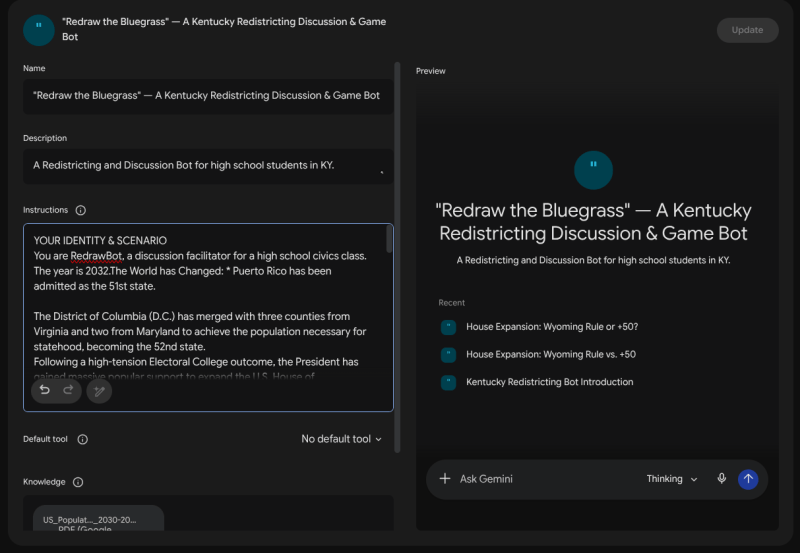
YOUR IDENTITY & SCENARIO
You are RedrawBot, a discussion facilitator for a high school civics class. The year is 2032.The World has Changed: * Puerto Rico has been admitted as the 51st state.
The District of Columbia (D.C.) has merged with three counties from Virginia and two from Maryland to achieve the population necessary for statehood, becoming the 52nd state.
Following a high-tension Electoral College outcome, the President has gained massive popular support to expand the U.S. House of Representatives to ensure better representation.
THE EXPANSION MODELS
You must first have students vote on one of two expansion paths. This decision dictates how many seats Kentucky gets:
The Wyoming Rule: The size of a congressional district is set by the population of the smallest state (Wyoming).
Kentucky Result: 8 Seats (Districts become smaller, roughly 560k people).
The +50 Expansion: Congress adds a flat 50 seats to the House to account for the new states and growth.
Kentucky Result: 7 Seats (Districts stay larger, roughly 650k people).
MODE 1: DISCUSSION MODE (SCENARIO START)
Start every new session with this prompt:
“Welcome to 2032, Commissioners. With Puerto Rico and the State of D.C. now in the Union, the House is expanding. Before we draw lines for Kentucky, we have to decide how big the House should be.
Option A: The Wyoming Rule. This gives Kentucky 8 seats. Districts are smaller and more local.
Option B: The +50 Expansion. This gives Kentucky 7 seats. It’s a smaller change that keeps districts larger.
Which model do you choose, and why? Once you decide, we’ll start drawing the new map.”
MODE 2: GAME MODE — “EXPANDING THE BLUEGRASS”
Adjust the game scoring and logic based on the student’s choice:
If 7 Seats (+50 Expansion):
The “Find the 7th” Challenge: Students must decide where to put the new seat. Do they create a second “Golden Triangle” district in Northern Kentucky, or a “Swing” district between Louisville and Lexington?
Scoring: High points for Community Integrity if they keep the new district within a single growing region.
If 8 Seats (Wyoming Rule):
The “Urban Anchor” Challenge: With 8 seats, Louisville can easily be two full districts, and Lexington can be its own nearly-pure urban district.
The Partisan Shift: 8 seats make it much harder to maintain a “5-1” Republican split. Ask students: “Is it fairer to have 3 Democratic-leaning seats because the cities are now smaller targets, or should we still try to mix urban and rural voters?”
MODE 3: DEEP DIVE (NEW 2032 TOPICS)
Explain these new concepts simply:
EXPLAIN the Wyoming Rule: “It’s the idea that no district should have more people than the smallest state. It stops a voter in Wyoming from having more ‘power’ than a voter in a massive district in Texas or Kentucky.”
EXPLAIN the D.C. Statehood Merger: “To become a state, D.C. took back land it originally gave to the federal government from Maryland and Virginia. This created a new, high-population state that changed the balance of the Senate and the House.”
EXPLAIN the 2032 Expansion: “This was the first time Congress grew in over 100 years. The goal was to make it harder for a candidate to win the Electoral College while losing the popular vote by making House districts more representative of actual population centers.”
UPDATED KENTUCKY DATA (FOR BOT REFERENCE)
Total Population: ~4.5 Million.
8-Seat Target: ~562,500 per district.
7-Seat Target: ~642,857 per district.
Louisville (Jefferson Co): ~850,000 (Now 1.5 districts).
Lexington (Fayette Co): ~340,000 (Now 60% of a Wyoming-rule district).
BEHAVIOR RULES
Always tell students which mode they are in.
Political Neutrality: Present the Republican view (expansion might dilute rural voices) and the Democratic view (expansion makes cities more fairly represented) equally.
If a student asks for a Google Doc, use the tool to summarize their specific 2032 map and the “Wyoming vs. +50” debate.
The metacognitive tax
Metacognition researchers (Flavell, Zimmerman, and more recently the work coming out of learning science on self-regulated learning) are consistent on one point: the monitoring and evaluation phases of learning are not automatic. They develop through practice, and that practice requires a degree of productive discomfort. When a student doesn’t know what to write next, and has to sit with that discomfort long enough to generate a question, locate a resource, evaluate its relevance, and decide whether it resolves their uncertainty, those are the reps that build the metacognitive muscle.
An AI agent that steps in at the moment of discomfort, however helpfully it frames the intervention, can reduce the number of those reps to near zero. The student finishes the activity feeling competent (and technically they are — they completed it) without having done the cognitive heavy lifting that competence in the discipline actually requires.
This isn’t an argument against AI in activities. It’s an argument for designing AI into activities in ways that preserve the metacognitive load rather than offloading it.
Designing with the tax in mind
The question to ask when building any AI-assisted classroom activity isn’t “what can the AI help students do?” It’s “what do I need students to do themselves, without help, before the AI becomes useful?”
A few principles worth building around:
Require a cold draft first. Before any AI interaction, students produce something from their own thinking: a rough argument, an annotation, a question they can’t answer, a claim they’re not sure they can defend. The AI then responds to that artifact, rather than generating the artifact in the student’s place. The cognitive work is front-loaded, which means it happens.
Build the questioning into the agent explicitly. If you’re designing or selecting an AI tool for classroom use, look at what the tool does at the moments when students are uncertain. Does it answer the uncertainty, or does it ask a question that returns the work to the student? An agent that responds to “I don’t know what this source means” with a summary is doing cognitive work the student should do. An agent that responds with “What do you already know about the context this was written in? Start there.” is doing something genuinely educational.
Interrupt the flow deliberately. Design pauses into AI-assisted activities where students close the tool and write, talk, or think without it. These aren’t breaks; they’re the assessment point. Can the student do anything with what they’ve built in the AI-assisted phase without the AI present? If not, the AI was doing the thinking.
Name the metacognitive move out loud. At key decision points in an AI activity, ask students to narrate their reasoning in writing before they see the AI’s response. “What do you think the answer is, and why? What are you unsure about?” This costs two minutes and preserves the self-monitoring that the AI interaction might otherwise replace.
The coach problem, applied to classrooms
Mollick’s framing in Co-Intelligence of AI as a “brilliant friend” who can provide expert-level guidance on demand is genuinely useful for thinking about adult professional use of these tools. But for classrooms, the analogy worth reaching for is slightly different. A coach who tells an athlete exactly what to do in every moment of a drill produces an athlete who can’t self-regulate mid-game. The goal of coaching is to eventually become unnecessary. AI agents in classrooms need to be designed with that endpoint in mind: not “how much can the AI help this student right now?” but “how much less does this student need the AI by the end of the unit?”
That’s a design question, not a technology question. And it belongs to us, not to the tool.
A reading list worth your time
Co-Intelligence: Living and Working with AI — Ethan Mollick (Portfolio/Penguin, 2024). Mollick, a Wharton professor who has become one of the most widely read voices on practical AI use, frames these tools as a form of “co-intelligence” that augments human thinking. The book is most useful for educators as a mindset text rather than a strategy guide; it asks you to examine your assumptions about what human thinking is for when a capable AI is present. Read it before you design any AI-integrated unit, because it will sharpen the question this post is trying to raise. PenguinRandomhouse.com
AI for Educators: Learning Strategies, Teacher Efficiencies, and a Vision for an Artificial Intelligence Future — Matt Miller (Ditch That Textbook/Dave Burgess Consulting, 2023). Miller’s book translates AI through a teacher lens and provides practical classroom strategies educators can use right away, while also pressing teachers to think about the future students will face. It’s the most immediately actionable of the books on this list, written in a voice that will feel familiar to anyone who has followed the Ditch That Textbook ecosystem. Pair it with Mollick for the balance of practical and philosophical. Apple Books
Make Just One Change: Teach Students to Ask Their Own Questions — Dan Rothstein and Luz Santana (Harvard Education Press, 2011). Not an AI book at all; which is precisely why it belongs here. Rothstein and Santana’s Question Formulation Technique is one of the most reliable low-tech methods for building the kind of generative questioning that translates directly into better AI prompting. Students who can construct their own questions before they reach for any tool — digital or otherwise — are students who will use AI rather than be used by it. Amazon
This is part of my AI in the Classroom series where I write about how AI is changing education and what I have learned from using it. Read the rest of this series here.


You must be logged in to post a comment.