
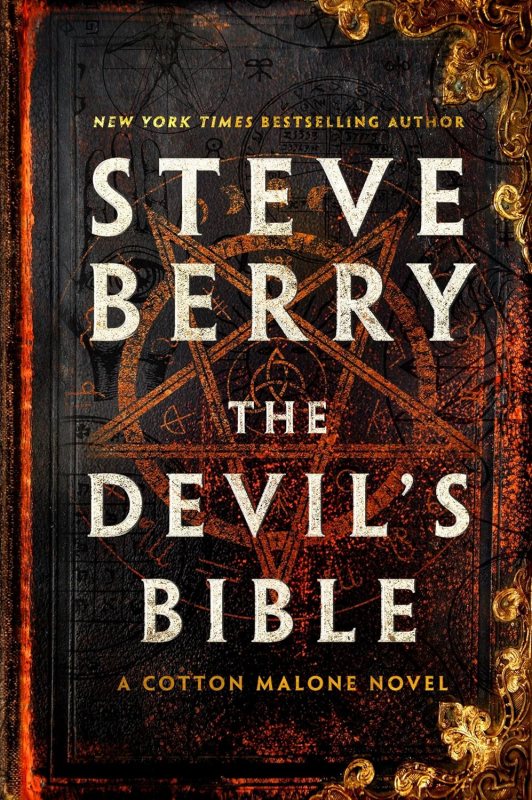
Series: Cotton Malone, Book 26
Genre: Historical Fiction / Espionage Thriller
Publisher: Grand Central Publishing Rating: ★★★½ (3.5 / 5)
Recommended For: General adult readers; AP European History and Modern World History (supplemental); mature high school recreational readers
Content Notes: Action violence, kidnapping, espionage; minimal language; no explicit sexual content
Sometimes the best reading experiences happen by accident. I came to Steve Berry’s The Devil’s Bible while deep in the middle of Peter Wilson’s magisterial scholarly history of the Thirty Years War; I needed something fast-moving and fictional to balance the academic weight of Wilson’s work. The library had Berry’s latest Cotton Malone installment available, so I grabbed it without much deliberation. What followed was an interesting experiment: reading a contemporary political espionage thriller that orbits, at least in premise, the same seventeenth-century conflict I was studying in exhaustive historical detail.
The result is a mixed verdict. Berry’s strengths as a thriller writer remain firmly intact, and the geopolitical scaffolding of this particular entry is genuinely clever. The execution, however, never quite delivers on what the historical premise promises.
The Premise: History Meets Contemporary Crisis
Berry’s signature formula is well established across the Cotton Malone series: a historical artifact or event becomes the flashpoint for a present-day political crisis, and Malone (along with his partner Cassiopeia Vitt and his former handler Stephanie Nelle) must navigate the resulting chaos before irreversible damage is done. The Devil’s Bible follows that blueprint faithfully.
The Codex Gigas, the medieval manuscript known as the Devil’s Bible, was among the treasures looted from Prague during the Thirty Years War and carried back to Sweden under Queen Christina. It has resided in Stockholm ever since. Berry’s plot hinges on a fictional diplomatic arrangement: Sweden will return the Codex to the Czech Republic as a goodwill gesture, and in exchange the Czech Republic will smooth Sweden’s path into NATO. The scheme is elegant; for anyone familiar with how Sweden’s actual NATO accession unfolded (with Turkey, and later Hungary, as the complicating parties), the substitution of the Czech Republic as a reluctant gatekeeper feels both plausible and timely.
Berry reportedly finished this novel roughly two years before Sweden formally joined the alliance in March 2024, and the near-prophetic quality of the geopolitical framing deserves genuine credit. He modeled the holdout-nation dynamic accurately, even if he changed the players.
The kidnapping of a Swedish princess (sister to the fictional king) sets everything in motion. Her captors want the Codex delivered to them rather than to Prague; her husband, a British financier with murky ties to Russian intelligence, complicates the negotiation considerably. Add Russia’s broader interest in derailing Swedish NATO membership, and the political architecture of the thriller is interesting enough to carry the story forward.
Where the History Disappoints
This is where my particular reading context amplified a real weakness in the novel. Berry typically devotes substantial space within each installment to the historical backstory; his books often feel like miniature history lessons wrapped around espionage plots, and that balance is a large part of their appeal. The Thirty Years War, Queen Christina, and the Codex Gigas represent extraordinarily rich material. The war reshaped the religious and political map of Europe; Christina’s reign was one of the most extraordinary of the seventeenth century; and the Codex itself carries a genuinely fascinating provenance.
Berry grazes all of it rather than diving in. The historical sections are thinner than usual, almost cursory, and a reader arriving without prior knowledge of the period will leave with only a vague impression of why any of it matters. Because I was reading Peter Wilson’s account of the conflict concurrently, the gap between what Berry touched and what he could have done with the material was conspicuous throughout.
The Codex never feels like a necessary element of the story. Almost any rare artifact could be substituted into the same plot structure without meaningfully changing the stakes or the atmosphere. That is the most honest criticism I can make of this book: the historical hook and the contemporary thriller sit alongside each other without ever fully integrating. In Berry’s stronger entries, you cannot imagine the story working without its specific historical foundation. Here, the seam shows.
What Berry Does Well
Separate the historical complaint from the thriller machinery, and Berry delivers what readers of the series expect. The pacing is brisk; the action sequences move efficiently from kidnapping to chase to confrontation without overstaying their welcome. Malone and Cassiopeia remain engaging company, and the Swedish and Czech settings give the novel a sense of place that feels appropriately European without becoming travelogue.
Berry also continues to distinguish himself from much of the thriller genre in terms of content choices. The language stays clean; the violence is present but not gratuitous; and the romantic elements between characters are handled with discretion rather than explicitness. For readers who want the tension and momentum of a spy novel without the content that frequently accompanies the genre, Berry’s books remain a reliable choice. This matters for educators who might consider recommending the series to mature high school readers.
The geopolitical imagination at work here is also worth acknowledging separately from the thriller plot. Berry’s instinct that Sweden’s NATO accession would involve a reluctant European partner using diplomatic leverage turned out to be a reasonable model for how events actually unfolded. That kind of contemporary political literacy, woven into entertainment fiction, is part of what gives the Cotton Malone series its particular texture and keeps it feeling current even when it reaches back centuries for its source material.
A Major Development (Spoilers Below)
⚠ Spoiler Warning: The following section discusses a significant character development at the novel’s conclusion. Skip ahead if you have not yet finished the book.
The death of Stephanie Nelle is the most consequential thing Berry does in The Devil’s Bible, and it is handled with more intentionality than her relatively reduced role in the preceding narrative might suggest. Nelle has appeared across all twenty-six Cotton Malone novels; she has been the institutional tether that repeatedly pulls a retired intelligence operative back into active service. Without her, the mechanics of how Malone gets drawn into future crises become genuinely unclear.
What makes her exit notable is Berry’s candor in the author’s note. He acknowledges that Nelle had run her course as a character; her narrative function had become repetitive across two-and-a-half dozen books, and he made a deliberate decision to close that chapter. That kind of authorial transparency about a long-running series is refreshing. It suggests Berry is thinking carefully about the longevity and coherence of his fictional universe rather than simply producing installments on schedule.
He also admits, honestly, that he is not yet certain where the series goes from here. The structural question is real: Malone is, in the fiction, a retired operative who gets pulled back repeatedly through Nelle’s network. With that mechanism gone, future entries will need a new engine for the premise. Whether Berry has a solution in development or is genuinely still working it out, the acknowledgment itself reflects the kind of writer-to-reader honesty that builds long-term trust with an audience.
Classroom and Educational Considerations
The Devil’s Bible is not a primary classroom text, and Berry does not intend it to be. It has genuine supplemental utility, though, for a few specific purposes.
For students studying the Thirty Years War or seventeenth-century European history, the novel can serve as a low-stakes entry point into the period. Even Berry’s surface-level treatment of the Codex Gigas and its wartime displacement gives students a human-scaled story to attach to what can otherwise feel like abstraction. The artifact’s journey from Prague to Stockholm under the chaos of the war is, on its own, a compelling piece of history worth pursuing beyond Berry’s pages.
The contemporary political plot has more direct classroom utility than the historical sections do. Sweden’s actual NATO accession process, Turkey’s leverage over the membership vote, and the broader question of how diplomatic concessions function in alliance politics are all live topics in AP European History and Modern World History courses. Berry fictionalizes the mechanism (Czech Republic rather than Turkey; a manuscript rather than fighter jets), but the underlying logic of how a reluctant party extracts concessions before granting membership approval is faithful to how real diplomacy works. That conversation, prompted by the novel and grounded in the actual historical record, could be a productive one.
For English Language Arts purposes, the novel offers a clean example of how popular fiction uses historical events as scaffolding for contemporary storytelling. The gap between what Berry does with his source material and what a more historically invested author might do is itself worth discussing with advanced students. Pairing a selected passage from Berry with an excerpt from a serious account of the Thirty Years War could generate a productive conversation about the obligations (or lack thereof) that fiction carries toward historical accuracy.
Final Assessment
The Devil’s Bible earns three and a half stars. It is a competent and often entertaining entry in the Cotton Malone series, but it is not Berry working at his best. The geopolitical premise is genuinely sharp; the thriller mechanics are reliable; and the decision to retire Stephanie Nelle gives the book a weight it might not otherwise carry. What holds it back is the unfulfilled promise of its historical premise. The Thirty Years War, Queen Christina, and the Codex Gigas deserved more room than Berry gave them, and readers who arrive expecting the usual depth of historical integration will likely share that disappointment.
My reading context made that gap especially visible. Coming to this novel while immersed in Peter Wilson’s account of the Thirty Years War was perhaps unfair to Berry’s more modest ambitions. Read on its own terms, as a well-crafted espionage thriller with an interesting political spine, it delivers. Read as a vehicle for the rich history its title invokes, it leaves considerable territory unexplored.
For educators: the Cotton Malone series as a whole is easy to recommend to mature high school readers who enjoy the thriller genre. This particular installment is best positioned as a companion to, rather than a substitute for, serious study of seventeenth-century European history or the contemporary politics of NATO expansion.
Pairs Well With: Peter Wilson, The Thirty Years War (scholarly history); research into Sweden’s NATO accession (2022–2024); the Codex Gigas as a primary source / artifact study topic
Everything reviewed here I have personally read, screened, or listened to, and many of these resources have been part of my classroom for years. This site exists because teachers deserve practical recommendations from someone who has been in the room. That said, every school community is different; please consult your district guidelines before using any book, film, or podcast with students.
To read more of my reviews follow the link.


You must be logged in to post a comment.