Coach Beard is not the obvious heart of Ted Lasso. He’s quiet, often reading while others talk, given to references that seem to come from nowhere. But across the seasons, Beard emerges as perhaps the most intentional learner on the show. His reading life isn’t a quirk; it’s a philosophy about how systems work and how leaders think. More importantly, his approach—careful, wide-ranging, deliberately building understanding across multiple texts—offers something crucial for teachers thinking about how to structure classroom space and culture. Beard understands what good educators understand; the conditions matter. A forest doesn’t create trees; it creates the conditions for trees to grow. A good classroom doesn’t create learning; it creates the conditions for learning to happen.
What Beard Reads
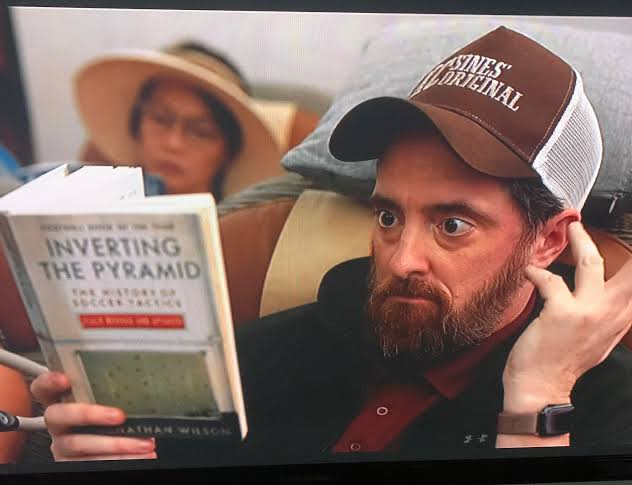
Beard’s reading trajectory reveals a deliberate thinker building a coherent philosophy. In early seasons, he reads technical books about football tactics like Inverting the Pyramid by Jonathan Wilson and Quiet Genius: Bob Paisley, British Football’s Greatest Manager by Ian Herbert. These aren’t just sports books; they’re about leadership through systems thinking.
In Season 2, Beard expands to Fever Pitch by Nick Hornby (obsession and belonging) and The Greatest by Matthew Syed (sports psychology). He’s building a library that explores not just tactics, but the human dimension of how teams function.
By Season 3, Beard is reading Entangled Life by Merlin Sheldrake, about interconnection and mutual dependence. He also references Dr. Suzanne Simard’s field work on forest ecosystems, where trees don’t compete but collaborate through underground networks. This progression isn’t accidental; Beard is thinking his way toward understanding how systems work and how leadership requires recognizing interconnection. His reading creates the foundation for how he coaches and understands what creates conditions for people to thrive.
Creating Conditions, Not Forcing Growth
When we think about creating space for student growth, we often focus on the dramatic—the inspiring moment, the motivational speech. But Beard’s approach suggests something subtler. A forest creates growth through conditions; the right balance of sunlight and shade, the right moisture, the presence of fungal networks that allow trees to support each other. A classroom operates similarly.
The books we make visible matter. The conversations we facilitate matter. The way we structure who talks to whom matters. The quiet, consistent presence we bring matters. None of these are as flashy as a single inspiring moment, but they shape the entire ecology of the space.
Beard doesn’t make grand speeches. He reads, he thinks, he occasionally offers an observation that reframes how someone else is thinking. When Nate complains about credit and unfairness, Beard doesn’t offer a pep talk; he references forest ecosystems where trees support each other through networks we can’t see. It’s exactly the right observation for that moment, and it only lands because Beard has been thinking deeply about systems and interconnection. His reading made that observation possible.

Reading Across Disciplines
Beard’s reading teaches that understanding complex systems requires reading across disciplines. He reads sports books and philosophy, tactics and psychology, biology and memoirs. He doesn’t stay in one lane.
For teachers, this matters. If we’re only reading pedagogy books or only in our content area, we’re limiting our capacity to think systemically. Beard reads Fever Pitch alongside Inverting the Pyramid because both illuminate different ways humans organize themselves around common purpose. We might read Bird by Bird by Anne Lamott alongside a book about ecology or neuroscience because each offers a different way of thinking about learning and growth. When we read widely, we bring more texture to our classrooms and model what genuine curiosity about how systems work looks like.
The Quiet Power of Observation
Beard spends so much time reading and observing rather than talking and directing because he understands that leadership sometimes means creating conditions and then stepping back. You can’t force a tree to grow by yelling at it. You can only ensure the soil is right, the water is there, the light is available.
In classrooms, this translates to restraint. It means asking questions instead of providing answers; creating space for student thinking instead of filling every silence with our own voice. It means trusting that the conditions we’ve created will support student growth without our needing to direct every moment of it. Beard is quiet not because he has nothing to offer, but because what he offers is most powerful when it’s offered at the right moment, in the right way, with enough observation behind it to make it land.
Building an Intellectual Ecology

The forest metaphor extends to how we structure intellectual life in classrooms. A healthy forest isn’t uniform; it contains diversity—different species, different ages, different rates of growth. Some trees thrive in full sunlight; others in shade. But all are supported by the same fungal networks, the same soil, the same water cycle.
A healthy classroom operates similarly. We’re not trying to make all students identical learners. We’re creating conditions where different kinds of minds can flourish. Some students thrive with direct instruction; others need exploration. Some grow through reading; others through discussion or making and creating. But all are supported by an underlying ecology of respect, intellectual seriousness, and the assumption that they belong.
Beard demonstrates this through observation and quiet trust. He reads constantly, gathering ideas from across disciplines, but his role is to think alongside Ted and offer observations when the moment is right. It’s Ted who gives books to players as gifts. But it’s Beard’s reading—his thinking about systems and interconnection—that creates the intellectual foundation for how the entire team understands growth and collaboration.
Patience and Long-Term Thinking
One of Beard’s consistent choices is patience. He reads books that take time to sink in. He watches carefully before intervening. He allows processes to unfold. In a culture that prizes quick wins, Beard’s patience feels countercultural.
But this is crucial for teaching. Real growth doesn’t happen on a semester timeline; it requires time. A student might not fully understand what a book teaches until months or years later. A philosophical idea might not land until encountered in a different context. A classroom culture of respect and intellectual seriousness doesn’t emerge from one good lesson; it emerges from thousands of consistent choices over time.
What It Looks Like in Practice
Creating classroom space informed by Beard’s philosophy looks like:
Making reading visible. Beard is constantly reading openly, modeling that thinking and reading are central to leadership. He’s not hiding his intellectual life; he’s doing it in public spaces where it’s visible to everyone. In classrooms, we read in front of our students. We talk about what we’re reading. We let them see us thinking through ideas, making connections, wrestling with concepts. This visibility signals that intellectual engagement isn’t something we do only for students; it’s something we do for ourselves, and it matters.
Facilitating connections. Beard connects Fever Pitch to football tactics to forest ecosystems to team dynamics. He helps people see how understanding one system illuminates another. In our classrooms, we can do the same. A concept from literature might illuminate something in history. A scientific principle might reframe how we think about human relationships. These connections aren’t random; they emerge from reading widely and thinking deeply about how different fields of knowledge speak to each other.
Asking better questions. Beard doesn’t lecture about forest ecosystems; he asks what it might mean that trees support each other rather than compete. He trusts the question to do its work. In classrooms, this means developing the skill of asking questions that open thinking rather than close it; questions that invite reflection and discovery rather than questions that have predetermined right answers. When a student struggles with frustration or competition, instead of immediately solving it, we might ask what that struggle is revealing about how they’re thinking about success.
Being present and observant. Beard notices when someone is struggling, when an idea is taking hold, when the moment is right for an intervention. He doesn’t force conversations or connections; he waits for the right moment. This requires us to slow down in our classrooms, to really pay attention, to be mentally available to our students rather than rushing through a predetermined script.
Underlying all of this is a simple but profound philosophy; people grow in the right conditions. Not through force or external motivation, but through being in spaces where growth is possible, where ideas are taken seriously, where they’re supported and challenged simultaneously, where they see models of intellectual engagement and curious thinking.
Beard has read enough to understand how such systems work. His reading has taught him that strength comes through connection, that excellence emerges from well-functioning systems, that leadership means creating conditions and trusting the process. The teacher who trusts that reading matters, who creates space for thinking, who asks good questions and listens carefully to the answers—that teacher is doing Beard’s work.
That’s wisdom worth learning from.
Coach Beard’s reading includes: Inverting the Pyramid by Jonathan Wilson; Quiet Genius: Bob Paisley, British Football’s Greatest Manager by Ian Herbert; Fever Pitch by Nick Hornby; The Greatest by Matthew Syed; Entangled Life by Merlin Sheldrake; Finding the Mother Tree by Suzanne Simard.
If you’re interested in the forest ecosystem concept Beard references, Dr. Suzanne Simard’s TED Talk and memoir offer accessible entry points.
Note on Images and Video Content: All images and video content featured in this post are the intellectual property of Warner Bros. Entertainment and Apple TV+. These materials are used for educational and critical commentary purposes only. Ted Lasso is an Apple TV+ original series developed by Jason Sudeikis, Bill Lawrence, Brendan Hunt, and Joe Kelly.

 BFWClassroom
You must be logged in to post a comment.