
When I was a kid, science fiction was a scarce resource. You got Star Wars whenever a network decided to air it, and you got Star Trek reruns that played late at night, well past my bedtime, so they may as well have been on the moon. Then there were the movies. The Wrath of Khan and The Search for Spock showed up on TV often enough that I wore them into memory, commercial breaks and all. Those broadcasts were my entire sci-fi diet; I didn’t know there was supposed to be more.
Watching them again now, I see something I only felt back then. These three films aren’t just the best stretch of Star Trek movies; they’re one continuous story, and that story built the Star Trek most of us still picture when we hear the name.
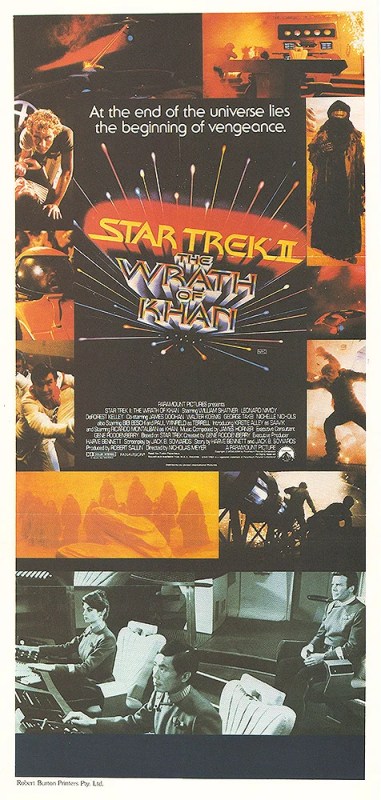
Part One: The Wrath of Khan (1982)
Director: Nicholas Meyer | Starring: William Shatner, Leonard Nimoy, DeForest Kelley, Ricardo Montalbán
I met Khan on a television screen, and years later I got to see him properly when a local theater re-released the film. That second viewing changed it for me. Ricardo Montalbán’s performance is enormous on a big screen (the chest, the voice, the Melville quotes); yet it never tips into cartoon, because his rage is personal. Kirk abandoned him, and his wife died on Ceti Alpha V. You understand him even while you root against him.
What I missed as a kid, and what I can’t stop seeing now, is Genesis. The story treats the device as a scientific miracle, a way to turn a dead world into a living one. Underneath, it’s a warning. Carol Marcus and her son David have built something that can create life or erase it, and nobody in the film seems fully ready to admit what that means. Khan simply wants it as a weapon; he’s only saying out loud what the device already is.
Then there’s the ending. Spock walks into the radiation-flooded engine room, saves the ship, and dies behind a pane of glass while Kirk watches. As a kid, I didn’t know what to do with that scene. I’d never seen a hero lose his best friend like that, and I’d certainly never seen the hero cry. “The needs of the many outweigh the needs of the few” became the moral spine of the film, and it sets up everything that follows.
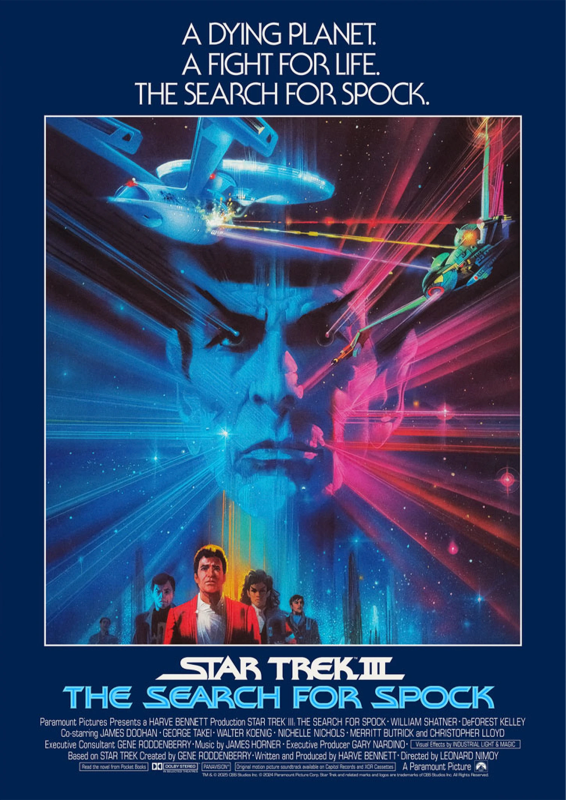
Part Two: The Search for Spock (1984)
Director: Leonard Nimoy | Writer: Harve Bennett | Starring: William Shatner, DeForest Kelley, Christopher Lloyd, Robin Curtis
This is my favorite of the three, and I’m not changing my mind. People call it the weaker middle chapter; I think they’re watching it wrong.
The Search for Spock takes the lesson from Khan and turns it upside down. Now the needs of the one outweigh the needs of the many. Kirk and his crew steal the Enterprise, defy Starfleet, and throw away their careers to bring back one friend. Nimoy talked about this in interviews years later; he and Harve Bennett shaped the film around friendship rather than grand space adventure, and you can feel it in every scene. McCoy carrying Spock’s katra and slowly losing his mind is played for both comedy and genuine pain. Scotty sabotaging the Excelsior, Sulu disabling a guard, Uhura holding a junior officer at gunpoint in a closet: every member of the crew gets a moment to choose loyalty over rules.
And then there are the Klingons. Seeing them was a thrill I still remember in my chest. Christopher Lloyd plays Commander Kruge (a year before he’d become Doc Brown, which blows my mind every time I remember it), and he’s genuinely frightening in a way that isn’t cold or calculated; he’s a warrior who believes in what he’s doing. The Bird-of-Prey, with its wings and green glow, is still one of the coolest ship designs in all of science fiction. The film even gave the Klingons a real language to speak. They stopped being thinly veiled Cold War Russians and became something closer to space samurai: people of honor, ritual, and sacrifice, whose devotion to violence is also their tragic flaw.
The villain here isn’t really a villain in the Khan sense, either. Kruge is the obstacle standing between a group of friends and the one person they need to save. That’s why it works. The stakes aren’t the galaxy; they’re Spock.
The film also finishes the Genesis arc with brutal honesty. David Marcus used unstable protomatter to make the Genesis wave work, cutting corners to play God, and the planet is tearing itself apart as a result. He goes back to investigate his own creation and is killed by Klingons trying to steal it from him, after he had, in a sense, stolen it from the universe first. Kirk’s collapse when he hears the news is Shatner at his best. Then he destroys his own Enterprise to win. By the end, Kirk has lost his son and his ship to get his friend back, and when Spock finally remembers him (“Jim. Your name is Jim.”), it’s worth every loss.
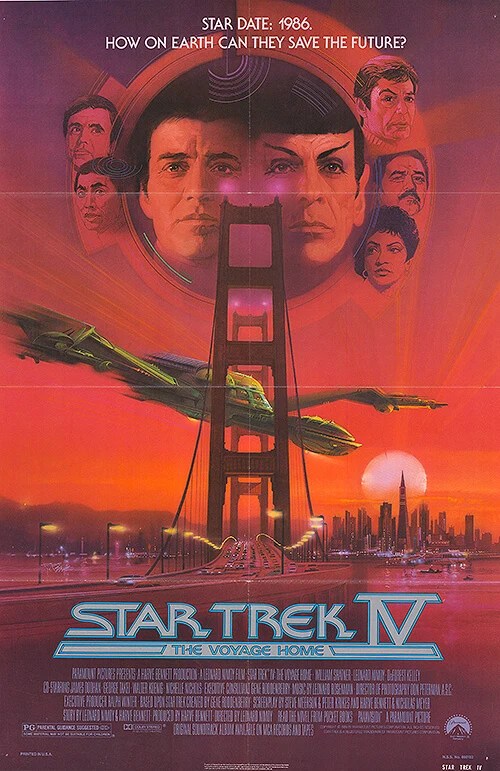
Part Three: The Voyage Home (1986)
Director: Leonard Nimoy | Starring: William Shatner, Leonard Nimoy, DeForest Kelley, Catherine Hicks
This is the one I saw in a theater, and my dad took me. I remember sitting there, a little kid overwhelmed by the scale of it, watching starships the size of the whole wall. After years of watching Star Trek on a small TV screen, it felt like the thing had finally become real.
What made it perfect for a kid my age, though, was something I only understood later: there’s no bad guy. Nobody needs to be defeated. An alien probe is destroying Earth’s atmosphere trying to talk to humpback whales, and humans hunted the whales to extinction. The crew’s job isn’t to fight anything; it’s to go back in time, fix a mistake humanity made, and make a different choice than the one we made the first time. Compared to the “go to space and blow things up” energy of Star Wars, that idea stuck with me hard.
It also landed in the same era as Back to the Future, and the two feel like cousins. Both are time travel comedies built on awkwardness. Spock in a headband trying to master “colorful metaphors,” Scotty talking into a computer mouse, Chekov asking strangers on the street where the “nuclear wessels” are, and Spock nerve-pinching the punk on the bus: these scenes are funny because the characters are so completely themselves in a world that has no idea what to do with them. After two films of death and grief, the crew earned the laughs, and so did we.
The Trilogy as a Whole
Watched as one story, these films create an arc I couldn’t see as a child. Scientists build something they shouldn’t. It costs Kirk his best friend. Then the planet it created destroys itself and takes Kirk’s son with it. Finally, stripped of their ship and facing charges, the crew has to save a planet from a destruction humans set in motion centuries earlier. It’s a story about hubris and repair, and about what we owe each other.
These films also built the Star Trek world as we know it. Starfleet became an institution with bureaucracy and accountability; the crew actually faces trial for what they did in III, and a Klingon ambassador demands Kirk’s extradition. Diplomacy, consequences, and loyalty all matter at once. That texture carried straight into The Next Generation, which premiered less than a year after The Voyage Home. As a kid, that felt like a reward; I’d just fallen completely in love with this universe, and suddenly there was a whole new crew arriving on TV every week.
Verdict
If someone asks me where to start with Star Trek, I send them here. Watch all three in order, ideally in a single weekend. Khan has the villain, The Voyage Home has the laughs, but The Search for Spock has the heart; and for me, heart has always been what Star Trek is really about.
To see other movie and book recommendations and a list of resources, read more here.


