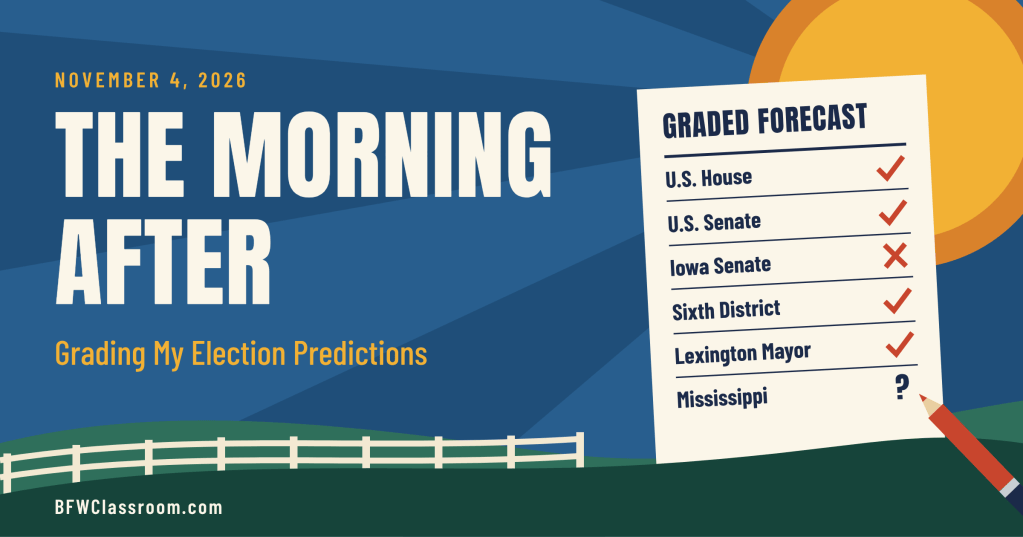
I got the direction right and the size badly wrong. Yesterday morning, I predicted a Democratic House, a narrow 51-49 Democratic Senate, and a modest two-point win for Zach Dembo here in the Sixth District. This morning, Democrats hold both chambers, Democrats have reached at least 54 Senate seats in one tally, and Dembo appears to have won by far more than I expected.
A forecast is a claim, and I told you to test claims; so here is my own score sheet. All results below are as of the morning of November 4, and several totals are still partial.
The National Scorecard
Democrats won both chambers, and my Senate call missed by at least three seats. The AP reported Democratic flips in Iowa, Kansas, Texas, South Carolina, Ohio, and North Carolina; the AP also called Maine for Troy Jackson over Susan Collins. That makes seven flips, where I had predicted four.
| Race | My call | Where it stands | Grade |
|---|---|---|---|
| House control | Democrats | Democrats won | Correct |
| House seats | About 235 | 225 in one tally; count unfinished | Too early |
| Senate control | Democrats | Democrats won | Correct |
| Senate seats | 51-49 | 54 in one tally, with Alaska, Mississippi, and Nebraska uncalled | Too low |
| Iowa Senate | Stays Republican | Democratic flip | Wrong |
The map tells the same story. Republicans hoped to gain as many as nine seats through new maps in Florida and Texas; the AP reported that the effort appeared to fall short. In short, I warned that redistricting would hold down the Democratic win, and it may have done less than I assumed.
One result outside Congress deserves its own moment. Deb Haaland (a member of the Laguna Pueblo) won the New Mexico governor’s race and became the first Native American woman elected governor of a U.S. state. The AP called the race at 8:46 p.m., and she led Republican Gregg Hull 57.25 percent to 42.75 percent. She was already the first Native American cabinet secretary, as Interior Secretary under President Biden.
The Shocks: Texas and Mississippi
Texas is a historic victory; Mississippi is a historic near-miss or an upset still waiting to be confirmed. They belong together because neither state was supposed to be part of this conversation for a Democrat.
Texas. James Talarico defeated Ken Paxton, and Democrats have not won a Texas Senate seat since 1988 or any statewide race since 1994. The final polls had shown Talarico ahead, so the forecasters were not blindsided; the shock is historical. More than 7.7 million Texans voted early (40.5 percent of registered voters), a modern midterm record, and national Republican groups spent more than $281 million on ads against him.
Mississippi. This is the true jaw-dropper, because one forecast gave Republicans a 90 percent chance of holding the seat. As of early this morning, the race was still uncalled: Scott Colom led Cindy Hyde-Smith by 43 votes, 462,821 to 462,778, with an estimated 44,000 votes left. A Colom win would be the first Democratic Senate victory there since John Stennis in 1982.
Hinds County paused its count overnight, and thousands of affidavit ballots still must be verified. There will be no runoff, because the top vote-getter wins. I will not call this one until the AP does; I have learned my lesson about confidence for at least one day.
The Central Kentucky Scorecard
I picked every local winner correctly, and I am least proud of the race I called boldest, since I still underestimated it. The AP declared Dembo the winner at 10:16 p.m., and partial returns had him up 53 to 43 with 74 percent of precincts in. That matters because I discounted the Democratic polls heavily, and those polls turned out to be closer than my discount.
| Race | My call | Result so far | Grade |
|---|---|---|---|
| U.S. Senate | Barr by 12 | Barr won; 53.8 to 44.1 with 73 percent counted | Correct; margin pending |
| Sixth District | Dembo by 2 | Dembo won; about 10 points in partial returns | Correct; margin too low |
| Lexington mayor | Gorton, 54-46 | Gorton won; about 55-45 (unofficial) | Very close |
| Frankfort | Supermajority holds | Democrats flipped a few seats; supermajority unchanged | Correct |
Gorton’s win also made history. She is the first woman to win three consecutive terms as Lexington’s mayor, and she could become its longest-serving mayor. I did not forecast Amendment 1, but voters approved the limit on the governor’s pardon power, with more than 70 percent voting yes in partial returns.
Sixty Days of Lame Duck
The current Congress now has exactly 60 days left, and voters have already told it who replaces many of its members. The new Congress is sworn in January 3. Members return November 9, and government funding expires December 11. Republicans still hold both chambers until January, so nothing passes without them. If I could choose two items for that calendar, here they are.
First, pass the college sports bill. The Protect College Sports Act (S. 4668) passed the Senate 77-22 on September 28. It would protect name, image, and likeness earnings, require disclosure of most deals above $600, cap agent fees at 5 percent, and preserve scholarships and post-eligibility medical coverage. Our students follow this world closely, and a patchwork of state rules serves neither athletes nor schools.
The bill is not simple, however, and its fate is uncertain in the House. President Trump backs it, while the Congressional Black Caucus, the AFL-CIO, and the NAACP oppose it. Critics also object to the antitrust protection it gives the NCAA. I want a bill finished this year, because the Senate-passed version dies when this Congress ends; I also want the House to take those objections seriously.
Second, end the war with Iran completely. Not a pause, not another extension: an end. The Senate rejected a House-passed war powers resolution 49-50 on September 24, so the margin is one vote. Meanwhile, the news is moving the wrong way. Talks are described as stalled, and President Trump has spoken of a possible “heavy hit.” He also told Fox News “part of it was Iran” when explaining the losses, while saying he would do it again.
Congress cannot sign a peace deal; that work belongs to diplomats, and Qatari, Pakistani, and Saudi mediators are still carrying proposals. Congress can, however, reassert its constitutional role over war. I want one more war powers vote before January, and I want senators who just lost, or who no longer face voters, to cast it with a clear conscience.
The Other Side, and the Classroom
A fair reader should push back on me here. Senate Republican leader John Thune says his party “will not stand idly by,” and defenders of the Iran policy argue that a hurried exit could leave Iran’s nuclear ambitions unresolved. On college sports, opponents argue that the bill favors the NCAA over athletes. Those arguments deserve an answer, not a victory lap.
The lesson for our students is simple: score the forecast, including your own. Ask them to compare yesterday’s predictions with today’s results, then separate three questions. Who won? Who has been called, and by whom? What is still being counted? Mississippi may be the best civics lesson of the week, because 43 votes out of nearly a million makes every ballot feel real.
Sources
- AP via PBS NewsHour: Democrats win control of the House
- Forbes: midterm live updates
- Oneindia: Senate and House tally
- ABC News (Australia): what happens next
- Texas Tribune: Talarico and Paxton
- Decision Desk HQ: Senate forecast
- Conservative Daily News: Mississippi count
- Mississippi Free Press: Colom and Hyde-Smith
- Mississippi Independent: Senate race uncalled
- The Washington Sun: Dembo flips the Sixth
- WKYT: Dembo wins
- WVXU: Barr defeats Booker
- WUKY: Gorton wins third term
- Herald-Leader via Yahoo: statehouse races
- WYMT: Amendment 1
- Holland & Knight: year-end deadlines
- Forbes: Protect College Sports Act
- Front Office Sports: bill’s House path
- NBC Palm Springs: Senate rejects Iran resolution
- Gulf News: Iran talks and Trump’s warning
- CBS News: Iran live updates
Thanks to Claude for helping me pull together the research and numbers this morning.


