
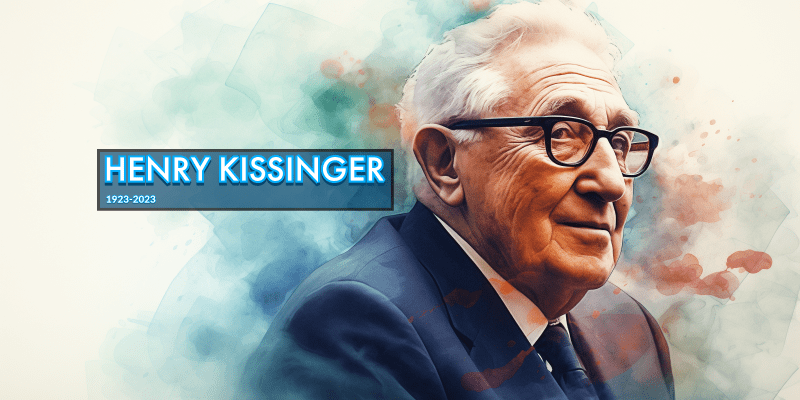
Throughout my professional career, two individuals have greatly influenced my perception of America’s role in the global landscape and the responsibility it bears for promoting democracy worldwide. These figures are Theodore Roosevelt and Henry Kissinger. It was with a heavy heart that I learned of the recent passing of the architect behind modern American foreign policy. Originally, I had planned to write a post on the Vietnam War and the Paris Peace Accords, but in light of this news, I have decided to revise and share here my teaching materials on this remarkable individual.
Henry Kissinger: A Life of Diplomacy and Power
Henry Kissinger, the 56th United States Secretary of State, is a towering figure in American and world history. He served in the Nixon and Ford administrations, playing a pivotal role in shaping US foreign policy during a period of immense global turmoil. Kissinger’s legacy remains a subject of debate, with some praising his diplomatic acumen and others criticizing his controversial policies. Nevertheless, his impact on the course of history is undeniable.
Early Life and Education
Born Heinz Alfred Kissinger in Fürth, Bavaria, Germany, in 1923, Kissinger and his family fled Nazi Germany in 1938, settling in New York City. He served in the US Army during World War II and later attended Harvard University, where he earned his PhD in international relations. After teaching at Harvard, he entered government service in the 1960s, advising Presidents Kennedy and Johnson on national security matters.
Kissinger and the Vietnam War
Kissinger’s career took a dramatic turn in 1969 when he was appointed National Security Advisor by President Richard Nixon. He became deeply involved in the Vietnam War, overseeing secret peace negotiations with the North Vietnamese government. While these negotiations ultimately failed to end the war, they bought time for the US to withdraw its troops and South Vietnam to collapse in 1975.
Secretary of State and the Pursuit of Détente
In 1973, Nixon promoted Kissinger to Secretary of State. In this role, Kissinger continued to pursue a negotiated settlement in Vietnam, finally achieving a ceasefire agreement in January 1973. He also played a key role in opening up relations with China, making a historic visit to Beijing in 1972. These efforts were part of Kissinger’s broader strategy of détente, aimed at reducing tensions between the US and the Soviet Union during the Cold War.
Certainly, here is an expanded version of the blog post on Henry Kissinger, incorporating his diplomatic endeavors beyond his time as Secretary of State:
Henry Kissinger: A Life of Diplomatic Prowess and Enduring Impact
Henry Kissinger’s illustrious career in diplomacy extended far beyond his tenure as Secretary of State under Presidents Richard Nixon and Gerald Ford. His legacy is marked by his unwavering commitment to resolving international conflicts through negotiation and his pioneering efforts to reshape the global landscape.
Israel Regional Peace Plan
Kissinger played a pivotal role in shaping the Middle East peace process, particularly during the 1970s and 1980s. He was instrumental in mediating the Camp David Accords of 1978, which led to the peace treaty between Egypt and Israel. He also engaged in shuttle diplomacy between Israel and its Arab neighbors, seeking to broaden the scope of peace agreements.
Economic Opening of China
Kissinger’s diplomatic legacy extends beyond political negotiations. He recognized the potential of China as a global economic power and played a crucial role in facilitating its economic opening up in the 1970s. His efforts paved the way for China’s integration into the global economy, a transformation that has had profound implications for the world’s economic landscape.
Books and Writings: A Legacy of Thought Leadership
In addition to his diplomatic endeavors, Henry Kissinger has established himself as a renowned and influential writer, showcasing his intellectual prowess and vast knowledge in various fields. With an impressive repertoire of books on international relations, history, and foreign policy, Kissinger’s literary contributions offer invaluable insights into the intricacies and complexities of global affairs.
His works delve into a wide range of topics, exploring the shifting power dynamics between nations, the challenges of navigating international relations, and the historical context that shapes contemporary geopolitics. By combining his firsthand experience as a statesman and his scholarly analysis, Kissinger provides readers with a unique perspective that transcends traditional academic research.
One of his notable works is “Diplomacy,” a comprehensive examination of the art and practice of diplomacy throughout history. In this book, Kissinger meticulously dissects key historical events and seminal diplomatic negotiations, revealing the intricate strategies and tactics employed by statesmen to shape the course of nations. Through his lucid storytelling and meticulous analysis, Kissinger educates readers on the significance of diplomacy in maintaining and forging global stability.
Another groundbreaking work by Kissinger is “World Order,” where he grapples with the elusive concept of global order and its evolution over time. In this thought-provoking book, he explores the clash between different civilizations, the impact of technological advancements on global governance, and the pivotal role of statesmanship in shaping the world order of the future.
Kissinger’s writings are characterized by their depth, rigor, and intellectual integrity. He effortlessly weaves together historical events, political analysis, and personal anecdotes, providing readers with a comprehensive understanding of the complexities inherent in international relations. His remarkable ability to distill complex concepts into accessible prose makes his books accessible to both scholars and general readers alike.
Overall, Henry Kissinger’s prolific writing career has solidified his reputation as a leading authority on global affairs. Through his books, he encourages readers to critically engage with the multifaceted challenges of our world and offers valuable insights into the ever-changing landscape of international relations. Whether you are a seasoned diplomat or a curious reader seeking to expand your knowledge, Kissinger’s thought-provoking works are a must-read for anyone interested in understanding the complexities of our globalized world.
Kissinger’s Legacy
Kissinger’s legacy is indeed complex and widely debated among historians and political analysts. Supporters of Henry Kissinger argue that he was a brilliant and astute diplomat who played a crucial role in shaping the post-World War II world order. They emphasize his achievements in diplomacy, particularly in ending the Vietnam War, opening up relations with China, and negotiating arms control agreements with the Soviet Union.
One of the key accomplishments attributed to Kissinger is his role in the rapprochement between the United States and China. Through secret negotiations, known as “ping-pong diplomacy,” Kissinger paved the way for President Nixon’s historic visit to Beijing in 1972. This breakthrough in relations between the two superpowers had significant geopolitical implications and helped to ease tensions during the Cold War era.
Kissinger’s efforts in arms control negotiations with the Soviet Union are also noteworthy. The Strategic Arms Limitation Talks (SALT) resulted in the signing of two important treaties, SALT I and SALT II, which aimed to curb the arms race and reduce the risk of nuclear conflict between the two superpowers. These agreements were seen as significant steps towards promoting stability and preventing a catastrophic confrontation.
However, on the other side of the debate, critics argue that Kissinger’s policies were often driven by self-interest and realpolitik, sometimes at the expense of human rights and ethical considerations. One of the darkest chapters in Kissinger’s legacy is his alleged involvement in controversial and violent events in Cambodia and Chile.
In Cambodia, the U.S.-led bombing campaign and support for the Lon Nol regime during the Vietnam War are said to have contributed to the rise of the Khmer Rouge, which led to the genocide of approximately 1.7 million people. Critics argue that Kissinger’s policies, aimed at preventing the spread of communism, had devastating consequences for the Cambodian people.
Similarly, in Chile, Kissinger’s association with the CIA-backed coup against democratically elected President Salvador Allende has drawn strong criticism. The rise of General Augusto Pinochet’s brutal military dictatorship resulted in widespread human rights abuses and political repression.
Furthermore, Kissinger’s close ties to the Nixon administration, particularly his role as National Security Advisor and later as Secretary of State, have been subject to scrutiny. His involvement in the Watergate scandal, although indirect, has raised questions about his judgment and ethical conduct during his tenure in high-level positions.
In conclusion, the legacy of Henry Kissinger is a subject of ongoing debate and analysis. While his supporters applaud his strategic thinking and diplomatic achievements, critics highlight the human costs and alleged disregard for ethical considerations in his policies. The complex nature of Kissinger’s legacy serves as a reminder of the challenges and complexities inherent in international diplomacy and the pursuit of global stability.
Teaching Activities
Here are some activities that students can do to learn more about Henry Kissinger:
- Research and Report: Have students research a particular aspect of Kissinger’s career, such as his role in the Vietnam War, his opening of relations with China, or his involvement in the Watergate scandal. Students can then prepare a report on their findings, presenting their information to the class.
- Debate: Divide the class into two groups, one representing Kissinger’s supporters and the other representing his critics. Have the two groups debate the merits and drawbacks of Kissinger’s policies, focusing on specific examples.
- Role-Playing: Have students role-play as key figures involved in the Vietnam War, such as Henry Kissinger, Richard Nixon, or Ngo Dinh Diệm. Students can then engage in a simulated negotiation or debate, trying to reach a peaceful resolution to the conflict.
- Documentary Analysis: Show students a documentary about Henry Kissinger, such as “The Fog of War” or “The Kissinger Transcripts.” Have students analyze the documentary, identifying key themes and arguments.
- Primary Source Analysis: Have students analyze primary sources related to Henry Kissinger, such as his speeches, memoirs, or transcripts of his conversations. Students can identify key themes, biases, and historical context.
Web Resources
Here are some web resources that students can use to learn more about Henry Kissinger:
- Henry Kissinger’s website: https://www.henryakissinger.com/
- The Kissinger Transcripts: https://archive.org/details/kissingertranscr00will
- “The Fog of War” documentary: https://www.youtube.com/watch?v=nU1bzm-BW0o
- The Kissinger Institute on Global Affairs: https://www.wilsoncenter.org/program/kissinger-institute-china-and-united-states
- Henry Kissinger’s biography on Wikipedia: https://en.wikipedia.org/wiki/Henry_Kissinger
By studying Henry Kissinger and his complex legacy, students can gain a deeper understanding of American foreign policy and the challenges of diplomacy in the modern world.
This is part of my Politics in the Classroom series, where I look at the importance of political campaigns, pop culture, sports, music, and geopolitics of the last 50 years and how to use them as resources in the classroom. To read more, check out my other posts in the series. (Link)

 BFWClassroom
You must be logged in to post a comment.