
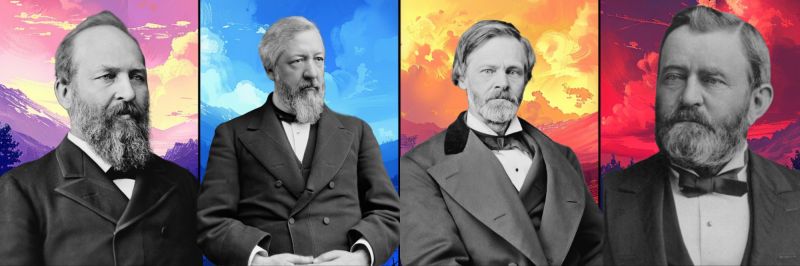
The 1880 Republican National Convention, held in Chicago from June 2 to June 8, stands as a fascinating chapter in the history of American politics. It was a time when political conventions operated with a level of drama and unpredictability that is hard to imagine today. This convention not only exemplified how the democratic process can unfold in a vibrant, albeit chaotic, manner, but it also highlighted the idiosyncrasies and machinations that can shape political outcomes.
The Context: Post-Civil War America
In 1880, America was still grappling with the aftermath of the Civil War and Reconstruction. The Republican Party, dominant in the North, was divided among factions with differing visions for the country. These factions were broadly categorized into the Stalwarts, led by Senator Roscoe Conkling, who supported the incumbent President Ulysses S. Grant for an unprecedented third term; the Half-Breeds, led by Senator James G. Blaine, who sought civil service reform; and a third, less defined faction that eventually coalesced around a compromise candidate.
The Candidates: A Battle of Titans
The convention featured a clash of titans, with Ulysses S. Grant, James G. Blaine, and John Sherman (the brother of the famous General William Tecumseh Sherman) as the main contenders. Grant, revered as a war hero, sought a return to the presidency after a hiatus, bolstered by the Stalwarts who appreciated his firm hand during Reconstruction. Blaine, charismatic and popular, was a champion of reform and represented a more progressive wing of the party. Sherman, meanwhile, had the backing of outgoing President Rutherford B. Hayes and was seen as a competent if not particularly charismatic, administrator.
The Process: A Test of Democracy
The process of nomination in 1880 was a true test of democratic principles within the party. Unlike today’s more streamlined primary system, delegates at the time were often free agents, swayed by speeches, deals, and the shifting dynamics of the convention floor.
The first few ballots were deadlocked, with none of the leading candidates able to secure a majority. Grant and Blaine, despite their strong support, could not break the impasse. Sherman’s candidacy, though respectable, lacked the necessary momentum to overtake his rivals. The convention seemed poised for a prolonged and bitter struggle.
The Dark Horse: James A. Garfield
Amidst this deadlock, an unexpected figure emerged: James A. Garfield. Garfield, a Congressman from Ohio, had not sought the nomination and had come to the convention as a supporter of John Sherman. However, his eloquence and reputation for integrity impressed many delegates. As the balloting continued, a movement to nominate Garfield gained traction.
On the 36th ballot, Garfield was nominated by a coalition of delegates who saw him as a compromise candidate, capable of uniting the divided party. This was a striking turn of events, illustrating how the convention process can elevate a relatively unknown figure to national prominence. Garfield’s nomination was a testament to the fluidity and unpredictability of democratic politics, where the convention acted as a true deliberative body, capable of reaching a consensus through open debate and strategic maneuvering.
The Aftermath: Triumph and Tragedy
Garfield went on to win the presidential election of 1880, narrowly defeating the Democratic candidate, General Winfield Scott Hancock. His victory was seen as a vindication of the convention process, demonstrating that a divided party could come together to support a consensus candidate.
Tragically, Garfield’s presidency was cut short. He was shot by Charles J. Guiteau, a disgruntled office seeker, just four months into his term and succumbed to his injuries 79 days later. Garfield’s assassination highlighted the intense pressures and dangers of political life in that era.
Lessons from 1880
The 1880 Republican National Convention offers several key lessons for modern observers of politics:
- The Power of Compromise: The convention showcased the importance of compromise in politics. Despite deep divisions, the delegates were able to unite behind a candidate who was not initially seen as a frontrunner, demonstrating the potential for democratic processes to produce unexpected but effective outcomes.
- The Role of Oratory and Integrity: Garfield’s rise was in part due to his impressive oratory skills and reputation for integrity. This highlights the enduring importance of personal character and communication abilities in political leadership.
- The Unpredictability of Politics: The convention was a reminder of the unpredictability inherent in democratic processes. The eventual nominee was not among the initial favorites, underscoring how fluid and dynamic political contests can be.
- The Impact of Factionalism: The divisions within the Republican Party were both a challenge and a source of strength. While factionalism created obstacles, it also ensured that a wide range of viewpoints were considered, ultimately leading to a more broadly acceptable candidate.
- The Human Element: The convention was a human drama, full of passion, strategy, and unexpected turns. It illustrated that political processes are not just about rules and procedures but also about the individuals who participate in them.
Further Reading
For those interested in delving deeper into the 1880 Republican National Convention and the political landscape of the era, the following resources are recommended:
- “Garfield: A Biography” by Allan Peskin: This comprehensive biography provides a detailed account of James A. Garfield’s life, including his rise to the presidency and his tragic assassination.
- “Destiny of the Republic: A Tale of Madness, Medicine, and the Murder of a President” by Candice Millard: This gripping narrative explores the broader context of Garfield’s presidency and the circumstances surrounding his assassination.
- “The American Political Tradition: And the Men Who Made It” by Richard Hofstadter: This classic work includes insightful profiles of key political figures, including Garfield, and offers a broader perspective on American political history.
- “The Presidency of Rutherford B. Hayes” by Ari Hoogenboom: This book provides background on the political environment leading up to the 1880 convention and the legacy of Garfield’s predecessor.
The 1880 Republican National Convention remains a vivid example of how democratic processes can unfold in unexpected ways, driven by the interplay of personality, strategy, and circumstance. It serves as a reminder that, even in times of deep division, the mechanisms of democracy have the potential to bring about surprising and ultimately unifying outcomes.
Special thank you to the James A. Garfield National Historic Sight for inspiring this blog post.
https://platform.twitter.com/widgets.jsNo lies detected.#jamesagarfield #jamesagarfieldnhs https://t.co/xhJW012BNn
— James A. Garfield National Historic Site (@GarfieldNPS) July 21, 2024

 BFWClassroom
You must be logged in to post a comment.