
Looking at 3 ECs that changed politics: Jefferson-Adams-Burr, Hayes-Tilden, and Bush-Gore
With just two weeks left in this year’s election cycle let’s take a minute to look at 3 controversial Electoral College results. The Electoral College system, established by the U.S. Constitution, has been a unique and sometimes controversial method of electing presidents. In certain elections, the outcome has been contentious, with disputes over electoral votes creating intense political crises. Three of the most famous elections that tested the limits of the system are the Jefferson-Adams-Burr election of 1800, the Hayes-Tilden election of 1876, and the Bush-Gore election of 2000. Each of these elections highlights the complexities of the Electoral College and its lasting impact on American democracy.
Election of 1800: Thomas Jefferson, John Adams, and Aaron Burr
The presidential election of 1800 is perhaps one of the most dramatic in American history. The contest was between the Federalist Party, led by incumbent President John Adams, and the Democratic-Republicans, led by Thomas Jefferson. However, the Electoral College revealed an unexpected flaw in the system: Jefferson and his running mate, Aaron Burr, each received 73 electoral votes, creating a tie.
At the time, the Constitution did not distinguish between presidential and vice-presidential votes, so the person with the second-most votes would normally become vice president. The tie between Jefferson and Burr threw the decision into the House of Representatives, where Federalist legislators had to choose between two Democratic-Republicans. Many Federalists supported Burr in an effort to block Jefferson, but after 36 rounds of voting, Alexander Hamilton’s support for Jefferson tipped the balance, and Jefferson became president. This election led to the 12th Amendment (1804), which reformed the Electoral College by requiring separate votes for president and vice president.
The 1800 election underscored the importance of political alliances and led to a more organized party system in U.S. politics. It also demonstrated the potential for confusion and manipulation within the Electoral College system.
Election of 1876: Rutherford B. Hayes and Samuel J. Tilden
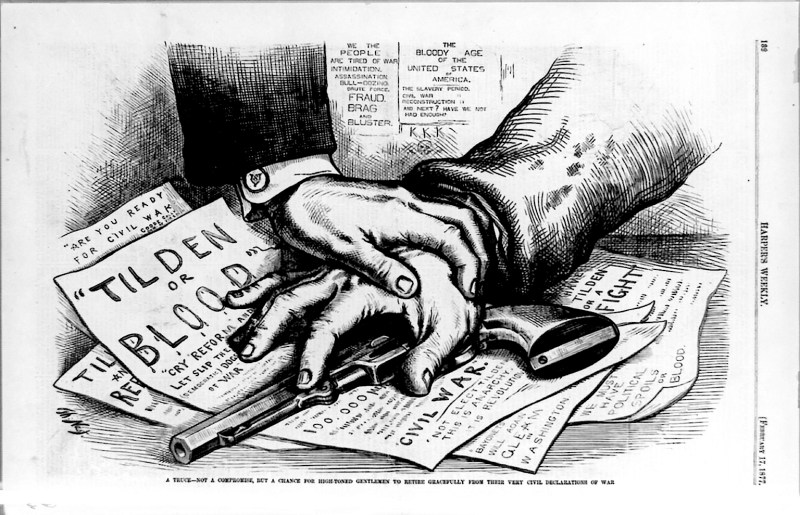
The election of 1876 was one of the most disputed and controversial elections in U.S. history. Rutherford B. Hayes, a Republican, faced Samuel J. Tilden, a Democrat. On Election Day, Tilden won the popular vote and was just one electoral vote shy of the 185 required to win. However, 20 electoral votes from four states—Florida, Louisiana, South Carolina, and Oregon—were disputed, with accusations of voter fraud and intimidation on both sides.

The results were a political powder keg because of the rise of terrorists groups like the KKK and a rollback of Reconstruction politics at the end of US Grant’s second term.
Image USGS – Elections 1876
To resolve the crisis, Congress created a bipartisan Electoral Commission made up of 15 members: five from the House, five from the Senate, and five from the Supreme Court. After much deliberation, the commission awarded all 20 contested votes to Hayes, giving him a narrow 185-184 victory.
The result was highly contentious, but an informal agreement known as the Compromise of 1877 helped smooth the transition of power. In exchange for conceding the presidency to Hayes, Democrats secured the withdrawal of federal troops from the South, effectively ending Reconstruction and allowing the rise of Jim Crow laws in the region. The 1876 election highlighted the deep divisions in the country post-Civil War and demonstrated how political compromises could shape the future of the nation.
Election of 2000: George W. Bush and Al Gore
In the modern era, the election of 2000 between George W. Bush and Al Gore became a defining moment in American political history. On Election Night, it became clear that the election would hinge on the results from Florida, where the vote count was extraordinarily close. The state’s 25 electoral votes would determine the next president.
What followed was a tense period of recounts and legal battles over the validity of votes. Issues such as the infamous “hanging chads” on punch-card ballots, butterfly ballots, and unclear voter intent became central to the dispute. After weeks of legal wrangling, the case made its way to the U.S. Supreme Court in Bush v. Gore. The Court’s 5-4 decision effectively halted the recounts, allowing Florida’s certification of Bush as the winner by just 537 votes to stand. This gave Bush a 271-266 electoral vote victory, despite Gore winning the popular vote by over 500,000 ballots.

The 2000 election highlighted weaknesses in the electoral system, including outdated voting technology and the potential for partisan disputes over vote counting. The election also reignited debates over whether the Electoral College is the best system for electing the president, as Gore’s loss despite winning the popular vote exposed potential conflicts between the two.
After the election, the Help America Vote Act (HAVA) was put in place to help states step up their election tech and avoid the same mess in the future. But guess what? The electronic voting machines that a bunch of states bought to follow HAVA ended up causing issues during the 2004 presidential election.
Image Credit: Official Palm Beach County, Florida Votomatic Voting Machine used in the November 7, 2000 U.S. Presidential Election, on display at the Florida Historic Capitol Museum, Tallahassee, Florida.
Comparing the Elections
While each of these elections involved distinct political contexts, they share common themes that reveal the underlying challenges of the Electoral College system.
- Electoral College Flaws: All three elections exposed weaknesses or ambiguities in the Electoral College. In 1800, the system was poorly designed for party politics, requiring an amendment to fix the issue of tied votes. In 1876 and 2000, the elections demonstrated how small margins in key states can throw the entire election into dispute.
- Partisan Disputes: Each of these elections was marked by intense political maneuvering. In 1800, Federalists attempted to block Jefferson by supporting Burr, while in 1876, both parties claimed victory in disputed states, leading to a political compromise. In 2000, legal challenges became a central tool in the fight for the presidency.
- Popular Vote vs. Electoral Vote: Both the 1876 and 2000 elections brought attention to the discrepancy between the popular vote and the Electoral College outcome. Tilden and Gore won the popular vote but lost in the electoral count, raising questions about the legitimacy of the system.
- Long-Term Consequences: Each election had profound impacts on American politics. The 1800 election led to the peaceful transfer of power between political parties, the 1876 election marked the end of Reconstruction and reinforced racial divisions, and the 2000 election reshaped election laws and voting technologies.
Conclusion
The Electoral College, while designed as a compromise by the framers of the Constitution, has repeatedly proven to be a source of political contention. The elections of 1800, 1876, and 2000 show how disputes over electoral votes can shape the political landscape for years to come, affecting not just the immediate outcome but also the very structure and function of American democracy. Whether these contentious elections serve as warnings for the future or as illustrations of the system’s endurance remains a subject of ongoing debate.
This is part of my Politics in the Classroom series, where I look at the importance of political campaigns, pop culture, sports, music, and geopolitics of the last 50 years and how to use them as resources in the classroom. To read more, check out my other posts in the series. (Link)

 BFWClassroom
You must be logged in to post a comment.