
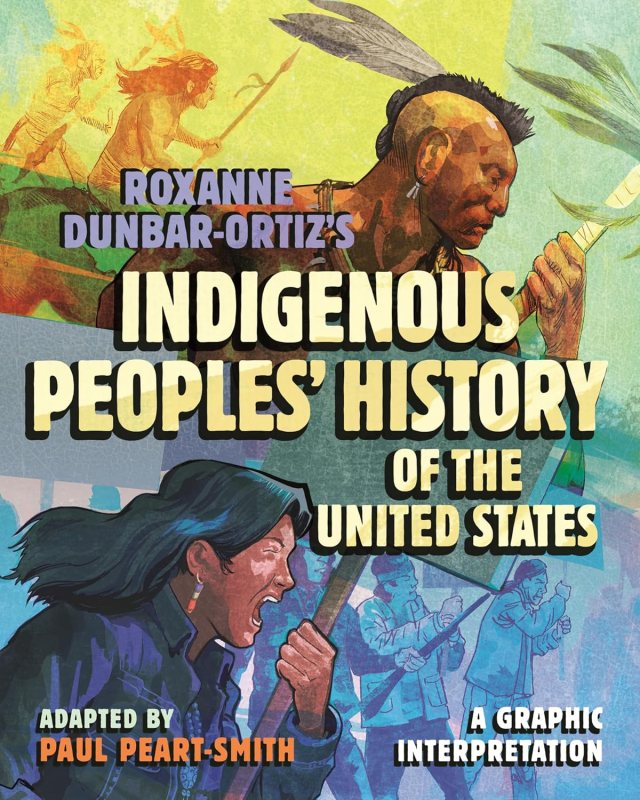
In the growing ReVisioning History series, An Indigenous Peoples’ History of the United States: A Graphic Interpretation brings a fresh, visual approach to Roxanne Dunbar-Ortiz’s critical and often unsettling look at U.S. history from an Indigenous perspective. Originally a narrative dense with historical insight, the graphic version adds rich illustrations that make the work even more accessible for a wider range of readers, particularly those in high school or anyone new to Indigenous studies.
Dunbar-Ortiz has been widely praised for her groundbreaking work, and this graphic adaptation, illustrated by artists Debbie Reese and Jean Mendoza, retains her powerful critique while visually amplifying her message. As author and historian Paul Ortiz states in his review, “This book serves as a crucial reminder of the necessity to reexamine the foundations upon which the United States was built—a history so often sanitized in mainstream texts” (Ortiz, Indigenous People’s Journal). The adaptation does justice to Dunbar-Ortiz’s mission: to disrupt a sanitized version of history with unfiltered truths about colonial violence and its enduring impacts on Indigenous communities.
The narrative pushes readers to question the traditional heroic lens through which history is typically told. The graphic interpretation does not shy away from challenging subjects, making it a valuable resource in classrooms. As Publishers Weekly notes, “The visual format breathes new life into Dunbar-Ortiz’s text, turning a scholarly analysis into a vibrant, accessible piece that feels alive with voices that have often been silenced in historical accounts.” The artwork engages readers in ways that pure text cannot, allowing visual learners and younger audiences to better grasp the gravity of historical events discussed.
For educators looking to teach history with a more nuanced perspective, this book provides an engaging, approachable alternative to traditional textbooks. The School Library Journal praises the adaptation as “a tool for building critical consciousness among young readers and adults alike,” underscoring its utility in sparking classroom discussions about Indigenous resistance and resilience.
As a history that embraces uncomfortable truths, An Indigenous Peoples’ History of the United States: A Graphic Interpretation (Amazon) is as visually compelling as it is intellectually stirring. For any reader committed to understanding the roots of contemporary social issues and embracing a more inclusive version of history, this adaptation is not only worthwhile but essential.
This is part of a collection of book and movie reviews intended to help educators. I have read/screened of of these books and at times included excerpts in my classroom over the years and highly recommend them. Keep in mind that not all classrooms are the same and every educator should evaluate school and district recommendations before using any book, movie, or podcast in classes.
To read more of my reviews follow the link.

 BFWClassroom
You must be logged in to post a comment.