

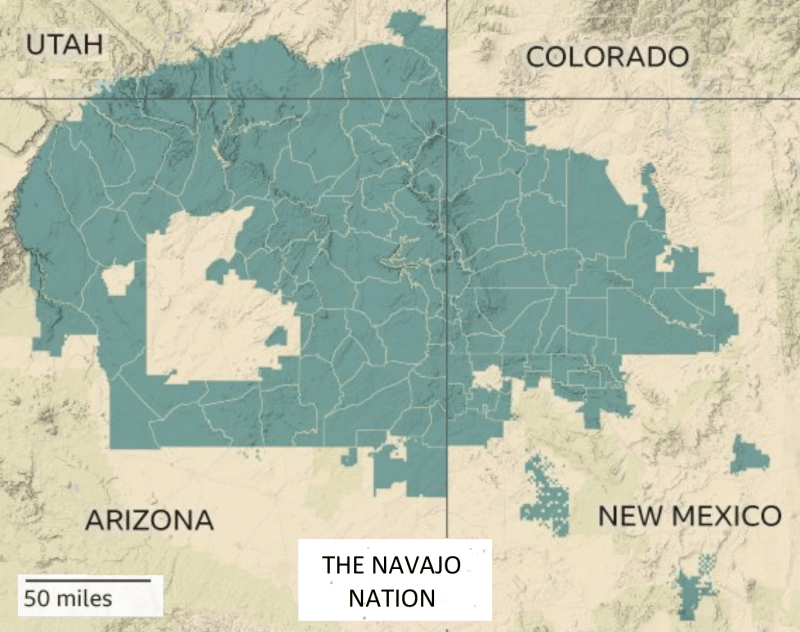
Imagine a territory larger than ten U.S. states, bordered by four sacred mountains, where traditional wisdom and modern governance blend to create something unique in American history. The story of the Navajo Nation isn’t just about lines drawn on maps – it’s about a people who transformed foreign concepts of government into something distinctly their own, all while maintaining connections to traditions as old as the red rocks of their homeland.
The Land Between the Mountains
In the beginning, according to Diné (Navajo) tradition, the Holy People set four sacred mountains to mark the boundaries of the Diné world: Blanca Peak in the east, Mount Taylor in the south, the San Francisco Peaks in the west, and Hesperus Mountain in the north. Think about that – a homeland defined not by arbitrary lines on paper, but by mountains that touch the sky.
Today, when we talk about “tribal sovereignty” and “self-determination,” we’re using modern terms to describe something the Diné have understood for centuries: the deep connection between land, governance, and identity.
From Shepherds to Soldiers to Sovereigns
The transformation of the Diné from a society of extended family groups into what would become the largest tribal government in North America is a story of adaptation and resilience. In the 1800s, while other tribes were being forced onto small reservations, the Diné managed to maintain a significant portion of their traditional lands – though not without tremendous cost and suffering.
The infamous “Long Walk” of 1864, when thousands of Diné were forced to march to Bosque Redondo, could have been the end of the story. Instead, it became a turning point. Think of it like a phoenix moment – from the ashes of that tragedy, the foundations of modern Navajo governance would eventually rise.
Building Something New from Something Ancient
By 1923, as oil was discovered on Navajo land, it became clear that the traditional system of local leadership needed to adapt to deal with outside interests. The U.S. government pushed for the creation of the Navajo Tribal Council, thinking it would make resource extraction easier to negotiate. But here’s the fascinating part – the Diné took this imposed structure and gradually transformed it into something uniquely their own.
Imagine taking a foreign blueprint for governance and redesigning it to reflect your own cultural values. It’s like being handed a smartphone and figuring out how to use it to record your grandparents’ traditional stories – taking new tools and using them to preserve ancient ways.
Democracy with Diné Characteristics
The 1938 creation of a structured tribal government could have meant simply copying the U.S. system. Instead, the Navajo Nation developed something distinctive. Traditional concepts like K’é (relationship, respect, unity) became part of modern governance. Local Chapter Houses preserved elements of traditional community decision-making while functioning within a larger governmental structure.
It’s like watching someone build a modern house using ancient architectural principles – the materials might be new, but the wisdom is timeless.
The 1968 Revolution
In 1968, the Navajo Nation did something revolutionary – it reorganized its government to create three branches, similar to the U.S. system, but with distinctly Navajo characteristics. The Title II reforms weren’t just about copying American governance; they were about creating a modern Indigenous democracy that could protect sovereignty and tradition simultaneously.
Think about that moment – taking the best elements of Western governance while maintaining cultural integrity. It’s like a jazz musician using classical training to create something entirely new and authentic.
Modern Nation in an Ancient Land
By 2024, the Navajo Nation stands as a powerful example of Indigenous sovereignty in action. With its own courts, police force, education system, and environmental regulations, it demonstrates what Native sovereignty can look like in the modern world. When Covid-19 hit in 2020, the Nation’s ability to implement its own public health measures showed the practical importance of tribal sovereignty.
But here’s what makes it truly remarkable: this modern government still operates within the context of traditional values. The presidential seal of the Navajo Nation shows the four sacred mountains. Council delegates still often begin meetings with traditional prayers. Modern environmental policies reflect traditional teachings about land stewardship.
Challenges and Transformations
Of course, the story isn’t all triumph. The Nation faces modern challenges: water rights battles, uranium cleanup, language preservation, economic development. But what’s remarkable is how these challenges are met with solutions that blend traditional wisdom with modern expertise.
When the Nation develops solar projects, they’re planned with traditional land-use principles in mind. When language preservation programs use smartphone apps, they’re connecting ancient words with new technology. It’s like watching a master weaver create traditional patterns with new materials – the design remains true while the techniques evolve.
File:NavajoNation map en.svg. (2023, August 18). Wikimedia Commons. Link
Looking Forward, Looking Back
The Navajo Nation today is both ancient and modern, traditional and innovative. Its story teaches us something crucial about sovereignty – it’s not just about political power, but about the ability to chart your own course while staying true to your values.
When young Diné learn coding at tribal colleges, or when traditional healers work alongside modern doctors in tribal healthcare facilities, they’re living examples of how a nation can embrace change without losing its essence.
The Lesson in the Land
Perhaps the most powerful lesson from the Navajo Nation’s story is this: true sovereignty isn’t just about having your own government – it’s about having a government that reflects who you are as a people. Between those four sacred mountains, the Diné have created something unprecedented: a modern Indigenous nation that functions in the contemporary world while maintaining profound connections to traditional ways.
So the next time you hear about tribal sovereignty or self-determination, remember the Navajo Nation. Remember those four sacred mountains, still standing guard over a people who took foreign concepts of governance and transformed them into something uniquely their own. Remember that sometimes the most powerful form of resistance is not just surviving, but thriving on your own terms.
This post is part of a series where I look at and provide resources for classrooms relating to Native American Heritage. Read more by following this Link

 BFWClassroom

You must be logged in to post a comment.