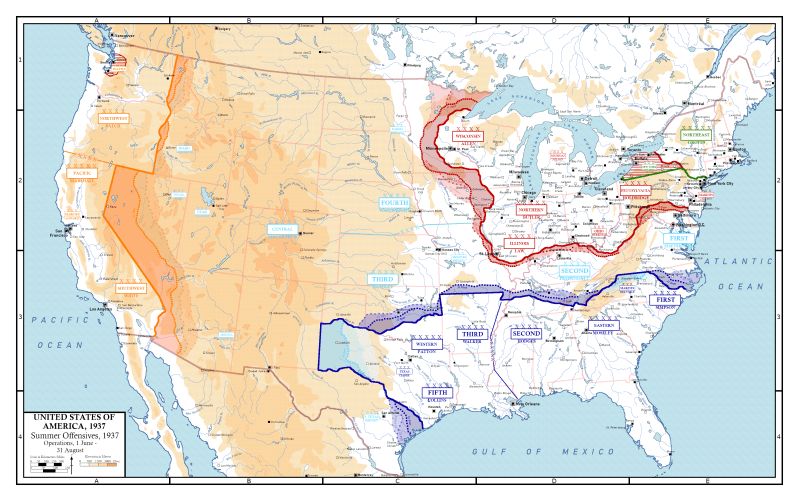
A map I found online shows an intriguing “what if” scenario in American alternate history: a hypothetical Second American Civil War in 1937 during the Great Depression. While this never happened, it has captured the interest of historians, game designers, and educators examining the social and political tensions of that time. I am fascinated by these historical “what if” scenarios and enjoy exploring them in various ways. AI has helped me predict political outcomes and balance what I know with unknowns. Recently, while creating a collection of digital maps for my school’s history department, I discovered an interesting US Military Academy war campaign map.
Origins and Authors of the Scenario
The concept of a 1930s American civil war has multiple origins, but it gained widespread recognition primarily through the Kaiserreich: Legacy of the Weltkrieg modification for the Hearts of Iron video game series. Originally conceived by a developer known as “Sarmatia” in 2005 for Hearts of Iron II, Kaiserreich has evolved into one of the most sophisticated alternate history mods in gaming.
The Kaiserreich mod presents an alternate timeline where the Central Powers won World War I, leading to dramatically different global politics. In this scenario, the United States experiences a far worse Great Depression, causing American politics to become “far more fractured and radical, with the far-left Socialist Party of America and the Longist America First-Union Party rapidly rising to power.”
The mod’s developers, known as the KR4 Team for the Hearts of Iron IV version, have created an extensively researched alternate history that examines how prolonged economic hardship might have shattered American political consensus. The developers have been able to “mine the historical record for bizarrely interesting characters and place them into positions of power, people like the White Russian officer Roman von Ungern-Sternberg, the Hapsburg ‘Red Prince’ Wilhelm, American demagogue Huey Long, failed fascist leader Oswald Mosley, and Manchurian warlord Zhang Zuolin.”
The Historical Context: Why 1937?
The choice of 1937 as the breaking point wasn’t arbitrary. By 1936, most economic indicators had regained the levels of the late 1920s, except for unemployment, which remained high. In 1937, the American economy unexpectedly fell, lasting through most of 1938. This “Roosevelt Recession” created a moment of particular vulnerability when New Deal optimism crashed into renewed economic despair.
The real 1930s saw genuine political radicalization in America. By 1932, approximately half of African Americans were out of work. In some Northern cities, whites called for African Americans to be fired from any jobs as long as there were whites out of work. Racial violence again became more common, especially in the South. Lynchings, which had declined to eight in 1932, surged to 28 in 1933.
Labor unrest was widespread, with National Guardsmen machine-gunning striking miners in the Southern Appalachian mountains and various communist-inspired labor movements gaining traction among desperate workers. The period also saw the rise of demagogues like Huey Long, whose populist “Share Our Wealth” program attracted millions of followers before his assassination in 1935.
The Scenario’s Factions
The hypothetical 1937 civil war typically involves multiple competing factions:
The Federal Government: Led either by President John Nance Garner (if FDR lost in 1936) or General Douglas MacArthur (if he stages a military coup), representing constitutional continuity but potentially authoritarian governance.
The Combined Syndicates of America: A socialist coalition led by figures like Jack Reed, representing industrial workers and advocating for a syndicalist system similar to what emerged in Europe in this timeline.
The American Union State: A populist, authoritarian movement often associated with Huey Long’s legacy, appealing to rural Americans and the economically displaced with promises of radical wealth redistribution.
The Pacific States of America: Representing the western states that might break away rather than submit to either radical faction, often supported by business interests and moderate politicians.
Additional factions could include New England (possibly aligning with British-backed forces) and various regional movements reflecting America’s diverse political geography.
Educational Value and Historical Analysis
While this scenario is fictional, it serves important educational purposes by helping students understand:
Political Polarization: How economic crisis can radicalize mainstream politics and create space for extremist movements. As one alternate history enthusiast noted, “With both parties wholly discredited, the Great Depression continuing until 1937 and an openly left-wing (maybe even a Socialist like Norman Thomas!) President elected, assuming that there will be political violence in the streets from starving people isn’t exactly a stretch.”
Economic Determinism: The relationship between economic hardship and political stability. The scenario forces students to consider what might happen if the New Deal had failed completely and unemployment remained catastrophically high.
Regional Differences: How America’s geographic and cultural divisions might manifest in a true crisis, with different regions following different ideological paths based on their economic base and cultural values.
The Fragility of Democracy: How democratic institutions can collapse when they lose legitimacy among significant portions of the population.
The U.S. Army War College Connection
The mention of a U.S. Army War College map for this scenario likely refers to academic exercises used in military education. The United States Army War College has a long history of conducting strategic exercises and war games to prepare military officers for various contingencies. The institution provides graduate-level instruction to senior military officers and has been conducting strategic studies since its establishment.
Military colleges have traditionally used hypothetical scenarios – including domestic unrest and civil conflict – to train officers in:
- Strategic decision-making under extreme circumstances
- Inter-agency coordination during national emergencies
- Constitutional considerations during domestic military operations
- Logistics and operational planning for unconventional conflicts
Such exercises don’t indicate expectation of these events but rather reflect the military’s responsibility to prepare for all contingencies, however unlikely.
Widespread Cultural Impact
The 1937 American Civil War scenario has gained remarkable cultural traction beyond its gaming origins. Kaiserreich has “over 30,000 strong subreddit, and an active discord community” with “an incredibly dedicated fanbase — many of whom eschew the base game and play only Kaiserreich — creating fanart, fiction, AARs, and a flood of in-joke memes.”
This popularity reflects a broader fascination with American alternate history, particularly scenarios exploring how the country might fragment along ideological, regional, or economic lines. The scenario has inspired:
- Academic discussions about political polarization
- Creative works exploring themes of American identity
- Historical analysis of Depression-era politics
- Educational simulations for teaching about democratic fragility
Lessons for Modern Times
While firmly rooted in 1930s context, this scenario offers sobering lessons for contemporary America. It illustrates how:
- Economic inequality can fuel political extremism
- Regional and cultural divisions can overwhelm national unity
- Democratic institutions require broad-based legitimacy to function
- External pressures (like foreign intervention) can exploit internal divisions
The scenario serves as a cautionary tale about the importance of maintaining democratic norms, addressing economic inequality, and preserving national unity across regional and cultural boundaries.
Conclusion
The hypothetical 1937 American Civil War scenario, while fictional, provides a powerful lens for examining one of the most turbulent periods in American history. Born from the creative minds of game developers and alternate history enthusiasts, it has evolved into a sophisticated tool for understanding political radicalization, regional tensions, and democratic fragility.
Whether used in military planning exercises, classroom discussions, or popular entertainment, this scenario reminds us that American democracy, while resilient, is not inevitable. It requires constant vigilance, compromise, and commitment to shared values – lessons as relevant today as they were during the dark days of the Great Depression.
The enduring popularity of this alternate history reflects our ongoing need to understand how societies hold together or fall apart, and what it takes to preserve democratic institutions when they face their greatest tests. In examining what didn’t happen, we better understand what did – and what we must do to ensure it never does.
While these events are not true they are based on historic fact and the possibility of one change in history. To read more of my Alternate History scenarios, be sure read here.

 BFWClassroom
You must be logged in to post a comment.