
Book Information
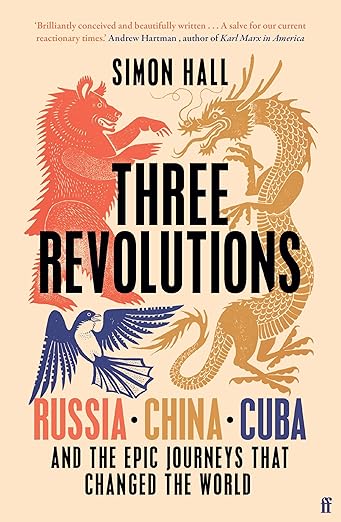
Title: Three Revolutions: Russia, China, Cuba and the Epic Journeys that Changed the World
Author: Simon Hall
Publisher: Basic Books
Publication Year: 2021
Pages: 400
Genre: Modern History, Revolutionary Studies, Journalism History
Overall Rating: ★★★★☆
Summary
Simon Hall’s “Three Revolutions” presents an innovative approach to understanding 20th-century revolutionary movements by pairing each major revolution with the American journalist who brought its story to Western audiences. Rather than offering traditional analysis of Lenin’s Bolshevik Revolution, Mao’s Communist triumph, or Castro’s Cuban uprising, Hall crafts a dual biography that humanizes both the revolutionary leaders and the correspondents whose reporting fundamentally shaped American understanding of these world-changing events.
The book’s brilliance lies in its structure around six pivotal journeys: Lenin’s sealed train from Swiss exile to Russia in 1917, John Reed’s travels to witness the Bolshevik Revolution, Mao’s legendary Long March across China in 1934-35, Edgar Snow’s dangerous trek to find Mao in remote northern China, Castro’s return to Cuba aboard the yacht Granma in 1956, and Herbert Matthews’ clandestine journey to interview Castro in the Sierra Maestra. Through these parallel narratives, Hall demonstrates how individual journeys—both literal and metaphorical—can alter the course of world history.
Strengths
Innovative Dual Biography Approach
Hall’s decision to pair revolutionaries with journalists creates a fresh perspective on familiar historical events. By examining how John Reed’s “Ten Days That Shook the World,” Edgar Snow’s “Red Star Over China,” and Herbert Matthews’ Cuban dispatches shaped American perceptions, Hall reveals the crucial role that journalism plays in creating historical narratives. This approach makes the book particularly valuable for understanding how media coverage influences public opinion and foreign policy decisions.
Exceptional Narrative Storytelling
Professor Hall brings both scholarly rigor and compelling storytelling to complex historical events. His background as a historian at the University of Leeds shows in the book’s careful research, while his narrative skills make revolutionary history accessible to general readers. The author’s ability to weave together multiple storylines across different continents and decades creates an engaging reading experience that feels more like adventure literature than academic history.
Powerful Examination of Journalistic Courage and Consequences
One of the book’s most compelling themes involves the personal costs faced by journalists who sought to report truth about controversial subjects. Hall documents how Reed was charged with sedition under the Espionage Act and died in exile, how Snow’s career suffered during the McCarthy era due to his sympathetic portrayal of Chinese communists, and how Matthews became a social outcast after his articles helped legitimize Castro. These stories powerfully illustrate how journalism can be both influential and dangerous, offering valuable lessons about the relationship between media, politics, and personal integrity.
Contemporary Relevance for Media Literacy
The book raises questions that remain urgent in our current media environment: How do we distinguish between reporting and propaganda? What happens when journalists become part of the stories they’re covering? How do governments and publics react when reporting challenges their preconceptions? These themes resonate strongly in our era of debates about “fake news,” social media journalism, and media bias, making the book highly relevant for contemporary readers.
Excellent Audiobook Experience
The audiobook edition, narrated by Hall himself, offers a particularly intimate and engaging experience. The author’s genuine passion for his subject comes through clearly in his warm, conversational delivery. Personal touches—like the sound of turning pages—create an atmosphere that suggests Hall truly enjoyed bringing these stories to life, making complex historical narratives feel like conversations with a knowledgeable friend.
Areas for Consideration
Limited Historical Analysis
While Hall’s focus on dramatic storytelling creates an engaging narrative, some readers may find that he emphasizes human drama over deeper historical analysis. The book sometimes prioritizes the excitement of individual journeys over comprehensive examination of the revolutionary movements’ broader historical significance and long-term consequences.
Insufficient Coverage of Revolutionary Violence
Critics have noted that Hall tends to gloss over the darker aspects of these revolutions, particularly the massive death tolls under Mao’s regime and the repressive measures implemented by all three revolutionary governments. The book’s focus on the romance of revolutionary struggle sometimes minimizes discussion of the human costs these movements imposed on their societies.
Potential for Romanticizing Controversial Figures
Hall’s sympathetic treatment of both the journalists and their revolutionary subjects may lead some readers to develop overly positive impressions of figures like Castro and Mao, whose later actions revealed the authoritarian nature of their movements. The book would benefit from more critical examination of how these leaders’ early promises compared to their eventual governance.
Historical Significance
Hall’s work makes important contributions to our understanding of how media coverage shapes historical memory and political opinion. By demonstrating how American journalists’ reports influenced public perception of foreign revolutions, the book illuminates the complex relationship between journalism, foreign policy, and domestic politics during the Cold War era.
The book’s examination of how the same events can be interpreted differently by various audiences provides valuable insights into the subjective nature of historical narrative. Hall shows how the journalists’ reports were simultaneously praised as groundbreaking journalism and condemned as communist propaganda, revealing the challenges inherent in objective reporting on controversial subjects.
Classroom Applications
For high school history and English language arts classes, this book offers excellent opportunities for:
- Comparative Revolution Studies: Analyzing similarities and differences between revolutionary movements across cultures and time periods
- Media Literacy Education: Examining how journalism shapes public understanding of world events
- Primary Source Analysis: Studying excerpts from Reed’s, Snow’s, and Matthews’ original writings
- Critical Thinking Development: Debating whether the journalists were objective reporters or biased advocates
- Current Events Connections: Drawing parallels between historical media controversies and contemporary journalism debates
- Role-Playing Exercises: Having students argue different perspectives on the journalists’ reporting and its consequences
Contemporary Relevance
The book’s themes about journalism, propaganda, and truth-telling speak directly to current debates about media credibility and the role of journalists in democratic societies. Hall’s examination of how governments and publics react when reporting challenges their preconceptions offers valuable context for understanding contemporary conflicts over media coverage of controversial events.
The personal costs faced by Reed, Snow, and Matthews for their reporting provide sobering reminders of the courage required for independent journalism, particularly relevant as journalists worldwide face increasing pressure from authoritarian governments and hostile publics.
Conclusion
“Three Revolutions” succeeds brilliantly in offering a fresh perspective on familiar historical events while providing valuable insights into the relationship between journalism and historical memory. Hall’s innovative dual biography approach creates an engaging narrative that will appeal to general readers while offering substantial educational value for students and educators.
The book’s greatest strength lies in its demonstration of how individual journeys—both physical and intellectual—can have profound historical consequences. By showing how journalists’ personal decisions to seek out and report controversial stories shaped American understanding of world events, Hall illustrates the power of individual agency in historical processes.
While the book could benefit from more critical analysis of the revolutionary movements’ ultimate consequences, it succeeds admirably in its primary goal of humanizing both the revolutionaries and the journalists who brought their stories to Western audiences. For readers interested in understanding how media coverage influences historical understanding, Hall’s work provides essential insights.
The book serves as both excellent historical narrative and valuable media literacy education, making it particularly suitable for high school students beginning to develop critical thinking skills about information sources and historical interpretation.
Recommended For
- High school students studying 20th-century world history or Cold War events
- Educators seeking engaging materials for teaching about revolutions and media literacy
- Students interested in journalism careers who want to understand the profession’s historical challenges
- General readers interested in fresh perspectives on familiar historical events
- Anyone seeking to understand how media coverage shapes public perception of world events
Final Assessment: Simon Hall has created an accessible and engaging work that successfully combines historical narrative with media analysis. While it could benefit from more critical examination of revolutionary violence, “Three Revolutions” offers valuable insights into the complex relationship between journalism, politics, and historical memory that remain highly relevant for contemporary readers.
This book was reviewed as part of the Libro.Fm Educators ALC program. If you are an educator and would like to gain early access to audiobooks via the Libro.fm ALC program follow this link to learn more. (https://libro.fm/alc-program)

 BFWClassroom
You must be logged in to post a comment.