There is a story about American history that most of us were never fully taught. It begins not in the twentieth century, not in the shadow of the Holocaust, but in 1492 — the same year Columbus sailed west — when Ferdinand and Isabella signed the Alhambra Decree and expelled every professing Jew from Spain. That single act of state violence set in motion a diaspora that would, within two generations, plant Jewish communities on the shores of the Americas. The story of Jewish Americans, in other words, is not a story that begins with tragedy in Europe and ends with survival. It is a story woven into the founding fabric of this country, thread by thread, from the colonial docks of New Amsterdam to the front lines of the civil rights movement.
May is Jewish American Heritage Month. It has been federally recognized since 2006, when Congress passed a resolution and President George W. Bush signed a proclamation designating May for that purpose. That makes it one of the longer-standing heritage observances on the federal calendar; it predates several months that are now widely recognized in schools across the country. And yet in many districts, May passes without a banner, without a lesson, without acknowledgment that the Jewish American story is part of the American story.
This post is for educators who want to change that, and for anyone who has ever reduced Jewish history to a single, catastrophic chapter. The Holocaust is real, and it must be taught; but a people’s heritage cannot be reduced to the worst thing that was done to them. Jewish American Heritage Month is an invitation to teach the full arc of a civilization’s fingerprint on this nation — from the colonial Atlantic world to the labor unions of the Lower East Side, from the March on Washington to the pop culture landscape every American student already knows.
The Alhambra Decree and the Atlantic Diaspora
To understand the first Jewish Americans, you have to go back to Iberia. For centuries, Jewish scholars, physicians, translators, and merchants had been part of the multicultural intellectual life of medieval Spain — the same Toledo translation movement that preserved Greek philosophy for the Western world depended heavily on Jewish scholars working alongside Arab and Christian counterparts. The expulsion of 1492 ended that era violently and sent somewhere between 100,000 and 200,000 people into exile.
They did not disappear. They dispersed — to the Ottoman Empire, to the Netherlands, to Portugal (where many were forcibly converted and became conversos, practicing their faith in secret under threat of the Inquisition), and eventually to the Americas. When the Dutch West India Company began expanding into the New World in the early seventeenth century, Sephardic merchants based in Amsterdam were active investors and traders in those ventures. The Dutch colonies, governed by a tradition more tolerant of religious diversity than Iberian Catholicism, gave these exiles a degree of protection unavailable in Spanish or Portuguese territories.
The first substantial organized Jewish community in the Western Hemisphere took root in Dutch Brazil, particularly in Recife, after the Dutch seized Portuguese-held territory in 1630. When the Portuguese reconquered Recife in 1654 and brought the Inquisition with them, the Jewish community had to flee again. Twenty-three of those refugees arrived by ship in New Amsterdam — present-day New York City. They were not welcomed by the governor, Peter Stuyvesant, who petitioned the Dutch West India Company to remove them; the company refused, in part because Sephardic Jewish shareholders held a stake in the enterprise. The refugees stayed, and American Jewish history began.
Building the Colonies
Within a generation, Sephardic Jewish communities had taken root in several of the most commercially significant port cities: Newport, Rhode Island; Charleston, South Carolina; Savannah, Georgia; and Philadelphia. Newport’s founding charter, rooted in Roger Williams’ principle of religious tolerance, offered unusual freedom, and the community that developed there became one of the most economically dynamic in the colonial Atlantic world. Merchants Aaron Lopez and Jacob Rodriguez Rivera made Newport a center of the spermaceti candle trade, connecting Caribbean, European, and North American commercial networks through the Jewish diaspora’s kinship ties. In 1763, that community dedicated the Touro Synagogue — the oldest surviving synagogue building in the United States, which still stands today.
In Savannah, forty-two Jewish settlers (most of them Sephardic) arrived from London in 1733, just months after the colony’s founding, making Georgia one of the earliest English colonies to have an organized Jewish community. In Charleston, a Jewish congregation was established by 1750, and Jewish landowners became significant figures in the colony’s indigo industry and its political life.
A Jewish metallurgist named Joachim Gans, recruited by Sir Walter Raleigh, was part of the 1585 expedition that attempted to found the Roanoke Colony — placing a Jewish professional at the very beginning of English colonization in North America, a fact that rarely appears in textbooks.
The Revolution and the Republic
By 1776, historians estimate there were roughly 2,000 Jewish residents in the colonies — a small number, but one that punched well above its weight in the founding moment. In Charleston, nearly every adult Jewish male fought on the side of the Revolution. In Georgia, Francis Salvador became the first Jew to hold elected office in the Americas when he was chosen to serve in the First and Second Provincial Congresses of South Carolina in 1775 and 1776; he was also the first Jewish American to die in the Revolution, killed in a militia engagement in 1776.
The most consequential Jewish contribution to the Revolutionary cause may have been financial. Haym Salomon, a Polish-born financier working in Philadelphia, served as a broker for the Continental Congress and the French and Dutch governments, raising capital to sustain the war effort when the Continental Army was near collapse. In the final years of the war, Salomon advanced the American government approximately $200,000 — an enormous sum — and died bankrupt, never repaid. Robert Morris, the Superintendent of Finance for the Continental Congress, wrote that without Salomon’s financial work, the Revolution’s military operations could not have continued.
The Founders themselves understood that the new republic was built, conceptually, on a relationship with the Hebrew tradition. Benjamin Franklin, John Adams, and Thomas Jefferson all proposed that the Great Seal of the United States depict the Israelites crossing the Red Sea. The inscription on the Liberty Bell at Independence Hall is a direct quotation from Leviticus: “Proclaim liberty throughout the land unto all the inhabitants thereof.” The Puritans had framed their emigration in Exodus imagery; the founders reached for the same well when they needed the language of liberation and covenant. The Hebrew Bible, mediated through centuries of Western scholarship that itself owed a debt to Jewish translators and thinkers, was part of the intellectual architecture of American democracy.
President George Washington recognized the Jewish community’s role in the founding when, in 1790, he wrote to the Hebrew Congregation in Newport, Rhode Island — a letter remarkable for its time — affirming that the new government “gives to bigotry no sanction, to persecution no assistance.”
The Nineteenth Century: Immigration, Commerce, and Reform
The Sephardic community that had dominated American Jewish life in the colonial period was joined, through the mid-nineteenth century, by waves of Ashkenazi Jews from Central Europe; many fled after the failure of the 1848 European revolutions. German Jewish immigrants became prominent in retail and commerce — Levi Strauss founded his dry goods business in San Francisco in 1853, and the blue jeans that resulted from his partnership with Jacob Davis became an icon of American working-class identity. The Lehman brothers, immigrant cotton traders from Bavaria, built a financial house in Montgomery, Alabama, before relocating to New York; their firm helped finance the development of American industry for a century.
Reform Judaism took root in American soil during this period, adapting religious practice to the conditions of a pluralistic democracy in ways that would shape both American religious culture and the broader conversation about how minority communities navigate between preservation and assimilation — a conversation that resonates across every heritage month we observe.
Labor, Justice, and the Progressive Era
The largest wave of Jewish immigration to the United States arrived between roughly 1880 and 1924, when more than two million Ashkenazi Jews fled persecution in the Russian Empire’s Pale of Settlement and the disintegrating Austro-Hungarian world. They settled primarily in American cities, and they arrived already radicalized by European labor organizing and leftist political culture. The sweatshops of the Lower East Side became the proving ground for the American labor movement.
Clara Lemlich, a young Ukrainian-born garment worker, stood up at a mass meeting in 1909 and called for a general strike of shirtwaist makers — a speech that launched what became known as the “Uprising of the 20,000,” one of the largest strikes by women workers in American history. Rose Schneiderman, another Jewish labor activist, organized alongside her and became one of the most effective advocates for workplace safety legislation. When the Triangle Shirtwaist Factory fire killed 146 garment workers in 1911 — most of them young Jewish and Italian immigrant women — it was the labor movement, led in significant part by Jewish organizers, that turned the tragedy into legislation. The fire and its aftermath reshaped American workplace law.
The International Ladies’ Garment Workers’ Union and the Amalgamated Clothing Workers became two of the most powerful unions in the country, pioneering the eight-hour workday, minimum wage standards, and workplace safety regulations that American workers across every industry still rely on today.
The Civil Rights Movement: Solidarity Across Lines
The Jewish American story connects directly to the story of Black freedom in America, and that connection is essential for social studies classrooms to understand — not as a simple narrative of alliance, but as a complex, sometimes contradictory, ultimately consequential partnership shaped by shared experience of marginalization.
When the NAACP was co-founded in 1909, a disproportionate number of its early White founders and leaders were Jewish; Lillian Wald, Joel Spingarn, Henry Moskowitz, Julius Rosenwald, and Stephen Wise were among them. Julius Rosenwald, the chairman of Sears Roebuck, funded the construction of more than 5,300 schools for Black children across the South between 1910 and 1940 — at the height of what became known as the “Rosenwald schools,” nearly forty percent of Black students in the South were educated in one of them, alongside Howard, Dillard, and Fisk universities.
Jack Greenberg served alongside Thurgood Marshall in the NAACP Legal Defense Fund and helped argue Brown v. Board of Education before the Supreme Court; the research undergirding that case had been commissioned by the American Jewish Committee. When the March on Washington gathered 250,000 people in August 1963, Rabbi Joachim Prinz — a Holocaust survivor who had himself been driven from Nazi Germany — spoke from the same platform as Martin Luther King Jr., saying that the Jewish experience had taught him that “the most urgent, the most disgraceful, the most shameful, and the most tragic problem is silence.” Of the three civil rights workers murdered in Mississippi during Freedom Summer in 1964 — an event that remains one of the defining moments of the movement — Michael Schwerner and Andrew Goodman were Jewish; James Chaney was Black. Estimates suggest that approximately half of the White volunteers who traveled to Mississippi that summer were Jewish Americans.
This history is complicated; there were also Jewish Americans who held enslaved people in the antebellum South, and there were real tensions between Black and Jewish communities over affirmative action, economic relationships, and political priorities that increased through the 1970s. Teaching those complications honestly is itself a civic education. The relationship between these communities is a case study in how marginalized groups navigate solidarity, self-interest, shared history, and political difference — which is exactly what American democracy has always required its citizens to work through.
The Cultural Fingerprint
Jewish American contributions to American culture are so pervasive that students often do not recognize them as such, which is itself an argument for explicit instruction. American popular music in the twentieth century — jazz, Broadway, rock and roll, hip-hop production — was shaped at nearly every stage by Jewish American artists, composers, producers, and label founders. George Gershwin composed “Rhapsody in Blue” and “Porgy and Bess.” Irving Berlin, a Russian Jewish immigrant, wrote “God Bless America” and “White Christmas.” Bob Dylan transformed American folk music and won the Nobel Prize in Literature. The Hollywood studio system was built largely by Jewish immigrant entrepreneurs — Louis B. Mayer, the Warner brothers, Samuel Goldwyn — who understood that film could stitch a diverse, fragmented nation together through shared stories. American comedy from vaudeville through the present — from the Marx Brothers to Mel Brooks to Jerry Seinfeld to Judd Apatow — carries a distinctly Jewish sensibility about language, absurdity, suffering, and survival that has become part of what Americans find funny.
In science, Albert Einstein arrived in the United States as a refugee in 1933, the same year the Nazis seized power, and spent the rest of his career at Princeton. Jonas Salk developed the polio vaccine. J. Robert Oppenheimer led the Manhattan Project. Ruth Bader Ginsburg sat on the Supreme Court for twenty-seven years and became, in the last decade of her life, a cultural icon for a new generation. Her insistence that dissent is itself a civic act connects directly to the labor activists of the Lower East Side, the civil rights lawyers of the 1950s, and the Sephardic merchants of Newport who argued with Peter Stuyvesant over the right to remain on American soil.
Why This Month, Why Now
Jewish American Heritage Month is not a consolation for suffering. It is not a commemoration of victimhood. It is a recognition that a people who arrived on these shores as refugees, as traders, as soldiers, as laborers, as scholars, and as advocates have shaped the laws, the culture, the commerce, and the conscience of this country in ways that go largely untaught. The Holocaust is part of this story, and it must be taught with clarity and moral seriousness; the USHMM’s educator resources exist precisely for that purpose. But if the Holocaust is the only chapter students ever read, we have not taught Jewish history — we have only taught Jewish tragedy, and in doing so, we have done exactly what the perpetrators of that tragedy intended: we have made absence the loudest word.
The Alhambra Decree and the Touro Synagogue. Haym Salomon and the Continental Congress. Clara Lemlich and the garment workers’ strike. Rabbi Heschel marching beside Dr. King. Ruth Bader Ginsburg’s dissents. These are American stories. They belong in American classrooms, in the month the federal government set aside for them twenty years ago, alongside every other community whose heritage month we already celebrate.
May is not full yet. Advocate for your school and/or district to make Jewish American Heritage Month part of their curricula and calendars.
About the Header
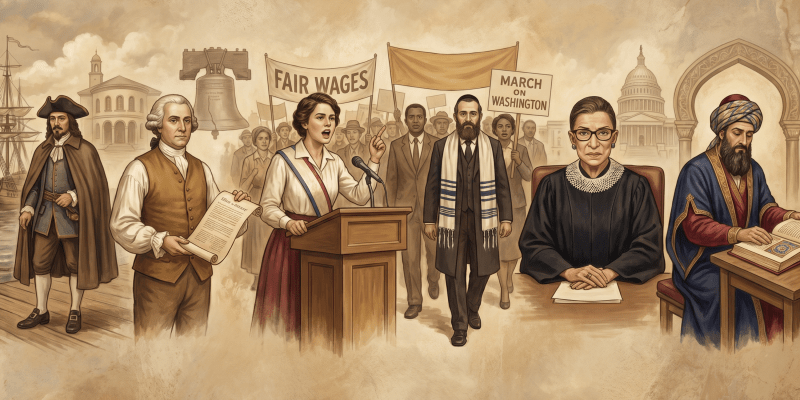
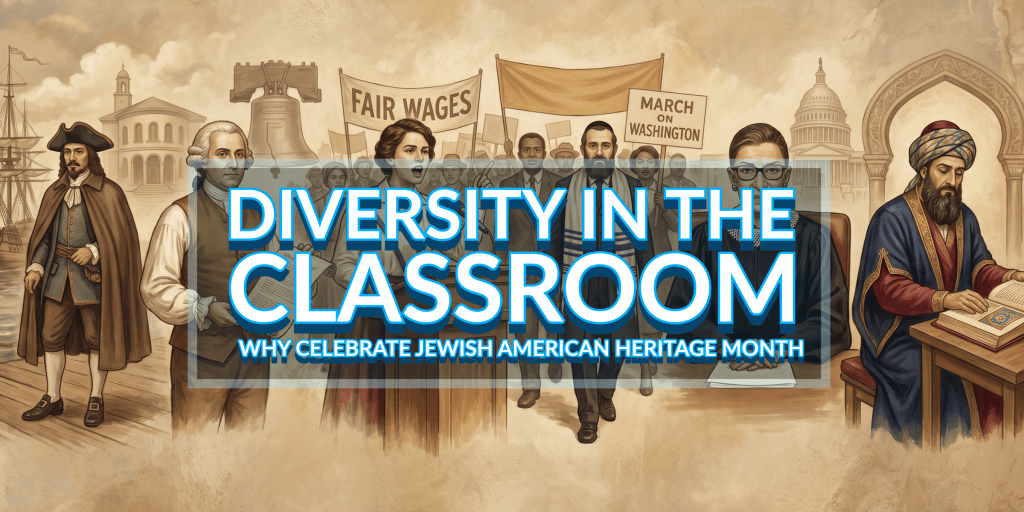
The Colonial Merchant on the Dock is inspired by Aaron Lopez (1731–1782), a Sephardic Jewish merchant born in Portugal who arrived in Newport, Rhode Island, and became one of the most prominent commercial figures in colonial America; his transatlantic trading networks connecting Newport, the Caribbean, and Europe made him a central figure in the spermaceti candle trade and in the economic life of the colonies. He is also inspired by the twenty-three Jewish refugees from Recife, Brazil, who arrived in New Amsterdam in 1654 and became the founders of organized Jewish life in North America.
The Revolutionary-Era Financier is inspired by Haym Salomon (1740–1785), a Polish-born broker who served as financial agent to the Continental Congress during the American Revolution; Salomon raised and advanced capital that sustained the Continental Army through its most desperate years, lent roughly $200,000 to the American government in the war’s final phase, was never repaid, and died bankrupt. Robert Morris, Superintendent of Finance for the Continental Congress, credited him as indispensable to the war effort.
The Labor Organizer at the Podium is inspired by Clara Lemlich (1886–1982), a Ukrainian-born garment worker on the Lower East Side of New York who, at a mass meeting in November 1909, rose and called in Yiddish for an immediate general strike of shirtwaist makers — a speech that launched the “Uprising of the 20,000,” one of the largest strikes by women workers in American history; and by Rose Schneiderman (1882–1972), a labor organizer and suffragist who spent decades fighting for workplace safety, minimum wage legislation, and women’s voting rights, and who transformed the Triangle Shirtwaist Factory fire of 1911 into a catalyst for lasting labor law reform.
The Civil Rights-Era Rabbi is inspired by Rabbi Abraham Joshua Heschel (1907–1972), a Polish-born theologian and philosopher who marched alongside Dr. Martin Luther King Jr. in Selma, Alabama, in 1965 and who spoke frequently of the moral imperative that Jewish historical experience placed on Jewish Americans to stand with others facing persecution; and by Rabbi Joachim Prinz (1902–1988), a Holocaust survivor and civil rights activist who spoke at the March on Washington in August 1963, telling the assembled crowd that his own experience of Nazi Germany had taught him that silence in the face of injustice was the greatest moral failure a free people could commit.
The Supreme Court Justice is inspired by Ruth Bader Ginsburg (1933–2020), Associate Justice of the United States Supreme Court from 1993 until her death; a Brooklyn-born daughter of Ukrainian Jewish immigrants, Ginsburg spent her career dismantling legal structures that enforced gender discrimination, co-founded the ACLU’s Women’s Rights Project, and became in the last decade of her life a cultural icon whose insistence on principled dissent connected the tradition of Jewish American civic activism across two centuries.
The Medieval Iberian Scholar is inspired by the Jewish intellectuals of the Toledo translation movement — among them Abraham ibn Ezra and Abraham bar Hiyya — who worked alongside Arab and Christian scholars in medieval Spain to preserve and transmit classical knowledge to the Western world, before the Alhambra Decree of 1492 ended that era of coexistence and sent the Sephardic diaspora into exile across Europe and eventually the Americas.
Sources and classroom connections available upon request. Primary source documents for many individuals mentioned in this post are available through the Library of Congress, the Gilder Lehrman Institute, and the USHMM‘s online educator portal.
This post is one of my Diversity in the Classroom readings. Their main purpose is to share the stories and history from people of diverse backgrounds. To Read More follow this Link.


You must be logged in to post a comment.