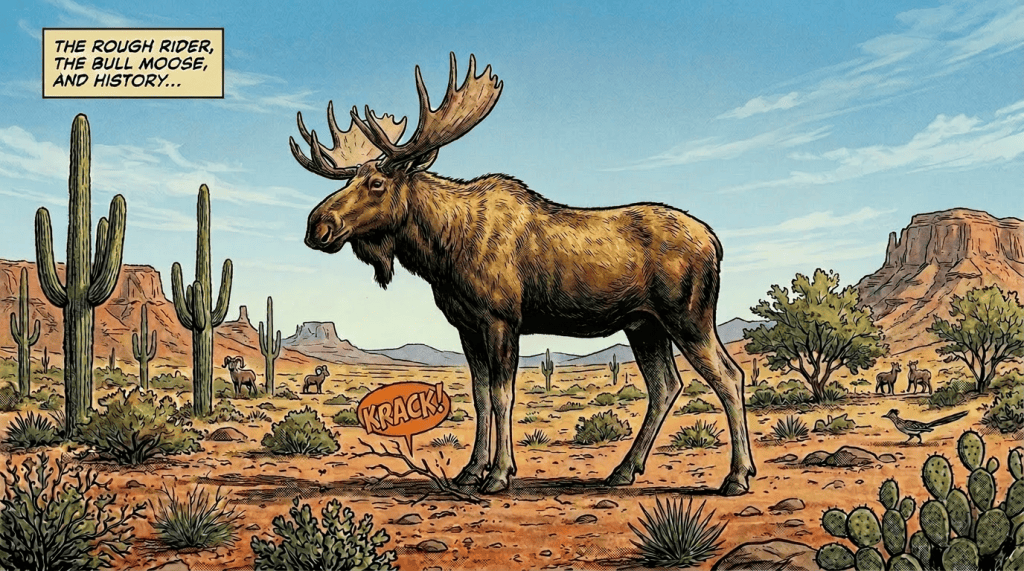
A Rudderless Progressive Party and the Mexican Revolution It Could Not Manage
“What If?” Series — Milwaukee, Part III of III
On the evening of October 14, 1912, a former president of the United States stepped out of the Hotel Gilpatrick in Milwaukee and into the barrel of a revolver. John Schrank fired a single .38-caliber round at close range. The bullet passed through Roosevelt’s steel eyeglass case and his folded fifty-page manuscript before lodging against his fourth rib. Roosevelt assessed the situation, concluded his lung was probably intact, and went to give the speech anyway.
He lived. He finished second in the November election. He returned to Oyster Bay with the bullet still inside him — surgeons had determined that extraction was more dangerous than leaving it in place — and he lived another six years, the bullet a permanent resident of his chest wall, until a pulmonary embolism took him in January 1919.
That is the history we have. But the third path from Milwaukee is the one where the bullet does exactly what it did in our timeline — lodges, stays, is left in place — and Roosevelt campaigns through October with the theatrical advantage of a man who was just shot and refused to stop. He wins the election on that momentum, the most improbable electoral outcome since Lincoln’s 1864 reelection. And then the bullet that everyone has stopped worrying about begins, slowly and invisibly, to kill him anyway.
This is the cruelest version of the story. It is also, in its combination of near-miss and delayed consequence, perhaps the most instructive one.
Historical Grounding: The 1912 Election and What a Progressive Victory Would Have Required
The Progressive Party that nominated Roosevelt in August 1912 was a genuine political creation, not a vanity project. Its platform was the most ambitious domestic program any major presidential candidate had offered since Reconstruction: women’s suffrage, workers’ compensation, a federal income tax, direct election of senators, and the beginnings of what Roosevelt called a national social insurance system — the policy infrastructure that Franklin Roosevelt would eventually build into the New Deal two decades later. The party had organizational energy, ballot access in most states, and the enthusiastic support of the most prominent reform intellectuals in the country.
What it did not have was institutional depth. Two major parties had spent generations accumulating the machinery of American political life: the county committees, the patronage networks, the legislative relationships, the courthouse connections that converted voter enthusiasm into reliable governance. The Progressive Party had been in existence for three months. Its congressional representation was a handful of senators and representatives who had either bolted from the Republicans or won special elections on the new party’s ballot line. It had no established relationships with the permanent federal bureaucracy, no history of managing the executive branch, and no reservoir of experienced administrators waiting to staff a new administration.
Roosevelt himself was the answer to all of these deficits. His eight years as president, his relationships across the congressional aisle, his command of the executive apparatus, his sheer personal force — these were the substitutes for institutional depth that the Progressive Party would have relied on entirely. Remove him, and you remove the foundation the whole enterprise was built on.
Point of Departure: He Wins, and the Wound Stays Quiet
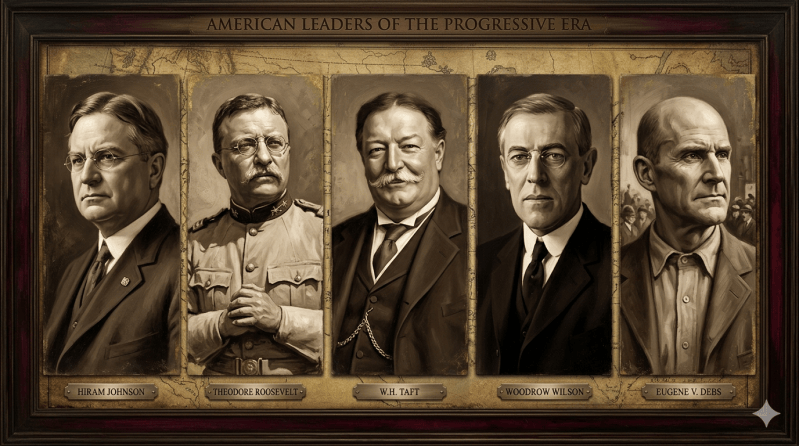
The bullet lodges where it lodges in our timeline. The campaign continues through October with Roosevelt physically diminished but theatrically powerful; the image of a man who took a bullet and kept talking is the most compelling campaign advertisement either party could have designed, and it is not designed — it simply is. The Progressive vote that had been softening in the final weeks of the race consolidates behind the candidate. Some of Wilson’s progressive supporters in the Northeast cannot bring themselves to vote against a man they have watched absorb a bullet with equanimity. Taft’s final weeks are a requiem.
On November 5th, Roosevelt wins a narrow but clear electoral college majority. He carries the industrial states of the Northeast and Midwest on the strength of a progressive coalition that the Milwaukee shooting had rendered briefly but decisively emotional rather than analytical. Wilson concedes with dignity. The Progressive Party has done what no third party had done since the Republicans themselves in 1860: it has won the presidency in its first serious national campaign.
The bullet stays quiet through the transition. Roosevelt is visibly thinner and tires more quickly than observers had seen before the shooting, but the campaign had been grueling and the wound had been real and the public extends the charity of not looking too closely at a president-elect who earned his exhaustion publicly. His physicians note the abscess forming around the lodged round in the dense chest-wall tissue, make the calculation that surgical intervention carries its own risks, and choose watchful management. They do not tell Roosevelt everything they know. This is not unusual for the era; the relationship between physician and prominent patient in 1912 routinely involves the physician managing information as much as managing illness.
Eight Months
Roosevelt is inaugurated on March 4, 1913, standing hatless in the cold as presidents do, visibly thinner than he was in October but still unmistakably himself — the compressed energy, the aggressive courtesy, the sense that the man standing at the podium is operating at a speed the occasion can barely contain. The progressive press celebrates. The reform agenda is real and the president who will pursue it is standing before the Capitol, and the next four years feel, for a few weeks, like the opening of something rather than the continuation of something.
The infection that watchful management was supposed to contain does not cooperate. By summer it has spread in the slow systemic way that pre-antibiotic infections spread when they find a lodged foreign body to organize around, and the physicians who had chosen not to operate in November are now facing a situation where surgical intervention is both more necessary and more dangerous than it would have been six months earlier. They operate in August. The surgery is, in the technical sense, a success; the bullet is removed, the abscess drained. Roosevelt spends six weeks in convalescence that is managed publicly as a routine recovery and privately as something considerably more serious.
He returns to the White House in October 1913 and governs for one more month. The septicemia — blood poisoning from the infected wound channel — has already passed the point where draining the abscess could contain it. He dies on November 9, 1913, of complications from the injuries sustained at Milwaukee, as his official death certificate will describe it. He is fifty-five years old. He has served eight months as president, enough time to make several appointments that matter, begin several initiatives that will need completion, and demonstrate in outline what a Progressive administration might look like at full strength.
It is not full strength. It is a sketch. And now someone else has to fill it in.
Hiram Johnson’s Impossible Inheritance
Hiram Johnson takes the oath of office on November 10, 1913. He is the governor who broke the Southern Pacific Railroad’s grip on California, a genuine reform credential and a genuinely hard thing to have done. He is also, in November 1913, the president of a party that was built entirely around someone else, staffed by someone else’s loyalists, organized around someone else’s vision, and still in visible grief over the man it actually wanted in this office.
The Progressive Party of late 1913 is rudderless in a specific and structural sense that goes beyond ordinary political difficulty. A new party governing the executive branch for the first time has no reservoir of experienced federal administrators to draw on; it must staff agencies with a combination of holdovers from the previous Republican administration, progressive academics and reformers who had never held federal office, and the occasional experienced hand borrowed from sympathetic Democrats. Roosevelt’s personal relationships with the congressional leadership of both parties had been the adhesive that might have held this improvised coalition together; Johnson has no comparable relationships, no comparable personal history, and no comparable gravity.
The cabinet Roosevelt had assembled in eight months reflects Roosevelt’s priorities rather than Johnson’s. Several of its members are loyal to the dead president’s agenda rather than to the institution they serve or the man now leading it, and some of them, recognizing early that Johnson cannot command the same negotiating space, begin making quiet accommodations with the Democratic congressional leadership in ways that undercut administrative coherence. Johnson fires three cabinet members by February 1914 and replaces them with his own appointments — more loyal, less distinguished, and lacking the progressive credibility that Roosevelt’s selections had carried.
The progressive press, which had been the administration’s most important outside constituency, responds to the transition with sympathy shading steadily toward disappointment. The editorials that had celebrated a Roosevelt administration now cover Johnson’s administration as a kind of stewardship — the Progressive Party holding the line, trying not to lose what Roosevelt had started, hoping to survive long enough to elect someone who could finish it. That is not the coverage that builds political capital. That is the coverage that signals to everyone with a decision to make that this administration is in a holding pattern.
The Left That Grows in the Gap
One of the structural consequences of a weakened Johnson administration that the post’s foreign policy focus tends to obscure is this: every month that the Progressive platform goes unfulfilled, every piece of legislation that dies in conference or emerges from it unrecognizable, every appointment that turns out to be a Roosevelt loyalist accommodating himself to Democratic congressional leaders rather than serving the president he was appointed under — all of it is organizational material for Eugene Debs and the Socialist Party.
Debs had argued throughout the 1912 campaign that the Progressive platform, ambitious as it appeared, was the ceiling of what reform within a capitalist political framework could offer, not its floor. The social insurance proposals were inadequate; the antitrust program left ownership structures intact; the labor protections were concessions designed to prevent workers from asking for more. Roosevelt’s personal authority might have pushed even those limited proposals through Congress in modified form and given the argument against socialism a governing record to point to. Johnson’s authority cannot, and does not, and the absence of a strong Progressive legislative record through 1914 validates Debs’s pre-election analysis more effectively than any speech he could have written.
Debs himself is doing what he always does: traveling, speaking, writing, organizing. The Appeal to Reason columns during the Johnson years have a specific target that they lacked when Roosevelt was the Progressive standard-bearer — now there is an actual Progressive administration to measure against the Progressive promise, and the measurement is damaging. A reader of Appeal to Reason in 1914 who had been persuaded in 1912 that the Progressive platform was the most that the American political system could deliver finds, two years later, that the American political system has delivered considerably less than that. The argument for going further is easier to make when the argument for stopping here has produced a weak, contested, Mexico-distracted White House that cannot manage either its domestic agenda or its foreign policy with consistent purpose.
The specific domestic failure that matters most to Debs’s organizing is the labor question. Roosevelt’s Progressive platform had included language on workers’ compensation, maximum hours, and the protection of workers’ right to organize that was, by the standards of the era, genuinely progressive. Johnson’s administration advances some of this — the workers’ compensation framework survives legislative conference in modified form — but the broader labor protections are traded away in the congressional negotiations that Johnson’s weaker position makes unavoidable. The AFL, which had been carefully neutral in 1912 and which Samuel Gompers had kept from endorsing the Socialist ticket despite Debs’s arguments, grows restless with a Progressive administration that is proving less useful to organized labor than its platform had suggested.
Debs does not want the AFL’s institutional endorsement; he regards Gompers’s brand of craft unionism, with its acceptance of capitalism as a permanent framework within which wages are to be maximized, as a fundamental strategic error. But he does want the workers that the AFL represents, and a Progressive administration that has disappointed organized labor is an administration that has done some of his organizing work for him.
The question that this scenario raises most sharply — and that is directly relevant to what follows in Mexico — is what happens to Debs and the Socialist Party when the United States enters the First World War. In our actual timeline, Debs’s antiwar speech in Canton, Ohio in June 1918 led to his prosecution under the Espionage Act of 1917 and a ten-year prison sentence. The Espionage Act was Wilson’s legislation, passed with Wilson’s strong personal support as part of the wartime mobilization apparatus that a confident, congressionally trusted Democratic president assembled around American entry into the war.
Johnson’s wartime mobilization is, as the Mexico section of this post describes, less coherent and less politically secure than Wilson’s. The legislative package Johnson can assemble around American entry is constrained by the congressional trust deficit his administration has been running since the contested inauguration of March 1913. Whether the Espionage Act passes in the same form under Johnson — with the same broad prohibitions on antiwar speech, the same enforcement provisions, the same prosecutorial discretion — is a genuinely open question. A weaker wartime executive produces weaker wartime legislation; the civil liberties tradeoffs that Congress is willing to make depend heavily on how much it trusts the president asking for them.
If the Espionage Act is weaker, or passed later, or enforced with less prosecutorial aggression than it was under Wilson’s Justice Department, Debs may not go to prison in 1918. A free Debs — or a Debs imprisoned for a shorter term, or not imprisoned at all — is a different figure in the 1920 election than the one who ran from a federal penitentiary in Atlanta and received nearly a million votes while wearing prison clothes. The Harding landslide probably still happens; the exhaustion with wartime mobilization and progressive reform is structural, not contingent on Debs’s personal freedom. But the socialist left that enters the 1920s without its leader having been imprisoned for his speech is a more organizationally intact left, with more institutional capacity, than the one that actually existed.
Whether that matters to the decade that follows — to the labor politics of the twenties, to the organizational infrastructure that will eventually be available when the Depression demands a response — is the question this scenario leaves open. The Johnson administration’s weakness is a domestic political story as much as a foreign policy one, and Debs is a large part of what that domestic story looks like from the left side of the ledger.
Mexico: The Crisis That Cannot Wait
Into this weakened, grief-laden, organizationally thin White House arrives, almost simultaneously with Roosevelt’s death, the first major foreign policy test of the decade. It arrives from Mexico, and it arrives with a complexity that the Progressive Party’s platform had given almost no attention and that Johnson’s entire political career had left him unequipped to manage.
The Mexican Revolution had begun in 1910 when Francisco Madero, a reformist landowner from the north, challenged the thirty-year dictatorship of Porfirio Díaz and won. Díaz fell; Madero was elected president; and then, in February 1913 — while Roosevelt was still alive and Johnson was still vice president — came the episode Mexicans call the Decena Trágica, the Ten Tragic Days. A military coup orchestrated by General Victoriano Huerta, with the active encouragement of the American ambassador Henry Lane Wilson, overthrew and murdered Madero. Huerta’s coup was brutal, nakedly illegitimate, and directly entangled with American diplomatic malpractice. Ambassador Wilson had hosted meetings at the American embassy at which the terms of the coup were finalized. The United States government, in the person of its representative in Mexico City, had helped put a murderous usurper in power.
In our actual timeline, President Woodrow Wilson responded to Huerta with principled firmness rooted in a clear constitutional philosophy. Wilson refused to recognize the Huerta government on the grounds that no government that came to power through the assassination of its predecessor could be considered legitimate by a republic committed to constitutional order. He recalled Ambassador Wilson, broke off the normal diplomatic relationship with Mexico City, and eventually, in April 1914, ordered the occupation of the Mexican port of Veracruz to prevent a German arms shipment from reaching Huerta’s forces. The policy was controversial; the Veracruz occupation produced real military casualties on both sides and a storm of criticism from Latin American governments that accused the United States of reverting to the interventionist habits it had supposedly abandoned. But it had coherent logic, a clear philosophical foundation, and a president willing to absorb the political cost of maintaining it.
Hiram Johnson has none of these resources.
Johnson’s Mexico
Johnson has no background in foreign policy. His entire political career was built on California railroad regulation. He has no secretary of state with the diplomatic standing or the institutional relationships that might anchor a coherent Mexico policy; the State Department holdovers from the Roosevelt administration are experienced professionals whose loyalty to Johnson is uncertain and whose primary instinct, in the absence of clear presidential direction, is to manage the situation rather than to resolve it.
The immediate question — whether to recognize Huerta — is one Johnson cannot answer quickly without splitting his coalition. Recognizing Huerta would align the United States with a government that murdered its predecessor and would enrage the reformist wing of the progressive coalition, which had built its domestic program on the idea that democratic legitimacy matters and that strong-arm governance is incompatible with progressive values. Not recognizing Huerta would antagonize the American business interests with substantial investments in Mexican oil, mining, and railroads — interests whose support for the Progressive Party had always been conditional and whose patience Johnson cannot afford to exhaust in his first weeks.
Johnson announces a policy of watchful waiting — a phrase Wilson actually used in our timeline, but that Wilson used to describe a deliberate strategic pause rather than a paralyzed indecision — and the two policies, identical in words, are entirely different in substance. Wilson’s watchful waiting was the expression of a coherent position about the limits of American military intervention combined with genuine confidence in diplomatic tools. Johnson’s watchful waiting is a way of not deciding while looking as if he is deciding. The distinction is clear to the Mexican constitutionalist forces under Venustiano Carranza, who are organizing resistance to Huerta in the north and who need to know whether the United States will eventually support them or whether they are fighting alone. It is equally clear to Huerta, who reads Johnson’s ambiguity as a negotiating opportunity rather than a principled stance.
The stall lasts through the winter of 1913 and into the spring of 1914, while Huerta consolidates power in Mexico City and the constitutionalist campaign expands in the northern states. By April 1914, the situation has become untenable: a German arms shipment is en route to Veracruz, and the question of whether to interdict it is now unavoidable.
Veracruz and Its Costs
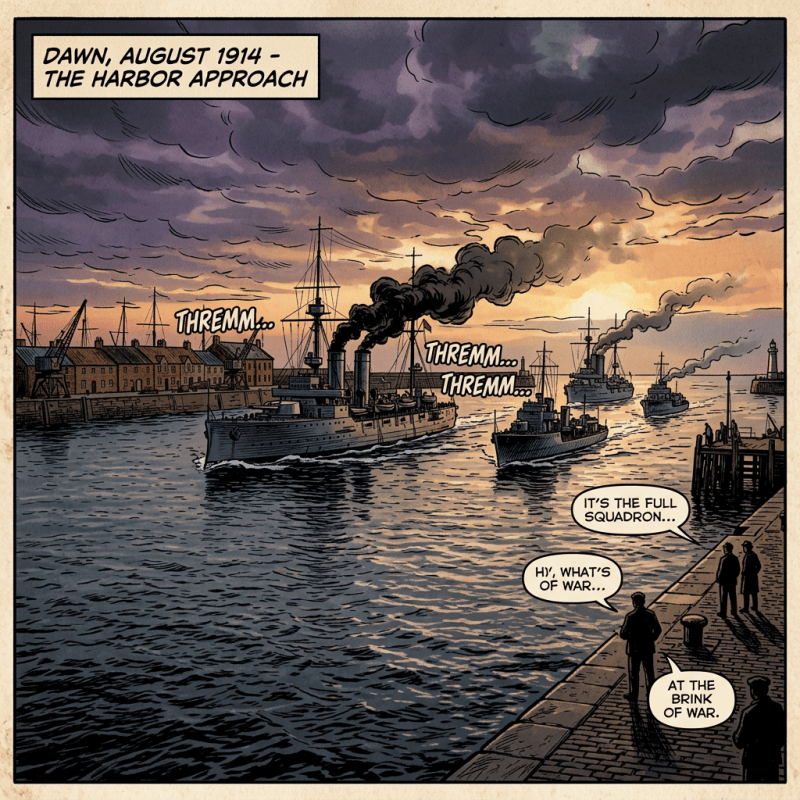
In our actual timeline, Wilson ordered the occupation of Veracruz on April 21, 1914. American forces seized the city, nineteen American sailors and marines were killed, and somewhere between 150 and 300 Mexican combatants and civilians died in the fighting. The occupation provoked outrage across Latin America and produced a diplomatic crisis that required Argentine, Brazilian, and Chilean mediation to resolve. Wilson accepted the mediation, the occupation ended by November, and the political cost of the episode was absorbed into the broader narrative of American engagement with the Mexican Revolution.
Johnson also orders the occupation. He cannot not order it; the German arms reaching Huerta’s forces would be a catastrophe that his opponents in both parties would use to define his presidency. But he orders it six months later than Wilson would have, from a weaker diplomatic position, without the prior groundwork of non-recognition that gave Wilson’s Mexico policy its internal logic, and without the relationships with the Argentine, Brazilian, and Chilean governments that Wilson had spent the preceding months carefully cultivating as exactly the kind of multilateral framework that might contain the fallout.
The occupation proceeds. The casualties are roughly what they were in our timeline. The Latin American diplomatic outrage is considerably louder, because Johnson has spent six months demonstrating that he has no consistent principle governing his Mexico policy; there is no framework of non-recognition to explain why Veracruz is a principled intervention rather than an opportunistic one. The mediation that resolves the crisis takes longer and extracts more diplomatic concessions from the United States, concessions that weaken American credibility with the constitutionalist forces who had been hoping for clearer support against Huerta.
By the summer of 1914, Huerta has been driven from power by the combined pressure of the constitutionalist campaign and the Veracruz occupation’s disruption of his supply lines. This part of the story ends approximately where it ends in our timeline. But the American credibility costs of how Johnson got there — the months of indecision, the absence of a stated principle, the diplomatic isolation during the Veracruz crisis — are considerably higher. The United States enters the subsequent period of the Mexican Revolution’s chaos with a weakened diplomatic position and a Johnson administration that has spent its first foreign policy test demonstrating that it cannot project consistent purpose.
The Progressive Party Without a Compass
Mexico is the most visible foreign dimension of the Johnson administration’s structural weakness, but it is not the only one. The European war that begins in August 1914 — the same European war in our timeline, produced by the same alliance system and the same assassination in Sarajevo — finds Johnson’s White House less prepared to manage the American neutrality question than Wilson’s had been. Wilson brought to the neutrality debate a fully articulated constitutional philosophy about the limits of presidential war-making and a set of personal convictions about American moral leadership that gave him a consistent position to defend even when individual decisions were controversial. Johnson brings a progressive domestic agenda and a California political career, neither of which is a particularly useful framework for navigating the summer of 1914.
The progressive coalition itself, which had been the administration’s reason for existing, begins to fragment during 1914 in ways that Roosevelt’s governing authority would have arrested and Johnson’s cannot. The labor wing and the social insurance reformers are pulling in different directions on the administration’s domestic priorities; the progressive governors who had won in 1912 are developing their own agendas that do not always align with the national party’s; and the progressive press that had been the coalition’s intellectual adhesive is increasingly divided between those who think Johnson should be more aggressive on the domestic program and those who think he should stabilize what exists before expanding it.
The 1914 midterms produce losses that are not catastrophic but that are significant enough to make the remaining two years of the term look like an exercise in managed decline. The Progressive Party goes into the 1916 election cycle asking voters to give it a second chance with a candidate who has an actual governing record — one of foreign policy stumbles, domestic fragmentation, and the long shadow of a man the party could not replace.
What the Bullet Actually Cost
The cruelest thing about this third scenario is the timing. Roosevelt governed for eight months — long enough to demonstrate what the Progressive agenda looked like in action, to make the appointments that would shape the party’s future direction, and to see, in outline, the administration he had built. Then the wound that everyone had stopped worrying about killed him anyway, and the progressive movement spent the rest of the decade governing as if it were standing in his place rather than finding its own.
The bullet that lodged against Roosevelt’s fourth rib in Milwaukee did not kill him on the night of October 14, 1912. It killed him eleven months later, slowly enough that the country could watch it happen and too slowly for anyone to have responded to it at a moment when responding might have made a difference. That gap — between the wound and the death, between the victory and the collapse — is where Hiram Johnson’s presidency lives. It is a presidency defined by what it was supposed to be and wasn’t, surrounded by the organizational debris of someone else’s vision, managing a revolution in Mexico that it hadn’t planned for, and holding together a coalition that had been designed around a center of gravity it no longer possessed.
History tends to remember the dramatic moments — the bullet, the speech, the victory. What it is slower to record is the slow cost of wounds that don’t heal cleanly, and the work done by the people left to govern in the space that someone else’s death opened up.
Discussion Questions:
1. Johnson’s Mexico policy was substantively similar to Wilson’s actual policy but arrived later, from a weaker diplomatic position, and without the philosophical framework that made Wilson’s version coherent to outside observers. Does “why” a government does something matter as much as “what” it does in foreign policy? Use the Veracruz occupation as your evidence and argue either that principle is essential to effective foreign policy or that outcomes are what ultimately matter.
2. The Progressive Party in this scenario is described as rudderless not because it lacked good people but because it was built around a specific individual’s authority rather than around institutional structures that could survive that individual’s removal. Drawing on what you know about how political parties actually function, what institutional changes might the Progressive Party have made in 1912 and 1913 to build a more durable organization — and why might those changes have been politically difficult to make at the time?
While these events are not true they are based on historic fact and the possibility of one change in history. To read more of my Alternate History scenarios, be sure read here.


You must be logged in to post a comment.