Celebrating the birthday of America’s most influential Chief Justice
While names like Washington, Jefferson, and Hamilton dominate discussions of America’s founding era, September 24th marks the birthday of perhaps the most quietly influential founding father of them all: John Marshall. Born in 1755, Marshall would go on to serve as Chief Justice of the Supreme Court for an unprecedented 34 years, fundamentally shaping the American legal system and the balance of federal power in ways that continue to define our nation today.
The Post-1800 Challenge
The election of 1800 marked a pivotal moment in American history. Thomas Jefferson’s victory over John Adams represented the first peaceful transfer of power between opposing political parties in the young republic. However, this transition also created a constitutional crisis that threatened to tear apart the fragile union. The Federalist Party, which had dominated the early years under Washington and Adams, suddenly found itself out of power, with many of its core beliefs about strong federal government seemingly rejected by the electorate.
It was in this context that John Marshall, appointed Chief Justice by Adams in his final days in office, emerged as the most important figure in preserving national unity and constitutional government. While Jefferson and his Democratic-Republicans controlled the executive and legislative branches, Marshall wielded the judicial branch with unprecedented skill and vision.
The Architect of Judicial Power
Marshall’s genius lay not in political maneuvering, but in his masterful use of the Supreme Court to establish enduring constitutional principles. His landmark decision in Marbury v. Madison (1803) established the principle of judicial review, giving the Supreme Court the power to declare laws unconstitutional. This single decision transformed the judiciary from the weakest branch of government into a co-equal partner with Congress and the presidency.
Through cases like McCulloch v. Maryland (1819) and Gibbons v. Ogden (1824), Marshall strengthened federal authority and promoted national economic integration. His broad interpretation of the Commerce Clause and the Necessary and Proper Clause created the constitutional foundation for a truly national economy, transcending state boundaries and local interests.
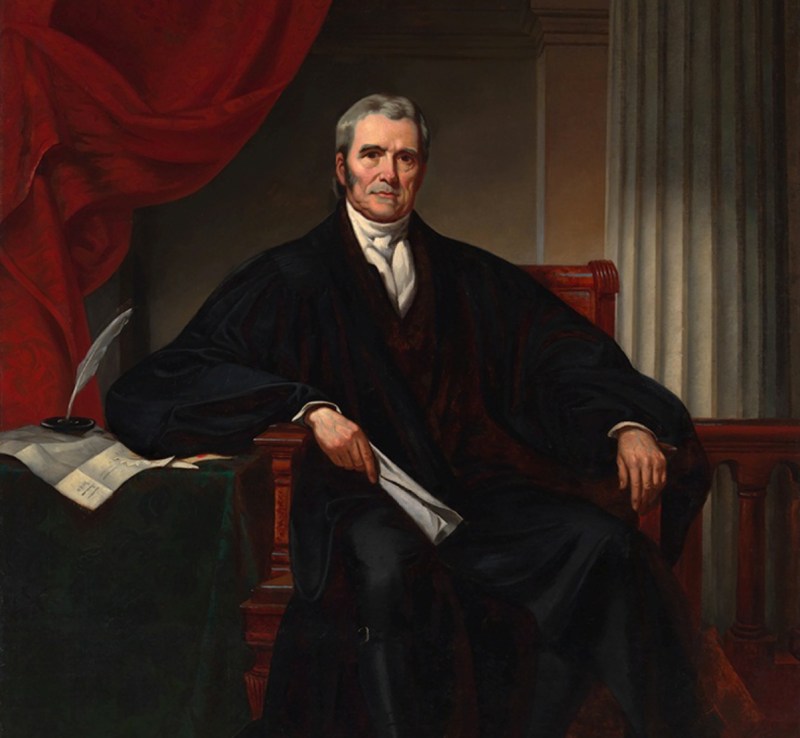
Painted in 1880, this portrait of former Member and Chief Justice of the United States John Marshall is a copy by Richard Brooke after the portrait by William D. Washington in Virginia’s Fauquier County Courthouse. The portrait shows Marshall in his judicial robes and seated on a raised dais. It is a pose reminiscent of 17th- and 18th-century European court portraiture. Official papers and an inkwell rest at his elbow, while a scattering of legal volumes tumble down the carpeted stair. (1880, Richard Norris Brooke; William de Hartburn Washington)
Preserving the Union Through Law
What makes Marshall’s contribution so remarkable is how he used legal precedent rather than political power to shape America’s future. While the Federalist Party faded into irrelevance, Marshall embedded Federalist principles of strong national government directly into constitutional law. His decisions consistently favored federal authority over state power, national economic interests over local ones, and constitutional unity over sectional division.
Marshall understood that in a democracy, lasting change comes not from winning elections but from establishing enduring institutions and legal principles. His Supreme Court became the guardian of national unity, consistently ruling in ways that strengthened the bonds holding the diverse states together. When political parties rose and fell, when sectional tensions threatened division, Marshall’s constitutional framework provided stability and continuity.
The Foundation for Growth
The constitutional principles Marshall established became the legal foundation for America’s explosive growth in the 19th century. His expansive interpretation of federal power enabled the construction of national infrastructure, the regulation of interstate commerce, and the creation of a truly national economy. The doctrine of implied powers he articulated in McCulloch v. Maryland would later justify the transcontinental railroad, the national banking system, and countless other federal initiatives that built modern America.
Perhaps most importantly, Marshall’s emphasis on the supremacy of federal law over state authority provided the constitutional framework that would eventually enable the federal government to address slavery and preserve the Union during the Civil War. While Marshall himself never directly confronted the slavery question, his constitutional jurisprudence established the legal tools that would later be used to maintain national unity.
A Lasting Legacy
John Marshall died in 1835, but his influence on American constitutional law remains unparalleled. Every major Supreme Court decision, every assertion of federal authority, every appeal to constitutional principle traces back to precedents he established. He transformed the Supreme Court from a weak and largely ignored institution into the final arbiter of constitutional meaning.
More than any other single individual, Marshall solved the fundamental problem of American federalism: how to create a strong national government while preserving state autonomy, how to maintain unity while respecting diversity. His legal genius provided the constitutional framework that has held America together through civil war, economic depression, world wars, and social upheaval.
As we celebrate John Marshall’s birthday, we honor not just a brilliant jurist, but the founding father who gave America the legal foundation for becoming a truly united nation. In an era of political division, Marshall’s example reminds us that lasting change comes through building strong institutions, establishing clear principles, and always placing constitutional duty above partisan advantage.
The United States that Marshall helped create through law and precedent has endured for nearly two and a half centuries. That may be the greatest founding father legacy of all.

 BFWClassroom
You must be logged in to post a comment.