
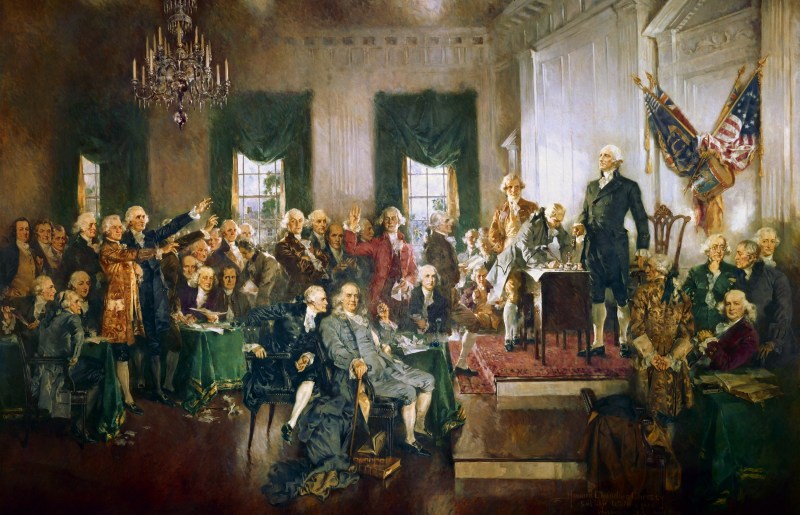
The summer of 1787 was supposed to mark the beginning of a new American experiment in self-governance. Instead, it became the moment when the dream of a unified republic died in the sweltering heat of Philadelphia’s Independence Hall. As delegates stormed out of the Constitutional Convention in August, no one could have predicted that within five years, the former thirteen colonies would fragment into three separate nations, each seeking protection under the wings of different European powers.
The Convention That Couldn’t
The warning signs were there from the beginning. The Articles of Confederation had already proven woefully inadequate—Congress couldn’t collect taxes, regulate interstate commerce, or even maintain a standing army. Shays’ Rebellion in Massachusetts had terrified the merchant class, while southern planters worried about slave uprisings without federal military support. The economic chaos was palpable: different states printed their own currencies, erected trade barriers against their neighbors, and squabbled over western territories.
When fifty-five delegates gathered in Philadelphia, they carried with them not just the hopes of a young nation, but the deep-seated prejudices and conflicting interests of their regions. The small states demanded equal representation; the large states insisted on proportional power. The South refused to count slaves for taxation but demanded they be counted for representation. Northern merchants wanted federal control over trade; Southern planters feared it would destroy their agricultural economy.
The breaking point came during the debate over the executive branch. Alexander Hamilton’s proposal for a president elected for life was shouted down as monarchical. The Southern delegates walked out when Pennsylvania’s Gouverneur Morris suggested that new western states should have limited representation to preserve the influence of the original thirteen colonies. By August 20th, the Convention had dissolved in acrimony, with delegates returning home to report that compromise was impossible.
The Great Fragmentation
Without a federal government, the confederation began to unravel almost immediately. The economic crisis deepened as states refused to honor debts to one another. Border disputes escalated into armed confrontations. By 1790, three distinct regional blocs had emerged, each seeking foreign protection to secure their interests.
The Northern Maritime Republic
The New England states, along with New York and New Jersey, formed the Northern Maritime Republic in 1791. Their economy was built on shipping, fishing, and emerging manufacturing. They had the most developed banking system and the strongest merchant class, but they lacked the agricultural base to feed their growing cities.
Desperate for markets and protection for their merchant marine, they turned to Great Britain. The British, still smarting from their loss in the Revolutionary War, were delighted to regain influence in North America. The Treaty of Boston in 1792 established the Northern Republic as a British protectorate. In exchange for preferential trade agreements and Royal Navy protection, the Northern Republic granted Britain exclusive trading rights in their ports and agreed to provide naval bases for the British fleet.
The relationship proved mutually beneficial. British capital flowed into Northern shipyards and early textile mills, while Northern merchants gained access to British markets and protection from pirates. The Northern Republic developed a parliamentary system closely modeled on Britain’s, with a Prime Minister answerable to an elected assembly. They kept their own currency but pegged it to the British pound.
The Southern Plantation Confederation
The Southern states—Virginia, North Carolina, South Carolina, and Georgia—had different concerns entirely. Their economy depended on tobacco, rice, and increasingly, cotton. They needed markets for their crops and, crucially, they needed assurance that their slave-based economy would be protected. The growing abolitionist sentiment in the North had alarmed Southern planters, who feared that any strong central government might eventually move against slavery.
The Southern Plantation Confederation, established in 1792, looked to France for protection. The French Revolution had created a republic that, despite its radical rhetoric about equality, was pragmatic about colonial slavery. France desperately needed raw materials for its industries and food for its Caribbean colonies. The Treaty of Richmond in 1793 established the Confederation as a French protectorate.
The French connection proved transformative for the South. French planters from Haiti, fleeing the revolution there, brought new agricultural techniques and expanded cotton cultivation. French capital helped build the first cotton mills in the South, though production remained focused on raw materials export. The Confederation adopted a republican government with a strong executive, modeled partly on the French system but with significant protections for slave owners written into their constitution.
The Middle Atlantic Union and the Western Spanish Protectorate
The middle states—Pennsylvania, Delaware, and Maryland—found themselves caught between their neighbors, while simultaneously facing the emergence of a fourth power that would reshape the entire continental balance. They had elements of both Northern commerce and Southern agriculture, but lacked the unity of economic interest that bound the other two regions. More critically, Pennsylvania’s rapidly growing western settlements beyond the Appalachians created a split that would prove impossible to bridge.
The western territories had always been economically distinct from the eastern seaboard. Settlers in what would have become Kentucky, Tennessee, and the Ohio Country depended entirely on river transport down the Ohio and Mississippi to New Orleans for their economic survival. When Spain closed the Mississippi to American commerce in the 1780s, these communities faced economic strangulation. It was into this desperate situation that figures like James Wilkinson stepped forward with a radical solution.
The Fourth Republic: The Western Spanish Protectorate
The most surprising development came from an unexpected quarter. In 1792, building on the existing Spanish conspiracy networks that had been operating since the late 1780s, the western settlements formally broke away to form the Western Spanish Protectorate. This confederation stretched from Fort Pitt (Pittsburgh) down the Ohio River valley, encompassed the entire Kentucky and Tennessee territories, and extended south to connect with Spanish New Orleans—creating a continuous Spanish-influenced corridor along the continent’s major river system.
The architect of this arrangement was General James Wilkinson, known to his Spanish handlers as “Agent 13.” Wilkinson had been secretly working with Spanish Governor Esteban Rodríguez Miró since 1787, when he swore allegiance to the King of Spain and received an annual pension of $2,000 for promoting Spanish interests in the western territories. Similar conspiracies had emerged in Tennessee, where leaders like James Robertson contacted Miró about the western settlements separating and joining Spain, while Dr. James White assured the Spanish governor that western settlers were prepared to set up an independent state under Spanish protection.
The economic logic was undeniable. Spain offered large land grants, religious tolerance, and the same commercial rights as Spanish subjects to Americans willing to swear loyalty oaths. For western farmers whose entire livelihood depended on shipping grain, tobacco, and livestock down the rivers to market, Spanish citizenship was a small price to pay for economic survival. Many prominent Americans, including Andrew Jackson, had already taken advantage of Spanish trading opportunities and signed loyalty oaths to conduct business down the Mississippi.
The Treaty of New Orleans in 1793 formalized the arrangement. The Western Spanish Protectorate received exclusive trading rights on the Mississippi, extensive land grants in Louisiana Territory, and Spanish military protection against Indian raids. In exchange, they provided Spain with a crucial buffer against British and French expansion, served as a source of agricultural products for the Caribbean colonies, and granted Spain strategic control over North America’s most important inland waterway.
The Reduced Middle Atlantic Union
Left with only their eastern portions, Pennsylvania, Delaware, and Maryland formed a much smaller Middle Atlantic Union in 1794. Deprived of their western territories and the crucial Ohio River trade route, they faced economic isolation between the British-backed North and French-supported South. The loss of western Pennsylvania was particularly devastating, as it had been the state’s fastest-growing region and a major source of agricultural exports.
The truncated Union initially attempted independence but soon realized the futility of their position. In 1795, they negotiated a protective arrangement with Spain as well, though of a different character than the western territories. The Treaty of Baltimore granted them limited access to Spanish markets through New Orleans and protection from their neighbors, but without the extensive territorial concessions that the western settlers had provided.
The Union developed a federal system that balanced the competing interests of its reduced but more homogeneous population. German-speaking communities in eastern Pennsylvania maintained significant autonomy, while Baltimore became a crucial entrepôt for trade between the Spanish territories and European markets. Though diminished, the Union found a profitable niche as intermediaries between the Spanish protectorates and Atlantic commerce.
The New Balance of Power
By 1800, North America had become a complex chess board of European rivalry, with four distinct American republics serving as proxies for their European protectors. The three American republics had become four, fundamentally altering the continental balance and creating a situation that more closely resembled the fragmented German states than the unified nation the founders had envisioned.
The Northern Maritime Republic evolved into a major naval power, with American-built ships carrying British goods around the world. Their close ties to Britain accelerated industrialization, making cities like Boston and New York major manufacturing centers. However, their dependence on British markets and protection limited their diplomatic freedom.
The Southern Plantation Confederation became the world’s largest producer of cotton, feeding both French and British textile industries despite the political tensions. The French connection helped them develop a more sophisticated plantation system, but it also made them increasingly dependent on slave labor as cotton cultivation expanded westward.
The reduced Middle Atlantic Union emerged as a crucial diplomatic mediator and commercial intermediary. Though geographically constrained, their position made them essential for any negotiations between the competing powers. Philadelphia remained the unofficial diplomatic capital of the former United States, hosting numerous conferences and trade negotiations.
The Western Spanish Protectorate developed into the continent’s agricultural powerhouse, controlling the entire Mississippi River system from Pittsburgh to New Orleans. Their strategic position gave them enormous leverage over continental trade, as goods from all other republics had to pass through Spanish-controlled waterways to reach international markets. The Protectorate’s diverse population—including French Creoles in Louisiana, Anglo settlers in Kentucky and Tennessee, German farmers from western Pennsylvania, and various Native American tribes who had allied with Spain—created a unique multicultural confederation unlike anything else in North America.
The Wilkinson Network’s Legacy
The success of the Western Spanish Protectorate owed much to the existing spy networks that James Wilkinson had established during the 1780s. These clandestine relationships provided the foundation for more formal diplomatic and commercial arrangements. Spanish officials like Governor Miró had been cultivating American separatist movements for years, offering land grants and commercial privileges to prominent Americans willing to swear loyalty to the Spanish crown.
The network included not just military figures like Wilkinson, but merchants, land speculators, and political leaders throughout the western territories. Benjamin Sebastian in Kentucky, various members of the Tennessee Cumberland settlements, and even some prominent Pennsylvanians had maintained correspondence with Spanish officials. When the Constitutional Convention failed, these existing relationships allowed for a rapid transition from covert influence to overt political arrangements.
Historical Foundation: The Spanish Conspiracies
This alternative history draws extensively on real historical events that nearly came to pass. The Spanish Conspiracy was not fictional—General James Wilkinson actually did swear allegiance to the King of Spain in 1787, received an annual pension of $2,000, and was known to Spanish officials as “Agent 13.” His “First Memorial” to Spanish Governor Esteban Rodríguez Miró explicitly sought to convince Spain to “admit us [Kentuckians] under protection as vassals.”
Similar conspiracies existed in Tennessee, where James Robertson contacted Governor Miró about the western settlements separating and joining Spain, while Dr. James White assured the Spanish governor that western settlers were prepared to set up an independent state under Spanish protection. Spanish policy actively encouraged these separatist movements, offering “land grants and promises of religious tolerance to induce Americans to settle in Spanish territory while at the same time encouraging and fomenting separatist movements in the American West.”
The economic pressures were real and severe: “Spain forbade American access to the river, and the North Carolina government in the east did not support the westerners in their demands for navigation rights. Cut off from any legal outlet for trade and harassed by the Creeks, the western settlements became vulnerable to the possibility of breaking ties with the east.” For western settlers, “Spain’s closure of the river seemed certain either to slow the westward movement of Americans, which was Spain’s intent, or to lead western settlers to break from the United States, establish their own nation-states, and negotiate separate access to the river.”
The failure of the Articles of Confederation created the perfect conditions for such arrangements. Congress couldn’t collect taxes, regulate interstate commerce, or maintain military forces, leaving western settlements particularly vulnerable to both economic strangulation and Indian attacks. In our timeline, the Constitutional Convention succeeded just barely, but the regional tensions and economic conflicts that nearly tore it apart were very real.
The story of the three American republics serves as a reminder that the United States as we know it was not inevitable. It was the product of compromise, luck, and the willingness of imperfect people to work together toward an uncertain future. The founders’ greatest achievement may not have been creating a perfect system of government, but rather creating one flexible enough to survive its own contradictions and grow into something they could never have imagined.
Perhaps most importantly, this alternative history shows us that even when grand plans fail, people find ways to adapt and survive. The three republics each found their own path to prosperity and stability, even as they remained forever changed by the dream of what might have been—a single, unified American nation stretching from sea to shining sea.
Primary Historical Evidence
- James Wilkinson’s Spanish Allegiance (1787): Documentation of Wilkinson’s oath of allegiance to Spain, his $2,000 annual pension, and his designation as “Agent 13”
- Wilkinson’s “First Memorial”: His direct correspondence with Spanish Governor Esteban Rodríguez Miró proposing to make Kentucky Spanish vassals
Academic Sources
- Spaniards, Scoundrels, and Statesmen: General James Wilkinson and the Spanish Conspiracy, 1787-1790 – Comprehensive academic analysis of Wilkinson’s treasonous activities
Reference Works
- Tennessee Encyclopedia: “Spanish Conspiracy” – Detailed coverage of similar conspiracies involving James Robertson and Dr. James White’s contacts with Spanish officials regarding western settlements
- Wikipedia: “Hanover” – Additional context on separatist movements in the American West
- 64 Parishes: “Spanish Colonial Louisiana” – Analysis of Spanish colonial policy offering land grants and religious tolerance to attract American settlers
Historical Context Sources
- Virginia Encyclopedia: Documentation of Spain’s Mississippi River closure and its economic impact on western settlers
- Tennessee Encyclopedia: Analysis of how Spanish policies threatened to fracture the early United States by encouraging western regions to establish independent nation-states
This idea of a fractured and disembodied American republic comes from Alan Taylor’s “American Republics” (2021, WW Norton) and how the fragility of the US Constitutional Convention gets lost in today’s history classes.
While these events are not true they are based on historic fact and the possibility of one change in history. To read more of my Alternate History scenarios, be sure read here.

 BFWClassroom
You must be logged in to post a comment.