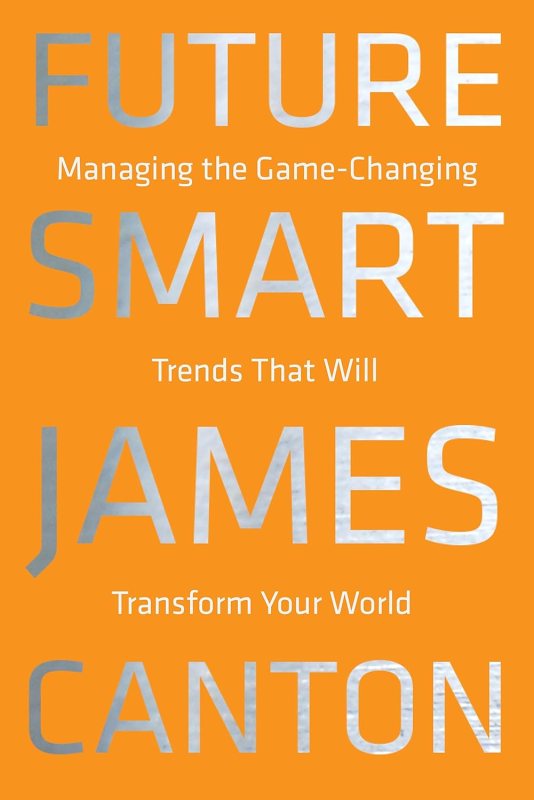
Book: Future Smart: Managing the Game-Changing Trends That Will Transform Your World by James Canton
Publisher: Da Capo Press (2015)
Audience: High School (Advanced) to College Level
Recommended for: AP Human Geography, Economics, English Language Arts, Technology and Society electives
Rating 3.75 of 5 Stars
Why This Book Matters (and Why Timing Matters More)
There is something genuinely poignant about reading a futurist’s predictions after the future has already arrived. James Canton’s Future Smart, published in 2015 with the confident urgency of a manifesto, promised to prepare readers for the sweeping technological, economic, and social disruptions heading toward us at speed. A decade later, that promise lands with a complicated thud; some of his forecasts proved prescient, others already feel like artifacts of a moment that has quietly passed us by, and the book’s style makes navigating either category more work than it should be.
Canton, a longtime technology forecaster and CEO of the Institute for Global Futures, built his reputation on advising governments and corporations about what comes next. Future Smart represents his most ambitious attempt to translate that expertise for a general audience, covering everything from artificial intelligence and biotechnology to climate disruption and geopolitical power shifts. Reading it now offers educators and advanced students a genuinely interesting exercise: not just in what a futurist predicted, but in how we evaluate prediction itself as a form of intellectual work.
Where Canton Got It Right
Credit where it is due: Canton correctly identified several currents that have since become undeniable facts of our world. His insistence that artificial intelligence would move from the margins of tech culture to the center of economic and social life reads now less like prophecy and more like observation delivered slightly early. He understood that the convergence of big data, machine learning, and connectivity would reshape labor markets in ways that would disorient workers and policymakers alike; those concerns, which felt somewhat abstract in 2015, feel urgently concrete today.
Canton also pressed readers to think seriously about climate disruption not as an environmental issue but as a strategic and economic one, arguing that nations and corporations ignoring climate risk were making a fundamental miscalculation about competitive advantage. He saw the rise of what he called the “innovation economy” driving inequality, fraying social contracts, and creating political instability in ways that would challenge liberal democratic institutions. None of that has aged poorly.
For classroom purposes, these passages retain genuine educational value. A teacher could assign specific chapters on AI or climate economics alongside current news analysis, asking students to evaluate what Canton anticipated correctly and where
reality diverged from forecast. That kind of critical comparison sharpens exactly the analytical thinking that AP-level social studies courses are designed to cultivate.
The Problem of Prose: When Style Undermines Substance
Unfortunately, Future Smart presents a significant obstacle that no amount of curricular creativity can fully overcome: the writing itself. Canton adopts a relentlessly breathless register that mistakes repetition for emphasis and jargon for insight. Sentences pile up in quick succession, each announcing that something is transformative, game-changing, or unprecedented, until those words lose whatever gravitational pull they once carried. The cumulative effect is exhaustion rather than urgency.
Consider how Canton approaches nearly every major topic: he introduces a trend, attaches a proprietary-sounding label to it, asserts its world-altering significance, and moves on before the reader has had a chance to sit with the idea. The book is full of formulations like “smart innovation ecosystems” and “future-ready organizations,” phrases that feel less like analytical tools and more like consultant-speak reaching for the impression of precision without quite achieving it. For high school readers, who are still learning to distinguish between ideas that sound important and ideas that actually are, this kind of prose is actively unhelpful.
Reading Future Smart in audiobook format would likely amplify these frustrations considerably. The written page at least allows a reader to pause, re-read a murky sentence, or skim past a particularly thin section; audio offers no such escape. The book’s lack of a strong narrative throughline, which might have compensated for its stylistic habits, makes sustained listening a genuine chore.
The Decay of Novelty: Reading a Decade Behind
Part of what makes the timing problem so acute is that Canton’s rhetorical strategy depends heavily on shock. He needs readers to feel the disorientation of encountering possibilities they had not seriously considered; that disorientation is the engine of the book’s energy. But the specific technologies and trends he positioned as startling in 2015 have since become household conversations. Artificial intelligence, gene editing, the gig economy, and the fragility of democratic institutions are no longer speculative concerns requiring a futurist to introduce them. They are the daily texture of contemporary life.
This is not really Canton’s fault; it is simply what happens when a book built around novelty meets a world that has caught up. But it does mean that educators considering Future Smart as classroom reading should think carefully about what problem they are trying to solve. If the goal is to introduce students to futures thinking as a methodology, there are fresher texts that accomplish this without the accumulated dust of dated predictions. If the goal is to use the book as a case study in forecasting, its datedness becomes the assignment rather than an obstacle; students can systematically evaluate Canton’s track record, which is a legitimately valuable exercise in applied critical thinking.
Classroom Applications and Honest Limitations
Future Smart is most useful in the classroom not as assigned independent reading but
as a source of excerpts for structured analysis. Individual chapters on artificial intelligence, biotechnology, and geopolitical competition contain enough substantive forecasting that students can engage with them critically; those chapters work well alongside more recent sources, inviting comparison and argument rather than passive absorption.
Teachers should be prepared for student frustration with the book’s style. This frustration is worth addressing directly rather than dismissing; the question of why a book about important ideas fails to communicate them compellingly is itself a rich classroom discussion. Canton’s book inadvertently teaches something valuable about the relationship between style and persuasion, and a teacher who frames it that way can turn the book’s weakness into a lesson about how effective argument actually works in nonfiction prose.
For English Language Arts courses specifically, Future Smart offers a useful negative model alongside more successful examples of popular nonfiction. Comparing Canton’s approach to writers like Michael Lewis or even Tim Marshall (whose Prisoners of Geography accomplishes something similar in scope while remaining rigorously readable) helps students understand that clarity and intellectual seriousness are not in tension; the best nonfiction writers treat them as inseparable.
Final Assessment
James Canton is a genuinely serious thinker about the forces shaping our world, and Future Smart contains real insight buried within its pages. The problem is the burying. A decade after publication, the book’s most resonant predictions have been validated by events; its prose, however, has not improved with age, and the novelty that once might have carried readers through the stylistic slog has largely evaporated.
Educators looking for a text that introduces students to futures thinking, technological disruption, or the intersection of innovation and social change will find better options available now, options that were written after the world Canton was predicting had actually arrived. Future Smart works best as a document to think about rather than a guide to think with: a snapshot of a futurist’s mind at a particular moment, with all the illuminations and blind spots that entails.
Approached that way, with realistic expectations and specific curricular goals, it has something to offer. Approached as the transformative, game-changing resource its subtitle promises, it will disappoint.
Recommended for: AP Human Geography units on global economic change; ELA courses studying nonfiction argument and style; Technology and Society electives with capacity for critical comparison assignments.

 BFWClassroom
You must be logged in to post a comment.