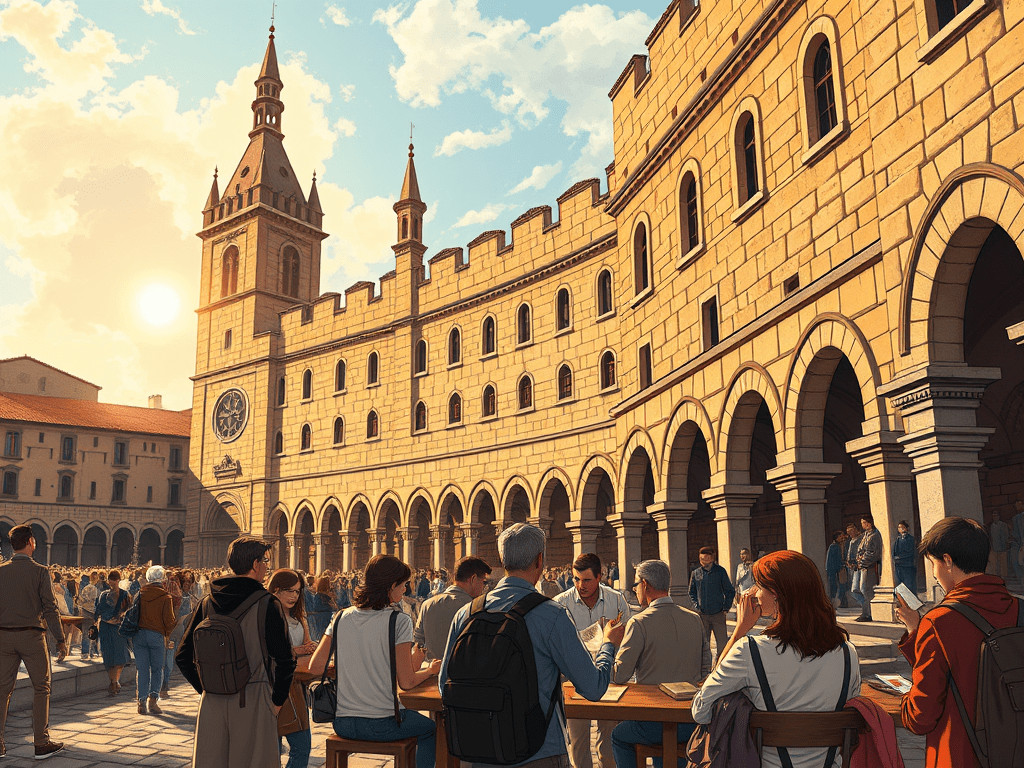
Posted for April 23 — St. George’s Day, and a fitting moment to celebrate the medieval English and European academic traditions that gave us the modern university
Every August, students across the globe pack up belongings, move into dormitories, and begin a ritual that feels deeply modern: signing up for courses, sitting in lecture halls, earning degrees that will (hopefully) open professional doors. What most of those students don’t realize is that this entire system, the credits, the faculties, the tension between institutional autonomy and outside funding, was essentially invented between roughly 1150 and 1350 CE. It was invented not by governments, not by tech billionaires, and not by secular reformers. It was invented, in fits and starts, by a medieval Catholic Church that couldn’t quite decide whether it wanted to control knowledge or simply unleash it.
By 1300, five universities stood as the undisputed pillars of European higher learning. Each was different in temperament and governance; yet each wrestled with the same fundamental question that still haunts higher education today: who gets to decide what is worth knowing, and who gets to pay for it?
The Five Pillars, circa 1300
Bologna (founded c. 1088) was the oldest and, in some respects, the most radical. Where other universities were organized around the faculty, Bologna was organized around the students themselves. Student guilds, called universitates, negotiated with professors over lecture schedules, fees, and the content of instruction. Professors who showed up late, kept poor notes, or skipped chapters faced fines. Bologna specialized in Roman law and canon law, which made it the training ground for the administrative class of both the papacy and the emerging Italian city-states. If you needed someone to draft a treaty, parse an inheritance dispute, or argue a case before a papal tribunal, you hired a Bologna graduate. This gave Bologna a distinctly practical flavor; it was never quite as theological as Paris, and its student-centered governance model would prove influential even if it was ultimately the exception rather than the rule.
Paris (organized by royal charter in 1200, though teaching predates that by decades) was, in many ways, the opposite of Bologna. Here, the masters controlled the curriculum, and the curriculum was dominated by theology and philosophy. Paris sat at the intersection of the Church’s intellectual ambitions and the explosive rediscovery of Aristotle, whose works had been largely unknown to Western Europe until Arabic translations (and their Latin renderings) began flooding through Spain and Sicily during the twelfth century. The University of Paris became the laboratory where scholastic theologians, most famously Thomas Aquinas, tried to reconcile Aristotelian logic with Christian doctrine. It was thrilling and dangerous work; the Bishop of Paris condemned a long list of Aristotelian propositions in 1277, suggesting that even within the Church’s most privileged institution, the tension between faith and reason could become explosive. Paris also pioneered the college system, where endowed residential halls (funded by private donors) gave poor students a place to live and study, and this pattern of private philanthropy funding institutional housing would echo through Oxford, Cambridge, and eventually the American residential college.
Oxford (teaching documented from 1096, rapidly expanded after 1167) grew partly as a political accident. When Henry II of England quarreled with the papacy over Thomas Becket, English students studying in Paris were recalled home by royal order; scholars flooded into Oxford, and what had been a modest collection of masters and students suddenly became something much larger. Oxford developed a fierce independence from both the Church and the Crown, and its characteristic structure, autonomous colleges funded by private endowments, gave it a resilience that purely crown-funded or church-funded institutions lacked. The Dominicans and Franciscans established houses in Oxford during the mid-thirteenth century and became some of its most intellectually aggressive voices; Roger Bacon, a Franciscan friar, conducted what might be called the earliest systematic experimental investigations into optics and natural philosophy within Oxford’s walls. The tension between the mendicant orders (who answered to Rome) and the secular masters (who answered to local ecclesiastical authority) made Oxford a perpetually contested space, and that contestation seems to have been intellectually generative.
Cambridge (founded 1209) is, in a sense, Oxford’s child. After a violent clash between Oxford students and townspeople in 1209, a group of scholars fled northeast and established a new institution on the fens. Cambridge would develop along lines broadly parallel to Oxford, with its own college system and its own blend of private endowment and Church patronage; for most of the medieval period it was the smaller and less prestigious of the two, but by the sixteenth century it would become the seedbed of the English Reformation in ways that would reshape the entire Anglophone world.
Salamanca (royal charter 1218, confirmed by Pope Alexander IV in 1255) represented a different and underappreciated strand of the university tradition. Founded under the patronage of Alfonso IX of León, Salamanca was from the beginning more intertwined with royal power than with papal authority, and it served a kingdom (and later an empire) with urgent practical needs. Salamanca trained the lawyers, theologians, and administrators of the Spanish Crown; by the late fifteenth century, it was producing the canonical debates about indigenous rights in the Americas that represent some of the earliest systematic thinking in Western history about international law and human rights. It was also deeply embedded in the multilingual, multicultural Iberian world, where Christian, Jewish, and Islamic intellectual traditions had mingled for centuries. Salamanca’s relationship with the Crown gave it funding and protection, but also made it vulnerable to royal interference in ways that the more insulated Oxford colleges were not.
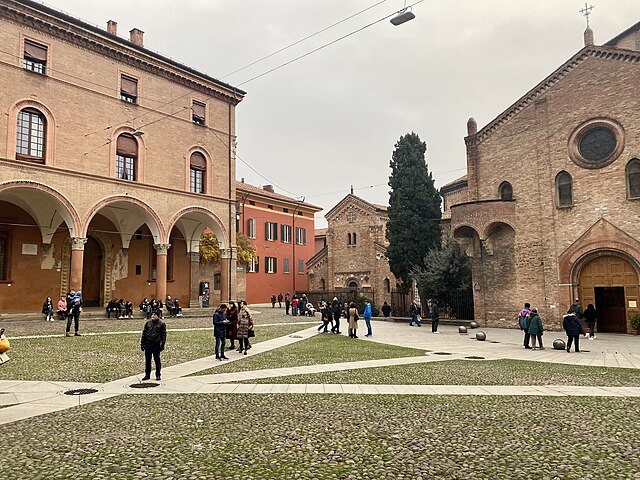
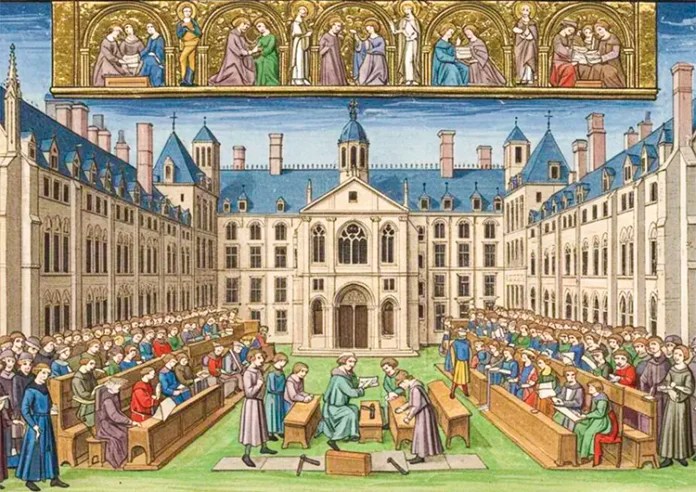
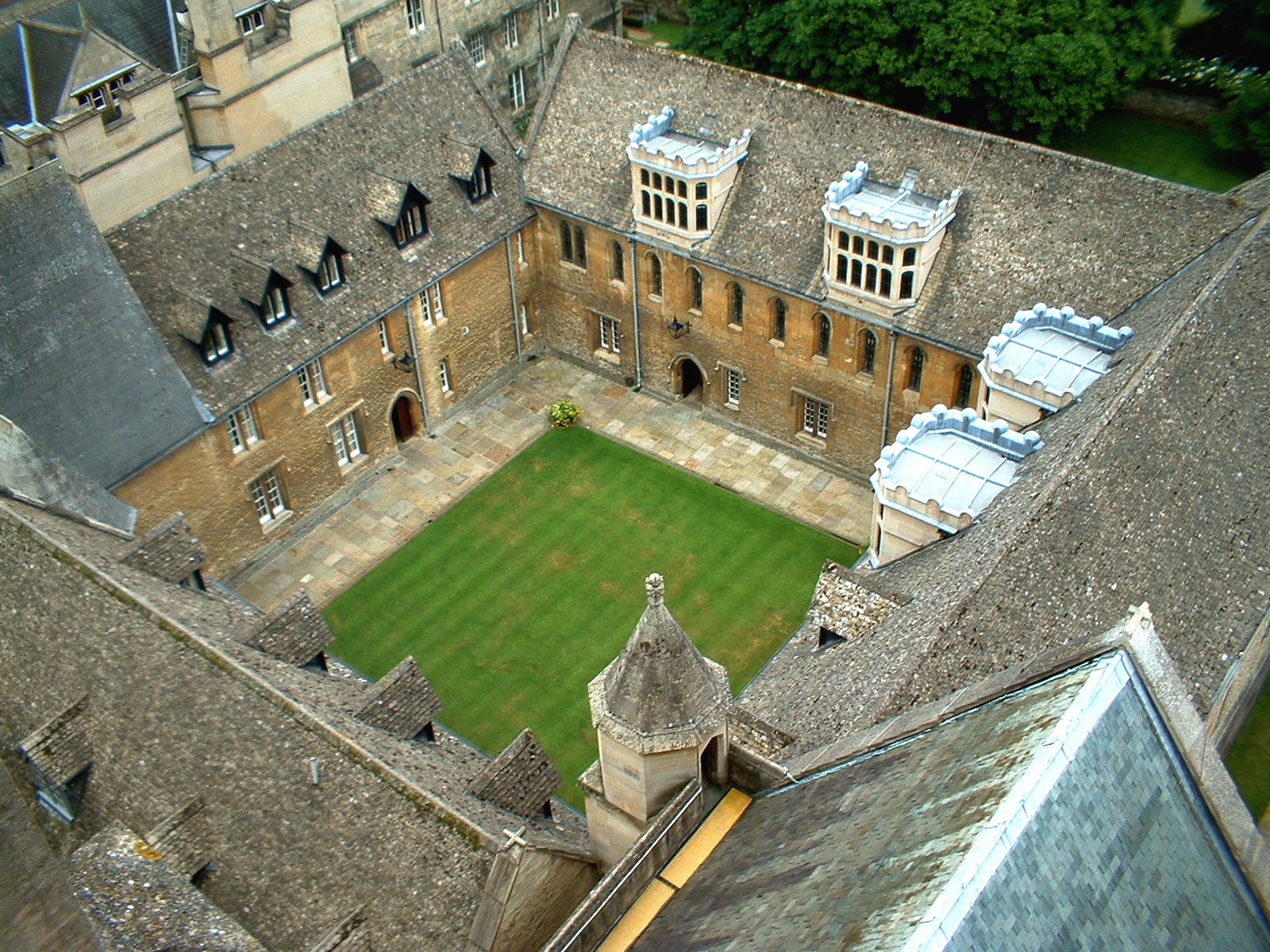
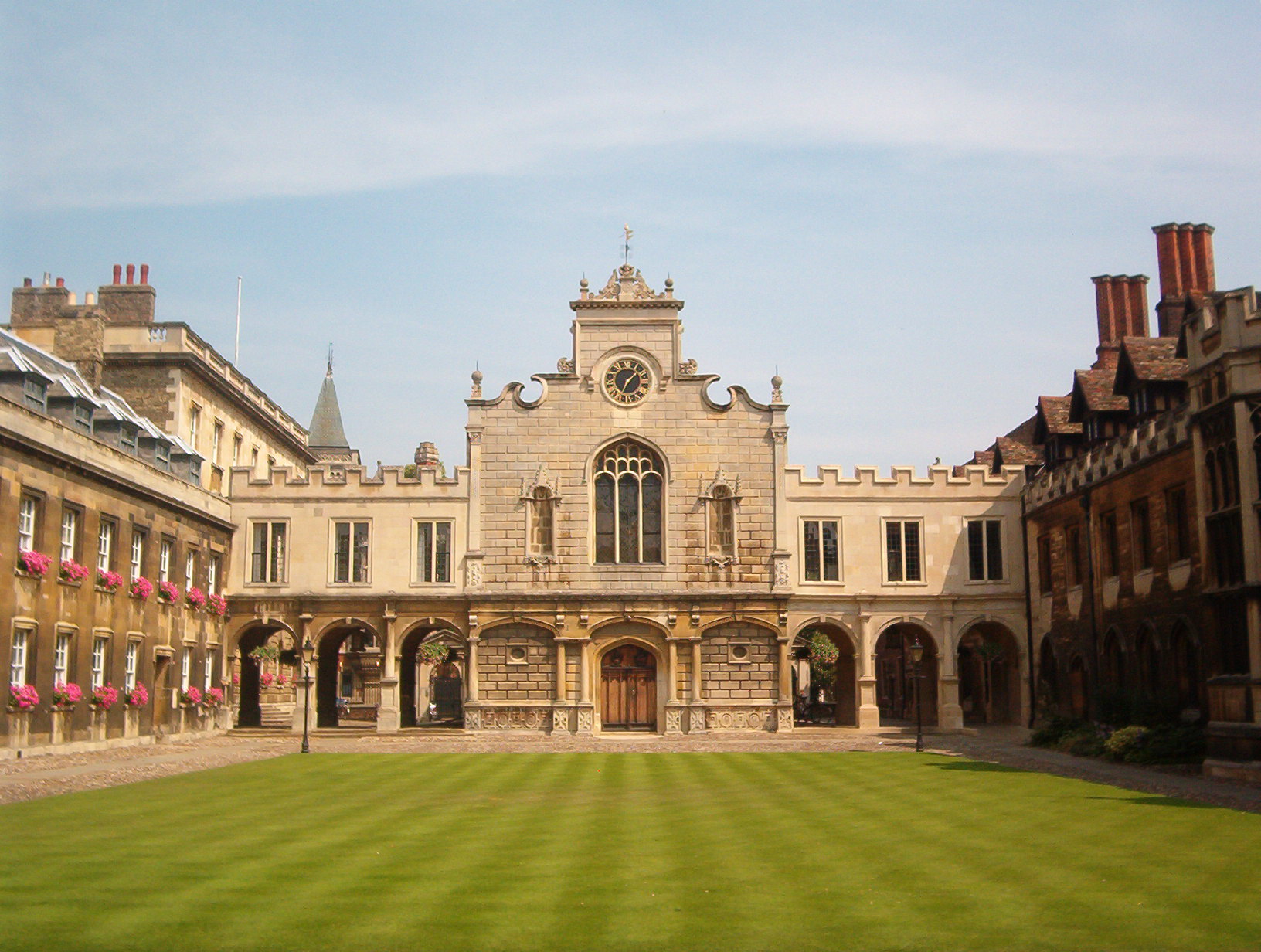
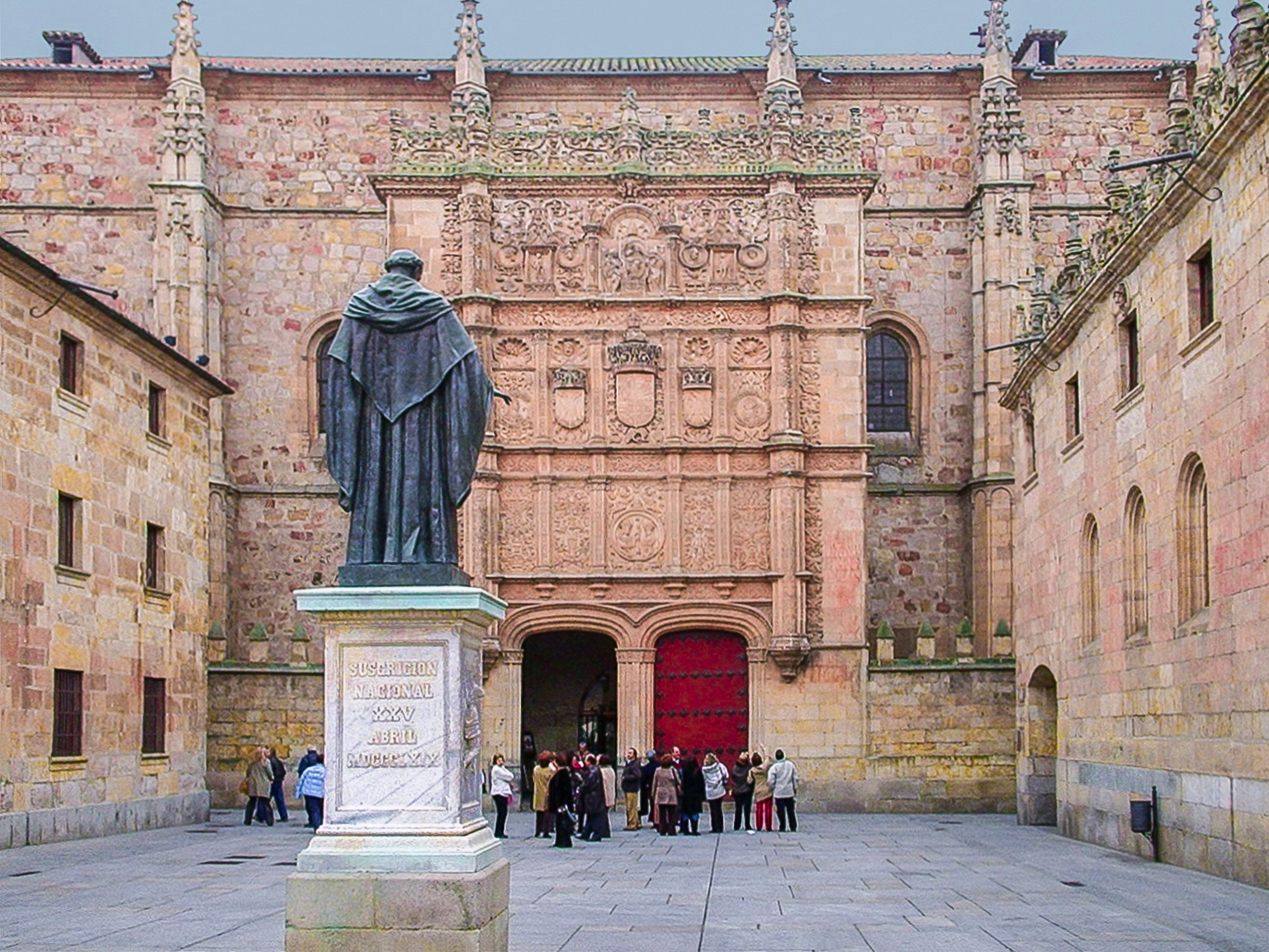
Clockwise from top left: Campus of University of Bologna, Manuscript of friars debating at the University of Paris, oldest Quad at Oxford, courtyard at University of Salamanca, and Old Peterhouse Chapel at Cambridge,
What the Fourteenth Century Changed
The 1300s were brutal and brilliant in roughly equal measure. The Black Death (arriving in Europe in 1347) killed between one-third and one-half of the continent’s population. The Hundred Years’ War destabilized France. The papacy relocated to Avignon and then fractured into competing claimants during the Great Schism. And yet, paradoxically, the fourteenth century also produced an extraordinary proliferation of new universities, and the reasons for that proliferation reveal something important about why the university system took the shape it did.
The key dynamic was this: before the Black Death, a student who wanted a first-rate education had to travel. Paris, Bologna, Oxford, Cambridge, and Salamanca drew students from across Europe, and this cosmopolitanism was partly their appeal and partly their institutional strength. After the plague, travel became more dangerous, populations were depleted, and local rulers who were trying to rebuild their administrative capacity could not simply send their best young men across the continent on the hope that they would return. The result was a wave of locally founded universities, each typically chartered by both a pope (who provided the institutional legitimacy and the right to award degrees recognized across Christendom) and a local secular authority (who provided land, funding, and a student population by mandating or encouraging attendance). Prague was founded in 1348 by Holy Roman Emperor Charles IV; Kraków in 1364 by Casimir the Great of Poland; Vienna in 1365 by Rudolf IV of Austria; Heidelberg in 1386 by Elector Rupert I of the Palatinate. Each of these was, in a sense, a nation-building project as much as an educational institution.
This pattern reveals the fundamental funding bargain that undergirded the medieval university, and that in modified form still underlies higher education today. The Church provided legitimacy, curriculum framework (theology at the center, with law, medicine, and the arts as satellites), and a universal degree currency, since a degree from any recognized studium generale was in principle valid throughout Christendom. Local secular authorities provided money, land, and a captive student population. Private donors (wealthy merchants, noble families, bishops acting in their personal rather than institutional capacity) endowed colleges, chairs, and scholarships. The resulting institution served three masters simultaneously: universal Catholic learning, local political need, and private philanthropic ambition. The tensions between these three sources of authority and funding were never resolved; they were simply managed, and that management produced something surprisingly durable.
The Mendicant Orders as Intellectual Wild Cards
One piece of this story that tends to get overlooked in survey treatments is the role of the Dominican and Franciscan orders (the mendicants, who took vows of poverty and were theoretically supported by begging rather than institutional wealth). Both orders established houses at every major university in Europe during the thirteenth century, and their presence fundamentally altered the intellectual character of those institutions.
The Dominicans, founded specifically to combat heresy through argument rather than force, were trained debaters who brought to the universities an emphasis on rigorous logical disputation; it is no accident that Thomas Aquinas (a Dominican) produced the Summa Theologica, one of the most systematically structured works in the Western intellectual canon. The Franciscans brought a different but equally powerful energy, one more inclined toward mysticism, toward direct observation of the natural world, and toward an almost democratic suspicion of institutional authority. Roger Bacon, William of Ockham, and (slightly later) Duns Scotus were all Franciscans, and their willingness to challenge received wisdom, whether from Aristotle or from the Church fathers, helped push European thought toward what we would eventually call empiricism.
Neither order was working against the Church; both were intensely Catholic. But both brought to the universities an institutional culture that was simultaneously inside and outside the normal ecclesiastical hierarchy, and that double position gave them a degree of intellectual freedom that secular masters and bishops often lacked. The mendicant houses at Oxford and Paris were, in a real sense, the first research institutions in Europe; their members were supported by their orders to think, write, and argue full-time, without the parish duties or administrative burdens that occupied most secular clergy.
The Model That Stuck
By 1400, the outlines of the modern European university were essentially in place. A central institution with recognized degree-granting authority, chartered by both ecclesiastical and secular power, funded through a combination of public support and private endowment, organized into faculties or colleges with semi-autonomous governance, attracting students from across a defined geographic region, and producing graduates trained for specific professional roles (law, medicine, theology, and administration): this is the medieval university, and it is recognizably also the twenty-first century university, albeit with the theology faculty somewhat diminished in status.
What the fourteenth century added, through the forced decentralization caused by plague and political fragmentation, was the idea that each significant political community deserved and needed its own university. This is the origin of the pattern by which every German principality, every Italian city-state, every Iberian kingdom eventually established its own institution; and it is the origin of the eventual American pattern, in which every state and eventually every major city sought to build something that combined public funding, private endowment, and professional training under a single institutional roof.
The bargain between the universal (the Church’s intellectual framework, later secularized but not really replaced) and the local (the prince, the city, the state, the benefactor who wants a building named after his family) is still the bargain that higher education strikes. Tuition, grants, alumni donations, state appropriations, federal research funding: these are the modern heirs of papal bull, royal charter, private bequest, and mendicant patronage. The names have changed; the structural tensions have not.
Why April 23?
April 23 is St. George’s Day, the feast of England’s patron saint, and it falls at a moment when the medieval academic calendar (organized around the four quarter days) was transitioning from the Easter term into the long summer period of study. More importantly, it is a day associated with English cultural memory in its deepest registers; Shakespeare was (probably) born and died on April 23, and the saint’s connection to both knightly virtue and dragon-slaying makes him an apt figure for the enterprise of higher learning, which has always involved a degree of combat with the monsters of ignorance, dogma, and institutional inertia.
For educators who want to mark the occasion, the story of the medieval university offers something genuinely worth celebrating: an institution that managed to survive plague, schism, war, and the competing ambitions of popes and princes, and that did so because it had distributed its foundations widely enough that no single catastrophe could bring it down. The model was messy, politically complicated, and never ideologically pure. It was also extraordinarily generative. Not a bad set of qualities for a classroom, come to think of it.
Further Reading: Charles Homer Haskins, “The Rise of Universities” (1923) remains the most readable introduction; more recent scholarship is available in Hilde de Ridder-Symoens, ed., “A History of the University in Europe, Volume I: Universities in the Middle Ages” (Cambridge University Press, 1992). “Powers and Thrones: A New History of the Middle Ages” Chapter 11: Scholars is a wonderful concise read and introduction (Viking, 2021)


You must be logged in to post a comment.