
Louis XIV, the Huguenots, and the Road Not Taken (1685)
Historical Grounding
On October 18, 1685, Louis XIV signed the Edict of Fontainebleau and erased nearly ninety years of uneasy but functional religious coexistence in France. The Edict of Nantes, issued by his grandfather Henry IV in 1598, had granted French Protestants (known as Huguenots) the right to worship in designated towns, to hold public office, and to maintain a network of fortified strongholds as security against Catholic reprisal. It was never a model of tolerance in the modern sense; it was a negotiated armistice between two communities that had spent the previous four decades tearing the country apart. But it worked, more or less, for the better part of a century.
By the time Louis moved against it, the Huguenots numbered somewhere between 800,000 and one million people in a kingdom of roughly twenty million. They were disproportionately represented among skilled artisans, merchants, textile manufacturers, and military engineers; cities like La Rochelle, Nîmes, and Montauban had substantial Protestant commercial classes. They were also, on the whole, politically loyal. The Fronde had not been their rebellion; they had largely sat it out. Louis’s decision to revoke the Edict was not driven by a genuine Huguenot threat to his throne but by a combination of sincere Catholic piety, the counsel of his Jesuit confessors, and the political logic of “one king, one law, one faith” that had become the ideological cement of absolute monarchy.
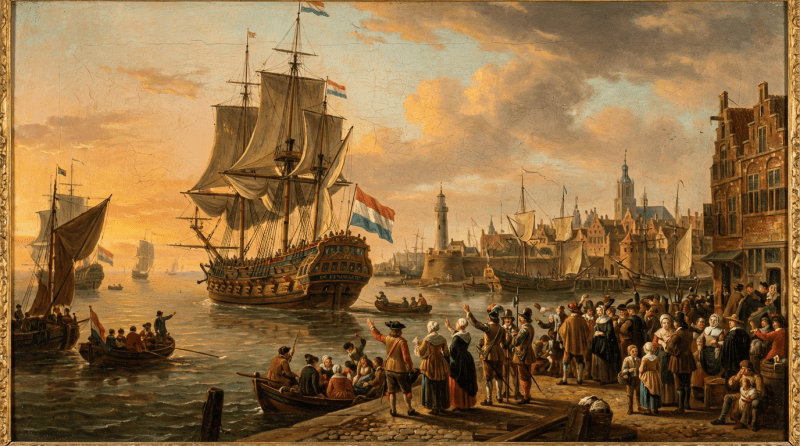
The immediate consequences were catastrophic. The Edict of Fontainebleau forbade Protestant worship, required the baptism of Huguenot children in the Catholic faith, and ordered Protestant pastors to convert or leave the country within a fortnight. Dragonnades, the brutal practice of quartering soldiers in Protestant households to compel conversion by harassment, had already been running for months before the formal revocation. Somewhere between 200,000 and 400,000 Huguenots fled France in the years that followed, despite royal edicts forbidding emigration. They went primarily to England, the Dutch Republic, Prussia, South Africa, and the Swiss cantons, taking their skills, their capital, and their networks with them.
The long-term consequences for France were severe and in some respects permanent. Entire industries collapsed or relocated. The silk trade of Lyon lost master weavers. The clockmaking and instrument-making trades of Paris thinned dramatically. The Prussian army gained skilled officers. The Bank of England was co-founded by Huguenot refugees. William III’s invasion of England in 1688, which dethroned the Catholic James II, was substantially financed and staffed by men whose families had been driven from France. Louis had intended to consolidate his kingdom; instead he had distributed its talent and its Protestant grievances across Protestant Europe.
The Huguenots were not simply religious refugees. They were a knowledge diaspora, and the nations that received them understood the value of what France had thrown away.
The revocation also hardened the confessional divisions of European politics for a generation. It gave William III the propaganda of a lifetime; it confirmed every Protestant suspicion about Catholic absolutism; and it complicated Louis’s diplomatic position in ways that contributed to the formation of the Grand Alliance that opposed him in the Nine Years’ War and the War of the Spanish Succession. The Sun King had not weakened France’s enemies. He had enriched them.
Point of Departure
The counterfactual here does not require us to imagine Louis XIV as a different kind of man, which is the surest way to produce historically useless speculation. Louis was genuinely devout, genuinely committed to confessional uniformity, and genuinely susceptible to the counsel of his confessor, Father La Chaise, and the influence of his morganatic wife, Françoise d’Aubigné (Madame de Maintenon), herself a converted Protestant. Those facts are fixed.
What was not fixed was the timing and the form. The revocation was not inevitable in 1685; it had been resisted within the royal council for years by figures like Colbert, who understood perfectly well what the economic consequences would be, and by diplomats who worried about its effect on alliances. Colbert died in 1683, which removed the most powerful voice for restraint. But his successor in economic matters, his son the Marquis de Seignelay, was not indifferent to the arguments. The pressure from the devout court faction had also been building for years; what changed in 1684 and 1685 was the combination of a major Catholic military victory (the fall of Luxembourg), a shift in the political atmosphere of the court, and the particular momentum of the dragonnades, which were generating reports of mass conversions that flattered the king into believing the problem was nearly solved.
Our point of departure is this: Louis XIV, persuaded by a combination of economic advisors and moderate Catholic counsel that formal revocation would produce exactly the brain drain that in fact occurred, issues instead a series of administrative restrictions on Huguenot worship that tighten conditions without eliminating the legal framework of the Edict. Call it the Reform of Nantes rather than the Revocation. Huguenot assemblies are reduced in number; Protestant pastors face increased harassment and legal obstacles; conversion is rewarded with tax exemptions and preferment. But the Edict itself stands. Emigration continues at a slower pace, driven by social pressure rather than legal compulsion, but the mass exodus of 1685 to 1700 does not happen.
This is plausible. Louis was not unpersuadable on practical matters when the argument was framed in terms of royal interest rather than principle. Colbert had delayed the revocation for years on exactly these grounds. What we are imagining is that Colbert lives a year or two longer, or that Seignelay makes the economic case forcefully enough in the council of 1685 to produce a more limited outcome. A small change in the composition of a royal council, in the presence or absence of a single influential voice, is exactly the kind of contingency that drives real historical change.
An Alternate Chain of Events
The most immediate consequence of maintaining the Edict, even in a weakened form, is that France retains the bulk of its Protestant commercial and artisanal class. The silk weavers of Lyon stay. The instrument makers and clockmakers of Paris stay, or most of them do. The financial networks that Huguenot merchants maintained across the Atlantic world, connecting La Rochelle to the Caribbean and the Protestant communities of the Dutch Republic, remain intact and operating within the French commercial system rather than being redirected into competing economies.
This matters enormously for the War of the League of Augsburg (the Nine Years’ War, 1688 to 1697) and its successor conflict. In the actual history, Louis fought both wars with a France already weakened by the economic disruption of the revocation and diplomatically hampered by the propaganda gift he had handed to William III. In our alternate timeline, the Huguenot artisan and merchant class remains a source of tax revenue rather than a source of Protestant propaganda; the grand coalition that William assembled against Louis is harder to hold together when it cannot point to religious persecution as a rallying cause.
The Dutch Republic and England still have reasons to oppose French hegemony in Europe; those reasons are geopolitical and commercial, not only confessional, and they do not vanish. The War of the League of Augsburg probably still happens. But it happens without the particular moral energy that the revocation gave to Louis’s opponents, and France fights it with a somewhat stronger economic base. The war may end differently, or on different terms; the Peace of Ryswick (1697) in the actual history left France exhausted and Louis chastened. In our alternate timeline, France negotiates from a somewhat stronger position.
The more interesting long-term divergence involves England. The Glorious Revolution of 1688 is, in the actual history, partly a Huguenot story: the financial backing, the organizational networks, the propaganda apparatus that made William’s invasion of England feasible all drew heavily on the refugee communities driven out of France. In our alternate timeline, those communities are smaller, less concentrated in England, and less politically motivated by fresh grievance. William still has reasons to pursue the English crown; the geopolitical logic of preventing a Catholic Stuart monarchy from being a French satellite is powerful regardless of religion. But the practical infrastructure of his invasion is weaker.
Does the Glorious Revolution still happen? Probably, but perhaps later, and perhaps with a different outcome. James II might be deposed but on terms that leave the English constitutional settlement more ambiguous; or the revolution might succeed on schedule but with a slightly different cast of characters and a slightly different set of financial arrangements. The Bank of England, which in actual history drew substantially on Huguenot capital and organizational expertise, might be founded later or on a smaller initial basis. The financial revolution that made England the dominant commercial power of the eighteenth century depended heavily on institutions and expertise that the Huguenot diaspora helped build. Slow that diaspora and you slow, at least modestly, the financial development of Protestant England.
The more dramatic divergence involves France itself. In our alternate timeline, a Huguenot commercial class that remains within France is a permanent source of social and eventually political tension. The Huguenots are not going to disappear through gradual conversion; the experience of the actual restrictions shows that harassment produces surface conformity and underground practice, not genuine religious change. What Louis has done in our scenario is create a legally ambiguous religious minority that is economically valuable but socially suspect, tolerated but not accepted, remaining in France but never fully incorporated into the Catholic social order.
This creates a different kind of pressure as the eighteenth century develops. The Enlightenment critique of religious intolerance, which in actual history drew heavily on the example of the revocation (Voltaire’s treatment of the Calas affair, his attacks on l’infâme, are directly connected to the Huguenot experience), still develops; the philosophes still find religious bigotry a useful target. But the argument is somewhat different. Instead of pointing to France’s expulsion of its Protestants as an example of barbaric policy, Voltaire and his contemporaries point to the continued second-class status of a Protestant minority that is present, visible, and economically productive but excluded from full civic life. The argument becomes less about past catastrophe and more about ongoing injustice, which is in some ways a sharper and more politically urgent critique.
The French state, managing this tension through the eighteenth century, is under pressure to either formalize Huguenot exclusion (which risks the economic consequences Louis avoided in 1685) or to move toward something like genuine toleration (which risks the wrath of the French Catholic Church and the more devout elements of the nobility). The Edict of Versailles, which in actual history was issued in 1787 and restored limited civil rights to French Protestants, might come earlier in our timeline, driven by the practical pressure of administering a large and economically important minority. Or it might come later, blocked by precisely the fear of Protestant political organization that a larger and more coherent community would generate.
Long-Term Consequences
The geopolitical consequences of a France that retains its Huguenot population ripple forward in ways that are genuinely difficult to trace with confidence, but a few threads are worth following. The first is the shape of European finance and industry in the eighteenth century. In actual history, the Huguenot diaspora was one of the significant mechanisms by which commercial and industrial expertise was transferred from France to England, Prussia, and the Dutch Republic. Huguenot refugees helped establish or expand the textile industries of England and Prussia; they brought clockmaking, instrument-making, and precision manufacturing techniques; they contributed to the development of banking and insurance institutions. A France that retains this talent base does not fall behind in these industries as rapidly as it actually did. The gap between English and French industrial development in the eighteenth century is not solely a result of the revocation, but the revocation contributed to it, and our alternate France has a somewhat stronger starting position.
The second thread is political and constitutional. The Huguenots in our alternate timeline are a political problem that the French monarchy never fully solves; they are a constituency with interests, networks, and increasingly, after 1750, a connection to Enlightenment arguments about religious freedom and the rights of conscience. The French Revolution, if it still happens (and the structural conditions that produced it are largely independent of the Huguenot question), unfolds in a country where the relationship between religion and civic life has been a live political debate for a century, and where there exists a Protestant community with experience of navigating that debate. The revolutionary settlement on religious questions might look somewhat different; the Civil Constitution of the Clergy, and the bitter conflict it produced, might be shaped by the presence of an established Protestant minority that the revolutionaries need to accommodate.
The third thread is transatlantic. Huguenot refugees in actual history played a significant role in the early settlement of South Africa (the Cape Colony), in the commercial networks of the Caribbean, and in the early history of several American colonies. A smaller diaspora means a different pattern of settlement in these regions; the Cape Colony develops differently without the Huguenot settlers of the Franschhoek Valley; the commercial networks of the Atlantic world are organized somewhat differently. These are second-order effects, and the uncertainty compounds quickly, but they are a reminder that the revocation was not only a European event.
Perhaps the most interesting long-term consequence involves the relationship between France and the broader Atlantic Protestant world. In actual history, the revocation confirmed France as the great Catholic power of Europe, the champion of Counter-Reformation politics, the enemy of Protestant liberties. This shaped French diplomacy for generations; it made alliance with Protestant powers diplomatically awkward and ideologically fraught; it contributed to the alignment of the Seven Years’ War, in which France found itself fighting against a coalition that included Protestant Prussia and Protestant Britain. In our alternate timeline, France’s confessional identity is murkier, its relationship to Protestant Europe more complicated, and the simple equation of France with Catholic reaction is harder to sustain. Whether this produces better or worse outcomes for France in the long run is genuinely uncertain; it depends on contingencies that multiply too quickly for confident prediction. But it produces a different Europe, and that difference matters.
Teaching Connections
This post pairs naturally with units on early modern European state formation, the Wars of Religion, and the relationship between religious and economic history. The Huguenot story is an unusually clean example of how religious policy and economic consequence interact, and students tend to engage with the concrete details of specific industries and skills being transferred across borders. It also opens productively onto discussions of religious toleration as a political rather than simply moral question: Louis XIV was not tolerating the Huguenots because he thought they were right, but because the Edict was a useful instrument of social management. When that calculus changed, the Edict went. What does it mean for a minority’s rights to rest on the majority’s assessment of their usefulness?
The post also connects to the broader What If series through its interest in how single decisions, made in specific historical circumstances by specific historical actors, can redirect the flow of economic development, political alliance, and cultural influence across generations. The Huguenot diaspora is not an abstraction; it is a specific group of people whose skills went to Berlin instead of Paris, whose capital built the Bank of England instead of French commercial institutions, whose descendants commanded Prussian regiments instead of French ones. Alternate history, at its best, makes that specificity visible.
Discussion Questions
1. Louis XIV justified the revocation partly on religious grounds and partly on the logic of national unity. Are these two justifications compatible? Can a state legitimately demand religious conformity as a condition of full citizenship, and where does history suggest such demands lead?
2. The Huguenot refugee communities in England and Prussia became economically significant within a generation. What does this tell us about the relationship between religious tolerance and economic development in early modern Europe? Is there a general lesson here, or is the Huguenot case too specific to generalize from?
3. If Louis had maintained the Edict in the modified form described in this post, would French Protestants eventually have achieved full civic equality, or would the pressures of Catholic France have produced a different kind of exclusion? What historical comparisons might help us think about this question?


You must be logged in to post a comment.