A Polish-Swedish Dual Monarchy and the Baltic World That Might Have Been
Companion Series Note | This post is the second of two exploring what might have happened if the Swedish and Polish branches of the Vasa dynasty had reunited. It takes Gustav Adolf’s actual death at Lützen in 1632 as its pivot and asks whether his daughter Christina’s regency might have opened a dynastic negotiation that produced a formal dual monarchy. The companion post, “What If Sigismund III Had Died at Khotyn?” takes an earlier and more dramatic pivot — Sigismund’s plausible death in 1621 — and asks what a living Gustav Adolf commanding a combined Vasa coalition might have done to the course of the Thirty Years’ War. Both posts work independently; read together, they map the full range of what the Vasa family connection might have made possible.
Two Crowns, One Family
For a brief window between 1592 and 1599, a single man wore two of northern Europe’s most consequential crowns. Sigismund III Vasa was simultaneously King of Poland-Lithuania and King of Sweden; a personal union that linked the vast Commonwealth with the rising maritime power of Scandinavia. Had that union held, the geopolitical architecture of northern and eastern Europe might have looked entirely different. It did not hold. The problem was confession.
Sigismund was Catholic, unambiguously and stubbornly so; Sweden was Lutheran, with a nobility and a church establishment that had no intention of surrendering those gains. When Sigismund’s Protestant uncle Charles IX moved against him and consolidated Swedish power in 1599, the deposition was less a coup than the logical conclusion of an incompatibility the union had never honestly addressed. The result was two Vasa branches evolving on parallel but divergent trajectories: the Swedish line (Protestant, increasingly militarized, aggressively expansionist in the Baltic) and the Polish line (Catholic, deeply enmeshed in the noble republic of the Commonwealth, and facing existential pressure from the Ottoman Empire to the south and a fractured but enormous Russia to the east).
For the next three decades, these two branches competed as much as they cooperated. Sweden, under the extraordinary generalship of Gustav II Adolf, became the dominant Protestant military power in the Baltic. Poland-Lithuania, under Sigismund III and then his son Władysław IV, fought wars on multiple fronts while holding together a confessional and ethnic patchwork that would have strained any administration. The Truce of Altmark in 1629 formalized Swedish dominance over Livonia, humiliating for Poland but stabilizing the northern frontier. The two branches of the family were, in practical terms, rivals in the same region.
What kept reunion plausible, despite all of this, was the dynastic bond itself. Both lines knew they were Vasas. Both acknowledged, however uncomfortably, that a common ancestor had once held both thrones. And in the early 1630s, the pressure of events was about to make that shared identity look newly interesting.
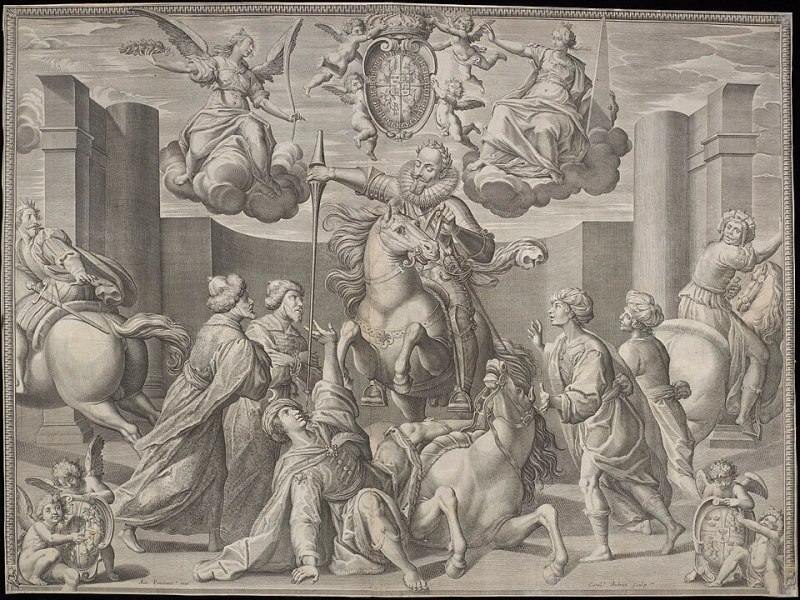
By Karl Audran – National Library of Poland, Public Domain, Wikimedia
Point of Departure: Lützen and the Opening It Created
On the morning of November 6, 1632, Gustav II Adolf rode into one of the bloodiest and most consequential battles of the Thirty Years’ War. The Swedish and allied German Protestant forces met Albrecht von Wallenstein’s Imperial army near the Saxon town of Lützen. The battle was a Protestant victory, but at a cost that silenced the celebration: Gustav himself was killed, struck by musket fire during a cavalry charge in the fog. He was thirty-seven years old.
He left behind a six-year-old daughter named Christina and a chancellor named Axel Oxenstierna who was, by any measure, one of the most capable administrators in European history.
In our timeline, Oxenstierna managed the Swedish regency with remarkable steadiness, continued the war effort through the 1630s and into the 1640s, and successfully steered Christina to adulthood and the throne. Christina eventually abdicated in 1654, converted to Catholicism, and died without heirs, ending the Swedish Vasa line entirely.
The point of departure is this: what if Oxenstierna, facing the genuine uncertainties of a child queen’s regency during a grinding continental war, had opened formal negotiations with the Polish Vasa line? The premise is not implausible. The family connection was acknowledged; the strategic pressures were mutual. And across the border, the newly inaugurated Władysław IV (who had become King of Poland-Lithuania in April 1632, just months before Lützen) was a king who understood better than anyone the frustration of a crown almost claimed and then denied.
Władysław IV had been elected Tsar of Russia by the Russian boyars in 1610, during the chaos of the Time of Troubles. Polish-Lithuanian forces had occupied Moscow. The Muscovite throne had been, for a moment, genuinely within reach. Then Michael Romanov was elected Tsar in 1613, the Commonwealth’s forces were gradually pushed back, and the dream of eastward expansion faded into the grinding diplomacy that ended with the Truce of Deulino (1618) and, more decisively, the Truce of Polyanovka (1634), in which Władysław formally renounced his claim to the Russian throne in exchange for Russian recognition of his Polish titles.
The Romanov consolidation had closed the eastern door. That closure is the catalyst in our counterfactual scenario, because it redirected Polish strategic attention westward and northward at precisely the moment when Sweden’s regency council was looking for partnerships that could stabilize its Baltic position.
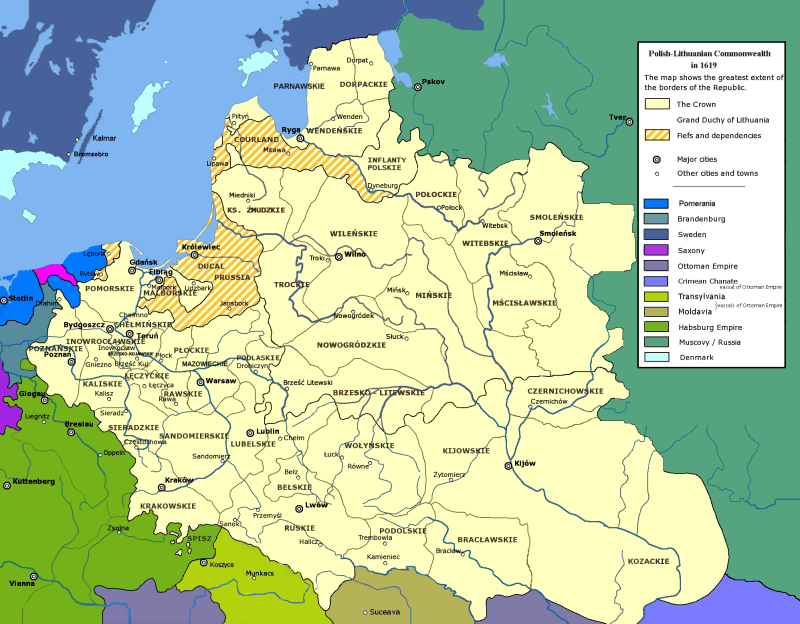
By User:Mathiasrex, based on layers of User:Halibutt – Own work, CC BY 3.0, Wikimedia
The Baltic Augsburg: Constructing a Dual Monarchy
The negotiations, as we are imagining them, would have begun somewhere in the mid-1630s, possibly through diplomatic channels opened at the 1635 Truce of Stuhmsdorf, which ended the Polish-Swedish conflict over Livonia and established a twenty-six-year armistice. That truce, in our timeline, was a businesslike suspension of hostility; in the alternate, it becomes the opening of something more ambitious.
The central problem was the one it had always been: confession. How do you unite a Lutheran crown with a Catholic one? The answer, in our counterfactual, is borrowed from a model that the Holy Roman Empire was simultaneously working out in blood: you do not resolve the confessional question; you institutionalize the coexistence. The Peace of Augsburg (1555) had established the principle that each ruler determines the confession of his territory. The Peace of Westphalia (1648) would refine this into something more sophisticated, allowing formal recognition of multiple confessional communities within the same political structure.
The dual monarchy our negotiators are constructing draws on this logic directly. Sweden remains Lutheran; its church, its clergy, and its noble establishment are guaranteed their confession in perpetuity, insulated from any Catholic pressure emanating from Warsaw. Poland-Lithuania remains Catholic; its own confessional commitments, including its uneasy relationship with the substantial Orthodox and Protestant minorities already living within the Commonwealth, are untouched by the union. The two crowns are separate; the two parliaments (the Riksdag in Stockholm, the Sejm in Warsaw) retain their separate legislative authority over domestic affairs.
What the union creates is a shared executive for foreign policy, military coordination, and Baltic trade, governed through a joint council drawn equally from Swedish and Polish-Lithuanian nobility. The precedent is not the Habsburg dynastic empire, where a single family absorbed and centralized; it is closer to a structured alliance given permanent institutional form through a marriage. The vehicle for that marriage, in our scenario, is Christina of Sweden (born 1626) and John Casimir Vasa (born 1609), Władysław IV’s younger brother.
John Casimir, in our timeline, spent time as a Jesuit novice, was briefly imprisoned by Richelieu, and eventually became King of Poland in 1648 after Władysław died without a male heir. In the alternate, the betrothal negotiated in the late 1630s gives him a different trajectory: rather than the priesthood, he enters diplomatic preparation for a marriage that will reunite the two Vasa lines. The betrothal is arranged when Christina is perhaps twelve or thirteen, with the marriage formalized in the mid-1640s. She is Queen of Sweden; he is a Polish magnate and heir to the Commonwealth’s throne. When Władysław IV dies in 1648, John Casimir inherits the Polish-Lithuanian crown, and the dual monarchy becomes reality: two kingdoms, two confessions, one ruling family, and one strategic interest.
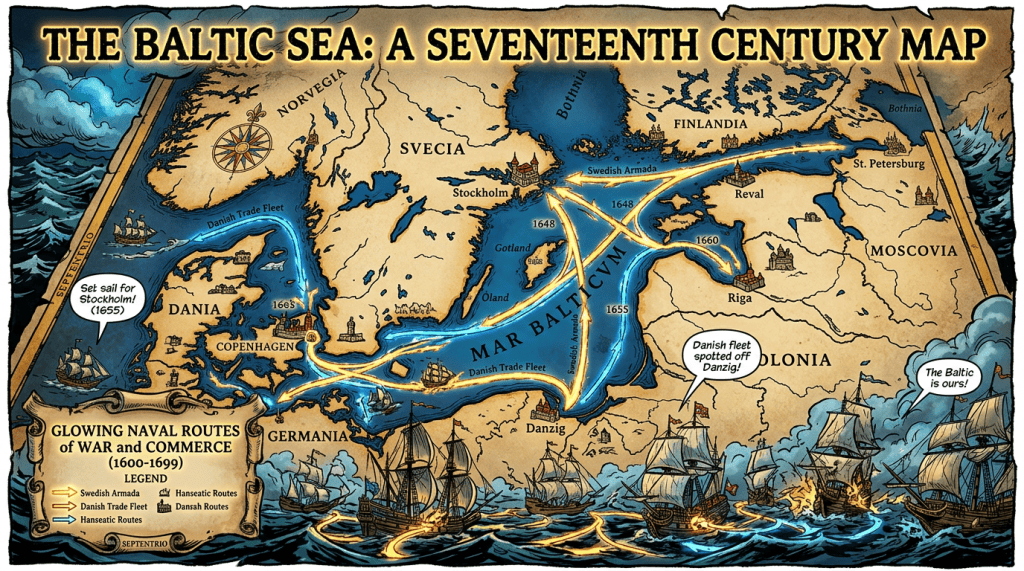
The arrangement holds because both sides need it to. Sweden needs a counterweight to Denmark’s control of the Øresund and the tolls that strangle Baltic commerce. Poland-Lithuania, having failed to absorb Moscow and facing renewed Ottoman pressure in the south, needs a northern ally whose military capacity is, by the 1640s, the finest in Europe. The shared Vasa bloodline provides the legitimating fiction; the mutual strategic interest provides the substance.
The Danish Reckoning and the Shape of the Baltic
To understand what this dual monarchy changes, you have to understand what Denmark meant in the seventeenth-century Baltic. Denmark controlled the Sound (the narrow strait between the Danish peninsula and the Swedish coast) and charged every ship that passed through it a toll that functioned as a tax on all Baltic commerce. Dutch merchants, English merchants, Swedish merchants, Polish grain exporters: all paid. This structural advantage had shaped Danish foreign policy for generations, and Sweden’s determination to break it was one of the defining engines of Swedish expansionism throughout the century.
In our alternate Baltic, the dual monarchy creates a strategic encirclement that Denmark has never faced before. From the north and west, Sweden presses along the traditional Scandinavian frontier; from the east and south, the Polish-Lithuanian partner controls Pomerania, Prussia, and the overland routes into the Danish peninsula’s hinterland. Denmark can be threatened by sea from Sweden and by land from the combined Commonwealth-Swedish interest simultaneously. The Danish advantage in the Sound becomes less decisive when the power threatening it can interdict Danish land connections and ally with the Dutch, who have their own grievances against Sound tolls.
The Kalmar War of 1611-1613, in which Denmark had humiliated Sweden, becomes in the alternate an aberration rather than a template, because Sweden never fights alone again. The steady Swedish pressure northward and westward that characterized the actual seventeenth century plays out in the alternate with a larger coalition behind it. The result, worked out over decades rather than a single dramatic campaign, is a gradual Danish retreat from Baltic hegemony; the Sound tolls are reduced, then renegotiated, then eventually abolished under pressure that cannot be defeated piecemeal.
Simultaneously, the dual monarchy’s Scandinavian dimension consolidates Sweden’s position in Finland. In our timeline, Finland was Swedish crown territory from the medieval period, but its governance was episodic and its institutional integration incomplete. In the alternate, the stability that comes from a resolved southern flank (no longer worrying about Poland as an adversary) allows sustained administrative investment in Finland, integrating it more firmly into the dual monarchy’s northern arc. The Baltic becomes, from roughly the 1660s forward, something approaching a Swedish-Polish lake, with Denmark contained at its western entrance and Russia frozen at its eastern edge.
Russia Locked Out: The Long-Term Consequences
The Romanov consolidation of 1613 had already set Russia on a trajectory of gradual western pressure. What changed the terms of that pressure, in our timeline, was access to the Baltic — specifically, the access that Peter the Great would eventually claim through the Great Northern War (1700-1721), wresting the Estonian and Livonian coastline from a Sweden that had overextended itself. St. Petersburg, founded in 1703 on the Gulf of Finland, was the architectural expression of Russia’s need for a western port that was not Archangel.
Archangel was Russia’s commercial lifeline to the West for most of the seventeenth century. Situated on the White Sea, it was navigable only during summer months; it was geographically remote from Russia’s population centers; and it depended on English and Dutch merchants to do the actual carrying trade, since Russia had no meaningful merchant fleet. Every Russian ruler who understood trade understood Archangel’s inadequacy. The Baltic was the answer, and the Baltic was what Sweden guarded.
In our alternate, the dual monarchy has made the Baltic problem dramatically harder. A Sweden that is not diplomatically isolated, that has a land-power partner controlling the southern Baltic coast, and that has resolved its Danish flank does not overextend itself in the way that the historical Sweden did under Charles XII. The dual monarchy has military depth; it has the grain and manpower reserves of the Commonwealth behind it; and it has, perhaps most importantly, a shared institutional interest in keeping Russia out of the Baltic trade network.
Peter the Great, or whoever plays his role in the alternate, still understands the strategic imperative. The drive toward the Baltic does not disappear simply because it is blocked. What changes is the outcome. The Great Northern War, if it happens at all in the alternate, is not fought against a Sweden stranded without allies; it is fought against a dual monarchy capable of coordinating resistance on land and sea simultaneously. Russian forces that, in our timeline, could exploit Swedish overextension in Poland (the Battle of Poltava in 1709 was decided partly by Polish political chaos) find in the alternate a Poland that is not internally fragmented but is a functional partner in the crown’s defense.
The result is not necessarily that Russia fails to grow. Russia’s eastern and southern expansion (into Siberia, toward the Caspian, against the Ottomans) proceeds roughly as it did in our timeline, because those frontiers are not controlled by the dual monarchy. What fails, or at least is drastically delayed, is Russia’s western integration. Without Baltic access, Russia remains dependent on Archangel and on intermediary merchants who work that route. The commercial and cultural consequences of that dependency ripple forward: no St. Petersburg, no systematic westernization of the court and the bureaucracy, no Petrine transformation of the Russian military along European lines. The Russia of the mid-eighteenth century, in this alternate, is a large and powerful land empire that has not made the institutional pivot toward European-style bureaucratic modernity that Peter forced in our timeline.
The dual monarchy, meanwhile, has created its own tensions. Confessional coexistence is not the same as confessional harmony; the history of the Holy Roman Empire demonstrates that cuius regio is a framework for managing conflict, not dissolving it. The Swedish Lutheran establishment and the Polish Catholic hierarchy will not share the same communion rail, and the politics of the joint council will periodically be inflected by theological grievances dressed up as constitutional ones. The Commonwealth’s szlachta (the Polish nobility), already suspicious of centralized authority, will find new reasons to resist coordination in any arrangement that seems to advantage Swedish preferences. These are not fatal flaws; the dual monarchy in our scenario survives because its external pressures are too severe to allow internal collapse. But they are real, and a historian looking at this alternate world would find in the dual monarchy’s internal politics a story of constant negotiation and periodic crisis — not unlike, in other words, the Holy Roman Empire itself.
The World Remade at the Baltic’s Edge
The dual monarchy imagined here is not a utopia. It is an arrangement of mutual necessity between two powers who share a family name and a set of strategic problems, who have found in each other an answer to threats neither could resolve alone. What it produces, over the course of a generation, is a Baltic zone of stability organized around Swedish-Polish interest rather than around the slow emergence of Russian imperial ambition that characterized the actual eighteenth century.
The implications extend well past the Baltic. A Russia that has not undergone Petrine modernization is a Russia that enters the eighteenth century without the military and administrative reforms that made it a European great power by 1750 in our timeline. The Ottoman Empire, in our timeline pressured from the north by a modernizing Russia, faces in the alternate a Russia that is powerful on land but less capable of sustained combined-arms operations. The Austro-Russian alliance that shaped the partitions of Poland in 1772, 1793, and 1795 has no logic in the alternate, because a functioning dual monarchy is not available to be partitioned. The map of eastern Europe is substantially different, and the difference radiates outward from a single negotiation that, in November 1632, nobody actually had.
The door that closed at Lützen was not merely military. It was dynastic, confessional, and strategic all at once. The Vasa family had come close to uniting the Baltic’s two greatest land-maritime powers in 1592, and had failed because of a Catholic king and a Protestant kingdom that could not find the institutional language to coexist. That language was being written, bloodily, in the Holy Roman Empire across the 1630s and 1640s. In our alternate, the Baltic Augsburg applies those lessons before the Peace of Westphalia formalizes them; and the northern tier of Europe enters the modern period not as a succession of competing nationalisms organized around a Russian-dominated east, but as something stranger and more durable: two crowns, two faiths, one sea.
Discussion Questions
1. The confessional coexistence built into the dual monarchy depends on both sides accepting that religious difference does not preclude political unity. What historical examples (from the Holy Roman Empire, the Polish-Lithuanian Commonwealth itself, or elsewhere) suggest whether this kind of arrangement tends to stabilize or to generate its own conflicts over time?
2. Władysław IV’s formal renunciation of his claim to the Russian throne in 1634 was a turning point in Polish-Russian relations. If that renunciation had never happened, or had been reversed under a Swedish alliance, how might Russian domestic politics have responded to a continued Polish claim on the Muscovite crown?
3. Russia’s eventual Baltic access, won by Peter the Great through the Great Northern War, is often described as essential to Russia’s development as a European power. Do you agree that geography determined that outcome, or were there political and institutional factors that made Baltic access essential rather than merely convenient?
4. The dual monarchy in this scenario is built on noble networks and dynastic legitimacy rather than on national identity. How does that foundation compare to the principles that organized European states in the nineteenth century, and what does that comparison suggest about the alternate world’s long-term stability?
Suggested Reading
Robert I. Frost, The Northern Wars: War, State and Society in Northeastern Europe, 1558–1721 (Longman, 2000). The single most useful scholarly overview for this post’s core geography. Frost traces how the overlapping ambitions of Sweden, Poland-Lithuania, Denmark, Russia, and Brandenburg turned the Baltic into a nearly continuous theater of war across a century and a half, and he is particularly good on how dynastic and confessional politics intersected with military capability. Essential background for understanding why the Vasa split mattered strategically, not just dynastically.
Norman Davies, God’s Playground: A History of Poland, Volume I (Columbia University Press, 1982). Davies remains the most readable and comprehensive English-language treatment of the Polish-Lithuanian Commonwealth’s internal structure, its noble republic, and its extraordinary confessional diversity. Chapters on the Vasa kings and the szlachta’s constitutional role are directly relevant to the scenario’s question of whether a dual monarchy could have survived Polish domestic politics. Students who find the Commonwealth’s legislative structure baffling will find Davies clarifying.
Peter H. Wilson, The Holy Roman Empire: A Thousand Years of Europe’s History (Harvard University Press, 2016). Wilson’s magisterial reassessment of the Empire is the essential companion for understanding how confessional coexistence was institutionalized in practice rather than in theory. His analysis of how the Peace of Augsburg and later the Peace of Westphalia created workable frameworks for Catholic-Protestant cohabitation within shared political structures is exactly the intellectual model this post borrows for its dual monarchy. Wilson also dismantles the old view of the Empire as a failed state, which has direct implications for how we evaluate complex multi-confessional arrangements.
Paul Douglas Lockhart, Sweden in the Seventeenth Century (Palgrave Macmillan, 2004). A concise and well-organized account of Swedish expansion and the Vasa dynasty’s role in it, accessible to readers without specialist background. Lockhart covers Gustav II Adolf’s military innovations, Oxenstierna’s regency, and Christina’s abdication in proportions that make the Swedish side of this counterfactual legible. Particularly useful for classroom preparation because the chapter structure maps cleanly onto the major chronological turning points the post addresses.
Chester Dunning, Russia’s First Civil War: The Time of Troubles and the Founding of the Romanov Dynasty (Pennsylvania State University Press, 2001). The authoritative English-language treatment of the chaos that briefly put a Polish prince on the Muscovite throne. Dunning’s account of why Władysław IV’s claim collapsed and how the Romanovs assembled enough legitimacy to end the crisis is essential reading for the post’s argument that the failure of Polish eastward expansion was the catalyst for westward reorientation. His treatment of the boyar factions and their shifting allegiances makes clear how contingent the Romanov outcome actually was.
Lindsey Hughes, Russia in the Age of Peter the Great (Yale University Press, 1998). The standard scholarly biography of Peter and his transformations, valuable here for what it reveals about the stakes of Baltic access. Hughes’s detailed treatment of the Great Northern War, the founding of St. Petersburg, and the Petrine military and administrative reforms illuminates exactly what the counterfactual’s Russia is missing without a Baltic window. Teachers who want to use this post alongside a unit on Peter the Great will find Hughes an invaluable bridge between the two narratives.
While these events are not true they are based on historic fact and the possibility of one change in history. To read more of my Alternate History scenarios, be sure read here.


You must be logged in to post a comment.