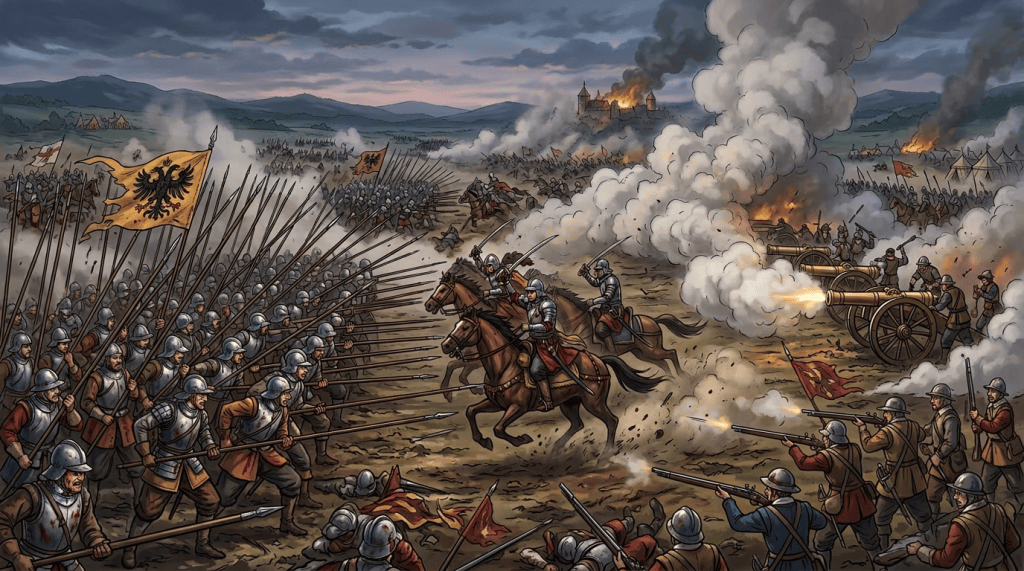
Gustav Adolf, the Vasa Reunion, and a Protestant Thirty Years’ War
Companion Series Note | This post is the first of two exploring what might have happened if the Swedish and Polish branches of the Vasa dynasty had reunited. It asks what a Vasa coalition led by Gustav Adolf himself could have done to the Thirty Years’ War, beginning with the plausible early death of Sigismund III in 1621. The companion post, “What If the Vasa Crowns Had Reunited?” takes a later pivot point — Gustav Adolf’s actual death at Lützen in 1632 — and asks whether his daughter Christina’s regency might have opened a dynastic negotiation that produced a dual monarchy on new confessional terms. Both posts work independently; read together, they map the full range of what the Vasa family connection might have made possible.
A King Stretched Thin
By the autumn of 1621, Sigismund III Vasa had been fighting someone for almost his entire reign. Crowned King of Poland-Lithuania in 1587 and briefly King of Sweden from 1592 until his Protestant cousin Charles IX deposed him in 1599, Sigismund had spent the intervening decades trying to recover what he had lost in the north while managing an enormous, fractious Commonwealth that fought Muscovy, Cossack uprisings, the Ottoman Empire, and its own nobility with equal regularity. He was fifty-five years old, a man whose stubbornness had outlasted his physical resilience, and the campaign season of 1621 had been brutal.
The immediate crisis was Ottoman. Following the catastrophic Polish defeat at Cecora in 1620 (where the Crown’s Grand Hetman, Stanisław Żółkiewski, died in the rout), the Commonwealth faced a massive Ottoman advance the following year under Sultan Osman II. Sigismund’s son Władysław commanded the Polish-Lithuanian-Cossack forces at the subsequent Battle of Khotyn, where a combined army of perhaps eighty thousand held off an Ottoman force twice its size for six weeks in September and October 1621. The battle ended in a negotiated truce rather than a decisive victory, but the Ottomans withdrew. The Commonwealth had survived.
Sigismund did not ride to Khotyn himself, but the organizational burden of the campaign fell on him; the recruiting, the financing, the political management of a Sejm that never funded wars as generously as it debated them. When the truce was signed in early October and the army began its exhausted withdrawal northward, Sigismund was already ill. In our timeline, he recovered, reigned for another decade, and died in April 1632 of a stroke following a barber-surgeon’s mishap. In the scenario we are exploring, the illness that followed Khotyn does not relent. Sigismund III Vasa dies in December 1621, and the two-crown world of the Baltic is suddenly, violently reorganized.
Point of Departure: The Wrong King Dies First
Władysław IV Vasa was twenty-six years old when his father died, and he was everything Sigismund was not. Where Sigismund had been rigid, doctrinaire, and obsessively focused on recovering the Swedish throne through Catholic legitimacy, Władysław was pragmatic, personally tolerant on matters of religion, and genuinely curious about military affairs in the modern European mode. He had commanded at Khotyn. He had, earlier, led Polish forces into Moscow during the Time of Troubles and come within a negotiation’s reach of the Muscovite throne. He understood that the Commonwealth’s future lay in capable governance and workable alliances, not in the recovery of a Swedish crown his father’s theology had already forfeited.
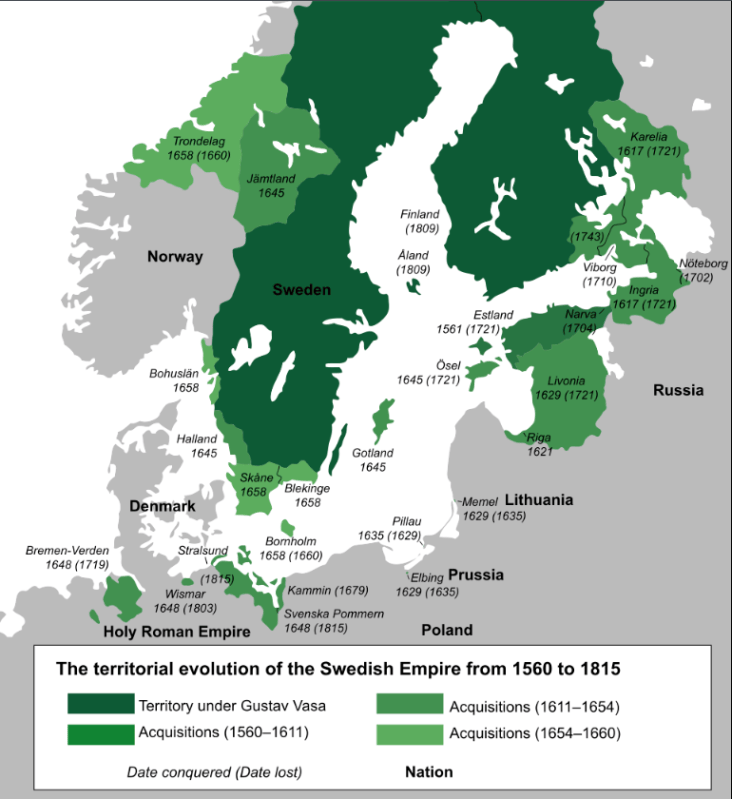
Across the Baltic, his second cousin Gustav II Adolf was twenty-seven, and already demonstrating the military genius that would make him the dominant Protestant commander of his generation. Gustav had seized Riga in 1621 while the Polish army was occupied at Khotyn, pressing Swedish advantage in Livonia with characteristic opportunism. In our timeline, the Polish-Swedish war dragged on through the 1620s, bleeding both sides, until the Truce of Altmark in 1629 formalized Swedish gains and freed Gustav Adolf to intervene in the Thirty Years’ War the following year.
The death of Sigismund changes this arithmetic entirely. Sigismund’s entire Polish foreign policy had been organized around one fixed point: the Swedish throne was his by right, and any accommodation with the Protestant branch of the Vasa family was a theological and dynastic betrayal. Władysław did not share this conviction. He had grown up watching his father’s obsession cost the Commonwealth diplomatic flexibility at every turn, and he had no intention of inheriting the grudge along with the crown.
The point of departure, then, is not simply a king’s death. It is the replacement of an ideologically rigid monarch with a pragmatic one at precisely the moment when the Thirty Years’ War (begun in 1618 and now entering its Danish phase) was reshaping the confessional map of central Europe, and when a young Swedish king with extraordinary military gifts was looking for the political conditions that would let him intervene at continental scale.
The Khotyn Compact: A Vasa Reunion on New Terms
The negotiations that follow Sigismund’s death in our scenario move quickly, because both Władysław and Gustav Adolf understand that speed is a strategic asset. The formal Polish-Swedish war in Livonia provides the framework: Władysław, newly crowned and dealing with the internal politics of a succession, has no appetite for a war his father started. Gustav Adolf, eyeing the Empire and its Protestant princes with increasing urgency, needs his eastern flank secured before he can move westward.
The settlement reached (let us place it in late 1622, following several months of diplomatic preparation) is not a personal union in the traditional sense. It is more precise and, arguably, more durable than that. Władysław formally recognizes Gustav Adolf’s title as King of Sweden, ending the Vasa claim dispute that had poisoned relations since 1599. Gustav Adolf acknowledges Władysław as the senior ruling Vasa and King of Poland-Lithuania, and renounces any Swedish territorial ambitions in Royal Prussia and the Commonwealth’s Baltic ports. Livonia is confirmed as Swedish; it is a painful concession for Poland, but Władysław calculates (correctly, in our scenario) that Livonia is less valuable than a functioning northern alliance.
The confessional architecture of the agreement is its most innovative feature. Władysław is Catholic; the Commonwealth contains Catholics, Orthodox Christians, Lutherans, Calvinists, and a substantial Jewish population, and its tradition of relative (if imperfect) religious tolerance is one of its genuine distinctions in early modern Europe. Gustav Adolf is Lutheran; the Swedish church is established and non-negotiable. The compact solves this not by demanding conversion or compromise but by establishing parallel legitimacy: each king is sovereign within his own confession, and neither crown can compel the religious practice of the other’s subjects. The model, as with the later Peace of Westphalia, is recognition rather than resolution.
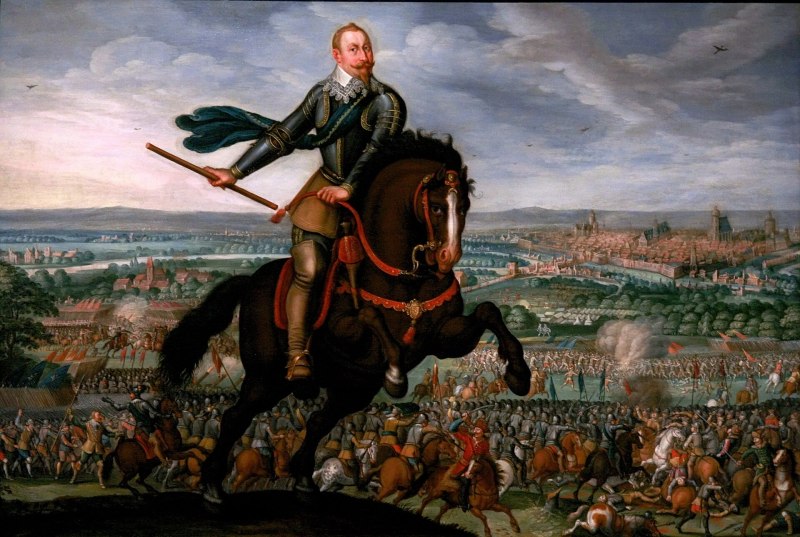
By Johann Jakob Walter – Self-photographed by Rama, 2010, Public Domain, Wikimedia
What the compact creates, in practical terms, is a coordinated military and diplomatic bloc centered on the Vasa name. When Gustav Adolf moves into the Empire, he moves not merely as King of Sweden but as the military arm of a Vasa coalition that includes the largest territorial state in Europe. The psychological and diplomatic weight of this is considerable; the Protestant German princes who had been skeptical of Swedish intervention (and who, in our timeline, were genuinely ambivalent about a foreign king marching through their territory) now see behind Gustav Adolf the shadow of Polish-Lithuanian power and the suggestion that the Protestant cause in the Empire has acquired a land-based eastern anchor it never possessed before.
The Alternate Thirty Years’ War: Protestant Momentum, 1623-1630
In our timeline, the Thirty Years’ War passed through four recognized phases. The Bohemian phase (1618-1625) ended in Habsburg victory at the Battle of White Mountain in 1620 and the brutal suppression of Bohemian Protestantism. The Danish phase (1625-1629) saw Christian IV of Denmark intervene on behalf of the Protestant princes and be decisively defeated by Wallenstein and Tilly, ending in the humiliating Treaty of Lübeck. The Swedish phase (1630-1635) saw Gustav Adolf arrive, win spectacular victories at Breitenfeld and the Lech, and then die at Lützen in 1632. The French phase (1635-1648) saw Richelieu’s France take over the anti-Habsburg effort by proxy and eventually grind the Habsburgs to the Peace of Westphalia.
In our alternate, Gustav Adolf does not wait until 1630. He does not need to; the Polish-Swedish war that consumed his strategic attention through the late 1620s has been resolved at Khotyn. He enters the Empire in 1623 or 1624, at the end of the Bohemian phase rather than its aftermath, and he enters with a substantially different resource base behind him. Swedish military capacity is already formidable; the Commonwealth’s cavalry tradition (the Winged Hussars, the finest heavy cavalry in Europe) adds a dimension of shock warfare that no Imperial commander has planned for. The supply lines run not just through Swedish Pomerania but through a Polish-Lithuanian logistics network that can sustain operations deeper into central Europe than purely Swedish resources would allow.
The Protestant German princes respond differently to this version of Swedish intervention. In our timeline, the Elector of Brandenburg, Georg Wilhelm, was famously reluctant to commit to Gustav Adolf, permitting Swedish passage through his territory only under military pressure. John George I of Saxony, the most powerful German Lutheran prince, did not join the Swedish side until after Breitenfeld (1631) and defected to a separate peace in 1635. In the alternate, the Vasa coalition’s size and the timing of its arrival change the calculus. Brandenburg and Saxony face a different question: not whether to trust a Swedish king who arrived with 13,000 men and ambitious promises, but whether to resist a Vasa coalition that has resolved its internal conflicts and arrives with the demonstrated military capacity of two major powers behind it.
The answer, in our scenario, is a broader Protestant military coalition assembled earlier and with more genuine commitment. The German Protestant princes do not simply permit passage; they contribute forces, coordinate logistics, and accept a shared command structure organized around Gustav Adolf’s proven military genius. The result is something that the actual Thirty Years’ War never quite achieved on the Protestant side: a unified field army drawing on Swedish discipline, Polish cavalry, and German territorial knowledge, commanded by the most tactically gifted general of the age.
The Battle of White Mountain’s consequences are not undone — Bohemia’s Protestant nobility has already been crushed, and the Habsburgs have already begun the process of re-Catholicizing the kingdom. But the suppression of Bohemia that, in our timeline, was the fait accompli that Protestant intervention was always fighting against becomes, in the alternate, a provocation that unifies rather than demoralizes the Protestant coalition. The Palatinate, stripped from Frederick V in 1623, becomes a rallying cause rather than a settled fact, because the coalition arriving to contest it is genuinely capable of contesting it.
Wallenstein’s Problem and the Habsburg Response
Albrecht von Wallenstein was, by the mid-1620s, the Habsburgs’ answer to every military problem. An extraordinarily capable commander and an even more extraordinarily capable logistician, Wallenstein had raised his own army essentially through entrepreneurial means, offering the Emperor a self-financing military force in exchange for nearly autonomous command authority. In our timeline, Wallenstein defeated the Danes, drove the Protestant cause to its lowest point, and then was dismissed by Ferdinand II in 1630 (partly because his success had made him too powerful and partly because the Catholic princes resented his methods), recalled in 1631 to meet the Swedish threat, and finally assassinated in 1634 after his independent diplomatic negotiations made him a suspected traitor.
In the alternate, Wallenstein faces a fundamentally different problem from the one that defined his actual career. The Protestant intervention he must counter is not a late, desperate Swedish rescue operation arriving after a decade of Habsburg victories; it is an earlier, larger, and more coherent coalition that arrives before the Protestant cause has fully collapsed. The logistical model that made Wallenstein formidable (living off the land, forcing occupied territories to support Imperial armies) runs into a coalition that can sustain itself from external resources and that does not depend on the German Protestant princes’ often-depleted territories for supply.
More critically, the Vasa coalition’s eastern dimension creates a strategic problem Wallenstein cannot solve with western-facing deployments. A Habsburg army that concentrates against Swedish-led forces in the Rhineland and Palatinate is an army that has left Silesia, Moravia, and the Habsburg hereditary lands relatively exposed to pressure from the east. Władysław IV, who in our timeline spent the late 1620s and early 1630s consolidating his position in Poland and managing Cossack relations, is in the alternate a partner in a coordinated campaign whose eastern pressure forces the Habsburgs to divide their attention and their forces.
Ferdinand II’s response in the alternate is instructive. In our timeline, the Edict of Restitution (1629), which demanded the return of all church properties secularized since 1552, was his most aggressive attempt to roll back Protestantism in the Empire and the act that finally pushed even reluctant Protestant princes toward the Swedish alliance. In the alternate, the Edict either does not come (because Ferdinand’s advisors recognize that they cannot fight the Vasa coalition and simultaneously antagonize every Protestant territory in the Empire) or comes earlier and with less force (because the Habsburg position is less secure and the diplomatic consequences more immediate). Either way, the Edict’s radicalizing effect on German Protestantism is diminished, replaced by a strategic calculation rather than a reactive fury.
The War That Does Not Become a Generation
The actual Thirty Years’ War lasted thirty years because neither side could land a decisive blow and because the conflict kept finding new investors (France, Sweden, the Dutch Republic, Denmark, various German princes) willing to continue fighting after earlier participants exhausted themselves. The Peace of Westphalia in 1648 was, in many ways, an exhaustion settlement: both sides had fought to the point where the map of 1618 was roughly restored with modifications, and the principle of confessional coexistence was acknowledged not because anyone had won but because no one could afford to keep losing.
In the alternate, the war is shorter, not because violence is less savage, but because the Protestant coalition’s greater coherence and earlier intervention produce a decisive military advantage before the conflict settles into the grinding attrition of its actual middle decades. The key campaign is somewhere in the late 1620s: a battle or series of battles in which the combined Swedish-Polish-German Protestant force defeats the main Imperial army in circumstances that do not allow Habsburg recovery on the same terms as before. Wallenstein is either killed, discredited, or simply unable to reconstitute his forces against a coalition that controls more territory and more supply than he can outrun.
The peace settlement that follows — let us imagine it falling somewhere in the early 1630s rather than 1648 — is not the Peace of Westphalia but a predecessor that works along the same confessional principles. What changes is the territorial distribution. Bohemia, in our timeline a Catholic re-conquest by 1648, is in the alternate a contested space where the Protestant coalition’s military success translates into at least partial protection for its surviving Protestant communities, if not full restoration of the pre-1620 settlement. The Palatinate is restored to the Frederick V line. The German Protestant princes who committed to the Vasa coalition receive territorial and confessional guarantees they did not have to fight another two decades to achieve.
The Habsburgs do not collapse; the institution is too deeply embedded in European political culture, and the Spanish branch continues to function as a major power. But the Austrian branch’s ambition to roll back Protestantism in the Empire is permanently defeated rather than merely deferred, and the settlement acknowledges what the actual Peace of Westphalia acknowledged: that religious uniformity in the Empire is neither achievable nor, at this point, worth the cost of pursuing.
The Longer Shadow: Eastern Europe Remade
The domestic consequences for the Vasa coalition itself are where the alternate history becomes most complex. Gustav Adolf, who in our timeline died at thirty-seven, survives in the alternate to a riper age because the campaign he fights is more decisive and less protracted. A living Gustav Adolf is one of the transformative figures of early modern statecraft; the Sweden he would have continued building, backed by a Polish-Lithuanian partner and flush with a successful continental war, is a Sweden that dominates northern Europe with a stability its historical counterpart never quite achieved.
Władysław IV, meanwhile, is a king whose position within the Commonwealth is substantially stronger than his historical self’s. The successful partnership with Sweden has given him diplomatic leverage that the historical Władysław never possessed, and his tolerance on religious matters (which in our timeline made him intermittently controversial in Catholic Poland) is now a structural feature of the Vasa compact rather than a personal eccentricity. The Commonwealth’s internal religious settlement is pressed in a more formally tolerant direction by the simple fact that its king is the partner of a Lutheran monarch, and that the szlachta’s Catholic majority must coexist with a foreign policy that depends on Protestant cooperation.
Russia, as in the first alternate scenario, is the power most structurally disadvantaged by these events. The Romanovs, having consolidated their position against Polish pressure in 1613, now face a Commonwealth that has resolved its northern conflict and freed its military attention eastward. The historical trajectory of Russian westward pressure that culminated in Peter the Great’s Baltic victories does not simply accelerate; it runs into a different obstruction. A Vasa coalition that has successfully reshaped the Empire’s confessional settlement is a coalition with military credibility and diplomatic weight, and the Baltic remains what the dual monarchy scenario also suggested: a Swedish-Polish-Lithuanian sphere that Russia cannot penetrate on the terms Peter eventually managed in our timeline.
The broader implication is a Europe that reaches the institutional conclusions of 1648 roughly twenty years earlier, under conditions that give the Protestant powers a more favorable starting position. This is not a Protestant Europe; the Catholic powers are too deeply embedded in France, Spain, Austria, and Poland itself for any such clean confessional resolution. It is instead a Europe in which the question of religious uniformity is foreclosed faster, and in which the energies that in our timeline went into another two decades of war go instead into the commercial, intellectual, and colonial expansion that was already underway in the 1630s. The Dutch Golden Age, the English Revolution, the French consolidation under Richelieu and then Mazarin: these proceed in modified forms, shaped by a continental settlement that arrived a generation early and under different terms.
The road not taken, here, runs through a dying king in December 1621 and a pragmatic son who looked across the Baltic and saw a cousin rather than an enemy. That the two men in our timeline never achieved what geography, family, and shared strategic interest all suggested they should have achieved is one of early modern history’s more instructive failures. The obstacle was not capability; both Władysław and Gustav Adolf were exceptional. The obstacle was a dead man’s theology, still governing the living from beyond the grave.
Discussion Questions
1. Sigismund III’s refusal to accommodate Swedish Lutheranism is often described as ideological rigidity, but his supporters argued it was principled consistency. How do historians distinguish between principled consistency and counterproductive stubbornness in political leaders, and what evidence from this period would you use to make that judgment?
2. The Protestant German princes in the actual Thirty Years’ War were famously reluctant to commit to the Swedish alliance until the situation became desperate. What does their hesitancy reveal about the relationship between confessional identity and territorial self-interest in early modern politics?
3. The alternate war ends earlier because the Protestant coalition is more coherent and better resourced from the beginning. Does the actual Peace of Westphalia’s durability (its principles survived, in modified forms, well into the nineteenth century) suggest that exhaustion settlements sometimes produce more stable outcomes than decisive military victories? Why or why not?
4. Both this scenario and the companion post on a post-Lützen reunion require the Vasa family to solve the same confessional problem in roughly the same way: parallel legitimacy rather than forced conversion. What does it suggest about early modern political culture that the practical solution was available but rarely implemented?
Suggested Reading
Peter H. Wilson, Europe’s Tragedy: A New History of the Thirty Years’ War (Harvard University Press, 2009). The most comprehensive and readable modern account of the war in English. Wilson dismantles the familiar four-phase narrative and replaces it with a more honest picture of overlapping conflicts, shifting alliances, and the monstrous human cost of a war that killed perhaps eight million people. Essential for understanding why the Protestant cause struggled so badly in the actual conflict, and therefore why the coalition imagined in this post would have been so consequential.
Cicely Veronica Wedgwood, The Thirty Years War (1938; reissued by NYRB Classics, 2005). Still in print for good reason. Wedgwood writes with narrative authority that no more recent historian has quite matched, and her portraits of the major figures (Wallenstein, Gustav Adolf, Ferdinand II, Richelieu) remain vivid and analytically useful. Teachers who want a single-volume introduction that students will actually read should consider Wedgwood as the entry point and Wilson as the follow-up.
Michael Roberts, Gustavus Adolphus: A History of Sweden, 1611–1632 (two volumes, 1953–1958; abridged edition available). Roberts essentially invented the modern historiography of Swedish military and administrative history, and his treatment of Gustav Adolf as both a military innovator and a political leader is still the standard. The abridged edition is more classroom-accessible; the full two-volume set is for readers who want to understand the Swedish military system in its institutional depth, which is directly relevant to imagining how that system would have performed with Polish-Lithuanian resources behind it.
Serhii Plokhy, The Gates of Europe: A History of Ukraine (Basic Books, 2015). An accessible and authoritative narrative history of Ukraine from ancient times through the modern era, with especially strong chapters on the Cossack Hetmanate and its relationship with both the Polish-Lithuanian Commonwealth and the emerging Russian state. Understanding the Cossack factor is essential for any serious engagement with the Commonwealth’s military capacity in this period; Plokhy provides that context without requiring specialist background.
Robert I. Frost, After the Deluge: Poland-Lithuania and the Second Northern War, 1655–1660 (Cambridge University Press, 1993). A detailed scholarly study of the catastrophic wars that devastated the Commonwealth in the mid-seventeenth century, known in Polish history as the Potop (the Flood). Frost’s account of how the Commonwealth’s constitutional structure and noble culture both enabled and undermined its military performance is directly relevant to the question of whether a Władysław-led Commonwealth could have sustained the kind of coherent foreign policy that the Khotyn compact imagines. Essential for thinking through the scenario’s domestic constraints.
Geoffrey Parker, The Military Revolution: Military Innovation and the Rise of the West, 1500–1800 (Cambridge University Press, 1988; second edition 1996). Parker’s influential argument that a cluster of military innovations in this period (firearms, fortification, logistics) fundamentally reorganized European power is the necessary backdrop for understanding why Gustav Adolf’s methods were so effective and why a combined Swedish-Polish military force would have been qualitatively different from either army fighting alone. The book also addresses how European military capacity translated into colonial and global power, which opens the longer-range implications of this alternate history for classroom discussion.


You must be logged in to post a comment.