Post 0 of 5 — Series Introduction
Most Civil War curricula are organized around battles. Antietam, Gettysburg, Vicksburg, Sherman’s March — the campaigns form the spine, and everything else hangs off them: the politics as prologue, the social history as sidebar, Reconstruction as epilogue if there’s time before the end of the semester. It is a reasonable structure for covering a lot of ground quickly, and it produces students who can place Pickett’s Charge on a timeline.
It does not produce students who understand why the Civil War still matters.
This series is built on a different argument: that the Civil War’s lasting significance is political, social, and economic, and that the military campaigns — while real and consequential — are the least useful entry point for students who need to make sense of a conflict whose questions have not been resolved. The constitutional transformation of federal authority, the social rupture of emancipation and its aftermath, the violent destruction of Reconstruction, the Lost Cause narrative and its century-long distortion of public memory — these are the threads that connect 1861 to the present, and they are the threads this series follows.
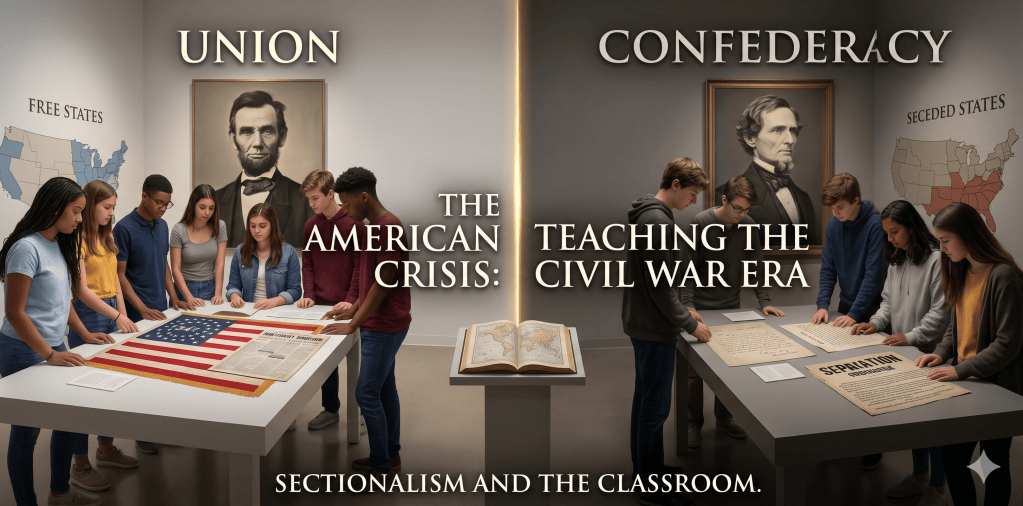
The series is called The American Crisis, borrowing Thomas Paine’s phrase for a moment when the country’s founding commitments were being tested against the hardest possible circumstances. It is five posts, each thematic rather than chronological, each built around a central question rather than a sequence of events.
Post 1 — The Breaking Point: Antebellum America and the Road to War asks why reasonable people thought secession was a good idea, and traces the forty-year political argument that made it feel like the only remaining option to those who chose it.
Post 2 — The Commanders: Military Leadership, Strategy, and Character uses the war’s officers — Grant, McClellan, Sherman, Lee, Longstreet, Frémont, Ely Parker — to examine what leadership under uncertainty actually looks like, and what the army’s decisions about who got to lead reveal about the war’s meaning.
Post 3 — The Politicians: Lincoln, Davis, and the War of Governments follows the political war that ran parallel to the military one, from Lincoln’s evolving use of executive power to Davis’s structural failures to Frederick Douglass’s pressure on both governments from outside formal institutions.
Post 4 — The Overlooked: Enslaved People, Women, Soldiers of Color, and the War’s Hidden Participants makes the case that the people history sidelined most consistently were often the ones who understood the war’s stakes most clearly — and who shaped its outcome in ways the official record has been slow to acknowledge.
Post 5 — Reconstruction: America’s Unfinished Revolution argues that Reconstruction is not an epilogue to the Civil War but the wound that American democracy has never fully healed, and that teaching it well is the most important civic education work the series does.
A companion piece — April 1865: The Month America Changed — sits alongside the series as a narrative essay rather than an analytical post; it covers the thirty most consequential days in American history and is timed for annual publication each spring.
For educators interested in teaching this material as a semester-length Advanced Studies course rather than a unit, a full course prospectus is available here: [The American Crisis: A Course Prospectus for Advanced Studies]. It maps each series post to a unit framework, lays out essential questions, and includes an assessment philosophy and an educator reading list.
The series is written for educators first — for classroom teachers who want to teach the Civil War era the way a historian would, through primary sources, essential questions, and arguments that connect the nineteenth century to the present. Students can read it; the For the Classroom sections in each post are designed to be used directly. But the framing, the sourcing, and the argument are aimed at the person planning the unit, not just completing the assignment.
The war happened. What we do with it is still being decided.
This post is one of seven in The American Crisis: Teaching the Civil War Era — a series I built for educators who want to teach this material the way it deserves to be taught: thematically, with primary sources, and with an honest eye toward the questions the war left unresolved. If you’re arriving here from a search or a share and want the full picture, the series introduction is the best place to start. The prospectus lays out a semester-length Advanced Studies course built on the same argument. [Post 0 — Series Introduction] | [Post 1 — The Breaking Point] | [Post 2 — The Commanders] | [Post 3 — The Politicians] | [Post 4 — The Overlooked] | [Post 5 — Reconstruction] | [April 1865 — The Month America Changed] | [Advanced Studies Prospectus]

 BFWClassroom