
The Bohemia Players, Revolutionary Spring, and a Democratic Europe (1848)
Historical Grounding
The revolutions of 1848 swept across Europe like wildfire, igniting hopes for democracy, nationalism, and social reform from Paris to Prague, Vienna to Venice. In our timeline, this Spring of Nations ultimately collapsed into reaction and disappointment. The uprisings shared a fatal structural weakness: they were isolated national movements without shared vision, effective coordination, or practical models for the democratic institutions they were trying to build. The Frankfurt Parliament dissolved in theoretical disputes about German constitutional arrangements; the Hungarian revolution was crushed by Austrian and Russian armies; the Italian uprisings were suppressed before they could consolidate. By 1850 the map of Europe looked remarkably similar to 1847, and the statesmen of the Restoration breathed a collective sigh of relief.
The reasons for failure are well documented. Revolutionary movements in different cities spoke different languages, pursued different nationalist goals, and often competed with one another rather than cooperating. Literate elites drove the constitutional debates while peasant and working-class populations remained largely disconnected from the political process. Conservative forces, particularly the Austrian military and the Russian Empire under Nicholas I, retained the organizational capacity and the political will to intervene decisively when revolutionary momentum faltered. The Habsburg commander Windischgrätz suppressed the Prague uprising in June 1848 with artillery; Radetzky defeated the Piedmontese at Custoza in July; and Russian intervention in Hungary in 1849 crushed the last significant revolutionary resistance.
What the revolutionaries of 1848 needed, and conspicuously lacked, was a mechanism for spreading ideas across linguistic and national boundaries, for making complex constitutional concepts accessible to ordinary people, and for modeling the kind of cooperative governance they were trying to create. The pan-European dimension of the revolutionary moment — the fact that people were simultaneously uprising in Paris, Berlin, Vienna, Prague, Budapest, Milan, and Rome — was its greatest potential strength and, in actual history, its greatest unrealized asset. Movements that could have learned from each other, supported each other, and presented a unified front instead developed in parallel isolation, each fighting and losing its own battle.
The failure of 1848 had consequences that rippled forward for decades. The discrediting of liberal nationalism — the idea that democratic governance and national self-determination could be achieved together through constitutional rather than military means — cleared the field for a harder, more aggressive ethnic nationalism that pursued its goals through war rather than argument. The German unification of 1866 to 1871 was Bismarck’s answer to the failure of 1848, and it produced a very different Germany than the Frankfurt Parliament had imagined.
“The 1848 revolutions failed not because democratic change was impossible, but because the revolutionaries could not talk to each other, and could not talk to the people whose support they needed to hold.”
Point of Departure
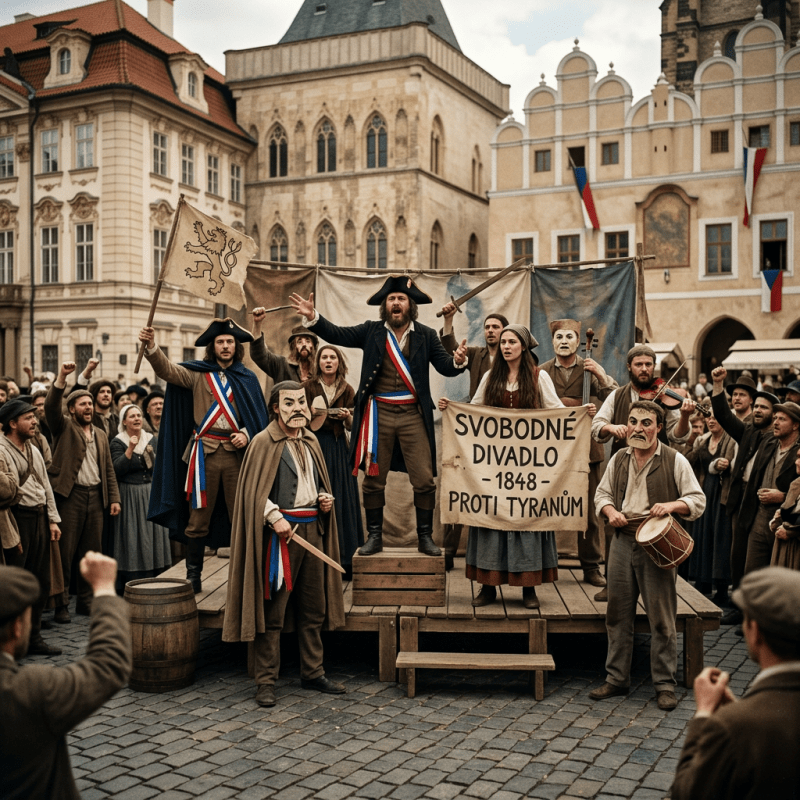
The Bohemia Players, a progressive theater troupe based in Prague, had been performing works that subtly challenged Austrian authority throughout the 1840s. Led by the charismatic director Václav Svoboda and featuring the actress Božena Němcová (sharing a name with the famous Czech writer), the troupe specialized in adaptations of folk tales that celebrated Czech national identity within seemingly innocuous entertainment. Our point of departure: when revolution erupts in Prague in March 1848, the troupe’s evening performance of an allegorical play — a thinly veiled critique of Habsburg authority — becomes an impromptu revolutionary rally when Austrian soldiers attempt to arrest the actors mid-performance. Rather than remaining in Prague, the troupe decides to carry their message across Central Europe, using their legitimate cover as traveling performers to become inadvertent messengers between revolutionary movements.
This is not as fanciful as it sounds. Traveling theater companies were a normal feature of nineteenth-century European cultural life; they crossed linguistic and political boundaries regularly; and the theatrical tradition of using allegory and folk narrative to address political themes was well established, particularly in the cultural ferment of the Vormärz period. The counterfactual asks what happens if one such company, at exactly the right historical moment, makes the right decisions and finds the right audiences — and if those audiences are ready to receive not just inspiration but practical models for what a democratic assembly should look and feel like.
An Alternate Chain of Events
The troupe’s journey through revolutionary Europe follows the arc of the actual uprisings, but with a crucial difference: they carry practical models, not just inspiration. In Vienna, where revolution has already begun but lacks clear direction, their performances provide Austrian revolutionaries with a compelling vision of democratic governance and, more crucially, an organizational model for coordinating between revolutionary movements through networks of artists and intellectuals. The Committee of Cultural Unity that forms around the Bohemia Players becomes, in effect, the first cross-border revolutionary coordinating body of the 1848 era.
In Frankfurt, where the Parliament is already struggling with abstract constitutional debates, the troupe introduces what they call Constitutional Evenings — public performances where constitutional articles are debated through dramatic dialogue, making complex political ideas accessible to ordinary citizens while building genuine popular support for democratic institutions. The Frankfurt Parliament, instead of dissolving in theoretical disputes, begins building the popular legitimacy it historically lacked. Crucial decisions about the relationship between the German states, and about the place of Austria in any future German polity, are debated in forms that give them emotional as well as intellectual weight.
In Budapest, the troupe’s pan-European perspective helps Lajos Kossuth’s government articulate a vision of civic nationalism that includes all citizens regardless of ethnicity, addressing the internal ethnic conflicts that historically weakened the Hungarian revolution. The troupe’s performance of a drama celebrating Hungarian independence while acknowledging the country’s Slovak, Romanian, and German minorities provides a cultural template for the kind of inclusive nationalism that Kossuth’s government struggled to articulate in actual history.
In northern Italy, Giuseppe Garibaldi, impressed by the troupe’s ability to inspire diverse populations, adopts their theatrical methods for his military campaigns, creating genuine popular foundations for democratic government in the territories his forces liberate. The Italian revolutions of 1848, which in actual history succeeded militarily in some regions and then lost their gains when French and Austrian intervention crushed the Roman Republic and the Venetian Republic, develop stronger popular roots that make suppression more costly and less complete.
The cascade effect is real but not unlimited. The Austrian military and Russian Empire do not simply evaporate because revolutionary coordination improves; they remain the dominant counterrevolutionary forces, and the struggles of 1848 and 1849 remain genuinely dangerous. What changes is the balance of political legitimacy. A revolutionary movement that has built genuine popular engagement and cross-border coordination is harder to suppress without creating the martyrs and the memories that sustain future resistance. The revolutions do not all succeed uniformly; but they succeed enough, in enough places, to create constitutional settlements that survive the immediate conservative reaction and begin the long work of building democratic institutions from the ground up.
Long-Term Consequences
The most significant long-term consequence of successful 1848 revolutions is a fundamental alteration of the trajectory of European nationalism. In actual history, the failure of liberal nationalism in 1848 discredited the idea that national self-determination and democratic governance could be achieved together; what emerged instead was the ethnic nationalism of the 1860s and 1870s, pursued through military force rather than constitutional argument, producing the wars of German and Italian unification and, ultimately, the alliance systems that made 1914 possible. In our alternate timeline, national self-determination has been achieved through constitutional rather than military means, and its first generation of practitioners have experience of cross-national cooperation rather than ethnic competition.
German unification, if it happens in this alternate timeline, looks very different from Bismarck’s achievement. The Frankfurt Parliament’s vision of a federated German nation-state, inclusive of Austria and organized around constitutional principles rather than Prussian military dominance, has a chance of realization. Whether it succeeds — given the enormous practical difficulties of unifying dozens of German states with different legal systems, religious compositions, and political traditions — is uncertain; but the attempt is made from a position of democratic legitimacy rather than military conquest, and the Germany that might emerge is a different kind of polity from the one Bismarck built.
A democratized Europe that avoids the specific form of ethnic nationalism produced by the failure of 1848 is not necessarily a peaceful Europe; democratic states have their own reasons for conflict, and the structural tensions of European great-power competition do not dissolve because constitutional forms change. But the specific mechanisms that produced the road to the First World War — the alliance systems built on ethnic grievance and military calculation, the mobilization timetables that turned a local crisis into a continental catastrophe — look considerably different in a Europe where the revolutions of 1848 left institutional rather than merely romantic legacies.
Discussion Questions
1. The theater troupe in this scenario succeeds partly because it provides a practical model, not just inspiration. What does this suggest about the relationship between cultural movements and political change? Can you think of historical examples where cultural innovation preceded and enabled political transformation?
2. The actual 1848 revolutions failed partly because national movements competed with each other rather than cooperating. Is cross-national revolutionary solidarity realistic, or does nationalism inherently produce competition even among movements with similar goals?
3. This post argues that the failure of liberal nationalism in 1848 contributed to the rise of more aggressive ethnic nationalism later in the nineteenth century. Is this a convincing causal argument? What other factors contributed to the development of European ethnic nationalism, and could they have been overcome even if 1848 had succeeded?
Google Gem Scenario
To play out this scenario with your students Bohemia Players in 1848: Copy the Gem here
Suggested Reading
Revolutionary Spring: Fighting for a New World by Christopher Clark (2023). The most comprehensive recent study of the 1848 revolutions, essential for understanding both their scope and the specific reasons for their failure. Clark’s attention to the coordination failures that doomed the revolutions provides the direct foundation for this counterfactual.
Kossuth and the Hungarians by István Deák (1979). The definitive study of the Hungarian revolution and its relationship to the broader European upheaval, with essential coverage of the ethnic tensions that weakened the Hungarian movement.
The Making of the Habsburg Monarchy by R.J.W. Evans (1979). Essential background on the structural tensions within the Austrian Empire that the 1848 revolutionaries were trying to address, and the deep roots of the conservative forces that ultimately crushed them.
Garibaldi: Invention of a Hero by Lucy Riall (2007). A sophisticated study of how Garibaldi’s reputation was constructed through performance and narrative, with important implications for how cultural and political leadership interact in revolutionary moments.
The Frankfurt Parliament 1848–49 by Frank Eyck (1968). A detailed study of the German constitutional assembly whose failure is central to the actual history and whose success is central to this counterfactual.
Springtime of the Peoples: The Great European Revolutions of 1848 by Mike Rapport (2008). An accessible and well-written account of the revolutions across Europe, ideal for teachers and students approaching the subject for the first time.
While these events are not true they are based on historic fact and the possibility of one change in history. To read more of my Alternate History scenarios, be sure read here.


You must be logged in to post a comment.