
There is a moment in any major civic conversation when the promotional language starts to curdle — when the promises made at the podium begin to collide with the numbers coming out of hotel booking systems and the photograph of a beloved mural disappearing under a coat of blue paint. The 2026 FIFA World Cup, which kicks off June 11 in Los Angeles and concludes July 19 at the stadium in northern New Jersey once known as MetLife, is arriving at exactly that kind of moment.
As someone who teaches government and current events, I find the World Cup irresistible as a teaching vehicle. It is, at its best, the most democratic sporting event on earth — a tournament that gives Senegal and Ecuador the same stage as France and Brazil. But the version of the World Cup now unfolding across the United States, Mexico, and Canada is raising serious questions about whether the event’s promises to host cities, to fans, and to the long-term project of growing the sport in North America can survive contact with FIFA’s commercial priorities and the current political climate in the United States.
The Numbers That Were Supposed to Be Easy
Start with the economic case, because that case was made loudly and repeatedly when the North American bid won hosting rights. A study by the Boston Consulting Group, cited by the United Bid Committee, projected that hosting the 2026 World Cup could generate more than $5 billion in short-term economic activity for North America, with a net benefit of approximately $3 to $4 billion after factoring in public costs. Individual host cities were expected to see between $160 million and $620 million in incremental economic activity. A later FIFA and World Trade Organization analysis went further, projecting more than 185,000 jobs created across the United States and an estimated $17.2 billion contribution to the national GDP.
Those numbers read well on a fact sheet. The current reality reads considerably more cautiously. Analysts now suggest the overall economic effect is expected to be modest for two main reasons: little new infrastructure has been built for the event, and much of the World Cup tourism is likely to displace existing tourism rather than generate new demand. In other words, a family that might have visited New York in July is being replaced by a German soccer family visiting New York in July — not an addition to the economy, just a substitution.
Established tourism hubs such as New York, Miami, and Seattle are expected to see only minimal employment growth, as they already attract large numbers of international visitors throughout the year. Smaller metropolitan areas like Kansas City may experience more visible short-term impacts relative to their existing visitor economies. The lesson embedded in that data point is one worth discussing in any economics class: the places least likely to benefit from a mega-event are the places that already have robust tourism infrastructure. The people who need the boost the most may get the least.
Empty Rooms and Broken Promises on Tickets
Perhaps nothing better illustrates the gap between promotional projections and ground-level reality than the combination of sluggish hotel bookings and the ticket pricing disaster that has consumed much of the pre-tournament conversation.
Across the 11 U.S. host cities, hotel operators have been reporting weaker-than-expected reservation levels, despite earlier projections anticipating a major tourism surge and record-breaking occupancy rates. Some hotel operators have described the tournament as a potential “non-event” for local lodging markets, with booking activity trailing a typical summer season. According to the American Hotel and Lodging Association’s outlook report, 80 percent of hotels in World Cup host cities say bookings are falling short of projections, and forecasts show domestic travelers are outpacing international travelers — an imbalance that threatens the broader economic impact the World Cup was expected to generate.
Why are international visitors not coming in the numbers expected? A significant part of the answer lies in ticket pricing. When the United States won the bid to host the tournament seven years ago, officials pledged to make hundreds of thousands of $21 seats available for the opening phase of matches. What fans actually encountered when tickets went on sale was something rather different. The cheapest tickets for the World Cup final were priced at $4,185 — more than five times what fans paid to attend the final stages of the 2022 World Cup in Qatar. Football Supporters Europe called the pricing structure “extortionate” and described it as “a monumental betrayal of the tradition of the World Cup.”
Fans also reported serious technical issues with FIFA’s official ticketing platform; after queueing for hours, many received error messages or were told tickets were sold out. Others compared the price of a single World Cup ticket to the cost of flying to Europe and watching a Premier League match. Dynamic pricing — introduced for the first time at a World Cup — made the situation even more opaque. FIFA’s marketplace, which serves as a resale platform, at one point advertised four tickets to the final at a cost of $2.3 million each. While FIFA does not control pricing on its resale site, it takes a 15 percent fee from both buyer and seller.
FIFA did eventually respond to the backlash. After fierce global criticism, FIFA confirmed that $60 tickets would be available for every World Cup match, including the final, distributed through national football federations — each team expected to receive between 400 and 750 seats per game under a new “Supporter Entry Tier.” That climbdown is welcome; it is also too small to undo the damage. Hundreds of tickets per match, in stadiums seating upward of 70,000 people, does not represent broad fan access. It represents a press release.
Notably, even one of the United States’ own players weighed in. USMNT midfielder Timothy Weah stated publicly that tickets are “too expensive,” a criticism that was dismissed by manager Mauricio Pochettino — and which caused additional backlash from American fans.
What’s in a Name? Quite a Lot, Actually
Beyond the economics of tickets and hotel rooms, FIFA has imposed a set of changes on host cities that deserve more attention than they have received — because they reveal something important about how the organization views its relationship with the communities it visits.
Consider the stadium naming issue. Under FIFA’s branding rules, no venue can display commercial brands that are not official FIFA sponsors. This includes stadium names, logos, visible advertisements in the stands, or any branding that could appear during television broadcasts or aerial shots. The result is that stadiums operating under corporate naming rights deals must temporarily surrender those names entirely.
The list of renamed venues is striking in its scope. MetLife Stadium becomes New York New Jersey Stadium; Levi’s Stadium in Santa Clara becomes San Francisco Bay Area Stadium; AT&T Stadium in Arlington becomes Dallas Stadium; NRG Stadium in Houston becomes Houston Stadium. In Mexico, the historic Estadio Azteca — recently renamed Estadio Banorte — will be registered as Mexico City Stadium throughout the tournament. In total, 14 of the 16 host stadiums across all three countries will be known by generic, city-based names.
There is a reasonable argument that FIFA’s clean stadium policy protects the integrity of the event. Corporations that did not pay to be global FIFA sponsors should not receive billions of dollars in free broadcast exposure. That logic holds. But the policy also creates some genuinely confusing situations: Gillette Stadium, which will be “Boston Stadium,” is actually located 30 miles outside of Boston in Foxborough, Massachusetts. And the MetLife situation became something of a case study in unintended consequences when MetLife announced it would not renew its naming rights deal at all — a decision that coincided with ongoing work to cover the stadium’s existing branding, creating a logistical challenge for FIFA and local authorities who now had to address signage across the surrounding area, not just inside the stadium itself.
The Olympics addressed a version of this same tension differently. For the 2028 Games in Los Angeles, the Olympics has said that sponsors of major venues — like SoFi Stadium and Intuit Dome — can keep their names on the arenas if they pay for that right. FIFA’s all-or-nothing approach generates no compromise revenue and produces the erasure of locally meaningful identities. Arrowhead Stadium in Kansas City, for example, is not just a sponsor name to Chiefs fans; it is a cultural landmark. Renaming it “Kansas City Stadium” for six weeks may not permanently damage anything, but it does communicate something about how FIFA perceives the places it visits: as stages to be temporarily branded, then vacated.
Dallas and the Whale: When “Spirit of the World Cup” Erases Local Culture
The stadium naming debate is abstract, in the sense that most people accept that temporary corporate rebranding is a procedural inconvenience. What happened in downtown Dallas is considerably less abstract, and it has provoked a genuine reckoning about what it means to host a global event on your own cultural terms.
Wyland Whaling Wall 82, titled “Ocean Life,” has spanned two sides of the Texas Utilities Building at 505 N. Akard Street in downtown Dallas since 1999. The work — featuring vivid depictions of whales and dolphins across 164-by-82-foot panels — is one of 100 “Whaling Walls” that environmental artist Robert Wyland has painted around the world since 1981. This week, crews began covering portions of the mural with new artwork tied to the 2026 FIFA World Cup. Wyland said he was never contacted before work began.
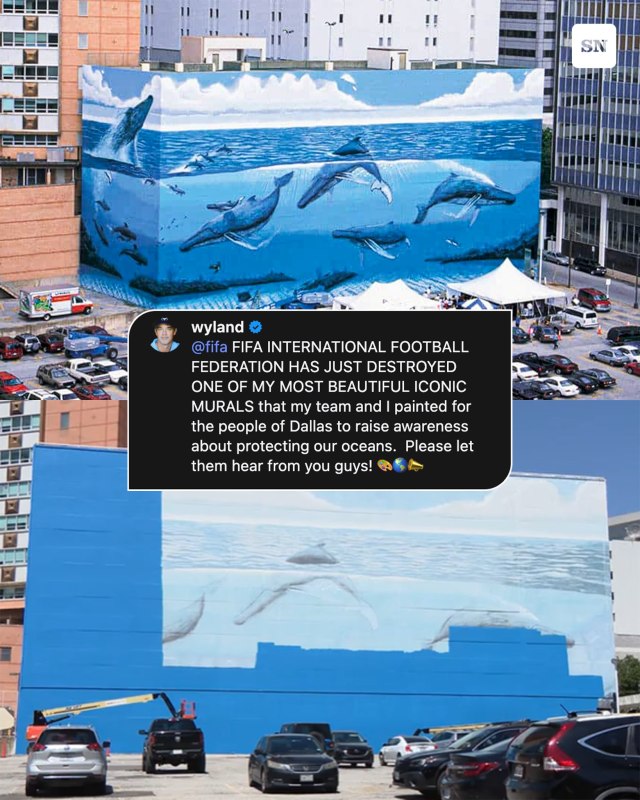
In a statement, the North Texas FIFA World Cup Organizing Committee said the new mural would “reflect the energy, unity, and global spirit surrounding the World Cup 2026.” Wyland disputed suggestions that he had approved the change, insisting that no one connected to FIFA, the city, or the building ownership group had received permission from him or his Wyland Foundation. When a committee member claimed they had contacted the artist, Wyland called that claim “a lie with a capital L.”
Image from The Sporting News and @wyland via X.com
Wyland warned that the destruction of the mural may violate the federal Visual Artists Rights Act, which gives artists legal standing when their work is destroyed or altered — even when they do not own the building on which the work appears. “If they can get away with it,” he said, “then all the public art in Dallas and all the public art in America is at risk.” Texas native Kacey Musgraves amplified the backlash after sharing a report on the mural’s removal: “This makes me really sad. We suck the soul out of everything.”
In their statement, organizers said that a portion of the original artwork would remain intact, describing it as “a tribute to its lasting impact on the city.” That framing — preserve a piece of something as a tribute after erasing most of it, without the artist’s knowledge or consent — captures something important about how large sporting organizations often approach local culture: with appreciation that arrives after the demolition crew.
The Bigger Picture: Three Countries, Many Headwinds
The economic and cultural frictions playing out in Dallas and in hotel booking spreadsheets are not happening in a vacuum. They are unfolding within a broader context that has made the 2026 World Cup genuinely unlike any previous tournament.
For the 78 games being played in the United States — three-quarters of all the tournament’s matches — several Trump administration immigration policies pose major challenges to players and fans alike. The administration issued two proclamations restricting or limiting the entry of nationals from 39 countries, meaning fans from Côte d’Ivoire, Haiti, Iran, and Senegal are all subject to travel bans. A proposed $250 “visa integrity fee” would bring the total price of tourist visas from countries like Mexico and Brazil to $435 per person. Visitors from Algeria, Cape Verde, Côte d’Ivoire, Senegal, and Tunisia were also required to post bonds of either $5,000, $10,000, or $15,000 before traveling.
FIFA reportedly requested bond waivers and discussed the issue at multiple meetings with the Trump administration over several months. The State Department ultimately announced it would waive the bond requirement for citizens of certain competing countries who purchased World Cup tickets and opted into a fast-track visa processing system — but visitors will still be subject to regular screening, which has become more stringent during Trump’s second term.
The American Civil Liberties Union and Amnesty International, along with more than 120 organizations, issued a “travel advisory” for the United States, warning World Cup fans about a “deteriorating human rights situation,” including increased surveillance, immigration enforcement, and the possibility of detention or deportation.
Canada has not been immune to the problems, either. Canada faces similar issues, with visa processing delays fueled by staffing shortages and high demand ahead of the tournament. And in Mexico, the security picture in Guadalajara became briefly alarming when retaliatory cartel violence following the capture of a major cartel leader raised concerns about matches in Jalisco — though FIFA officials said there were no intentions to move any matches, and the Mexican government committed 100,000 troops to security during the tournament.
Transatlantic flight bookings for summer 2026 are reportedly 14 percent lower than 2025 levels, and international visitor numbers to the United States dropped 5.2 percent in early 2026 compared to the previous year. The tourism that does materialize is increasingly likely to be domestic, and domestic visitors — while welcome — do not generate the same kind of international economic spillover that a World Cup is supposed to produce.
Growing the Game, or Shrinking Its Audience?
Here is the question that cuts closest to the long-term stakes: if the 2026 World Cup is supposed to be soccer’s great American coming-out party, what happens when the party is priced beyond the reach of the fans who would most benefit from attending?
Soccer’s growth in the United States over the past three decades has been driven substantially by immigrant communities — families from Mexico, Central America, West Africa, South Asia, and dozens of other places where the sport is not an emerging interest but a generational inheritance. Many of those families live in host cities. Many of them cannot afford $265 for the cheapest group-stage ticket for a game in Dallas, let alone the travel and hotel costs on top of it. The fans who know the game best may end up watching it on television, while the seats go to corporate hospitality packages and secondary-market scalpers.
Critics, players, media, unions, and traditionalist fan groups have criticized what they view as the “Americanization” of soccer — a set of commercial decisions by FIFA that prioritize revenue extraction over fan access and cultural authenticity. The halftime show planned for the final at the renamed New Jersey stadium — featuring Madonna, Shakira, and BTS, in a deliberate imitation of the Super Bowl format — has drawn exactly this kind of criticism. Supporters argue that it modernizes the World Cup and provides a platform for global cultural exchange; critics see it as a signal that the event is being reshaped around American entertainment norms rather than soccer traditions.
That tension is real, and it will not be resolved by the time the final whistle blows in July. The question for American soccer — for MLS, for youth programs, for the U.S. national teams — is whether hosting the world’s largest sporting event generates a durable wave of fan development, or whether it produces a six-week commercial spectacle that prices out the very communities most likely to sustain the sport over the following decade.
The 1994 World Cup, the last time the United States hosted, is often credited with jump-starting American soccer. MLS launched the following year. Youth participation surged. A generation of players grew up with memories of watching Romário and Baggio and Roberto Carlos in their own stadiums. But history suggests measured expectations are warranted: of the nine cities that hosted matches in 1994, only Boston, San Jose, Washington, and New York experienced meaningful growth in leisure and hospitality jobs that year, and most cities recorded similar or higher growth in 1995, suggesting that gains were due as much to the strong economy as to the tournament itself.
Thirty years later, the conditions are different in ways both encouraging and concerning. The American soccer ecosystem is genuinely larger and more sophisticated. The national men’s team is a legitimate World Cup contender. The fan base is more passionate and more knowledgeable. But the price of admission to the moment is higher than it has ever been, and the organizational decisions made in the months leading up to the tournament — on tickets, on branding, on public art, on who gets to travel to the United States without paying a $15,000 bond — suggest that FIFA’s primary interest is not in growing soccer in America. It is in monetizing soccer’s most commercially valuable window.
That is a distinction worth teaching. It is also worth remembering when the next city puts together a bid.
For the Classroom
What does it mean when a sporting event “grows” a sport? Walk students through the difference between generating short-term enthusiasm (attendance, media coverage, merchandise sales) and building sustainable infrastructure (youth programs, local leagues, accessible ticket pricing, coaching development). Ask them: who has to benefit from the World Cup for it to actually grow soccer in the United States over the next decade? Is that the same group that FIFA’s current pricing strategy is serving?
Why would a city agree to FIFA’s naming rights policy? Have students research the MetLife naming rights deal — a $17 to $20 million per year, 25-year agreement — and discuss the economics of corporate branding in sports. Then ask: if FIFA’s rules mean that name disappears for six weeks, and MetLife responds by walking away from the deal entirely, who won that negotiation? What does the Wyland mural situation add to that conversation about who controls a city’s public identity during a global event?
Further Reading
- Al Jazeera: “Why are FIFA World Cup 2026 tickets so expensive?” (April 2026)
- American Hotel & Lodging Association: U.S. Hotel Outlook Report / FIFA World Cup 2026
- American Immigration Council: “50 Days Until the World Cup: Travel Bans, ICE, and Iran Cause Uncertainty” (April 2026)
- WFAA / CBS Texas: Coverage of the Wyland “Whaling Wall 82” Dallas mural controversy (May 2026)
- Fortune: “The World Cup is supposed to be an economic windfall. But ‘you’re seeing a number of headwinds’ now” (April 2026)
- Football Supporters Europe (FSE): Statement on 2026 World Cup ticket pricing
- Travel Tomorrow: “2026 FIFA World Cup host cities in the US to see modest tourism boost” (May 2026)
Bryan F. Wilson teaches social studies and English language arts in Lexington, Kentucky. BFWClassroom.com publishes resources for educators. Opinions expressed in this blog do not represent those of my employer.
BFWClassroom.com | This work is licensed under CC BY-SA 4.0.


You must be logged in to post a comment.