
Posted to BFWClassroom.com | Bryan F. Wilson
A 192-page internal analysis of the 2024 election cycle is now circulating under the title Build to Win. Build to Last. Written by Democratic strategist Paul Rivera at the request of DNC Chair Ken Martin, the report draws on more than 300 interviews, mountains of publicly available ad spending data, and a decade’s worth of electoral history to argue that the Democratic Party needs a 10-year “Majority Party Strategy” to rebuild its relationship with American voters. The DNC withheld the report until CNN published its reporting on the document’s contents — at which point the DNC released its own annotated version, with red-text commentary pushing back on specific claims throughout Rivera’s analysis.
It is worth reading; because the report, taken on its own terms, says something more uncomfortable than its authors may have intended.
Let me work through what the report actually claims, what the evidence supports, and what the document quietly reveals about a party still struggling to name the structural problem it is sitting inside.
The Framing: What the Report Wants You to Take Away
The core argument is not complicated. Since the high-water mark of Barack Obama’s 2008 landslide, Democrats have experienced what the report calls “stagnation and retrogression” at every level of government: state legislatures, governorships, the Senate, the House, and ultimately the presidency. The party won a trifecta in 2020 and then watched it slip away in 2024, as Donald Trump became the first Republican to win the popular vote since George W. Bush in 2004.
The report’s prescription is similarly clear: Democrats must “organize everywhere to win anywhere,” invest in state parties year-round rather than seasonally, stop ignoring rural voters, fix a demonstrated problem with male voters (especially young men of color), and shift their media strategy toward digital-native platforms. It calls for an “always on” approach to messaging rather than the late-cycle spending blitz that characterized Democratic campaigns through 2024.
On its surface, this is solid electoral analysis. Much of it is probably correct as a matter of political tactics. The North Carolina governor’s race offers the report’s most persuasive case study: Josh Stein outperformed Kamala Harris by nearly 8 points statewide, running ahead of her with men, rural voters, white non-college voters, and new voters alike. The report draws useful contrasts between Stein’s early, affirmative candidate definition and the national campaign’s struggle to introduce Harris to voters in a compressed timeline after President Biden’s late withdrawal.
The section on the “always on” media problem is also genuinely illuminating. Republicans and right-wing organizations maintain consistent messaging infrastructure between election cycles; Democrats flood the zone in October and then go dark. The practical consequence is that by the time Democratic candidates are defining themselves for voters, the opposition has already been filling that vacuum for months. The early DGA investment in North Carolina, running supportive media for Stein from May through August, is correctly identified as a model worth replicating.
So: the tactical advice is real, much of it is supported by the data the report presents, and some of it will probably help.
What the Report Can’t Quite Name
Here is where I want to slow down, because this is where my own lens on history and politics does its most useful work.
The report opens with an honest statement of the historical problem: Democrats had their best moment in 2008, failed to cement those gains with working Americans, and have been losing ground ever since. It correctly identifies 2010 as the catastrophic inflection point — not just because of the midterm shellacking, but because of the redistricting cycle that followed. Republican trifectas in key states after the 2010 Census produced congressional maps that have structurally advantaged the GOP for a decade-plus; the report acknowledges this clearly.
But then the analysis stops short of following that thread all the way through.
The report says Democrats failed to “capitalize on the economic disaster of the Bush presidency by cementing a relationship with working Americans.” That sentence is doing an enormous amount of work, and the report never unpacks it. What would cementing that relationship have actually required? The 2009-2010 Democratic trifecta produced the Affordable Care Act — a significant achievement — but also produced a stimulus package widely criticized by economists as too small, a bank bailout that rescued financial institutions while millions of homeowners lost their houses, and a financial reform bill (Dodd-Frank) that regulated Wall Street without fundamentally restructuring the conditions that produced the crisis. The Tea Party’s rage, whatever its bad-faith elements, was also tapping something real: millions of Americans who felt the federal government had prioritized the institutions that failed them over the people those institutions had harmed.
The report’s version of this story is that Democrats had a messaging problem. My reading is that they had a governing problem, and the messaging problem followed from it.
This distinction matters enormously for how you interpret 2024. The report treats the shift of working-class voters — including Latino voters, young men of color, and rural voters — toward Trump as primarily a communication failure. Democrats didn’t show up consistently enough, didn’t define Harris early enough, didn’t reach voters on digital platforms where they actually live. All of that may be true. But it sidesteps a harder question: why, after decades of Democratic governance at various levels, do so many working-class voters feel that the Democratic Party is not fighting for them?
The report’s own evidence points toward an answer the analysis doesn’t fully embrace. Ballot measures for Medicaid expansion, minimum wage increases, non-partisan redistricting, and reproductive freedom consistently win in states where Democratic candidates lose. Ohio voters enshrined abortion rights in their state constitution in 2023 and then voted for Trump for president in 2024 by double digits. That is not a coherence failure among voters; it is a signal that voters have separated “Democratic Party as institution” from “policies I want.” The party has become, for many of these voters, something associated with a professional class and its concerns — and the question of whether that perception is earned or manufactured is more complicated than the report acknowledges.
The Infrastructure Problem Nobody Wants to Fund
The section I found most structurally honest is the one on state party disinvestment — though even here the report pulls its punch.
The report is correct that the Obama administration’s decision to prioritize Organizing for America (a campaign-adjacent organization) over the DNC and state parties after 2008 had lasting consequences. When the party infrastructure needed to exist for the 2010 midterms, it had been systematically starved. That decision compounded every subsequent loss: the 2010 redistricting maps, the 2014 shellacking, and the 2016 collapse of the Blue Wall all trace some portion of their roots to an infrastructure vacuum created deliberately at the top.
What the report doesn’t fully grapple with is why this pattern keeps recurring. State parties are unglamorous. Organizing directors in rural Kentucky don’t generate the kind of donor excitement that a high-profile Senate race in a swing state does. The Democratic donor class — the bundlers, the big-check writers, the tech executives whose fundraising lists power national campaigns — tends to invest in candidates and moments, not in the permanent civic infrastructure that makes candidate success possible. The report calls for an “always on” approach; but the structural incentives of the current Democratic fundraising ecosystem actively work against it.
The report notes that Democrats raised and spent more than $8 billion in federal elections in 2024. The Harris campaign outspent Trump by more than $500 million and still lost. That is not primarily a resource problem. It is a resource allocation problem rooted in a fundamentally transactional relationship with political power: money flows toward the exciting race right now, not toward the county party organizer who will still be there in three years building the relationships that make the exciting race possible.
The Male Voter Problem: Real, But Complicated
The report is appropriately alarmed about Democratic losses among male voters — particularly young men, young Latino men, and young Black men. Harris won only 40% of men overall; Stein won 51% in the same state on the same night. The gap is real and it is not reducible to Robinson’s implosion, since similar patterns appeared across battleground states without a catastrophic Republican candidate at the top.
What I notice is that the report is much better at identifying the problem than explaining it. The recommended interventions — “deploy male messengers,” “address economic concerns,” “don’t assume identity politics will hold male voters of color” — are more tactical than analytical. They describe what campaigns should do without fully engaging why the drift is happening.
My own read, informed by watching how this plays out with high school students: young men, including young men of color, are operating in an economic environment that is genuinely hostile to working-class stability. Manufacturing has hollowed out. Service sector jobs don’t carry the cultural weight or the economic security that unionized industrial work once did. The kinds of community anchors — churches, civic organizations, trade unions — that historically gave working-class men a sense of participation in something larger than themselves have weakened. Into that vacuum, online influencer culture (including explicitly right-wing influencer culture) has moved aggressively, offering a story about masculinity, status, and who is responsible for the loss of both.
The Democratic Party’s response to this has been, in aggregate, to make arguments about systemic structures (accurate, but abstract) while the other side makes arguments about identity and cultural belonging (often false, but visceral). The report is right that Democrats need to engage male voters differently; but the engagement will require more than better media strategy. It will require an honest reckoning with what has actually happened to working-class communities and a concrete, material response to it — not just better-targeted ads.
What the Disclaimer Tells You
There is a detail about this document that deserves mention before I close, and it goes directly to how I obtained and read it.
CNN published the report after the DNC withheld it — releasing it only once CNN’s reporting made the contents public anyway. The version CNN published includes annotations in red that the DNC added to Rivera’s original text; CNN was clear that it did not modify the report and does not vouch for the accuracy of any statements within it or within the DNC’s own annotations. I downloaded and analyzed that copy directly from CNN’s website.
The DNC’s own disclaimer appears on every single page: “This document reflects the views of the author, not the DNC. The DNC was not provided with the underlying sourcing, interviews, or supporting data for many of the assertions contained herein and therefore cannot independently verify the claims presented.”
The red-text DNC annotations flag dozens of specific claims throughout the document as unsupported, internally inconsistent, or contradicted by public reporting. Some of the vote margin figures appear inaccurate. Some of the state-level claims are flagged as contradicting publicly available data.
This is worth sitting with. A party that cannot produce a reliable internal post-mortem — that has to disclaim its own commissioned analysis before it is even released — is a party with a serious accountability infrastructure problem. The report calls on Democrats to “accept hard truths”; the reader is left wondering whether the institution that commissioned the report is capable of that level of honesty about itself.
The Region the Autopsy Doesn’t Know How to Talk About
I want to be direct about something the report almost touches before pulling back: the collapse of Democratic support across the southern Appalachian corridor and the rural interior South is not a recent phenomenon, and it is not primarily a messaging problem. I have been watching it happen in real time for more than twenty years, and the communities driving that shift are ones I know — not as data points, but as places where people I understand built their lives around economic arrangements that were dismantled and never honestly replaced.
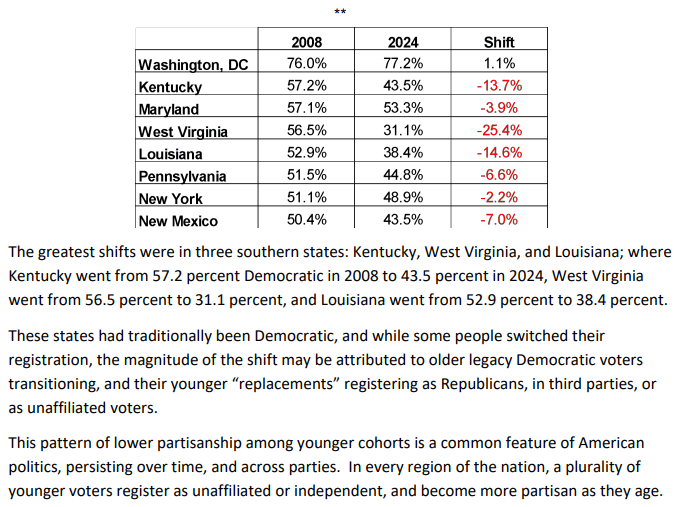
The report does briefly acknowledge the scale of the voter registration collapse in Kentucky and West Virginia. Kentucky went from 57.2 percent Democratic registration in 2008 to 43.5 percent in 2024; West Virginia dropped from 56.5 percent to 31.1 percent in the same period. Louisiana showed a similar trajectory. Rivera’s explanation is largely demographic — older legacy Democrats aging out, younger voters registering Republican or unaffiliated. The DNC’s annotators don’t push back on those numbers.
But here is what the report never asks: why are younger voters in these communities choosing not to identify as Democrats? What happened between the generation that voted for FDR, Truman, LBJ, and Jimmy Carter — the generation that built Democratic Party identity in coal country, tobacco country, and small-farm Appalachia through union halls, rural co-ops, and community organizing — and the generation that now votes Republican by thirty-point margins?
The answer is not a mystery, and it is not primarily about cultural signaling or social issues, though those have become the surface explanation. The structural answer runs through a single word the report never uses: NAFTA.
The North American Free Trade Agreement, passed in 1993 under a Democratic president with significant Democratic congressional support, accelerated the export of manufacturing jobs from precisely the communities that had built Democratic Party loyalty since the New Deal. Southern Ohio, southern Indiana, southern Illinois, eastern Kentucky, West Virginia — these were not incidentally industrial regions. They were the backbone of a mid-century economy that combined coal extraction, small manufacturing, union employment, and family agriculture into a working-class political identity that was inseparable from Democratic Party affiliation. When NAFTA opened those jobs to wage competition they could not survive, the promises of retraining programs and replacement industries were, in most of these communities, never kept at meaningful scale.
I watched this happen in Kentucky. The tobacco buyout of 2004 is a useful marker: federal policy eliminated price supports and production quotas that had stabilized small farm income in the Bluegrass and the mountains for decades, with a one-time buyout payment and a vague promise of economic transition assistance. What followed in many rural Kentucky counties was not transition — it was contraction. The opioid crisis, which devastated Appalachian Kentucky in ways that are still being counted, did not arrive in a vacuum; it arrived into communities whose economic anchors had been pulled up and whose social infrastructure — churches, union halls, community organizations — had been steadily weakening for a generation.
The political consequence was not irrational. Communities that had voted Democratic because Democrats built the institutions that gave their economic lives structure and stability stopped voting Democratic when those institutions were gone and the party that claimed to represent working people had helped dismantle them. The cultural realignment that followed — the move toward Republican identity rooted in evangelical Christianity, gun culture, and an increasingly explicit white working-class identity politics — did not cause the economic collapse. It filled the vacuum the economic collapse created.
Rivera’s report gets close to this in one passage about Ohio. He notes that “Ohio’s manufacturing communities voted for Obama in 2008 and 2012, but have been economically hollowed out and decisively shifted to Republicans. Good manufacturing jobs disappearing and being replaced by lower-wage service work has fundamentally altered the political landscape.” That is accurate as far as it goes. But it goes nowhere — no historical cause, no policy analysis, no acknowledgment that trade policy championed by Democratic administrations contributed to that hollowing, and certainly no reckoning with what a serious response would require.
The region I am describing — West Virginia, Kentucky, southern Ohio, southern Indiana, southern Illinois, and the interior South — does not appear in the report’s electoral analysis as a distinct strategic concern. It shows up only in the registration data, and only to note that the numbers are bad. There is no section asking whether these communities are winnable, what it would take to win them, or whether the party has any obligation to them beyond hoping demographic change eventually makes them irrelevant to the math.
That last point is the one I find most troubling. The implicit logic of the DNC’s strategic vision — organize the Rising American Electorate, hold the suburbs, compete in the Sun Belt — is a logic that writes off the Appalachian interior as a lost cause. And that may be electorally rational in the short term. But it is also a governing choice with moral weight. These are communities experiencing some of the highest rates of poverty, lowest life expectancy, worst addiction outcomes, and most acute infrastructure decay in the country. The argument that Democrats cannot win them is probably true in the current cycle; the argument that Democrats therefore have nothing to say to them is a different argument entirely, and a more troubling one.
I have been an educator in Kentucky for more than two decades. The students I teach are the children and grandchildren of the communities this report doesn’t know how to talk about. When I watch their families navigate an economy that offers them Dollar General and Amazon fulfillment centers as replacements for the union manufacturing jobs their grandparents held, and then watch the Democratic Party’s autopsy respond to their political choices with an analysis that never mentions NAFTA, never mentions agricultural policy, never mentions the tobacco buyout, and never names a single concrete material commitment to their communities — I understand why the registration numbers look the way they do.
What I Actually Think
The 2024 election was not primarily lost because Democrats ran the wrong ads, or because they spent too much on broadcast and not enough on connected television, or even because the candidate switch came too late. Those things mattered at the margins; in an election decided by a fraction of a percent across a handful of states, margin-level interventions matter.
But the deeper problem is structural: the Democratic Party has spent decades building a coalition that overrepresents professional-class interests, university-adjacent values, and the concerns of people for whom the economy has largely been working — while the communities most dependent on a politics of material solidarity have been watching their economic foundations erode, their institutions hollow out, and their concerns treated as either taken-for-granted (among reliable Democratic voters) or unwinnable (among Republicans).
The report’s ten-year strategic vision is oriented around winning. That is not wrong. But winning needs to be in service of something; and “build to win, build to last” is not an agenda — it is an organizational aspiration. The communities this report wants to bring back into the Democratic coalition are asking a version of the question that has always mattered most in democratic politics: what, exactly, are you building toward, and for whom?
That question won’t be answered by better ad buys. It will be answered — or not — by governing choices, by whose interests get prioritized when the resource tradeoffs get hard, and by whether the Democratic Party can become, again, a party whose institutional identity is inseparable from the material wellbeing of working people at every level of the economy.
The report knows what the party has lost. The harder work is deciding what it is willing to actually change to get it back.
A note on sourcing: The version of this report I read and analyzed was downloaded from CNN’s website, where it was published after the DNC declined to release it until CNN reported on its contents. The CNN copy includes the DNC’s own red-text annotations alongside Paul Rivera’s original text. CNN has stated it did not modify the report and does not vouch for the accuracy of any statements within it or the DNC’s annotations. I have tried to reflect that interpretive complexity throughout this post; where I describe specific claims from the report, I am describing Rivera’s arguments or the DNC’s responses to them, not independently verified facts.
This is part of my Politics in the Classroom series, where I look at the importance of political campaigns, pop culture, sports, music, and geopolitics of the last 50 years and how to use them as resources in the classroom. To read more, check out my other posts in the series. (Link)


You must be logged in to post a comment.