Gerrymandering, the Case for a Bigger House, and Why 2030 Changes Everything
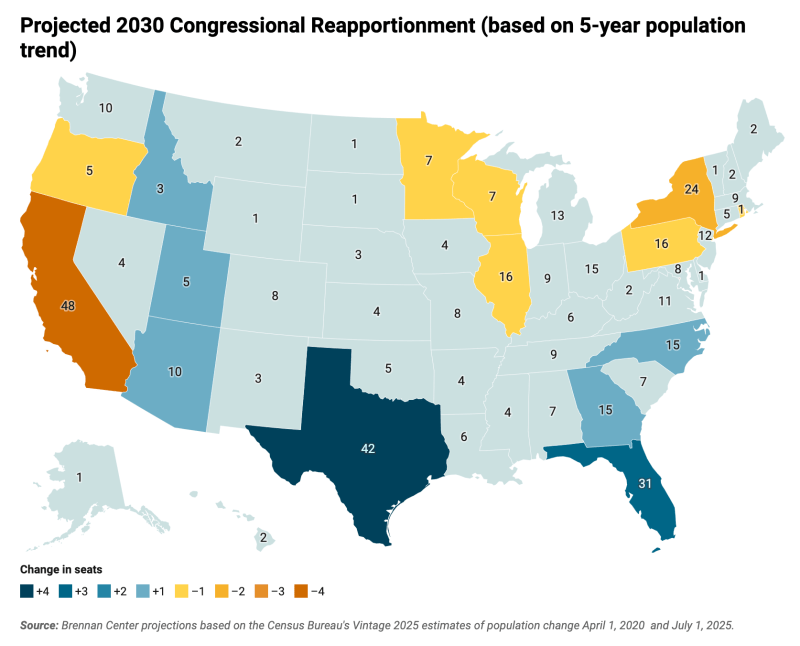
There is a map making the rounds from the Brennan Center for Justice that every civics educator in the country should be looking at right now. Based on Census Bureau Vintage 2025 population estimates, it projects what congressional reapportionment will look like after the 2030 Census — and its implications run directly through the middle of the gerrymandering wars currently consuming American politics.
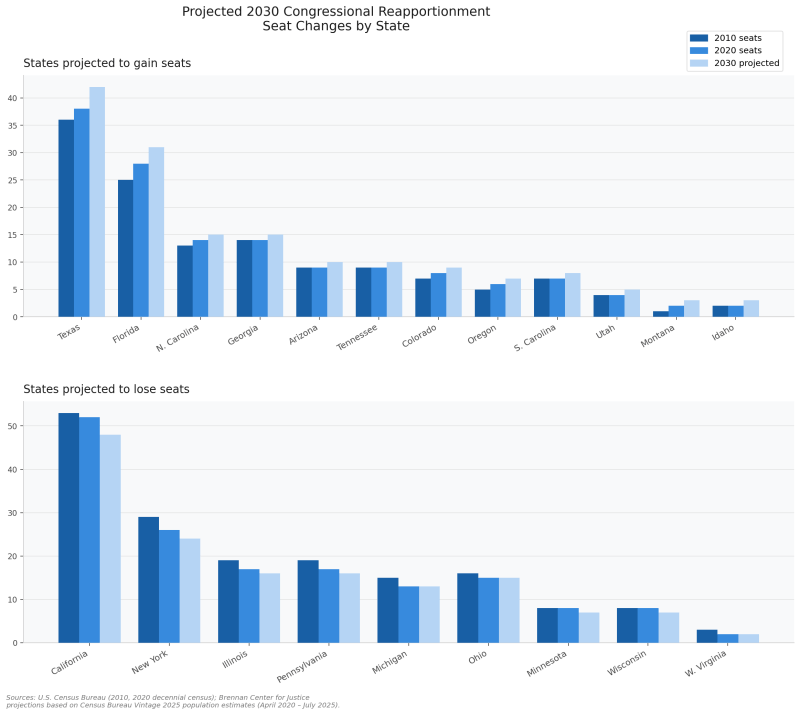
The map tells a story that the architects of today’s partisan redistricting schemes may not want to hear: the population shifts already underway will require substantial redrawing of congressional maps by the end of the decade regardless of whatever lines are being drawn and fought over right now. Texas, the epicenter of the current redistricting battle, is projected to gain four additional seats by 2030. California, whose voters just approved partisan redistricting in direct retaliation for Texas, is projected to lose four seats. Florida gains four. New York loses three. Minnesota loses two, as does Oregon.
Before we get to what those numbers mean for the current moment, we need to understand how we arrived at a political environment in which the sitting president of the United States is directing states to redraw congressional maps in the middle of a decade — and why the structural problem underneath all of this has a solution that nobody in power seems willing to seriously discuss.
How We Got Here: The 1929 Cap and Its Consequences
The United States House of Representatives has had 435 members since 1929. That number was not constitutionally mandated, scientifically derived, or the product of careful democratic deliberation. It was the result of a political impasse following the 1920 Census, when Congress could not agree on reapportionment and simply froze the House at its existing size, then codified that freeze into statute.
For nearly a century, the number of members of the House of Representatives has been set at the 1929 cap of 435 members. The number of constituents represented by each member has dramatically increased since the cap was arbitrarily set. In 1929, the U.S. population was approximately 122 million people. Today it is more than 335 million. Every congressional district that contained roughly 280,000 constituents at the time of the freeze now contains more than 760,000. A representative who was once expected to maintain a direct, accountable relationship with a community the size of a mid-sized city now nominally represents a constituency the size of a major metropolitan area.
This matters for gerrymandering in a direct and underappreciated way. When districts are large, map-drawers have enormous flexibility to sort voters in ways that dilute or concentrate political power. A district of 760,000 people drawn across a metropolitan area can absorb and neutralize urban Democratic voters, or pack rural Republican voters into artificially safe districts, or crack a coherent community across multiple district lines — all with precision that becomes harder to execute when districts are smaller and more geographically constrained. The frozen House is not merely an inconvenience for democratic representation; it is one of the structural conditions that makes aggressive gerrymandering possible in the first place.
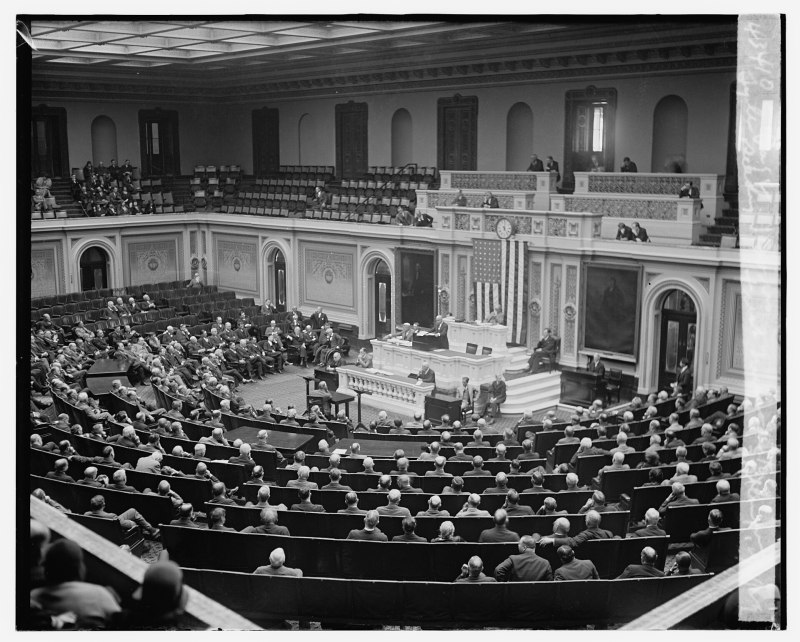
National Photo Company Collection, Public domain, via Wikimedia Commons
The 2025 Redistricting Wars: A Race to the Bottom
The current redistricting crisis is worth understanding in its full sequence, because both parties are responsible for the escalation even if the starting gun was fired by one side.
Redistricting is usually performed only once a decade after the release of data from the U.S. Census. Texas Republicans, at the urging of President Donald Trump, passed a new map in August packing together Democratic voters in major urban and suburban areas and drawing new borders around Democratic seats to include more Texans who voted for Trump. In July, Trump ordered Texas Gov. Greg Abbott to redistrict the state in the middle of the decade in order to carve out an additional five Republican-leaning congressional districts. The stated goal was to bolster Republican odds in the 2026 midterms by locking in structural advantages before voters could register their dissatisfaction with the administration’s agenda.
The response from California was swift and, to put it charitably, politically understandable while being institutionally corrosive. Gov. Gavin Newsom’s plan to counter what he called Trump’s election gerrymander in Texas with redistricting in California was approved by the California Legislature, calling for a special election on a ballot measure that would suspend the state’s current congressional districts — which were drawn by an independent commission — and replace them with a map intended to favor Democrats. California voters passed Proposition 50 with over 64 percent voting yes, with the new maps to be in effect through 2030, at which point the state will resume its independent redistricting commission process.
There is a profound institutional irony in what California did. The state had, for years, been held up as a model of redistricting reform — a bipartisan independent commission drawing maps without direct legislative interference. Many California Democrats were reluctant to give up the state’s independently drawn congressional districts, but said it was a necessary step to counter gerrymanders in Republican states. The argument — we must destroy our independent commission in order to save it — captures the logic of the current moment with uncomfortable precision.
Meanwhile, the Texas maps themselves have been contested in court almost continuously since they were signed into law. A constitutional law professor described the Supreme Court’s ruling allowing the maps for 2026 as “a preliminary determination that would allow the maps to go into effect for 2026, but it would not be a situation in which that necessarily blesses the maps for future use in future elections in 2028 and beyond. After 2030, we would need to do a redistricting after the next census anyway.” And analysis from the Brookings Institution suggests that the resulting Texas plan will most likely add only two Republican seats, not five — and in a challenging electoral environment, Republicans could actually lose seats.
The redistricting battle that consumed the summer and fall of 2025, triggered a multi-state gerrymander arms race, dismantled California’s independent commission, generated multiple federal lawsuits, and cost an enormous amount of political capital — may net, at best, two additional Republican House seats in a state that was already going to gain four seats after 2030 anyway.
What the Brennan Center Map Actually Shows
Look at the Brennan Center’s 2030 projection map carefully. The population trends already visible in the Census Bureau’s Vintage 2025 estimates tell a consistent story about where Americans are moving and why the current redistricting fights are being waged over a demographic landscape that is actively shifting beneath the mapmakers’ feet.
The big gainers are states in the Sun Belt and Mountain West. Texas projects to gain four seats, reaching 42 congressional districts. Florida gains four, reaching 31. North Carolina picks up one; Montana, Oregon, and Colorado each gain seats. These are states experiencing sustained in-migration — some from domestic population movement and some from immigration — and their representation in Congress will grow accordingly.
The big losers cluster in the upper Midwest and Northeast. New York loses three seats, dropping to 24. California loses four, settling at 48 — still the largest congressional delegation in the country, but meaningfully smaller. Minnesota loses two. Illinois loses two. These are states experiencing population stagnation or outflow, and their congressional influence will contract to match.
Here is the structural consequence that the current redistricting wars are running headlong into: Texas Republicans are fighting for five additional seats in a state that is projected to have four new seats handed to it after 2030 by sheer population growth anyway. California Democrats are abandoning their independent commission to claw back five seats in a state that is projected to lose four seats after 2030. Both parties are spending enormous institutional capital and goodwill fighting for a map advantage that will be legally required to be redrawn in four years regardless of outcome.
This is not to say the 2026 elections don’t matter — they do, and the House majority that will govern for the next two years will be shaped by these maps. But the framing of the current redistricting fights as durable structural victories is wrong. They are expensive, institutionally destructive maneuvers for a single election cycle, implemented on top of a demographic landscape that is actively working against the assumptions embedded in the maps.
The Structural Fix Nobody Wants to Discuss
The reason gerrymandering is so politically rewarding — and so difficult to reform through anything short of a constitutional crisis — is that it operates on a fixed resource. With 435 House seats, every seat that one party can lock down through map manipulation is a seat the other party cannot contest. The zero-sum nature of the current system makes gerrymandering a rational, even obligatory strategy for any party that controls a state legislature at the right moment in the decade.
Expand the House substantially, and the calculus changes.
The debate over expansion includes specific mathematical formulas designed to determine an appropriate new size for the House. The “Wyoming Rule” suggests setting the national representative-to-constituent ratio to approximate that of the smallest state, currently Wyoming; applying the Wyoming Rule based on the 2020 Census would increase the House to approximately 573 seats. The “Cube Root Rule” proposes that the size of a national legislature should be the cube root of the nation’s total population, which using 2020 census figures suggests a House size of about 692 seats.
Both proposals have serious legislative backers. Rep. Earl Blumenauer introduced the Restoring Equal and Accountable Legislators in the House Act, which would add 150 seats to the House, increasing it to 585 members. “Members of the House of Representatives are their constituents’ most direct connection to the federal government,” Blumenauer said, noting that the number of constituents in a single congressional district has dramatically increased since the cap was arbitrarily set in 1929. In the current Congress, the House Expansion Commission Act was introduced in April 2025, establishing a commission to study proposals for expanding the House and examining the Cube Root Law, Wyoming Rule, and other methods, along with cost implications and practical challenges.
A substantially larger House would not eliminate gerrymandering — political actors will always attempt to manipulate whatever system exists — but it would significantly reduce its effectiveness. Smaller districts mean less geographic flexibility for mapmakers; communities are harder to crack or pack when each district serves a smaller, more defined population. More districts means more competitive terrain where the parties have to actually compete rather than relying on structural lock-ins. And more representatives per state means that the loss of any single seat has proportionally less impact on the total partisan outcome — reducing the incentive for the kind of all-or-nothing gerrymander battles currently playing out in Texas and California.
There is also a representational argument that I find, as an educator, more compelling than the partisan one. My students — who live in a congressional district with more than 750,000 constituents — are nominally represented by a single member of Congress who simultaneously manages constituent services for a population the size of Louisville, staffs committee assignments, tracks legislation across multiple policy areas, raises money for the next election cycle, and maintains a presence in both Washington and the home district. The idea that this constitutes robust democratic representation is, to put it gently, aspirational. A House that actually represented the current population at the ratio the founders roughly envisioned would look substantially different from the one we have.
The Short-Term Thinking Trap
What concerns me most about the current redistricting moment — and this applies to both Texas Republicans and California Democrats — is the substitution of tactical calculation for genuine democratic thinking.
The Texas gambit is built on the assumption that locking in five additional Republican seats for 2026 is worth the institutional cost of normalizing mid-decade partisan redistricting, dismantling whatever remained of bipartisan norms around map-drawing, and triggering a multi-state gerrymander arms race. Even on its own terms, the plan will most likely add only two seats, and Republicans could actually lose seats in a challenging electoral environment. The institutional damage is durable; the seat gains are speculative.
The California response is built on the mirror-image logic: fighting fire with fire, protecting the House majority, responding to Republican aggression with Democratic aggression. The Proposition 50 argument — that California could not “unilaterally disarm” while Texas gerrymanders — is not unreasonable as a matter of political survival. But the new maps will be in effect through 2030, at which point the state will resume its independent redistricting commission process — in a state that is projected to lose four seats. California Democrats will enter the 2030 redistricting cycle with a smaller delegation, a temporarily suspended commission process, and a public that has now approved partisan legislative redistricting once, establishing a precedent that the independent commission was always conditional.
Both states are spending enormous political capital fighting over a map that population trends are already rendering obsolete. The Brennan Center’s 2030 projections are not a guarantee — they are projections based on five-year trends, and actual Census counts will differ — but they are directionally reliable enough that any serious political strategist should be asking: what are we actually buying with all of this?
The honest answer is: one election cycle of structural advantage, at the cost of institutional norms that, once broken, are very difficult to rebuild.
What Should Come Next
The redistricting wars of 2025 make a compelling case — through demonstration of failure rather than principled argument — for two structural reforms that have been circulating in democratic reform circles for years.
The first is a federal prohibition on mid-decade redistricting except in cases of court order. In 2025 and 2026, lawmakers in a number of states including California, Missouri, North Carolina, Ohio, Texas, and Utah have redrawn their congressional district maps ahead of the 2030 Census, and some members of Congress have begun introducing legislation that would prohibit states from undergoing more than one redistricting following each decennial census. That legislation deserves serious consideration; the current situation, in which a president can direct a friendly governor to redraw maps whenever political pressure demands it, is not a sustainable democratic norm.
The second is House expansion. The 435-seat cap is a 97-year-old legislative accident that has become a structural condition for the gerrymandering wars. Expanding the House — whether through the Wyoming Rule, the Cube Root Rule, or a one-time significant increase — would not solve American democracy’s representational problems by itself; but it would make the zero-sum battle over existing seats substantially less rewarding, give communities more direct access to their representatives, and reduce the leverage that any single state’s redistricting cycle has over national political outcomes.
Neither reform has a realistic path through the current Congress. But the 2030 Census is approaching faster than the political class seems to recognize; the population trends visible in the Brennan Center projections will produce a new map regardless of what Texas and California do between now and then. The question is whether that mandatory redrawing happens within a reformed institutional framework — or within the same broken one that produced the current mess.
Looking at that Brennan Center map, I am reminded that the demographic future has a way of arriving whether or not the political system is ready for it. Texas will get its four new seats. California will lose four. New York will shrink. Florida will grow. The lines will be redrawn. The only question is who draws them, under what rules, and whether the House they are drawn for is still the same arbitrarily-capped 435-seat body it has been since the era of Calvin Coolidge.
It does not have to be.
The Brennan Center map referenced in this post is based on Census Bureau Vintage 2025 estimates of population change between April 1, 2020 and July 1, 2025.
Bryan F. Wilson teaches social studies and English language arts in Lexington, Kentucky. BFWClassroom.com publishes resources for educators. Opinions expressed in this blog do not represent those of my employer.
BFWClassroom.com | This work is licensed under CC BY-SA 4.0.


You must be logged in to post a comment.