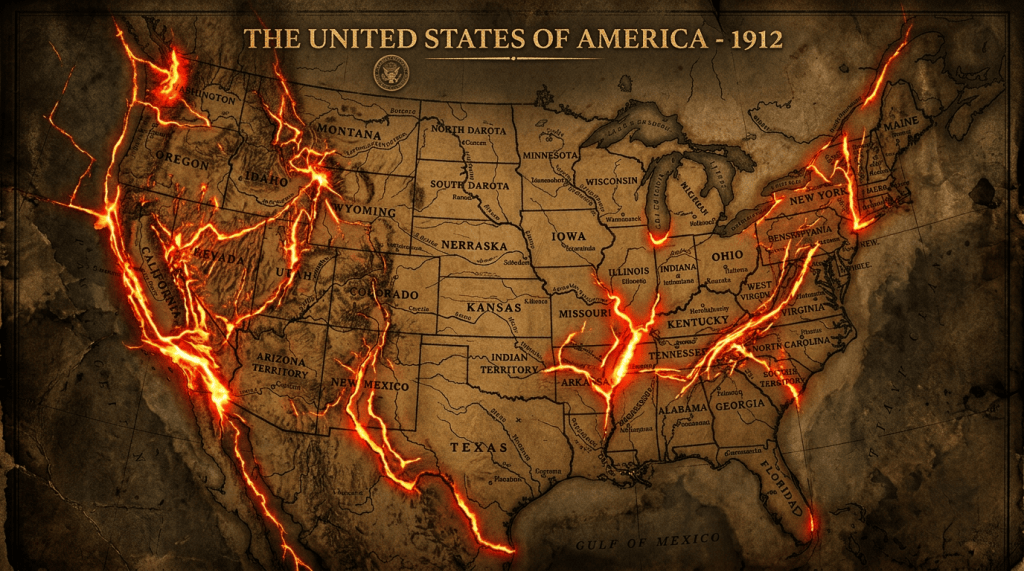
The Grief Campaign, the Dead President-Elect, and the Crisis That Followed
“What If?” Series — Milwaukee, Part I of III
On the evening of October 14, 1912, a former president of the United States stepped out of the Hotel Gilpatrick in Milwaukee and into the barrel of a revolver. John Schrank, a saloon keeper from New York who had trailed Theodore Roosevelt across six states, fired a single .38-caliber round at close range. The bullet passed through Roosevelt’s steel eyeglass case and his folded fifty-page manuscript before lodging against his fourth rib, roughly an inch from his heart. Roosevelt felt the blood spreading across his shirt, assessed the situation — no blood in the mouth, so the lung was probably intact — buttoned his coat, and went to give the speech anyway.
He lived. He finished second in the November election. He returned to Oyster Bay and spent six more years being Theodore Roosevelt, until a pulmonary embolism took him in January 1919.
That is the history we have. But the variables involved in the Milwaukee shooting were close enough to other values that the outcome could easily have gone differently — a slightly different angle, a manuscript that was thinner or differently folded, a bullet that traveled another inch before stopping. Three different outcomes from that single moment each produce a meaningfully different America. This post follows the first of them: a Roosevelt who survives long enough to win the election, but not long enough to take the oath. And the constitutional crisis that follows is one the country had, in a different form, lived through before.
Historical Grounding: The Race No One Expected Anyone to Win
The 1912 election was already one of the most structurally unusual in American history before anyone fired a shot. The Republican Party had fractured along a fault line that had been widening since at least 1909, when the Taft administration sided with the conservative Senate leadership on tariff reform in ways that Roosevelt’s progressive allies regarded as a betrayal of everything the previous eight years had built. By 1911, the insurgency had found organizational form through the National Progressive Republican League; by February 1912, Roosevelt had declared his candidacy; and by June, when the Republican National Committee handed the nomination to Taft at Chicago’s contentious convention by seating disputed delegates in ways that effectively decided the outcome before the balloting began, Roosevelt’s supporters had walked out and formed the Progressive Party.
The new party was real — it had ballot access, genuine organizational energy, and an ambitious platform that included women’s suffrage, workers’ compensation, direct election of senators, and the beginnings of what Roosevelt called a national social insurance system. What it did not have was the institutional infrastructure that two generations of major-party machine politics had built: the county committees, the patronage networks, the courthouse relationships that converted voter enthusiasm into reliable turnout. What it had instead was Theodore Roosevelt, whose name on a ballot was worth more organizational capacity than any amount of infrastructure could substitute for. The party and the man were not separable in any meaningful sense, and everyone involved understood this.
Woodrow Wilson, the Democratic nominee, understood it clearly enough to build his strategy around it. He ran a careful campaign, positioning his New Freedom philosophy as a principled alternative to both Taft’s conservatism and Roosevelt’s expansive federal vision, and he relied on the arithmetic of the split to do much of his electoral work. A divided opposition meant that even a genuine minority of the popular vote would likely produce a majority of the electoral college. Wilson needed to hold his own coalition, not to persuade the other side’s voters. The mathematics were working for him.
Point of Departure: A Wound That Does Not Heal
The bullet penetrates slightly deeper than it does in our timeline, nicking the pleural lining of the left lung without fully puncturing it — enough to begin a slow internal bleed that the Milwaukee surgeons on the night of October 14th can stabilize but cannot fully repair with the techniques available to them in 1912. Roosevelt does not collapse; he is constitutionally incapable of collapsing in front of a crowd. The attending physicians deliver their verdict on the morning of October 15th in the careful language that medical men of that era used when they were managing a public narrative as much as a patient: the former president may campaign if he insists, but he will not recover fully before the election, and the risk of secondary infection is real. He has, in the clinical phrase of the period, a reasonable chance of dying within ninety days.
Roosevelt insists on continuing. Of course he insists.
The Grief Campaign
What follows is unlike anything American presidential politics had produced before or would produce again. Roosevelt’s campaign stops, which had been combative and energetic — a bull moose in full charge — become something closer to pilgrimages. The crowds that had come to see a fighter now come to see a wounded man who refuses to stop fighting, and the emotional register shifts entirely. Women who had not previously engaged with electoral politics begin appearing at campaign events and at the organizational work behind them in numbers the male party apparatus does not know quite what to do with. Progressive newspapers stop covering the race as a horse race and start covering it as a cause. The question is no longer whether Roosevelt can win a three-way split that the mathematics seemed to make nearly impossible; it is whether the country can bring itself to deny the presidency to a man who took a bullet and kept talking.
The political arithmetic moves in ways the pundits cannot easily quantify. Some portion of Wilson’s voters — particularly in the progressive Northeast, where Roosevelt’s reform record was strongest — cannot bring themselves to vote against a man they believe may be dying. The argument that Roosevelt might not survive to govern does not function, as Wilson’s strategists hope it will, as a reason to vote for the healthy candidate; it functions instead as a referendum on whether the country will honor what Roosevelt represents. Some Republican voters who had stayed with Taft out of institutional obligation feel that loyalty dissolve in the heat of what appears to be a genuine national emergency. Taft himself, whose relationship with Roosevelt had curdled into something close to mutual contempt, issues a statement of sympathy and then watches his campaign’s remaining momentum evaporate.
On November 5th, Roosevelt wins. He carries perhaps 280 electoral votes to Wilson’s 240, with Taft reduced to a rump showing in Utah and Vermont. The Progressive Party, which three weeks earlier had been a personality-driven third party with uncertain long-term prospects, has somehow won the presidency of the United States.
The Man Who Refused the Narrative
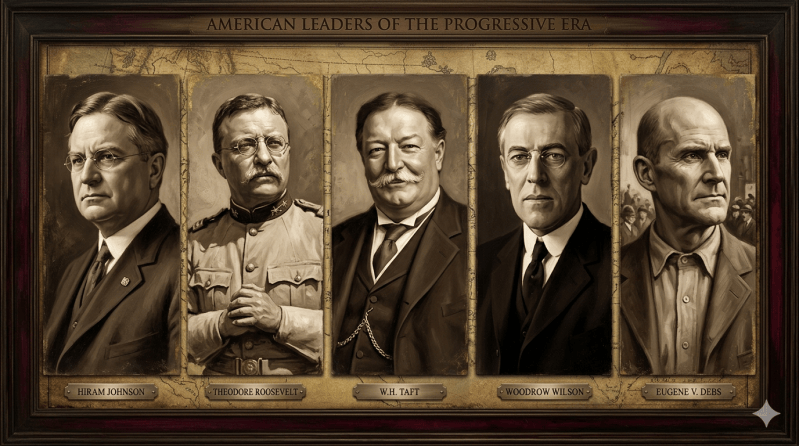
While the progressive press converted Roosevelt’s wound into a referendum on national character, and while Wilson’s campaign managers tried to find language that would honor a fallen rival without conceding the election, Eugene Debs was doing something neither camp expected and neither quite knew how to respond to: he kept running on the same platform he had been running on since the Socialist Party nominated him in May, and he refused the emotional register of the grief campaign entirely.
Debs had received 900,000 votes in the 1912 election in our actual timeline — nearly six percent of the popular vote, the strongest showing the Socialist Party ever achieved in a presidential race. He was not a protest candidate in any dismissive sense; he was the representative of a genuine political tradition with deep roots in the industrial Midwest, the western mining camps, the tenant farming communities of Oklahoma and Texas, and the significant portion of the progressive intellectual world that thought Roosevelt’s New Nationalism was a management strategy dressed up as reform. His Appeal to Reason column reached nearly half a million subscribers weekly. He was, by any honest accounting, the fourth major figure in the 1912 race.
His position on Roosevelt had been consistent and specific throughout the campaign. Roosevelt, in Debs’s framing, was the most dangerous kind of political opponent: a charismatic reformer whose program would give working people just enough — regulated corporations, a few labor protections, the aesthetics of a Square Deal — to prevent them from developing the class consciousness that actual economic change required. The New Nationalism was, from the Socialist perspective, a scheme to save capitalism from itself by making it slightly more tolerable, and Roosevelt was its most gifted salesman. Debs respected the salesmanship while opposing the product with everything he had.
A mortally wounded Roosevelt generating a sympathy wave that might carry him to the White House does not change any of this analysis, and Debs says so — in print, in speeches, in the patient and occasionally scorching prose that had made him the most effective labor orator of his generation. His argument, delivered in the weeks between the Milwaukee shooting and the November election, runs roughly as follows: the question of who occupies the White House is less important than the question of who owns the economy; mourning a reformer while leaving the underlying structure of ownership and exploitation intact is precisely what the ruling class hopes working people will do; and the grief campaign, whatever its emotional authenticity, is functionally a mechanism for channeling popular anger into a ballot box rather than into the organizational work that might actually produce change.
This argument costs Debs some votes he might otherwise have received. There are workers who had been considering a Socialist ballot and who find, in the weeks after Milwaukee, that they cannot bring themselves to vote against a man they watched absorb a bullet with equanimity. Debs does not soften his position to hold them. That is not a strategic error on his part; it is a deliberate choice rooted in his conviction that a socialism that adjusts its message to capture sympathy votes has already compromised the thing that makes socialism worth voting for.
What the grief campaign does do — and this is its most consequential effect on the Socialist trajectory — is temporarily drain the emotional oxygen from the policy arguments where Debs was making his strongest case. The debate about whether the federal government should own the railroads, about whether a national minimum wage could exist without socialist ownership of the industries that paid it, about whether the Progressive platform’s social insurance proposals were genuine redistribution or the minimum necessary to prevent redistribution — these are the arguments Debs was winning on the stump in September and early October 1912. For three weeks after Milwaukee, nobody is having those arguments. Everyone is talking about the bullet.
The longer-term consequence, playing out through the Johnson administration that follows Roosevelt’s death, is actually more favorable to Socialist organizing than the grief campaign’s temporary dominance suggests. A Progressive administration governing without Roosevelt’s authority is an administration that will deliver less than it promised — and the gap between what the Progressive platform said and what a weakened, contested Johnson White House can actually produce is precisely the organizational space in which Debs’s arguments find their audience. By 1914, the Socialist Party’s municipal and state-level gains in the industrial Midwest are running ahead of their 1912 pace, not behind it, because the alternative to socialism now has a governing record that can be examined and found wanting.
Before the Oath
The twelve weeks between the election and the March 4th inauguration are twelve weeks of visible physical deterioration. Roosevelt attends to the transition publicly and with evident will; he names cabinet officers, receives congressional leaders at Oyster Bay, writes the customary correspondence. He does all of this while coughing into handkerchiefs that his staff quietly replaces and while submitting, with decreasing patience, to physicians who are growing progressively more alarmed. The secondary infection the Milwaukee surgeons had warned about arrives in January, as infections in the pre-antibiotic era had a way of arriving: quietly at first, then decisively. By February, Roosevelt is conducting business from his bed at Oyster Bay, and the dispatches from his household carry the careful language of men who are managing a public narrative as much as a patient.
He dies on the morning of February 14, 1913 — three weeks before his scheduled inauguration. He is fifty-four years old.
The Constitutional Crisis: A Question Without an Answer
What follows is not grief alone. It is grief combined with a constitutional question that the framers had not anticipated, that existing precedent did not cleanly resolve, and that two sets of very capable lawyers immediately began arguing from opposite directions.
The Twentieth Amendment — which would eventually establish that a vice president-elect assumes the presidency when a president-elect dies before taking office — would not be ratified until 1933, twenty years in the future. In February 1913, the Constitution is silent on the specific situation the country now faces. Article II establishes the mechanics of presidential succession for a sitting president; it does not address what happens when the president-elect dies before the inauguration, because the framers had not imagined that scenario as a distinct constitutional problem requiring its own solution.
The country had, however, lived through something analogous. In 1876, the disputed election between Rutherford Hayes and Samuel Tilden had produced a genuine constitutional crisis when the electoral votes of three Southern states were submitted in duplicate — one set certified for Hayes, one for Tilden — and Congress had no established mechanism for resolving which set to count. The crisis was resolved, finally and controversially, by a specially constituted Electoral Commission of fifteen members that voted along strict party lines to award all disputed electoral votes to Hayes. The resolution satisfied almost no one, required a separate political bargain (the informal Compromise of 1877, which ended Reconstruction) to gain Democratic acceptance, and left a lasting suspicion that the outcome had been negotiated rather than adjudicated. Thirty-six years later, every senior politician and every constitutional lawyer in the country is alive to how badly that precedent had served the republic and how unwilling the public would be to accept another arrangement that smelled of backroom dealing.
This is the environment in which Hiram Johnson, the Progressive vice president-elect, asserts his right to the presidency. Johnson’s lawyers make a straightforward argument: he was elected on the same ticket as Roosevelt, he is constitutionally eligible to serve, and the will of the voters who chose the Progressive ticket is most directly honored by his inauguration on March 4th. The death of a president-elect is analogous, they argue, to the death of a sitting president; the succession should follow the same logic, and the vice president-elect should assume the office just as a vice president would assume it under the existing succession provisions.
Wilson’s lawyers offer a more complicated but not frivolous counter-argument, drawing directly on the 1876 precedent. The electoral college, they contend, chose Roosevelt specifically — it was Roosevelt’s name on the ballot, Roosevelt’s electoral votes that were cast, Roosevelt’s majority that was certified. With Roosevelt dead before taking office, the election result is effectively contingent; the condition that the voters and the electoral college relied upon — that Roosevelt would actually serve — has failed. The electoral votes may therefore be void, or may revert to the discretion of the individual electors, or may require Congress to make a determination about who is the lawful president-elect. Under any of these readings, Congress has a role, and in a Congress organized by Democrats, that role might reasonably be exercised in favor of the candidate who won the popular vote.
Wilson himself does not push this argument publicly — the political cost of appearing to contest a dead man’s electoral victory would be catastrophic. He does nothing to discourage his lawyers from making it, and nothing to prevent Democratic congressional leaders from treating it as a live question that requires congressional resolution rather than executive assumption.
The House Takes Up the Question
What follows resembles the 1876 crisis in structure while differing from it in every particular. There is no disputed electoral certificate; the Progressive electors had voted for Roosevelt and Johnson on the constitutionally designated day, and those votes are a matter of record. The question is not which votes to count but what the counted votes mean in a situation the Constitution did not specifically address. This distinction gives the crisis a different legal texture than 1876 while preserving its essential political character: a question about presidential legitimacy being resolved, under time pressure, by a Congress with partisan interests in the outcome.
The Democratic leadership of the House does not want Johnson to take office. This is not primarily ideological — Johnson’s progressivism is, in many respects, more compatible with the Democratic platform than Taft’s Republicanism — but institutional and political. A Johnson presidency means four years of Progressive governance, which means four years of the new party consolidating the organizational infrastructure that could make it a permanent fixture of American politics at the expense of the Democratic Party itself. The Democrats have every incentive to use whatever constitutional ambiguity is available to them to force the question into a forum where they have leverage.
The mechanism they reach for is a joint resolution calling for congressional inquiry into the constitutional status of the electoral votes cast for a candidate who died before taking office, pending the development of a formal legislative remedy. The resolution does not explicitly challenge Johnson’s right to the presidency; it simply asserts that the question requires congressional deliberation before it can be settled definitively. The deliberation is scheduled to conclude before March 4th — or so the resolution’s sponsors claim, in the knowledge that the schedule is almost certainly unworkable.
The crisis drags from mid-February through the first days of March. The country watches the argument unfold in the press with an anxiety that is entirely comprehensible: this is exactly the kind of constitutional uncertainty that democratic republics are supposed to have resolved at the founding, and the fact that it has not been resolved is producing a vacuum that partisan maneuvering is rushing to fill, just as it had in 1876.
The resolution comes not from Congress but from the Supreme Court, which in a procedurally unprecedented move — and under enormous public pressure — issues an advisory opinion (not a formal ruling, which would require a justiciable case, but a formal statement of constitutional interpretation from the full Court) that the vice president-elect succeeds to the presidency upon the death of the president-elect by the same logic that the vice president succeeds upon the death of the president. The opinion is not unanimous; three justices dissent on the grounds that the Court has no jurisdiction over a question that is not before it in any case. But it gives enough political cover to the Democratic congressional leadership to stand down, and Johnson is inaugurated on March 4, 1913, eleven days after the Court’s statement is released.
He is inaugurated as a man whose legitimacy has been publicly contested, publicly litigated, and resolved by an institution that was arguably stretching its own authority to resolve it. That is not the foundation from which you build a strong presidency.
Johnson’s Weakened House
Hiram Johnson is not a weak politician. As California’s reform governor, he had broken the Southern Pacific Railroad’s stranglehold on the state’s politics — a genuine achievement against a genuinely powerful opponent — and he had organizational instincts sharper than his national profile suggested. But he enters the White House carrying the weight of a contested inauguration, a party built for someone else, a Congress organized by the opposition, and the daily reminder that the man the country actually elected is buried at Oyster Bay.
The Progressive Party of March 1913 is a party in mourning, and mourning does not translate easily into the grinding daily work of legislation and executive management. The cabinet Johnson inherits was selected by and for Roosevelt; several of its members are loyal to the idea of Roosevelt more than to the institution of the presidency or to Johnson personally, and some of them, recognizing early that Johnson cannot command the same gravity, begin accommodating themselves to the Democratic congressional leadership in ways that undercut the administration’s coherence. Johnson replaces two of them by summer, and the progressive press — which had been the administration’s most important outside ally — begins covering the White House with a mixture of sympathy and disappointment that is more politically damaging than outright opposition would be.
The constitutional crisis has left a specific wound beyond the political weakness it created: it has established, as a working precedent, that a vice president-elect can assume the presidency upon the death of the president-elect. But it established this precedent through an extrajudicial advisory opinion and a congressional stand-down rather than through settled law, and the Democrats who controlled Congress had made clear that they regarded the outcome as a concession rather than an acknowledgment of Johnson’s legitimacy. Every major legislative fight of the next two years carries the subtext of that contested inauguration; the opposition is not fighting a president whose right to the office it fully accepts.
The Long Consequence
The Progressive Party’s institutional survival — the genuine legacy of this scenario — comes at a price that shapes everything that follows. Because Johnson governs, the party acquires the administrative experience and the patronage relationships that purely oppositional third parties never develop. Several elements of the Roosevelt domestic agenda advance in modified form; the 1914 midterms produce losses but not collapse. Going into 1916, the Progressives are a wounded but functioning party, asking voters to give them a second chance with a candidate who has an actual governing record to run on and an actual constitutional dispute to have survived.
The Twentieth Amendment, when it eventually comes, arrives shaped by the specific arguments made and not made in February and March of 1913. The lawyers who drafted the 1933 version are drafting it with this alternate crisis in mind; the provision that clarifies succession for a dead president-elect is written with the precision of people who know exactly what the ambiguity cost the last time.
And the Supreme Court’s advisory opinion — unprecedented, contested, but effective — opens a conversation about the Court’s role in constitutional crises that will not be closed for a generation. Whether that conversation produces good institutional outcomes is a question that this alternate republic will spend years working out.
Discussion Questions:
1. The 1876 Hayes-Tilden crisis was resolved by a specially constituted Electoral Commission that voted along party lines. The 1913 crisis in this scenario is resolved by a Supreme Court advisory opinion that stretches the Court’s normal jurisdiction. Compare these two resolutions: which is more democratically legitimate, which is more constitutionally defensible, and are those the same question?
2. Johnson enters the presidency with his legitimacy publicly contested and his party still mourning Roosevelt. Identify two specific ways this weakened political foundation shapes what he can and cannot accomplish as president. Then consider: can you find a real historical president whose effectiveness was similarly constrained by the circumstances of how he came to office?
While these events are not true they are based on historic fact and the possibility of one change in history. To read more of my Alternate History scenarios, be sure read here.


You must be logged in to post a comment.