
George III’s Abdication and the Birth of the British Commonwealth
The American Revolutionary War’s conclusion in 1783 marked one of the most humiliating defeats in British imperial history. King George III, who had personally championed the conflict and refused all compromise with the rebellious colonies, found himself presiding over the dismemberment of his empire. In our timeline, the king absorbed this defeat and continued his reign for nearly four more decades. But what if the “Mad King” had made a different choice? What if George III, overwhelmed by guilt and political isolation, had chosen to abdicate in 1783, triggering a constitutional crisis that fundamentally transformed British governance and created the world’s first modern commonwealth republic?
The Point of Departure: Windsor Castle, September 1783
In our timeline, King George III weathered the storm of American independence, eventually recovering his political position and reigning until 1820. But imagine if events had unfolded differently in the aftermath of the Treaty of Paris. The king, devastated by what he viewed as personal failure and facing unprecedented criticism from Parliament, ministers, and the press, reaches a breaking point.
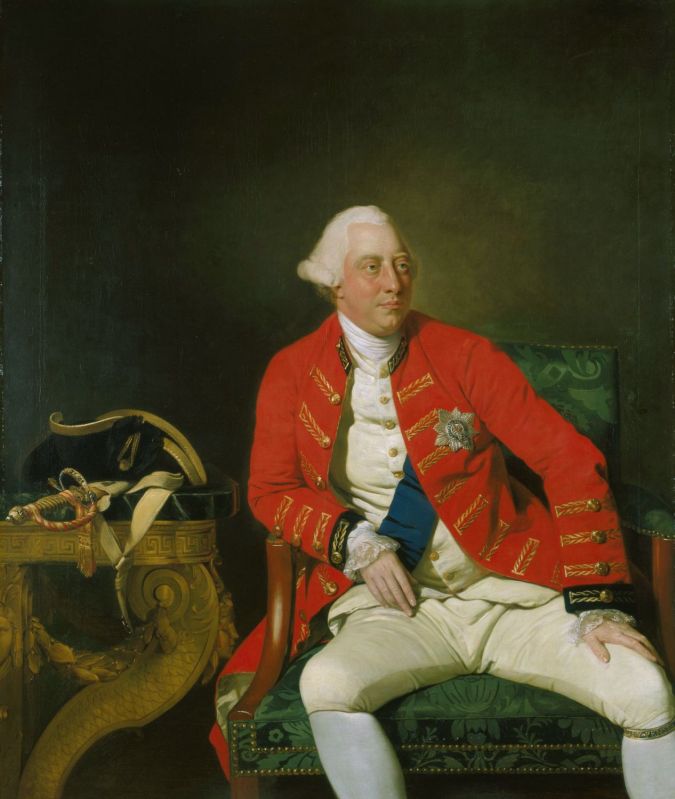
Image: King George III of England, in his general’s coat, aged 33 years, oil painting on canvas by Johann Zoffany, circa 1771.
The catalyst comes during a private meeting with Lord North, his former Prime Minister who had resigned in disgrace following the Yorktown surrender. North, seeking to console his former sovereign, inadvertently triggers a crisis by suggesting that perhaps the American war had been “God’s judgment” on British imperial pride. The comment strikes George III like a thunderbolt, confirming his growing belief that his personal sins have brought catastrophe upon the nation.
On September 15, 1783, King George III announces his intention to abdicate the throne, citing his “unworthiness to rule” and his desire to “seek divine forgiveness through penitence and retirement.” The announcement sends shockwaves through British society and triggers the greatest constitutional crisis since the English Civil War.
An Alternate Chain of Events
The succession crisis that follows is immediate and genuinely alarming. George’s eldest son, the Prince of Wales, is twenty-one years old, politically associated with the Whig opposition, and widely regarded by sober observers as dissolute, self-indulgent, and constitutionally unsuited to the burden of monarchy. More importantly, the prince’s own Whig circle has spent years arguing that the monarchy had overreached under George III; accepting a crown that arrives trailing the wreckage of an American war and an abdicated father is politically treacherous, and the prince knows it. He does not refuse outright, but he delays, temporizes, and signals through intermediaries that he has conditions.
Parliament, which has no clear constitutional mechanism for managing a monarch who abdicates rather than dies, is thrown into an argument that exposes every fault line in British political culture. The precedents are alarming: the last time England had been without a settled monarch was the Interregnum after the execution of Charles I, and the last formal abdication — of James II — had been managed by the convenient legal fiction that he had “vacated” the throne by fleeing. Neither precedent is comfortable. The lawyers disagree about what the law requires; the politicians disagree about what the situation demands; and the public, reading the newspapers, begins to form its own opinions.
Fox, brilliant and opportunistic, sees in the crisis an opening for the kind of parliamentary supremacy that the Whig tradition had always advocated but never quite achieved. His argument is elegant: if Parliament can make a king, as it effectively did in 1689, it can make the terms on which kingship operates. Pitt, younger and more cautious but equally ambitious, sees the same opening and calculates differently: a constitutional settlement that preserves the form of monarchy while transferring its practical substance to Parliament is more durable, more politically saleable, and less likely to provoke the kind of conservative reaction that an explicitly republican moment would generate.
The outcome, after months of negotiation and genuine constitutional crisis, is not a republic but something England had not seen since Cromwell: a Commonwealth settlement in which parliamentary sovereignty is made explicit and institutional, the royal prerogative is dramatically curtailed, and the Prince of Wales eventually accepts the throne not as a hereditary right but as a parliamentary grant with conditions attached. Pitt, appointed First Minister by parliamentary vote rather than royal prerogative, becomes the effective head of government with a clarity of constitutional authority that his actual career never quite achieved.
The international reaction is significant and swift. France under Louis XVI views the British constitutional crisis with a mixture of alarm and satisfaction; the ministers who observe it most carefully include men who will play important roles in the events of 1789, and they draw their own conclusions about the fragility of monarchical legitimacy when it is tested by failure. The American republic, which might have been expected to find a parliamentary Britain sympathetic, is in fact anxious about the instability — Hamilton and Madison, drafting the American Constitution in these same years, observe the British crisis as a cautionary lesson about what happens when constitutional arrangements are improvised under pressure rather than designed in advance.
Pitt’s Commonwealth government implements reforms that his actual government always struggled to push past royal resistance. The India Act of 1784 passes more cleanly and with stronger parliamentary teeth. Irish grievances receive earlier and more serious parliamentary attention, though the structural tensions of Anglo-Irish politics do not dissolve simply because the constitutional framework changes; the land question, the religious question, and the question of legislative independence all remain, and a parliamentary solution to them is not automatically better than a royal one. But the character of the engagement is different, and in politics, how you address a grievance sometimes matters as much as whether you address it.
Long-Term Consequences
The most significant long-term consequence of a British Commonwealth emerging in 1783 is its probable effect on the French Revolution. Louis XVI and his ministers, watching Britain navigate a constitutional crisis without either civil war or republican revolution, have a model of managed political transformation that the actual French monarchy lacked. Whether this model is useful to them depends on contingencies that compound quickly; the French fiscal crisis and the structural problems of the Ancien Régime are not primarily caused by ideological failure, and a British example does not automatically solve them. But it changes the ideological atmosphere of the 1780s in ways that might have mattered at specific moments of decision — in the convening of the Estates-General, in the management of the early National Assembly, in the choices made in the critical summer of 1789.
The British monarchy survives as an institution but is transformed in its character across the nineteenth century. The prince who accepts the throne under parliamentary conditions is a constitutional figurehead two or three generations earlier than Britain actually produced one. Whether this earlier and more explicit constitutional settlement produces a more stable or a more contested monarchy depends on the character of the monarchs themselves and the skill of the political class that manages the transition — neither of which can be specified with confidence from here. What can be said is that the settlement removes the monarchy from the center of political controversy in a way that the actual British monarchy, which remained genuinely politically significant well into the Victorian era, was not.
The British Empire also develops differently. A parliamentary government with explicit constitutional authority over colonial affairs is both more capable of systematic colonial administration and more exposed to parliamentary criticism of colonial abuses. The abolitionist movement, which in actual history worked through Parliament to end the slave trade in 1807, might find an earlier and cleaner path in a Commonwealth government that is more responsive to organized moral pressure than a king who had his own views on the matter. Whether this produces earlier abolition depends on the specific political calculations of a specific parliamentary majority; it is not guaranteed, but it is more possible in a system that has made parliamentary responsiveness its explicit constitutional foundation.
Perhaps the most interesting consequence is the effect on the political culture of the English-speaking Atlantic world. A Britain that establishes parliamentary sovereignty explicitly in 1784, and an America that establishes constitutional republicanism in 1789, develop through the nineteenth century in a relationship that is closer in constitutional form than the actual relationship between the two countries. Whether this produces earlier Anglo-American alignment, different patterns of emigration and cultural exchange, or a different international position for the English-speaking world in the century of European nationalism and industrialization is genuinely uncertain — but the question is worth asking.
Discussion Questions
1. George III’s abdication, in this scenario, is driven by a combination of personal guilt, religious conviction, and political exhaustion. How much weight should historians give to individual psychology in explaining major political events? Can a single person’s emotional state really redirect the constitutional history of a major power?
2. The Commonwealth settlement makes parliamentary sovereignty explicit much earlier than it actually became in Britain. Does earlier formalization of a constitutional principle necessarily make it more stable, or does gradual evolution produce more durable institutions than explicit constitutional settlement?
3. Britain’s actual constitutional development was often described as uniquely stable because it evolved gradually rather than through revolutionary rupture. If that gradualism was itself contingent on specific decisions and accidents, what does that tell us about the relationship between political stability and constitutional design?
Suggested Reading
The Loss of America by Andrew O’Shaughnessy (2013). The definitive study of how American independence affected British politics and constitutional thinking at the highest levels, with excellent coverage of George III’s personal response to defeat.
William Pitt the Younger by William Hague (2004). A thorough political biography that illuminates the reform agenda Pitt might have pursued with cleaner constitutional authority, and the specific obstacles that royal prerogative placed in his way.
Charles James Fox by L.G. Mitchell (1992). Essential for understanding the Whig vision of parliamentary sovereignty that the abdication crisis might have realized, and the specific arguments Fox was already making before the crisis.
The Madness of King George III by Ida Macalpine and Richard Hunter (1969). The foundational medical and psychological study of George III’s condition, essential context for the abdication scenario and the documented record of his depressive episodes.
The Age of George III by J.H. Plumb (1963). A comprehensive study of late eighteenth-century British politics and society that makes the instability of 1783 concrete and shows how much depended on the king’s personal political survival.
Edmund Burke: A Life in Letters edited by F.P. Lock (2006). Burke’s correspondence provides a contemporaneous conservative perspective on parliamentary reform that would have been central to the debate over any Commonwealth settlement.
This alternative history was inspired by a thought while visiting the Two Georges exhibition at the Library of Congress the June 2025. Several of the documents on display reference George IV inability to be a leader and George III thinking of abdication. George III’s personal response to American independence and the recognition that monarchical legitimacy was more fragile than often assumed, creating opportunities for peaceful republican transformation.

 BFWClassroom
You must be logged in to post a comment.