
The Shell Game
Cold War Geopolitics and the Redistribution of Colonial Wealth, 1945–1991
This post is part of The Long Ledger series on BFWClassroom.com. The series examines 125 years of American economic foreign policy and its global consequences.
The Cold War is usually taught as a clash of ideologies, and the ideologies were real. Liberal democracy and Soviet communism were genuinely incompatible visions of how human society should be organized, and both superpowers believed, at least partly, in what they were selling. Leaders on both sides made decisions based on genuine conviction. The fear of nuclear war was not theater. The Berlin Wall was not a metaphor.
But if you follow the money rather than the rhetoric, a different picture emerges alongside the ideological one: two industrial powers, standing in the rubble of a European colonial system that had just eaten itself alive, competing to absorb its markets, its resources, and its client relationships. The Cold War was, in significant part, a decades-long negotiation over who would inherit the economic infrastructure of empire. The shell was ideology. Underneath it, almost always, was a resource, a trade route, a labor market, or a currency arrangement.
That is not cynicism. It is accounting. And it is an accounting that makes the post-Cold War world considerably more legible than the purely ideological narrative allows.
What Decolonization Actually Disrupted
Between 1945 and 1975, dozens of nations across Asia, Africa, and the Caribbean gained formal independence from European colonial powers. This was, by any measure, a profound moral and political achievement. It was also an enormous economic disruption, and that disruption is the context without which Cold War interventions make no sense.
The European colonial system had been, among other things, a highly organized extraction network. British cotton came from Egypt and India; French rubber came from Indochina; Belgian copper came from the Congo; Dutch oil came from the East Indies. The metropolitan economies of Europe were structured around this inflow of cheap raw materials and the captive export markets that colonial relationships provided. When decolonization unraveled those relationships over the course of three decades, it didn’t simply change political maps; it left a vast, contested space of resources and trade relationships suddenly available for renegotiation.
The United States and the Soviet Union did not create this vacuum. European imperialism created it, and European weakness after WWII made it impossible to maintain. But both superpowers moved aggressively to fill it, each offering newly independent nations a development model, an alliance structure, and a set of economic relationships; and each understanding that the power that controlled more of that former colonial infrastructure would be structurally stronger in the long competition ahead. The Third World was not incidental to the Cold War. It was, in many respects, the primary arena.
The Marshall Plan as Economic Architecture
The Marshall Plan (1948–1952) is remembered, correctly, as a remarkable act of postwar generosity that helped rebuild Western Europe and prevented economic desperation from driving democratic governments toward communist parties. All of that is true. It is also true, and not in contradiction, that the Marshall Plan was the most sophisticated piece of economic foreign policy the United States had ever executed.
American manufacturers needed export markets. A devastated Europe could not buy American goods. The Marshall Plan rebuilt European purchasing power, and in doing so, it rebuilt the primary market for American exports. It was altruistic and strategic simultaneously, and the two motives were not in conflict; they pointed in the same direction. The economists who designed it understood that a stable, prosperous Western Europe would be a trading partner, a military ally, and a political bulwark against Soviet influence, all at once.
What the Marshall Plan did not do was extend those same reconstruction investments to the developing world, and that asymmetry shaped the next fifty years of global politics. When Kwame Nkrumah in Ghana, Gamal Abdel Nasser in Egypt, or Jawaharlal Nehru in India sought comparable economic partnerships from the United States, what they generally received instead was strategic conditionality: align with us geopolitically, adopt our preferred economic policies, and we will consider assistance. The Non-Aligned Movement, founded at the Bandung Conference in 1955, was at its core a refusal of that conditionality; an assertion that newly independent nations should be able to pursue their own economic development without becoming pawns in someone else’s competition. The movement has been underreported in American history curricula, but it represented the political aspirations of the majority of the world’s population.
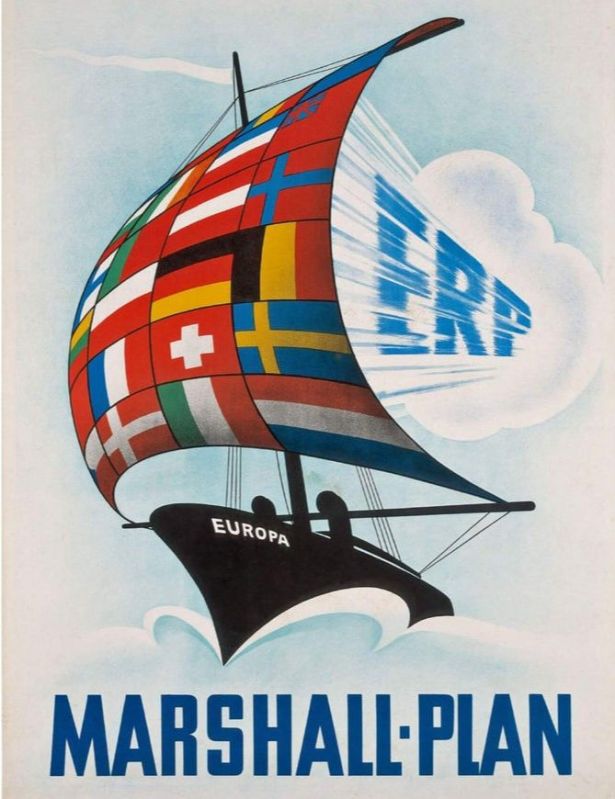
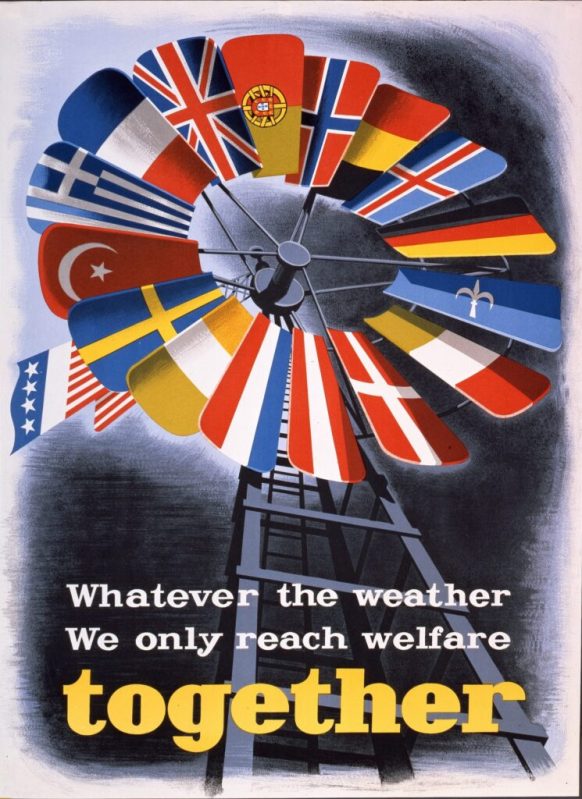


Collection of Posters promoting the Marshall plan and the sticker seen on most supply crates being delivered to European markets.
The Gold Standard’s End and the Petrodollar’s Birth
In August 1971, President Nixon announced that the United States would no longer honor the Bretton Woods commitment to exchange dollars for gold at $35 per ounce. This decision, often called the Nixon Shock, was one of the most consequential economic policy choices of the twentieth century, and it received relatively little public attention at the time.
The gold standard had functioned as a constraint on American spending. The Vietnam War, the Great Society social programs, and the general expansion of federal expenditure during the 1960s had created more dollars in circulation than American gold reserves could back at the agreed exchange rate. Foreign governments, particularly France under de Gaulle, had begun converting their dollar holdings to gold, draining American reserves. Nixon chose to sever the link rather than choose between military spending and domestic programs, and the global economy, having no viable alternative reserve currency, had little choice but to adapt.
What replaced the gold standard was not immediately obvious, but by the mid-1970s a new architecture was becoming clear. A series of agreements between the United States and Saudi Arabia, the details of which remain partially classified, established that Saudi Arabia would price its oil exports exclusively in U.S. dollars and would invest its surplus oil revenues in U.S. Treasury securities. In exchange, the United States would provide security guarantees and military equipment to the Saudi government. Other OPEC nations followed. The petrodollar system was born.
The implications were profound and durable. Any nation that needed to buy oil, which meant every industrialized nation on earth, needed to hold U.S. dollars to do so. Global demand for dollars was thus structurally guaranteed by the energy market rather than by any gold reserve. The United States gained the ability to run persistent trade deficits and finance its government debt at lower interest rates than any other country in the world, because the global economy had no practical alternative to holding its currency. This arrangement was not an act of economic genius so much as an act of extraordinary opportunism in a moment of structural necessity; but it became the financial foundation of American hegemony for the next fifty years. Understanding this system is essential for understanding nearly every major American foreign policy decision that followed.
The 1973 Oil Crisis as Proof of Concept
The OPEC oil embargo of 1973 demonstrated both the system’s power and its vulnerability in the same event. When Arab OPEC members cut off oil exports to the United States and the Netherlands in response to their support for Israel in the Yom Kippur War, the economic consequences were immediate and severe: gasoline prices quadrupled, long lines formed at filling stations across America, and the economy slipped into recession.
What the crisis also demonstrated, however, was that the petrodollar arrangement was structurally resilient even under attack. Saudi Arabia and other Gulf producers still needed a stable currency in which to denominate their exports and invest their surplus revenues, and no alternative to the dollar existed with comparable depth and liquidity. The crisis created short-term pain but ultimately reinforced the dollar’s centrality, because the remedy, paying more dollars for oil, generated more dollar demand rather than less. The petrodollar system survived its first major stress test, and American policymakers drew the conclusion that protecting Gulf energy stability was a core national interest; not primarily because Americans needed the oil, but because the dollar’s global role depended on oil being priced in dollars.
Proxy Wars as Resource Contests
The hot conflicts of the Cold War era, Korea, Vietnam, Angola, Mozambique, Nicaragua, Afghanistan, and dozens of smaller interventions, are usually analyzed through the lens of containment doctrine and ideological competition. That analysis is not wrong. But it is incomplete in ways that matter for understanding why those conflicts happened where they did rather than somewhere else.
Vietnam sat at the intersection of Southeast Asian shipping lanes and held significant natural resources including coal and offshore oil potential. Angola contained some of the largest oil deposits and diamond reserves on the African continent; and in one of the Cold War’s more revealing episodes, American and Cuban troops were fighting on opposite sides in Angola while Gulf Oil, an American company, continued operating in the country throughout the conflict, paying royalties to the Marxist MPLA government the United States was officially opposing. The economics and the ideology were pulling in different directions, and the economics won.
Afghanistan sat at the crossroads of Central Asian trade routes that both superpowers and, later, Chinese planners recognized as strategically critical. The American decision to fund and arm the Afghan mujahideen against the Soviet occupation was framed in the language of freedom and self-determination; it was also a calculated effort to impose on the Soviet Union the kind of costly, inconclusive military commitment that the United States had recently experienced in Vietnam. The long-term consequences of that decision, the arming of groups that would later reconfigure into the Taliban and Al-Qaeda, were not part of the calculation at the time. They became the inheritance of the next generation.
The Soviet Model’s Fatal Flaw
The Soviet Union’s economic system had genuine achievements. It industrialized a largely agricultural society within a generation, produced world-class science and engineering, and provided basic material security to hundreds of millions of people who had previously lived in conditions of considerable poverty. It deserves a more honest accounting than it typically receives in American curricula.
It also had a structural flaw that no amount of political will or central planning could overcome: it could not price things accurately. A market economy uses prices to signal, imperfectly and often unjustly but continuously, where resources are needed and where they are being wasted. The Soviet command economy replaced prices with planning, and planning, however sophisticated, could not replicate the information-processing capacity of millions of simultaneous economic decisions. Shortages and surpluses accumulated. Misallocations compounded. The system grew brittle precisely where it most needed flexibility.
By the 1980s, the Soviet Union was spending roughly 25% of its GDP on military competition with an American economy roughly twice its size. It was sustaining that commitment on an increasingly dysfunctional economic base. Ronald Reagan’s defense buildup accelerated the strain, and that acceleration was deliberate strategic policy. But the Soviet collapse was not engineered from the outside; it was the outcome of internal economic contradictions that had been building for decades. The Cold War ended not because democracy defeated communism in a grand ideological contest, but because one economic model exhausted itself trying to compete with another that, whatever its significant flaws, was more flexible and more productive.
For the Classroom
“Why does the U.S. care so much about the Middle East?” The honest answer involves a fifty-year-old currency arrangement built on oil. The petrodollar system means that Middle Eastern energy stability is directly connected to the dollar’s global role, which is directly connected to the U.S. government’s ability to borrow cheaply and project power globally. Students who understand that connection can read current foreign policy headlines with considerably more clarity than those who don’t.
“Was the Cold War actually about freedom?” Partly, and genuinely in some cases; the people who lived under Soviet domination in Eastern Europe and elsewhere experienced real oppression, and American opposition to that was not purely cynical. But the Cold War was also a competition to control the economic infrastructure that European colonialism had built and could no longer manage. Both things are true, and students are sophisticated enough to hold both at once.
“Why didn’t the Non-Aligned Movement work?” It did work, to a degree, in terms of giving smaller nations diplomatic leverage they would not otherwise have had. What it couldn’t overcome was the structural reality that newly independent nations needed development financing, and the two superpowers controlled most of it. Economic dependency is harder to escape than political dependency, and many nations found that formal independence didn’t translate into economic sovereignty.
“What does it mean when people say the dollar is the world’s reserve currency?” It means the dollar is the currency most countries hold in their central bank reserves and use to settle international transactions, especially for commodities like oil. That status gives the United States enormous structural advantages: it can run trade deficits without the currency crises that would afflict other nations, and it can borrow money at lower interest rates because global demand for dollars is structurally guaranteed. Understanding reserve currency status is the key to understanding why challenges to that status, like the ones currently unfolding in Gulf energy markets, matter so much to American policymakers.
“Why did the Soviet Union collapse so suddenly?” It wasn’t actually sudden; the economic contradictions had been visible for decades. What looked sudden was the political unraveling, which happened quickly once the economic legitimacy of the system had collapsed. The lesson is that institutional systems often appear stable right up until they don’t, and the economic stresses that bring them down usually predate the visible political crisis by years or decades.
Further Reading
- Odd Arne Westad, The Global Cold War: Third World Interventions and the Making of Our Times (2005) — the essential account of Cold War competition in the developing world
- Greg Grandin, Empire’s Workshop: Latin America, the United States, and the Rise of the New Imperialism (2006) — carefully sourced on economic conditionality in Latin America
- Stephen Kotkin, Armageddon Averted: The Soviet Collapse, 1970–2000 (2001) — clear-eyed on the Soviet economic failure without triumphalism
- Daniel Yergin, The Prize: The Epic Quest for Oil, Money and Power (1991) — the definitive history of oil’s role in modern geopolitics; the petrodollar sections are essential
- Vijay Prashad, The Darker Nations: A People’s History of the Third World (2007) — history of the Non-Aligned Movement from the perspective of its participants
- Documentary: The Commanding Heights (PBS, 2002), Part 2 — covers this period through the collapse of the Keynesian consensus
Next: Part 3 — Free Markets as Foreign Policy: Trade Agreements, Capitalist Hegemony, and the Limits of Economic Freedom, 1991–2008


You must be logged in to post a comment.