
Free Markets as Foreign Policy
Trade Agreements, Capitalist Hegemony, and the Limits of Economic Freedom, 1991–2008
This post is part of The Long Ledger series on BFWClassroom.com. The series examines 125 years of American economic foreign policy and its global consequences.
When the Berlin Wall came down in 1989, something unusual happened in Western intellectual life: a significant number of serious people decided that history had ended. Not literally, of course, but in the sense that the great contest of organizing principles was resolved. Liberal democratic capitalism had won. What remained was, more or less, implementation.
Francis Fukuyama’s 1992 book The End of History and the Last Man became the intellectual shorthand for this mood, and Fukuyama was genuinely half right. The Soviet alternative had collapsed, and no comparable systemic rival to market capitalism existed anywhere in the world. The ideological competition that had structured global politics for seventy years was, in a meaningful sense, over.
But the assumption embedded in the triumphalist mood, that the absence of a rival meant the presence of a universal model ready for global export, turned out to be one of the more expensive intellectual errors of the late twentieth century. The decades between the Soviet collapse and the 2008 financial crisis were not a period of economic freedom spreading naturally across a liberated world. They were a period in which a specific set of economic rules, written primarily by American and Western European financial institutions, expanded aggressively into spaces that no longer had the political or institutional capacity to resist them. The difference between those two framings matters enormously, and understanding it explains a great deal about the world we currently live in.
The Washington Consensus and Its Discontents
In 1989, economist John Williamson coined the term “Washington Consensus” to describe the package of economic policies that the International Monetary Fund, the World Bank, and the U.S. Treasury were recommending, and in many cases requiring, of developing nations seeking financial assistance. The package had a consistent core: fiscal austerity, privatization of state enterprises, deregulation of financial markets, trade liberalization, and the removal of capital controls.
These policies were not designed in bad faith. Their architects genuinely believed that open markets, stable currencies, and reduced state interference in the economy would produce growth, and eventually, broad prosperity. The theoretical case for them was real, grounded in actual economic research, and supported by the experience of economies that had grown successfully under broadly market-oriented conditions. The problem was not the theory in isolation; it was the application of the theory as a universal template, regardless of institutional context, political capacity, or historical circumstance.
In Latin America, structural adjustment programs imposed by the IMF as conditions for debt relief produced a decade so economically damaging that the 1980s are simply called “the lost decade” across the region. Argentina followed IMF prescriptions more closely than almost any other nation and collapsed spectacularly in 2001, with its currency frozen, its banks shuttered, and its middle class losing savings overnight. In sub-Saharan Africa, the forced privatization of state enterprises frequently transferred public assets to foreign corporations at below-market prices rather than building domestic private sectors with local ownership and local employment. In Southeast Asia, the removal of capital controls contributed directly to the financial crisis of 1997–98, when speculative money flooded out of Thailand, Indonesia, and South Korea as quickly as it had flooded in, leaving devastated currencies and years of economic contraction in its wake.
The irony that rarely gets acknowledged in polite policy circles is this: the countries that developed most successfully during this period did so by selectively ignoring Washington Consensus prescriptions. South Korea, Taiwan, and China all maintained significant state involvement in strategic industries, managed their currencies actively, and opened their economies on their own terms and timelines rather than on schedules set by external creditors. The lesson that successful development requires institutional capacity and careful sequencing, not just market liberalization applied on a uniform timetable, was available in the data throughout this period. It was not always welcome in the policy conversation.
NAFTA, WTO, and the Architecture of Alignment
The North American Free Trade Agreement (1994) and the formation of the World Trade Organization (1995) are typically presented as achievements of economic rationalism: lower tariffs, more trade, more growth, efficiency gains for everyone. The economic gains were real, though unevenly distributed in ways that would become politically significant within a decade. What gets considerably less attention in standard accounts is the political and regulatory architecture embedded in both agreements.
NAFTA did not simply lower trade barriers between the United States, Canada, and Mexico; it locked in a specific regulatory and investment framework that was extremely difficult for any signatory government to alter without triggering trade dispute mechanisms. Chapter 11 of NAFTA, for instance, allowed foreign corporations to sue member governments directly for regulatory changes that affected their expected profits. This provision was less a trade rule than a constraint on democratic governance, and it quietly transferred significant decision-making authority from elected legislatures to international arbitration panels staffed primarily by corporate lawyers. Environmental regulations, public health standards, and labor protections all became potentially subject to corporate challenge under this framework.
The WTO’s dispute resolution mechanism operated on similar principles at a global scale, creating a framework in which trade rules could override domestic policy choices across a wide range of areas. The rules were not purely American impositions; European and other developed-nation interests shaped them substantially, and many developing nations initially supported liberalization in sectors where they had competitive advantages. But the overall architecture privileged economies with sophisticated legal and financial institutions, and it created significant compliance costs for developing nations that were nominally equal members of the system but lacked the institutional capacity to navigate its procedures effectively.
None of this makes free trade wrong as a concept. Open markets genuinely do create growth, reduce prices for consumers, and generate efficiency gains that benefit people across income levels. But the specific rules written into these agreements encoded the interests of the parties who had the institutional capacity to write them, and those parties were predominantly wealthy, predominantly Western, and substantially interested in protecting their own competitive advantages while advocating universal openness. The gap between free trade as a concept and specific trade agreements as political documents is one that teachers and students alike need to be equipped to recognize.
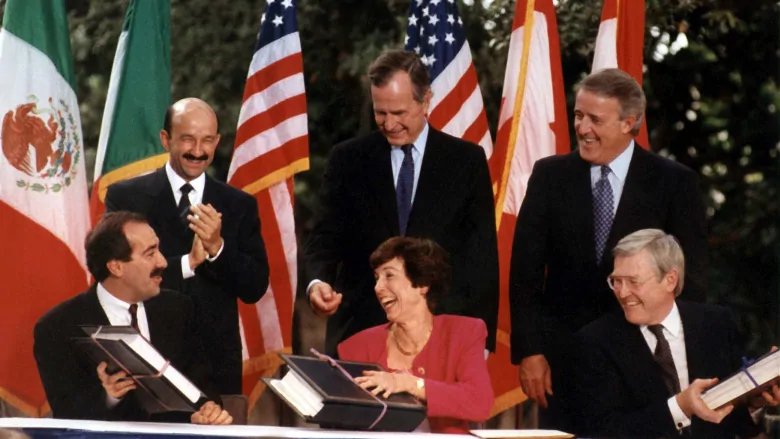
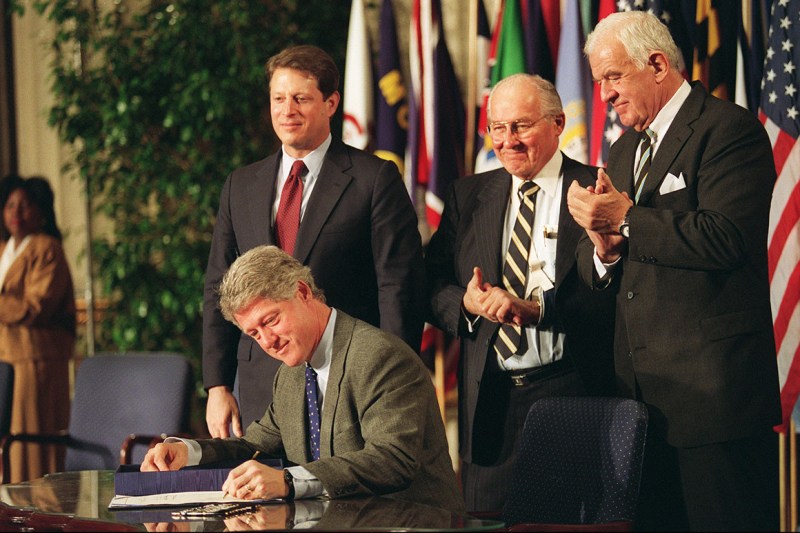
NAFTA was so complex that it required two different Presidential terms to get it formally signed and passed by congress. Left GHW Bush with leaders of Mexico and Canada in Aug 1992 and then WJ Clinton and congressional leaders in Dec. 1993 Images via Getty Images
The China Bet and Why It Failed
When China joined the World Trade Organization in 2001, the prevailing assumption in Washington, and in much of the American business community, was that economic integration would produce political liberalization. The theory had a coherent logic: a growing Chinese middle class, exposed to global markets and global information flows, would develop the civic expectations and political aspirations that typically accompany prosperity, and those aspirations would create irresistible pressure for democratic governance. Trade was, in this vision, a vector not just for commerce but for political transformation.
The assumption was not unreasonable given the historical precedents available at the time. South Korea, Taiwan, and several other East Asian economies had followed a developmental path that moved from authoritarianism toward democracy as they became wealthier and more integrated into global markets. There was genuine reason to think China might follow a similar trajectory.
It didn’t. The Chinese Communist Party had watched the Soviet collapse carefully and drawn a specific lesson from it: economic liberalization without political control was a recipe for regime change, and regime change meant the end of the party’s power. The party’s response was to pursue economic liberalization aggressively while simultaneously tightening political control, investing heavily in surveillance technology, information management, and party discipline. The result was a form of authoritarian capitalism that the integration theorists had not seriously planned for and that proved considerably more stable and adaptable than they had predicted.
China’s WTO entry also created what economists now call the “China shock”: a rapid displacement of manufacturing employment in the United States and other developed economies that was larger and more persistent than the economic models had predicted. Researchers David Autor, David Dorn, and Gordon Hanson documented in a landmark 2013 paper that roughly 2 to 2.4 million American manufacturing jobs were lost in the decade following China’s WTO accession, concentrated in specific communities and regions that had no comparable alternative employment available. The macroeconomic models showed net aggregate gains; the people in those communities experienced net losses. That gap between GDP figures and lived economic experience became one of the defining political fault lines of the 2010s, generating a backlash against globalization that neither major party had adequately anticipated or prepared for.
The 2008 Crack in the Consensus
The financial crisis of 2008 is often narrated as a story about mortgage fraud, reckless banks, and regulatory failure. All of those elements were present and real. But at a deeper level, the crisis was a stress test for the neoliberal consensus itself, and the consensus failed a significant portion of that test.
The deregulation of financial markets, pursued aggressively in the United States from the late 1970s onward and exported through the Washington Consensus framework to much of the world, had created a system of extraordinary complexity and extraordinary fragility. Financial instruments were layered upon financial instruments, structured products were packaged into other structured products, and the whole edifice was held together by credit ratings that assumed housing prices would never decline nationally at the same time. When they did, the unwinding cascaded through the global financial system with a speed and breadth that regulators had confidently assumed was impossible.
The crisis did not end the neoliberal consensus, but it cracked it in ways that proved permanent. Governments that had been told for two decades that state intervention in markets was inefficient and counterproductive found themselves nationalizing banks, guaranteeing financial institutions against failure, and deploying Keynesian stimulus on a scale not seen since the New Deal. The intellectual whiplash was significant. The political consequences would take a decade to fully materialize, but when they arrived, in the form of populist movements on both left and right that rejected the globalization consensus, they drew on a reservoir of grievance that the 2008 crisis had filled and that no subsequent recovery had adequately drained.
For the Classroom
“Is free trade actually good?”
It’s one of the most important questions students can ask, and it deserves a real answer rather than a party-line one. The concept of free trade, reducing barriers so that goods and services flow to where they can be produced most efficiently, genuinely does create economic growth and lower prices. The question worth pressing is: free trade on whose terms, written by whom, and with what provisions for the people displaced in the transition? Those are political questions, not economic ones, and they’re the questions that explain why “free trade” became a flashpoint in American politics rather than a consensus good.
“Why didn’t China become a democracy?”
Because the Chinese Communist Party drew the correct lesson from the Soviet collapse: economic liberalization without political control is a path to regime change. The party chose to pursue one without the other, and built the surveillance and information management infrastructure to make that combination sustainable. Students who understand that answer are better equipped to evaluate current U.S.-China tensions than those who frame it simply as a story of good guys and bad guys.
“Why are there so many former factory towns that never recovered?”
The China shock is a real and well-documented phenomenon, not a political talking point. The economic models that predicted net gains from trade liberalization were correct at the aggregate level and wrong at the community level. The gains were widely distributed and invisible; the losses were geographically concentrated and devastating. That asymmetry is one of the central failures of the globalization era, and it’s one that neither political party has fully reckoned with.
“What caused the 2008 financial crisis?”
The proximate causes were specific: mortgage fraud, deregulated financial products, credit ratings that didn’t reflect real risk. But the structural cause was decades of policy choices that treated financial market deregulation as a universal good and that assumed markets would self-correct before systemic failure became possible. The crisis was the point at which accumulated risk became impossible to hide. Students who understand that structure can recognize similar patterns in other contexts, which is the actual educational goal.
“Why do some countries stay poor even with foreign aid?”
Because structural adjustment conditions often required those countries to open their markets before their industries were competitive, privatize assets before local buyers existed to purchase them, and cut the public spending that their populations most needed, all in exchange for debt relief that frequently left them as indebted as before. Aid and structural adjustment operated simultaneously in many countries, with the conditions attached to the latter often undermining the stated goals of the former.
Further Reading
- Dani Rodrik, The Globalization Paradox: Democracy and the Future of the World Economy (2011) — the most intellectually honest account of globalization’s tradeoffs from an economist who supports open markets but not uncritical ones
- Joseph Stiglitz, Globalization and Its Discontents (2002) — insider critique of the IMF from a former World Bank chief economist; polemical at moments but grounded in genuine experience
- Branko Milanovic, Global Inequality: A New Approach for the Age of Globalization (2016) — the “elephant graph” showing who won and who lost from 1988–2008 is worth putting in front of students
- David Autor, David Dorn, and Gordon Hanson, “The China Syndrome” (2013, American Economic Review) — the foundational empirical paper on trade-induced job displacement; accessible summaries are widely available
- Michael Lewis, The Big Short (2010) — narrative account of the 2008 crisis that is both engrossing and analytically sound
- Documentary: Inside Job (2010, dir. Charles Ferguson) — Oscar-winning documentary on the 2008 crisis; does not oversimplify and does not exonerate
Next: Part 4 — The Incubator: Terror, China, and the Fracturing Dollar Order, 2000–2025


You must be logged in to post a comment.