Ask a room full of high school students to name a war, and they’ll give you an answer quickly and confidently. Ask them what the war was actually about, and the room gets quieter. That gap between naming and understanding is one of the most persistent challenges in history classrooms, and the problem starts earlier than most people realize; it starts with how we decided to name conflicts in the first place.
The naming of wars is not a neutral act. It is a political, cultural, and often accidental process, shaped by whoever won, whoever had the printing presses, and whatever simplified the story enough to fit on a monument or a textbook chapter heading. When we inherit those names without interrogating them, we hand students a framework that obscures more than it reveals.
The Colonial Problem: Names That Hide the Whole Picture
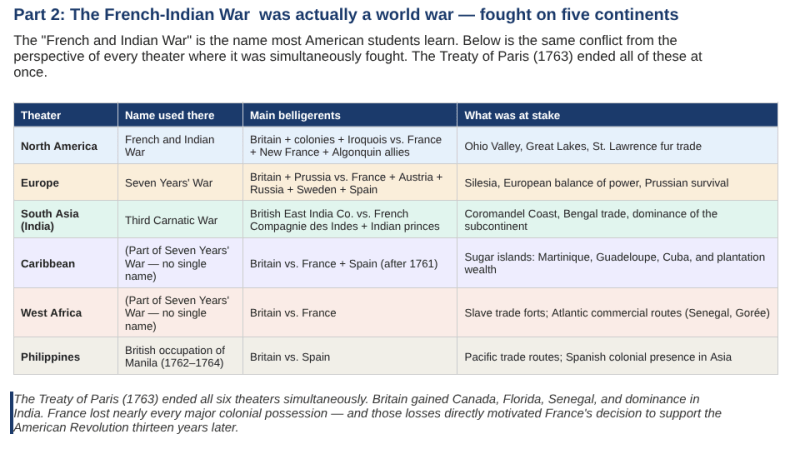
The clearest example of this sits right at the beginning of American history instruction: the French and Indian War. The name is not wrong, exactly, but it is dramatically incomplete. Students who learn it in isolation walk away thinking this was a discrete conflict between British colonists and a French-and-Native coalition, fought somewhere in the forests of Pennsylvania and upstate New York, and resolved by 1763. They’re missing nearly the entire story.
The French and Indian War (1754–1763) was the North American theater of the Seven Years’ War, which was simultaneously being fought across Europe, the Caribbean, West Africa, India, and the Philippines. It involved Austria, Prussia, Russia, Sweden, Spain, and Portugal alongside Britain and France. Historians have called the Seven Years’ War the first true world war, and by almost any measure, that description holds up. But students who know it only as the “French and Indian War” have no conceptual hook for any of that context; the name actively works against the larger picture.
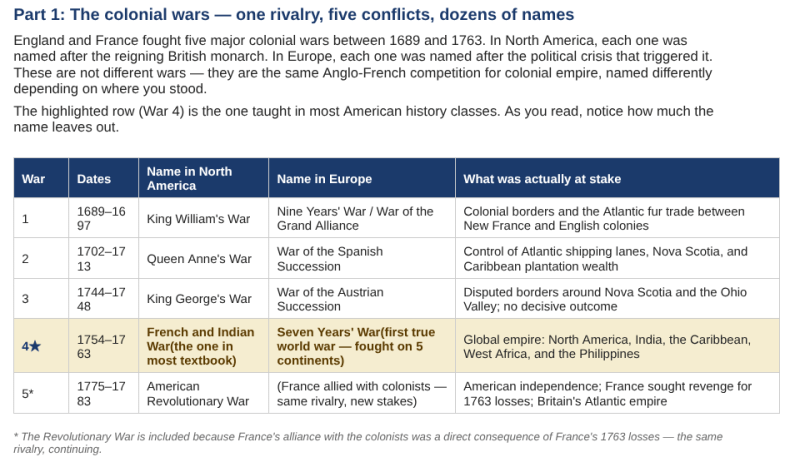
It gets more complicated when you pull back further. That conflict was not even an isolated Anglo-French confrontation. It was the fifth in a series of major colonial wars between England and France dating back to 1689: King William’s War, Queen Anne’s War, King George’s War, the War of Austrian Succession (which overlapped with King George’s War in North America), and finally the Seven Years’ War. Each of those conflicts had a different name in North America than it did in Europe, because colonial administrators and later historians named them after the reigning British monarch or the immediate local cause rather than the broader European competition driving the entire sequence. Students who encounter these wars one chapter at a time rarely recognize that they are watching the same two empires fight the same fight over colonial possessions across more than seventy years.
The naming convention tells students who the belligerents were (sort of) but almost nothing about what was actually at stake: trade routes, plantation economies, the fur trade, Atlantic supremacy, and the question of which European power would control the wealth extracted from the Western Hemisphere.
When “Conflict” Becomes a Political Dodge
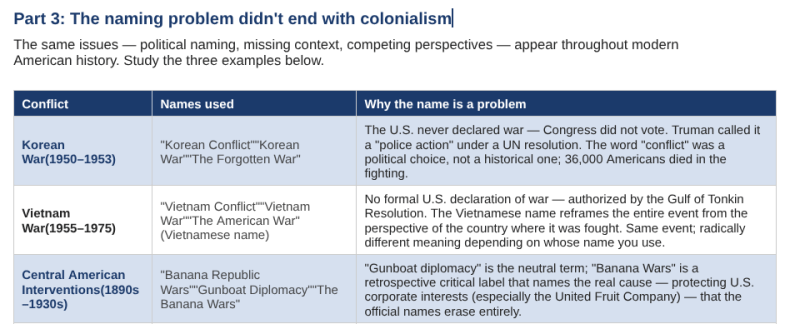
The Korean War offers a different kind of naming problem, and it is one students notice quickly when you point it out. The United States never formally declared war on North Korea or China. Congress did not issue a declaration; President Truman committed troops under the authority of a United Nations Security Council resolution and his own executive power, calling it a “police action.” Because of that legal distinction, the conflict was officially referred to for years as the “Korean Conflict” in government documents and veterans’ paperwork, even as more than 36,000 Americans died in three years of intense fighting.
The word “conflict” did real work here; it was not imprecision, it was policy. Calling it a war would have invited uncomfortable constitutional questions about congressional authority and might have complicated Cold War diplomacy with the Soviet Union and newly communist China. So the government named it in a way that minimized it, and students who encounter both terms in different sources are often genuinely confused about whether they are reading about the same event. They are, and the inconsistency is the lesson: naming a war (or refusing to) is itself a form of political speech.
Vietnam offers a similar dynamic. “The Vietnam War” is common in American usage, but “the Vietnam Conflict” appears in enough official and journalistic contexts that students encounter both. More importantly, Vietnamese historians and the Vietnamese government refer to the same events as the “American War,” which immediately reframes the entire conflict from the perspective of the country where it was actually fought. None of those names are wrong, but each one positions the student inside a particular interpretive tradition without telling them that’s what it’s doing.
The Banana Republic Wars and the Problem of Motive
The conflicts that American military forces fought in Central America in the late nineteenth and early twentieth centuries present yet another variation on this problem. Students rarely encounter these wars at all in standard curricula, and when they do, the names tend to cluster around geographic labels (the Nicaragua campaigns, the Haiti occupation) or blur into the general heading of “gunboat diplomacy.” The term “Banana Republic Wars” is informal and retrospective, more common in critical historiography than in textbooks, but it captures something the official names obscure almost entirely: these were interventions conducted largely to protect the commercial interests of American corporations (particularly the United Fruit Company), carried out by U.S. Marines who occupied sovereign nations for years at a time.
The names those interventions carry tell students where they happened. They don’t tell students why, who benefited, or what the occupied populations experienced. A student who learns “the Marines intervened in Nicaragua in 1912 and again in 1927” has a date and a place; they don’t have a story. The name doesn’t carry the weight of the context, so the context gets dropped.
What This Means in the Classroom
The practical consequence of all this naming confusion is a student mental model that treats wars as self-contained events with clear beginnings and endings, fought between obvious enemies, for reasons the name makes plain. The French and Indian War was fought between the French and the Indians. The Korean Conflict was a conflict (smaller than a war, apparently). Vietnam was a war in Vietnam. Each of those impressions is partly true and significantly misleading.
One of the most useful reframes for students is to introduce the idea that war names are primary sources, not neutral labels. Ask students: Who named this conflict, and when? What did they leave out? Who called it something different, and why? Does the name describe the cause, the location, the belligerents, the outcome, or the politics of the people doing the naming?
That line of questioning turns a potential point of confusion into one of the richer entry points in historical thinking. It asks students to interrogate the very vocabulary they’ve been given, and it opens up the question that sits underneath all of it: whose perspective is built into the story we’ve been told?
Wars are hard enough to teach without the names working against us. But when we make the naming itself part of the lesson, the difficulty becomes productive; and students start reading history more carefully than the chapter titles ever asked them to.

 BFWClassroom
You must be logged in to post a comment.