Every so often, professional development does what it is supposed to do. It doesn’t just add a new tool to the shelf; it reframes the shelf entirely. That is what happened during the week of June 16–20 at Berea College, where I participated in We Hold These Truths to be Self-Evident: Teaching the Holocaust and Human Rights, a week-long seminar hosted by the Olga Lengyel Institute for Holocaust Studies and Human Rights (TOLI) and facilitated by Lauren Hill and Wendy Zagray Warren at the Carter G. Woodson Center for Interracial Education.
I drove to Berea each day expecting to come home with lesson plans. What I came home with instead was something harder to quantify and more difficult to ignore: a reorientation toward human rights as a throughline, not a unit.
Where We Started
The week opened with grounding work that I did not expect to sit with as long as it did. Wendy’s opening session on land acknowledgment and the question of what we mean by “home” set a tone that echoed through everything that followed. We were not simply being asked to teach about history; we were being asked to examine where we stand within it. That distinction matters more than it sounds.
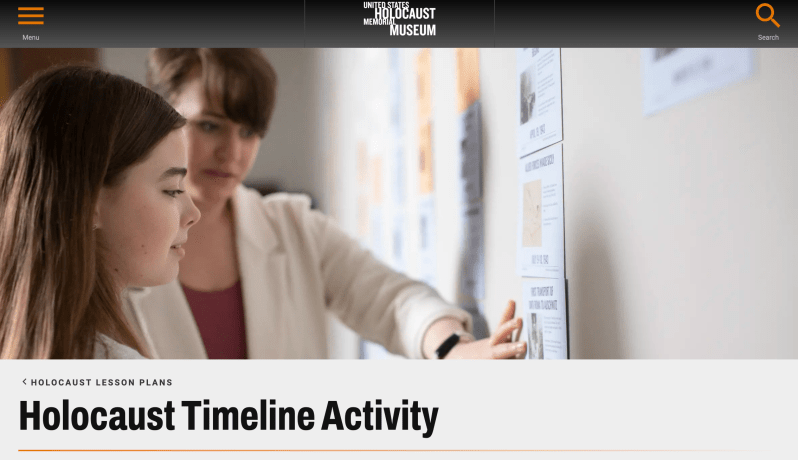
Tuesday afternoon introduced the inquiry design framework through the lens of democracy and the Holocaust, and the evening closed with the Timeline activity, which built the historical scaffolding we would need for the rest of the week. As someone who has taught U.S. History and Government for over two decades, I came in with a working knowledge of the chronology. What the timeline activity gave me was not new information so much as a renewed sense of how to sequence that information for students who are encountering it for the first time.
The Sessions That Shifted Something
Wednesday brought two sessions that deserve their own conversation. Drs. Jill Abney and Karen Petrone led the group through the history of antisemitism, the rise of fascism, and how Hitler systematically dismantled democratic institutions. These are not easy conversations to navigate in a seminar room, and they are not easy conversations to bring into a high school classroom. What the session modeled was that the difficulty is not a reason to avoid the material; it is precisely the reason to approach it carefully and with preparation.
Wednesday afternoon also introduced Wendy’s We Hold These Truths to be Self-Evident framework, which she returned to across multiple sessions throughout the week. The work of placing the Declaration of Independence in dialogue with the Universal Declaration of Human Rights gave me a practical and rigorous anchor for the kind of document-based inquiry I want to build into my freshman Government classes. In the past I have used the UN UDHR materials, I like the language and framing from Amnesty and may use this page in future classes.
Thursday and the Middletown School
Thursday was the day that broke the week open in a personal way. The morning included Wendy’s Turning Homeward session on eugenics and its legacy, followed by a presentation from Dr. Jessica Klanderud on teaching Black history in Kentucky through the Association for Teaching Black History in Kentucky. She spoke at length about how her life is a combination of intersectionality and how that shapes her work with in the classroom and at the Carter G. Woodson Center at Berea College. Both sessions reinforced the same difficult truth: the history of human rights violations is not something that happened elsewhere. It happened here, in Kentucky, in counties most of us drive through without thinking twice.
That afternoon, Sharyn Mitchell and Jackie Burnside led our group at the Middletown School in Berea, one of the Rosenwald Schools built across the South and border states in the early twentieth century to provide education for Black children during the era of legal segregation. The session drew on the remarkable archival collections housed at Berea College’s Special Collections and Archives, including scanned primary documents, oral history audio, and materials from the Lincoln Institute and the Farristown, Kentucky Oral History Project. Berea College students also produced a heritage brochure documenting Historic Black Berea: An Interracial Community, 1866–1900s, the kind of student-generated local history work that models exactly what I want to build with my own students.
What made this visit land differently than a standard historical tour was the conversation it opened about Madison County, my home county, and the segregation history that shaped schools, communities, and opportunities there within living memory.
Friday: Oral History and the Choices We Make
Friday morning brought one of the most practically useful sessions of the week. Arwen Donahue and Lauren led a session on oral history as both a pedagogical tool and a form of historical witness. Arwen is the author of This Is Home Now: Kentucky’s Holocaust Survivors Speak (University Press of Kentucky), a remarkable oral history collection that pairs survivor testimonies with photographs by Rebecca Gayle Howell. Hearing the original audio from that project in the room with the people who helped bring it into existence was one of those moments that reminds you why primary sources matter in ways that secondary accounts cannot replicate.
The afternoon session, Oath and Opposition, worked through the framework of choices and what Wendy called “choiceless choices,” drawing on the Pyramid of Hate and Pyramid of Power to examine how ordinary people navigate extraordinary pressures. This activity, which is no longer available on the USHMM website, gave participants a framework for examining complicity, resistance, and bystander behavior that translates directly into classroom discussion. It is exactly the kind of activity that asks students to locate themselves in a historical situation rather than observe it from a safe distance.
Friday also included Lauren’s Judaism 101 session, which grounded the week’s historical content in the living culture and theology of the people most directly affected by the Holocaust. That sequencing, history first and then the people behind the history, felt intentional and right.
Saturday and the Closing
The week was scheduled to close at Temple Adath Israel in Lexington, where the group would attend a traditional Reform Shabbat morning service, stay for a Q&A with the rabbi, and share their action plans in a final closing session. Family obligations kept me from attending those final activities, and I genuinely wish I had been able to be there; the arc of the week made it clear that Saturday’s closing was designed to bring everything together in a meaningful way.
What I was able to do was complete my action plan, which felt like the right way to honor the work of the week even from a distance. The closing session asked the question the whole week had been building toward: So what? What will you do with what you’ve learned? I may have missed the room where that question was asked aloud, but I didn’t miss the question itself.
What I Am Taking Back
I came in expecting to build lesson plans. I am leaving with something more structural: a commitment to human rights as a genuine throughline across the units I teach, not a single week in October bracketed by other content.
Practically, this means several things. I plan to use the USHMM Timeline activity and the Some Were Neighbors posters as anchor materials for an interactive community discussion night in December, open to parents and community members. I want to develop a full Oral Histories unit for my Debate and Rhetoric class, drawing directly on what Arwen modeled with This Is Home Now, and connect that work to the Lexington Public Library and UK Libraries Archives for possible long-term storage and partnership. I also plan to integrate the oral history interview format into the Defense of Learning portfolio cycle for my freshman Government students, giving them a structured way to talk with a mentor or significant adult about their own growth and the habits that will carry them forward.
The larger shift, though, is one I am less comfortable admitting in a professional document: I walked into this week thinking I could build something significant largely on my own, the way I tend to build most things. I walked out understanding that the work of teaching toward truth is not a solo project. It is a school-wide effort, a community effort, and in some cases a generational one.
TOLI gave me the framework. The rest is the work of the year.
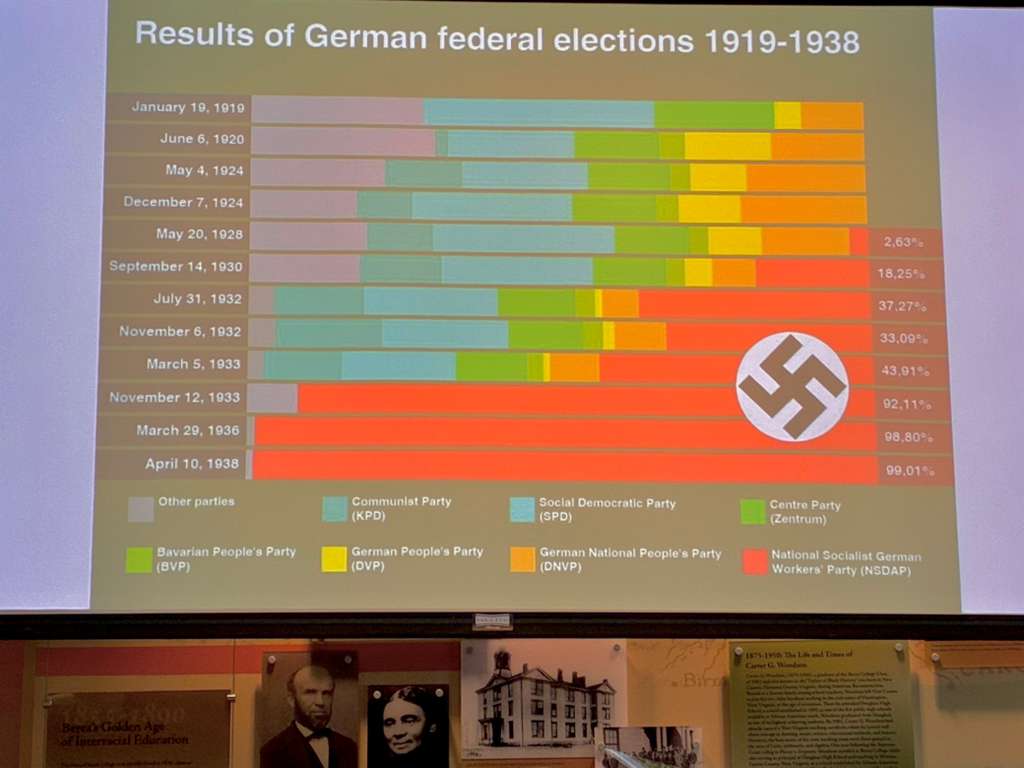
Graph showing the rise of the Nazi Party. 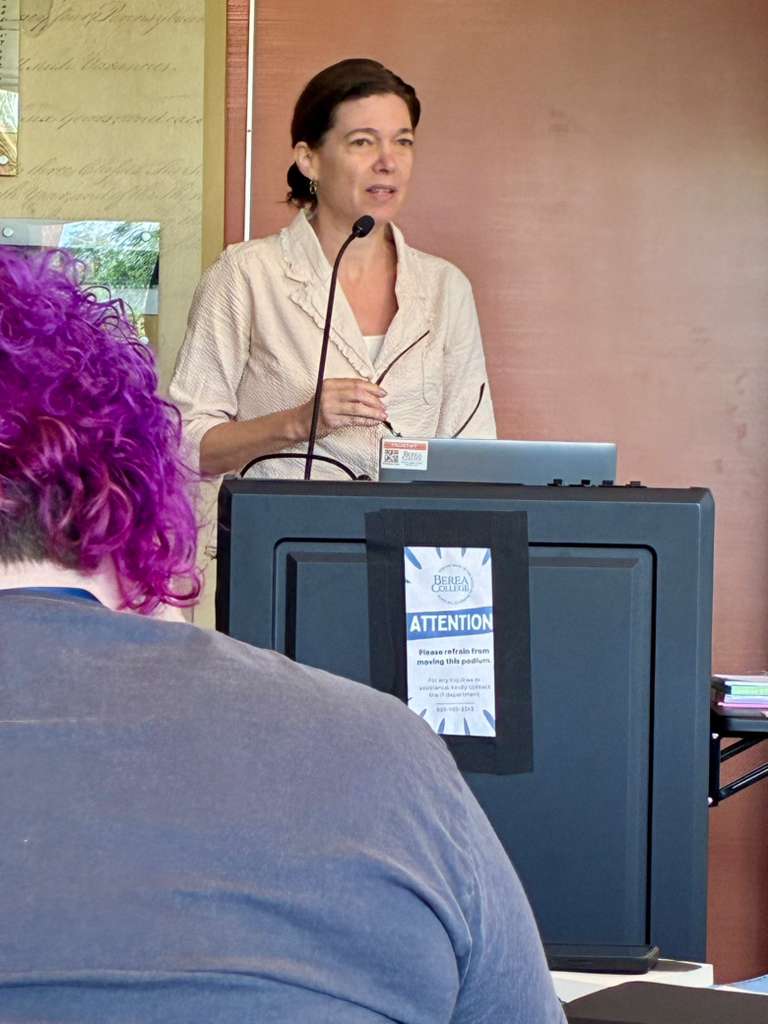
Arwen Donahue speaking about her book and collecting the stories. 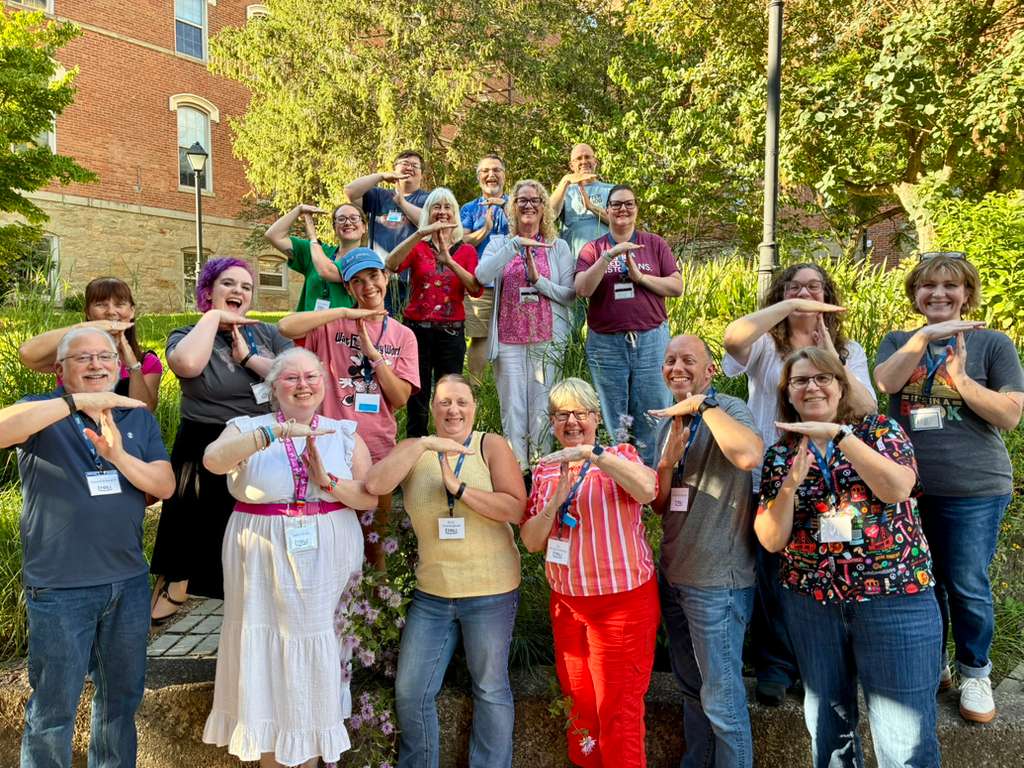
The whole TOLI group on Friday. 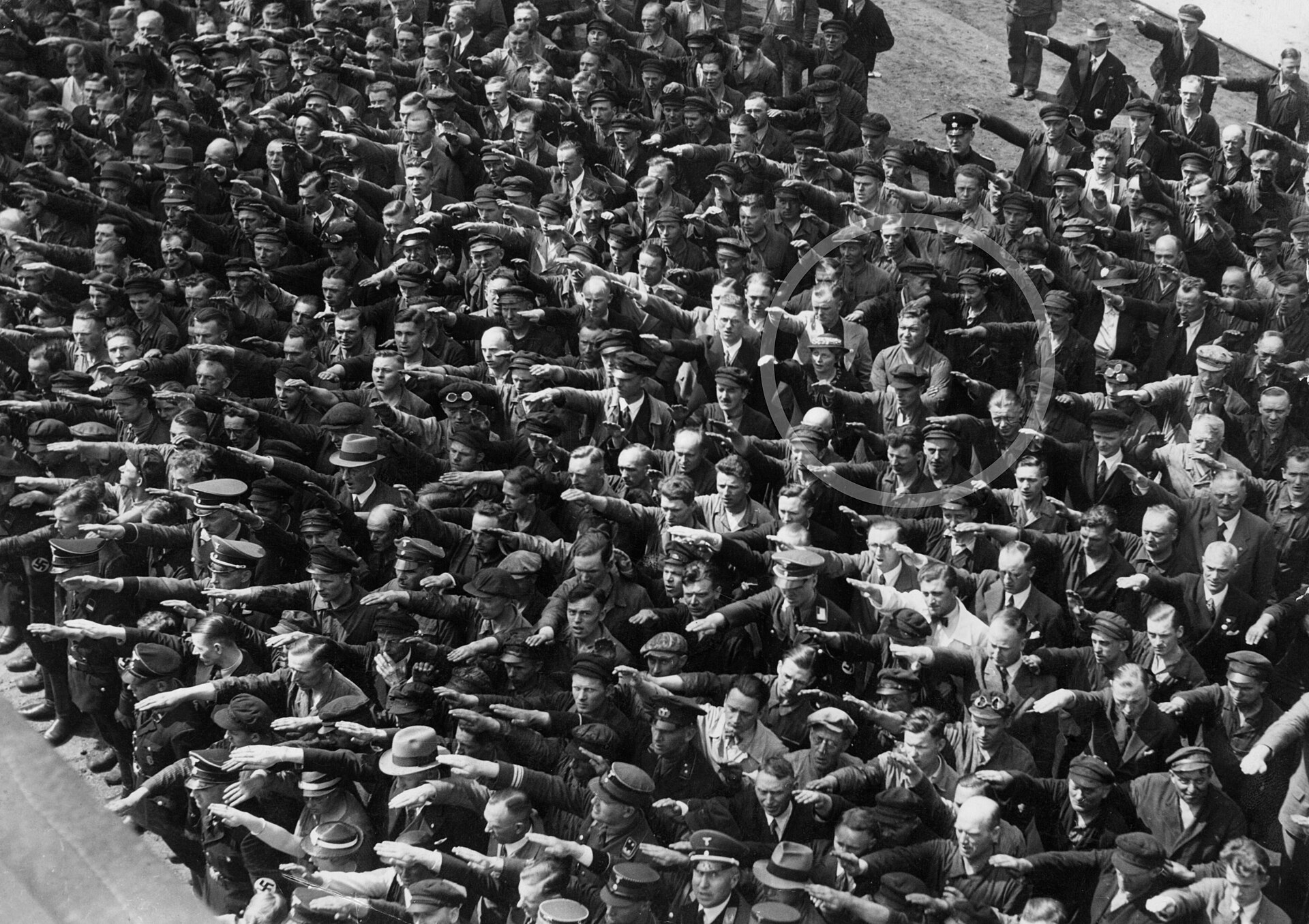
Employees of the shipyard Blohm und Vow from Hamburg gathered for the launch of the training ship ‘Horst Wessel’ and demonstrate the Nazi salute with the raised right arm. One worker in the right half of the picture denied it and crosses his arms in a defiant gesture – also a kind of resistance. The name of the worker is August Landmesser., 01.01.1936-31.12.1936 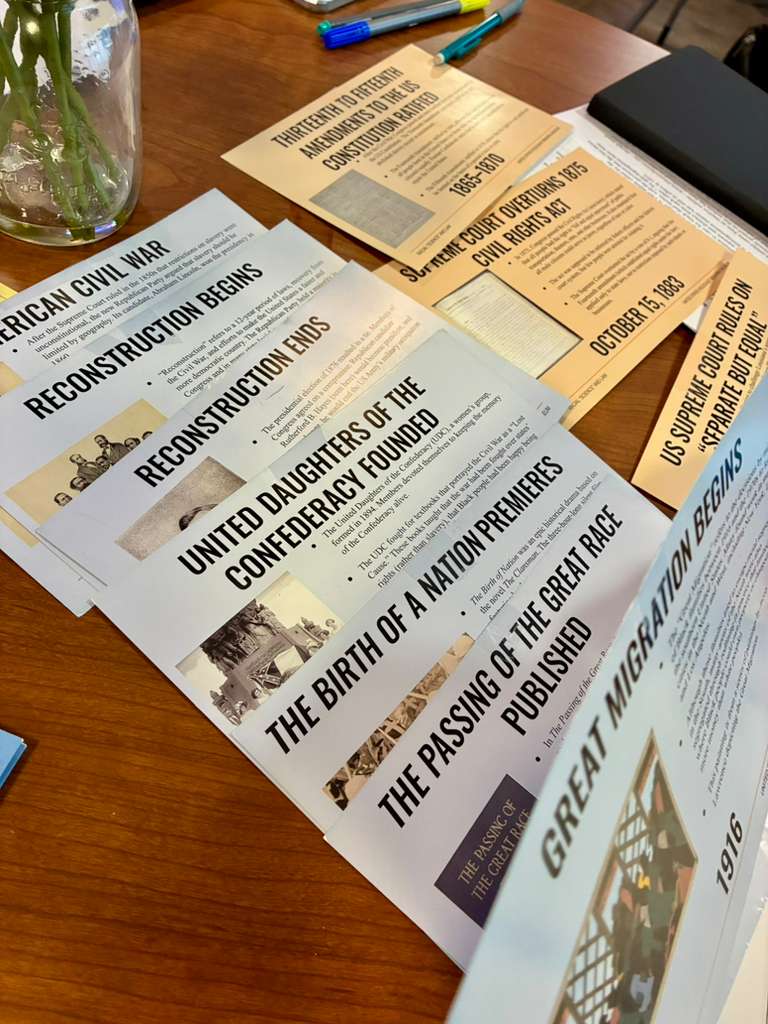
Cards from the USHMM timeline activity. 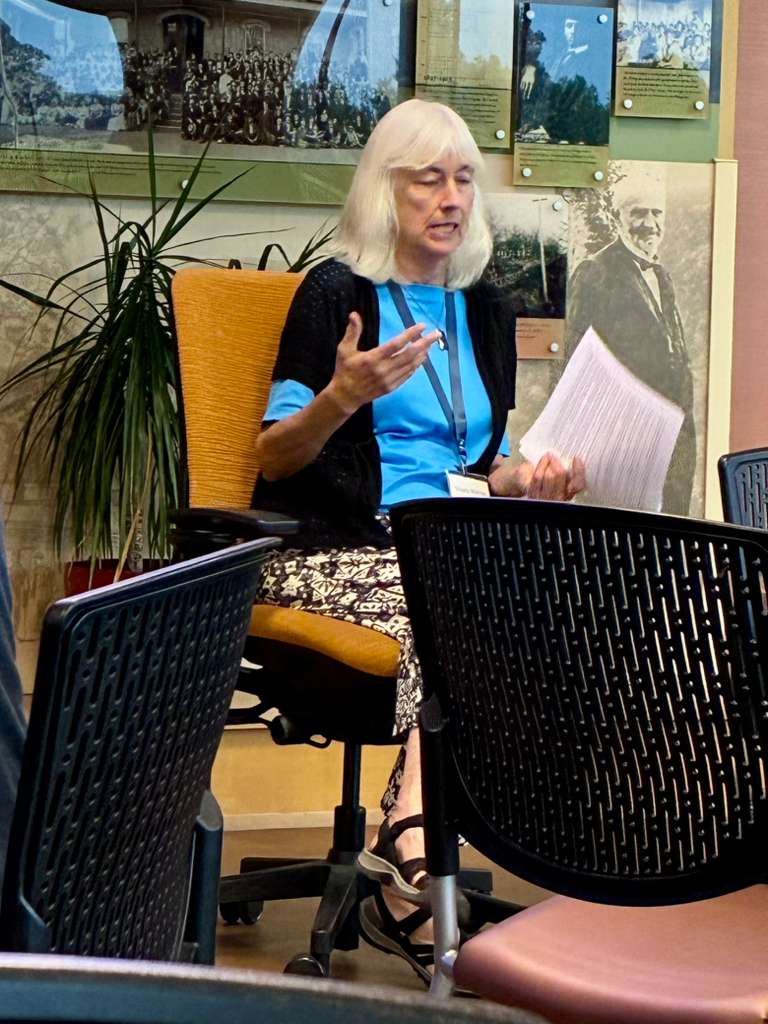
Wendy speaking to the group. 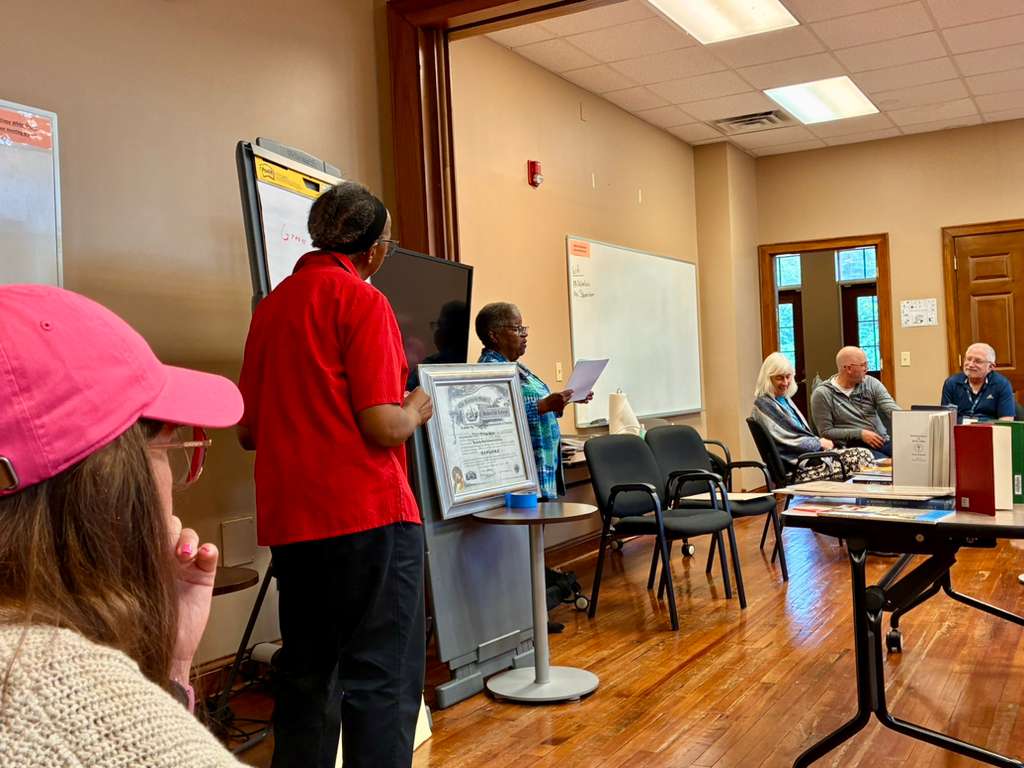
Jackie and Sharyn speaking inside the Middletown School.
Resources
If any of what I’ve described here is useful to your own practice, these are the places worth starting.
TOLI — The Olga Lengyel Institute for Holocaust Studies and Human Rights The Kentucky regional program page includes information about the seminar, its partners, and how to apply for future cohorts. https://www.toli.us/regional-program/kentucky/
United States Holocaust Memorial Museum (USHMM) The USHMM offers extensive free classroom resources, including the Timeline of Events and the Some Were Neighbors poster and discussion series. https://www.ushmm.org
Berea College Archives — Middletown School: Black in Appalachia (Scanned Materials) Primary documents related to the Middletown School and the broader history of Black education in Appalachian Kentucky. https://berea.access.preservica.com/uncategorized/SO_5227f31c-05f8-4d5f-b784-4f66c39160ae/
Berea College Archives — Middletown School History (Video/Audio) https://berea.access.preservica.com/uncategorized/SO_97d9d6cb-0bea-4159-8e02-6ad42260b0c6/
Berea College Archives — Lincoln Institute Oral History https://berea.access.preservica.com/uncategorized/SO_e8b92dba-12ea-4938-be8a-740244246029/
Berea College Archives — Farristown, Kentucky Oral History Project https://berea.access.preservica.com/uncategorized/SO_2f792601-8bdb-41fb-9ef6-c625c72dbbc7/
This Is Home Now: Kentucky’s Holocaust Survivors Speak Arwen Donahue’s oral history collection, published by the University Press of Kentucky, is available through the link below and through most library systems. https://www.kentuckypress.com/9780813182384/this-is-home-now/
The TOLI Kentucky seminar was conducted in partnership with the University of Kentucky Jewish Heritage Fund Holocaust Education Initiative, the Association for Teaching Black History in Kentucky, the Carter G. Woodson Center at Berea College, and Temple Adath Israel in Lexington.


You must be logged in to post a comment.