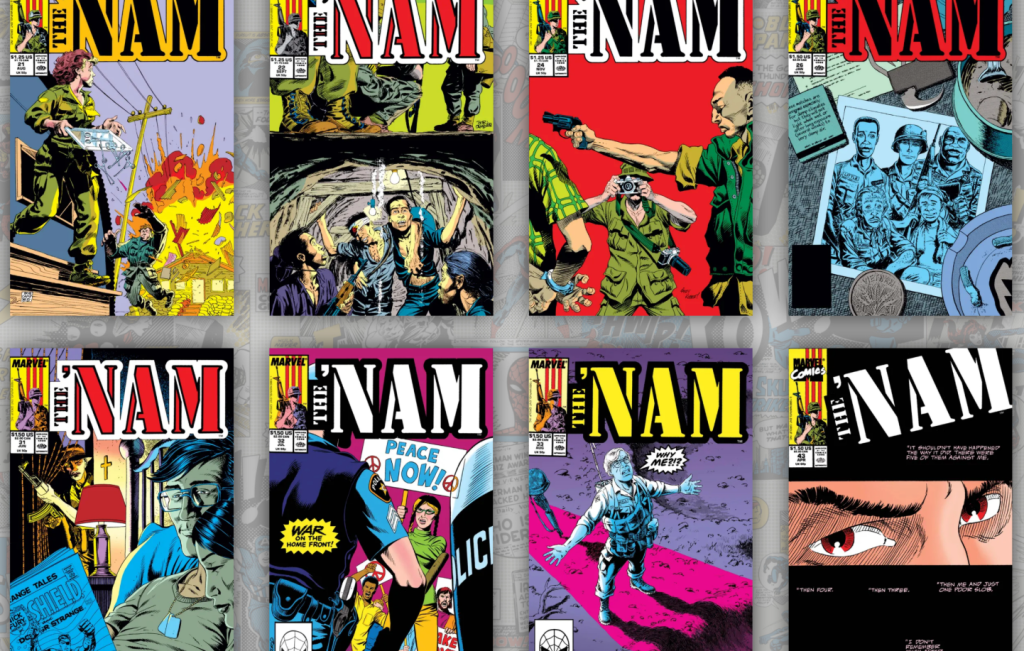
Opening: A War Comic That Kept Time
This is part of my Comics in the Classroom series where I look at the importance of the comic book industry and how to use them as resources in the classroom. To read more check out my other posts. (Link)
In December 1986, Marvel Comics put a 75-cent comic on the spinner rack that did something no superhero book had ever tried; it promised to tell the Vietnam War one month at a time, in something close to real time, from the point of view of the soldiers who walked it. The ‘Nam ran for 84 issues, from December 1986 to September 1993, and this December marks forty years since its first issue arrived.
Veterans Day is a good moment to revisit it, because The ‘Nam was never only a war comic. It was a way for veterans to tell stories they had carried home (and, in many cases, carried quietly for twenty years). It was also, almost by accident, a history lesson for a generation of kids who had grown up in the long shadow of Vietnam without ever having watched it unfold on the evening news. Those kids were often the sons and daughters of the men the comic was about.
This post looks at how two veteran writers, Doug Murray and Don Lomax, used the book to work through their own war; how a larger circle of veteran creators and letter-writing readers turned it into a shared space for memory; and how six specific issues can serve as readable, discussable primary-source companions in a high school history or ELA classroom.
Origins: Two Veterans, a Mock-Up Cover, and a Calendar
The book began with a connection between veterans. Larry Hama, an Army veteran of the Vietnam War who was by then writing and editing at Marvel, reached out to fellow veteran Doug Murray in 1984 about Vietnam stories for the black-and-white magazine Savage Tales. Murray was a wounded noncommissioned officer who had served two tours. Together with artist Michael Golden, they produced “The 5th to the 1st” for the October 1985 issue, and it was well received.
The ongoing series came from an unusual direction. In 1986, editor-in-chief Jim Shooter showed Hama a mock-up cover of a jungle-camouflaged infantryman with the words “THE ‘NAM” pasted across it, and he told Hama to build a book to go with it. Hama asked Murray to write the proposal, and Golden (who had been planning to draw Batman for DC) signed on because he wanted to work on something other than superheroes.
The defining choice was structural. Each issue would take place one month after the previous one, roughly twenty years before its publication date; because a standard tour of duty lasted about a year, no character could stay in the book much past twelve issues. Murray has said the real-time approach was a joint decision with Hama, and he connected it to something every grunt understood: soldiers tracked their days in-country on short-timer calendars. The comic, in other words, kept the same clock its characters did.
The early book also wore its sources openly. Most of the stories in the first thirteen issues were based on incidents that had happened to Murray or to people he knew, and the actions of the fictional 23rd Infantry squad were built on real operations. Issues included “‘Nam Notes,” a glossary of GI slang and Vietnamese phrases, and Murray laid out the unit structure from squad to brigade so readers could follow who reported to whom.
Two Writers, One War: Murray and Lomax
It would be easy to overstate this, so I want to be careful. Neither Murray nor Lomax, as far as the public record shows, described The ‘Nam in clinical terms as therapy for post-traumatic stress, and educators should avoid putting that diagnosis in their mouths. What the record does show is two veterans who turned memory into narrative, deliberately and with discipline, and who used a mass-market comic to say things about their war that the culture had rarely let them say.
Doug Murray (issues #1–45, and briefly #49–51) wrote from the inside of the infantry. He and Hama chose to avoid politics and keep the camera on the foot soldier, and Murray later said the result offered a pretty accurate picture of how the average soldier saw the war. That restraint was itself a kind of processing; rather than argue about whether the war was right, Murray recreated what it felt like to be nineteen, scared, bored, and exhausted in a place nobody at home seemed to understand. He was also protective of the men he wrote about. When a reader compared GIs to concentration camp guards, Murray answered in print that returning veterans had been treated badly and that the comparison was beneath contempt.
Murray’s tenure ended badly. After editor Don Daley took over, Daley wanted superheroes in the book and wanted to drop the real-time structure; the arguments grew bitter, and a commissioned Punisher script was one of the final straws. Murray had hoped, had he stayed, to bring his first-year protagonist back to Vietnam as a reporter to deal with Agent Orange.
Don Lomax (issues #70–84) arrived with his own war already on paper. Drafted in the fall of 1965, he deployed in 1966 with the 98th Light Equipment Maintenance Company as a wheel-and-track mechanic, and he kept notes and sketches throughout his tour. Those notebooks became Vietnam Journal, his independent series from Apple Comics, which ran sixteen issues between 1987 and 1991. Lomax has described the war as the experience that opened his eyes, and he has said that he went in trusting nearly everyone (the government included) and came out trusting almost no one. Impressed with Vietnam Journal, Daley brought him in to write The ‘Nam in 1992, and Lomax built his stories from his own experiences and those of other veterans.
Lomax also did something poignant with the book’s history; in his first issue, he brought Murray’s protagonist back. Ed Marks returned to Vietnam as a war correspondent, which was very close to the homecoming Murray had imagined but never got to write.
The Wider Circle: A Team of Veterans and a Page of Letters
Between and around those two writers stood a larger team, and a larger community. Artist Wayne Vansant, who served in the Navy during the war, penciled 58 issues and became the book’s visual identity after Golden. Chuck Dixon, who took over as regular writer after Murray, wrote a five-part story about the war’s mental toll on a Marine named Joe Hallen; that arc is one of the clearest places where the series puts psychological injury, rather than physical combat, at the center of the page.
The most important “writers,” though, may have been the readers. The letters column, “Incoming,” gave veterans and civilians a place to write about friends and family they had lost and about how the war had shaped their lives, and most issues also carried news of veterans’ organizations and reunions. For a lot of men in the late 1980s, a comic book letters page was one of the few public places where Vietnam could be talked about plainly, without a political argument attached. That is a remarkable thing for a monthly Marvel title to have been.
The outside reaction reflected how unusual the project was. The first issue outsold X-Men in its release month, The Washington Post ran a major feature on it, and the series earned a Best New Series nomination at the 1987 Jack Kirby Awards. Veterans were divided in an instructive way. William Broyles Jr., a Marine veteran and former Newsweek editor, praised its gritty realism; Jan Scruggs of the Vietnam Veterans Memorial Fund wondered aloud whether a comic book might trivialize the war; and the Bravo Organization, a Vietnam veterans’ group, named it the best media portrayal of the war, ahead of Platoon.
The War They Didn’t See on TV: Reaching the Next Generation
The students who picked up The ‘Nam in 1986 had been born, for the most part, after the evening news stopped showing the war. They knew Vietnam through Rambo posters, through Platoon, and through the silences of the adults around them. Many of them had a father, uncle, or neighbor who had served and did not talk about it.
Murray wanted those readers. He pursued the Comics Code seal specifically so the book could reach a wider and younger audience through mainstream newsstands. The Code came with real limits (no drug use, no sex, no profanity), and anyone who knows the war knows how much that cut away. Yet the constraint also made the book shareable; a twelve-year-old could buy it at the drugstore, and a parent could read it over his shoulder.
The real-time structure did the rest. A reader who followed the book month by month experienced the war the way a soldier did, as a slow accumulation of days, rather than as a documentary with a known ending. Characters rotated out, some went home and some did not, and the reader felt the absence. For the children of the Vietnam generation, that was something television news had never offered: a way into the war that was paced, personal, and relatable, and that left room for questions at the dinner table.
Six Issues for the Classroom
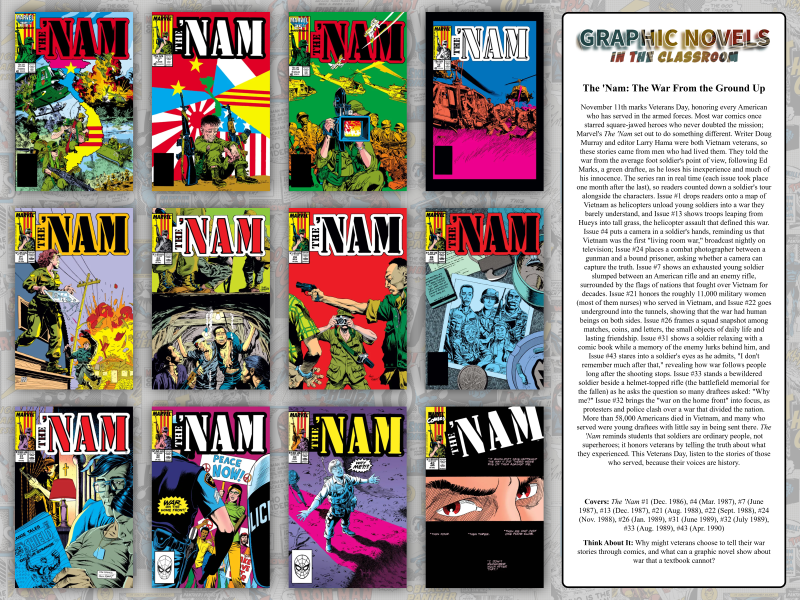
The commentaries below are written for teachers deciding what to pull. Every issue was Comics Code approved at publication, but I note content considerations for each. Plot summaries are drawn from published indexes and reviews; please preview each issue before classroom use, and treat specific panel details here as items to confirm against your copy.
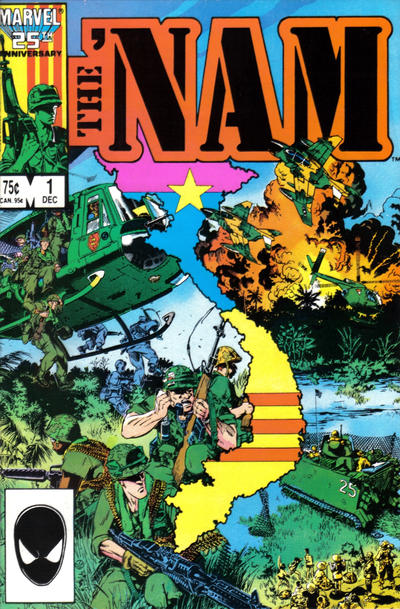
1. The ‘Nam #1 (December 1986): “First Patrol”
Doug Murray and Michael Golden
The first issue opens with PFC Ed Marks, a clean-cut kid with a fear of heights, boarding a plane in January 1966 bound for South Vietnam. He is assigned to the 4th Battalion, 23rd Infantry, 25th Infantry Division, and on his first day at the Cu Chi base camp he runs into a first sergeant expecting a bribe. The issue’s lesson is that the war Marks expected and the war he got are two different things; corruption, confusion, and the knowledge held by veterans of a few months matter as much as any battle plan.
Classroom value: This is the ideal entry point. Pair it with the opening chapter of Tim O’Brien’s The Things They Carried or with a letter home from the Library of Congress Veterans History Project, and ask students to compare how each text establishes the soldier’s sense of disorientation. The “‘Nam Notes” glossary also makes a strong vocabulary and context-building tool. Suggested level: grades 8 and up.
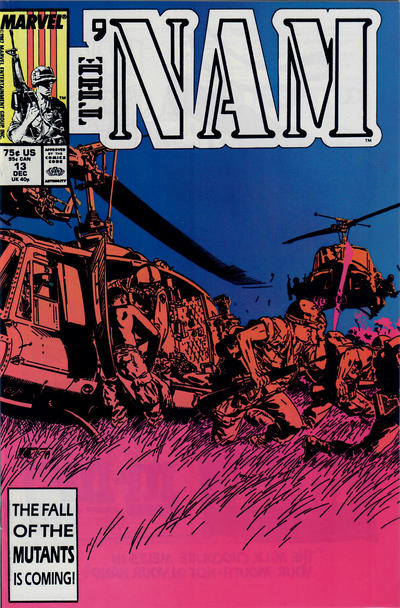
2. The ‘Nam #13 (December 1987): The End of a Tour
Doug Murray and Michael Golden
True to the real-time premise, Ed Marks reaches the end of his year in this issue. Marvel’s solicitation describes Marks confronting the effects of chemical warfare firsthand, and reviewers point to this stretch of the series as the moment the book’s central experiment pays off: the character readers had followed for a year simply leaves, because that is what a tour of duty did. Golden penciled twelve of the first thirteen issues, and this one closes his signature run.
Classroom value: Use this issue to discuss the individual tour system, which sent soldiers home alone rather than with their units, and its connection to the difficulties veterans faced on returning. The chemical warfare thread opens a door to Agent Orange as a long-term veterans’ health issue, which students can research through the Department of Veterans Affairs. Suggested level: grades 9 and up. (Fact-check note: confirm the issue’s specific story beats against your copy, since online summaries are thin.)
3. The ‘Nam #24 (November 1988): Tet and the Photograph
Doug Murray and Wayne Vansant
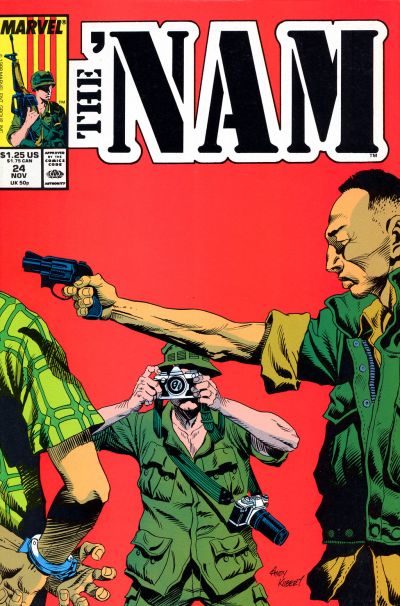
This is the issue most worth teaching, and it is the one with the journalist and the shooting on the street. Issue #24 covers the Tet Offensive of 1968; the fictional men of the 4th Battalion, 23rd Infantry, are ordered into Saigon, fight at a radio station, and then witness AP photographer Eddie Adams taking his Pulitzer Prize-winning photograph of South Vietnamese police chief Nguyễn Ngọc Loan executing a captured Viet Cong fighter, Nguyễn Văn Lém, on February 1, 1968. The Grand Comics Database notes that the artwork is an homage to Adams’s “Saigon Execution.” Rather than simply redrawing the famous image, the comic turns the scene around and focuses on Adams himself, looking through his camera; the photographer becomes a character in the war. Squad leader “Ice” captures what the moment will mean when he says the picture will be on the front page of every newspaper in the States.
Classroom value: This is a master class in media literacy. Scholar Lauren Earle has written about how this issue frames the photograph through the camera, and she contrasts it with Thi Bui’s graphic memoir The Best We Could Do, which renders the same image from a Vietnamese American family’s perspective. Put the original photograph, the ‘Nam panel, and the Bui page side by side; then ask what each version includes, omits, and asks the reader to feel. Add context students rarely get, such as Adams’s later regret (he wrote in Time that “two people died in that photograph”) and Susan Sontag’s argument that Loan staged the moment for the gathered press. Content note: this issue depicts an execution; provide advance notice and an opt-out. Suggested level: grades 10 and up.
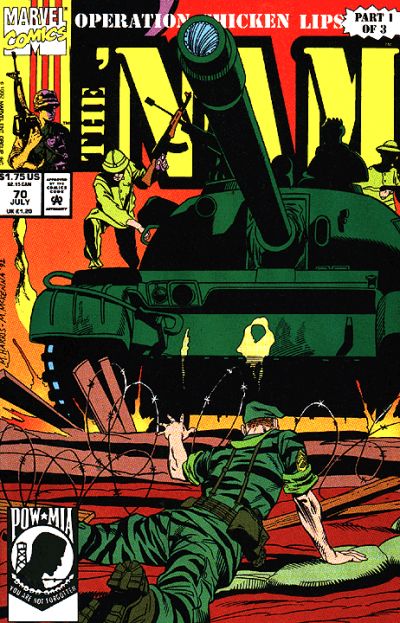
4. The ‘Nam #70 (July 1992): Ed Marks Comes Back
Don Lomax and Wayne Vansant
Lomax’s debut brings Ed Marks back to Vietnam in the spring of 1972, now a war correspondent with a journalism degree from Columbia. His editor sends him to a firebase to cover a Special Forces A-Team. The issue is a deliberate bridge between the two writers’ visions; Lomax gives Murray’s everyman a second tour, this time with a notebook instead of a rifle.
Classroom value: Marks’s return as a reporter invites a conversation about how veterans become storytellers, which is the very thing both of the book’s veteran writers did. Students can compare the soldier’s perspective of issue #1 with the journalist’s perspective of #70 and discuss how role shapes what a person sees. This pairs well with a lesson on war correspondents, from Ernie Pyle to the Vietnam press corps. Suggested level: grades 9 and up.
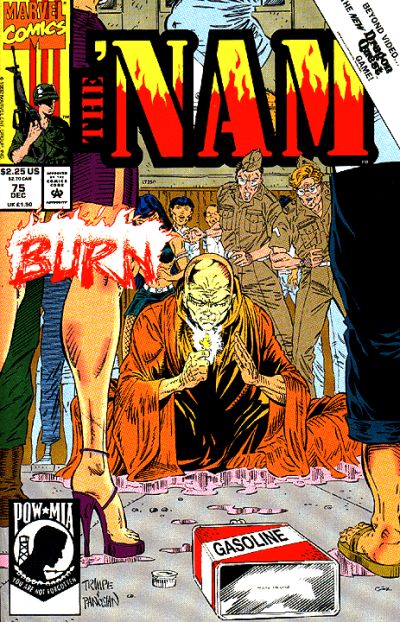
5. The ‘Nam #75 (December 1992): “Burn”
Don Lomax
Issue #75 was a 48-page special devoted to the My Lai Massacre of March 1968, published under the Comics Code more than two decades after the event. It is a striking choice for a mainstream comic; the book that began by avoiding politics confronted the war’s most notorious atrocity committed by American troops.
Classroom value: For advanced history students, this issue can anchor an inquiry into accountability, chain of command, and moral courage, especially when paired with the story of helicopter pilot Hugh Thompson Jr., who landed his aircraft to stop the killing. It also opens a discussion about what a veteran writer owes to the truth when the truth implicates his own side. Content note: this is the most difficult issue on this list; preview it carefully, consult your administration, and consider using excerpts rather than the full issue. Suggested level: grades 11 and up, or college. (Fact-check note: confirm credits and specific content against your copy.)
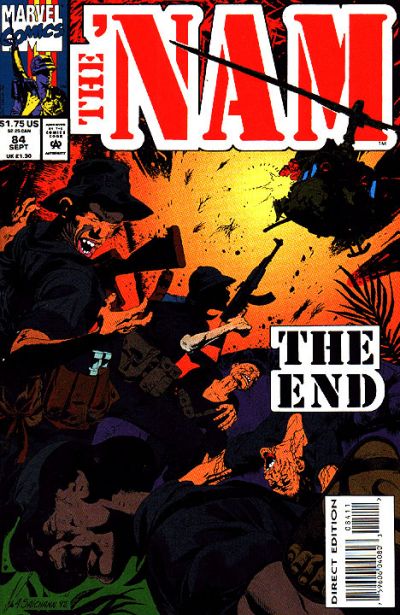
6. The ‘Nam #84 (September 1993): The Letter
Don Lomax and Alberto Saichann
The final issue does not end with a battle. Ed Marks comes to hold a letter written by a five-year-old North Vietnamese girl to her father, a soldier fighting in the South; it contains nothing but a stick-figure drawing of her family standing beside their house and their water buffalo. After seven years of telling the war from the American side, the series closes by turning the reader’s attention to the family on the other side of the line.
The ending came early. Marvel canceled the book a year before its planned 96-issue run because sales had fallen and management wanted more superhero titles, and Lomax later recalled being dismissed by his editor with a curt “Sayonara.” The unpublished issues #85 and #86 later appeared in the Punisher special The Punisher Invades the ‘Nam: Final Invasion.
Classroom value: This issue is a natural capstone for a unit on perspective and empathy. Ask students why a veteran writer might choose to end his war story with an enemy soldier’s child, and what that choice says about the veteran’s own reckoning. It pairs beautifully with Bảo Ninh’s novel The Sorrow of War or with Vietnamese perspectives included in the Ken Burns and Lynn Novick documentary The Vietnam War. Suggested level: grades 8 and up.
Positive Impact
The ‘Nam proved that a mainstream publisher could sustain a realistic, non-superhero war comic in the late 1980s, years after DC’s long-running war titles had mostly faded. It gave veterans a venue to write, draw, and read about their own experiences, and its letters page functioned as a kind of print reunion. Most importantly for educators, it modeled history told from the ground up; it asked readers to see a war through privates and corporals rather than presidents and generals, and that perspective translates directly into the historical thinking skills we want students to practice.
Challenging Legacy
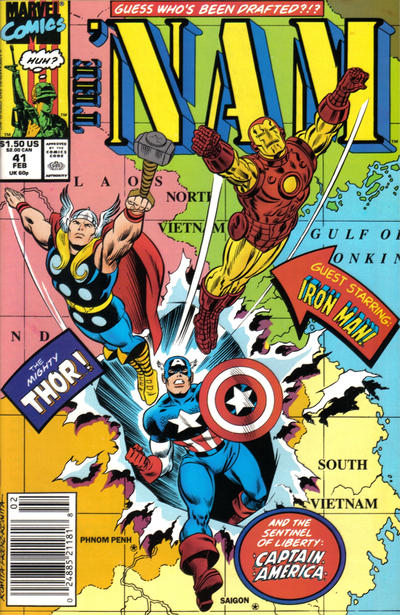
The book did not always live up to its premise. Once Murray left, the real-time structure was abandoned and the original squad was dropped as the focus. Issue #41 brought Captain America, Iron Man, and Thor into the story as figures in the soldiers’ imaginations, and readers disliked it. The Punisher arrived in issues #52–53 (January–February 1991) and returned later, a commercial move that cut against the book’s founding promise of no indestructible heroes. The Comics Code also softened the war considerably; the language, drug use, and moral chaos that veterans describe in memoirs are mostly absent here. Teachers should present the series as one veteran-shaped perspective among many, not as the definitive account, and they should be especially attentive to how Vietnamese characters are represented in earlier issues.
Personal Reflection
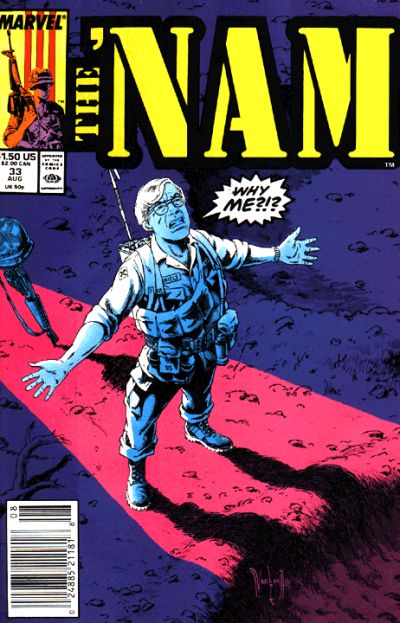
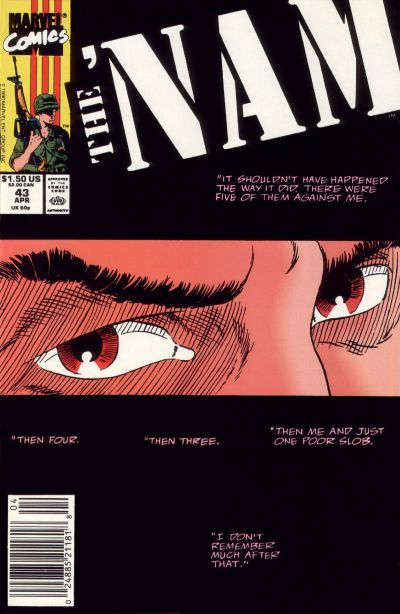
The first two issues of The ‘Nam I ever owned were not ones I picked out. They came from a blind draw pack (one of those sealed bundles of comics you bought without knowing what was inside), and when I opened it I found issues #33 and #43. I have kept both of them ever since.
Neither would make a collector’s list of key issues. Issue #33, “Back in the Saddle Again” (August 1989), follows Specialist Daniels, a soldier who has already survived one tour and is sent back for another; Marvel’s own description notes that his body may hold up, but his mind is another story. Issue #43, “The Weight” (April 1990), has a title that says nearly everything, and its premise is that even the best soldiers struggle to keep their wits in Vietnam. Both came from Doug Murray and Wayne Vansant late in Murray’s run, when he had been living with these stories on the page for more than three years.
What stayed with me is that neither story is really about the fighting. Both are about what soldiers carry after it: regret over decisions made in seconds, the guilt of surviving when friends did not, and a slow wearing down of the mind that the military of the 1960s had very few words for. Post-traumatic stress disorder did not enter the American Psychiatric Association’s diagnostic manual until 1980, so Murray was writing for readers who had only recently been given a name for what many of their fathers, uncles, and neighbors had brought home. I did not have that vocabulary as a young reader either; but I understood, turning those pages, that the war did not end for the men who came back from it.
Looking back, it seems fitting that chance handed me those two quiet issues instead of a battle story. I wonder what I would have thought if I had gotten the issue 41 with introduction of Thor, Iron Man, and Captain America. This one comes off almost as a filler issue and missed the point of the larger story being told. I think I would have been turned off because it was the gritty story of war that I wanted to read, They taught me early that some of the most important war stories happen inside a soldier’s head, and that is the lesson I hope my students take from The ‘Nam on Veterans Day.
Conclusion: The Calendar Ran Out, but the Conversation Didn’t
The ‘Nam never reached the end of the war it set out to chronicle. Its calendar ran out in 1993, a year short of its goal, cut down by the same market forces that made superheroes king. Yet it accomplished something more lasting than a complete timeline. It let two veterans, and the larger team and readership around them, turn private memory into public story; and it gave the children of the Vietnam generation a way to see a war their parents rarely described.
That is exactly what we ask students to do on Veterans Day: to listen, to look closely, and to understand that history is made of individual people keeping track of their days. Forty years after its first issue, The ‘Nam still offers a way into that conversation.
Additional Resources for Educators
Collected editions
- The ‘Nam: 1966–1969 Omnibus (Marvel, 2025), collecting issues #1–45 and the Savage Tales stories
- Punisher Invades the ‘Nam (Marvel, 2018), collecting #52–53, #67–69, and related issues (for context on the series’ later direction)
- Don Lomax, Vietnam Journal collections (Caliber Comics)
Scholarship and articles
- “How Marvel Comics in the 1980s Refought the Vietnam War,” Vietnam magazine via HistoryNet
- Lauren Earle, “How Do Comics Engage with the Vietnam War? Two Photography Case Studies,” Americana: The Journal of American Popular Culture (Fall 2023)
- Andrew S. McNeil, “Doug Murray’s The ‘Nam: A Literary Examination of the Traumatic Effects of War Told through Visual Literature” (St. Cloud State University thesis, 2016)
Primary sources and archives
- Eddie Adams, “Saigon Execution” (AP, February 1, 1968)
- Library of Congress Veterans History Project (oral histories and letters)
- The Vietnam Center and Sam Johnson Vietnam Archive, Texas Tech University (holds issues of The ‘Nam)
Companion texts
- Thi Bui, The Best We Could Do (graphic memoir)
- Tim O’Brien, The Things They Carried
- Bảo Ninh, The Sorrow of War
Compliance note: Nothing in this post or the recommended issues involves content restricted under Kentucky SB 150. Issues #24 and #75 contain depictions of wartime violence (an execution and a massacre) and should be previewed, with advance notice to students and families.


You must be logged in to post a comment.