Using Constitutional Comics to Teach the First Ten Amendments
December 15, 1791. On this date, Virginia became the final state needed to ratify the first ten amendments to the United States Constitution, bringing the Bill of Rights into effect. This anniversary offers educators a powerful opportunity to help students understand not just what these amendments say, but why they matter in students’ daily lives.
The challenge we face in teaching constitutional law to high school students isn’t that the material is inherently dry—it’s that traditional approaches often fail to connect 18th-century legal language to 21st-century lived experience. This is where graphic narratives and constitutional comics become invaluable pedagogical tools.
Why Comics Work for Constitutional Education
The visual nature of comics allows students to see abstract constitutional principles in action. When a student reads the text of the Fourth Amendment, they encounter words like “unreasonable searches and seizures.” When they read a graphic adaptation showing a colonial soldier forcing his way into a family’s home to quarter troops, or a modern illustration of a student’s locker search, the amendment transforms from abstract legal text into concrete scenarios with real stakes.
Comics also excel at showing multiple perspectives simultaneously. A well-designed page can present the government’s interest in maintaining order alongside an individual’s right to privacy, forcing students to grapple with the tensions inherent in constitutional law rather than memorizing simplified “correct answers.”
Practical Applications in the Classroom
Several excellent resources exist for teaching the Bill of Rights through visual narratives. The “Cartoon History of the United States” by Larry Gonick provides accessible overviews, while more recent works like “Action Presidents” and various constitutional graphic adaptations offer age-appropriate entry points for different reading levels.
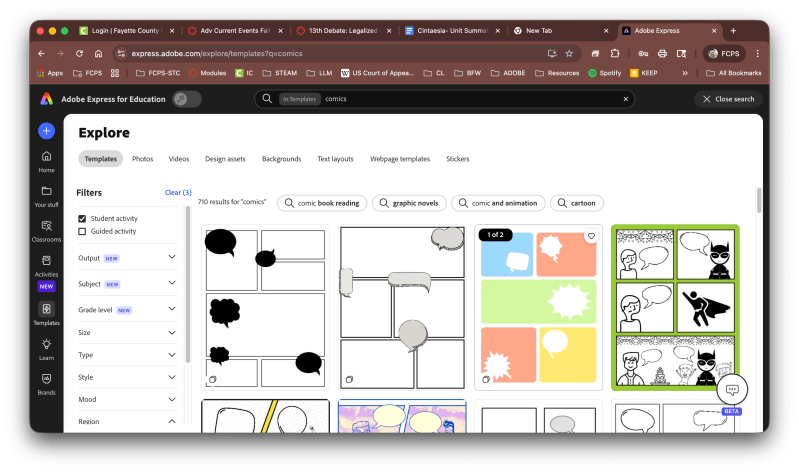
But the real pedagogical power comes when students create their own constitutional comics. I’ve found success with a project where students select one amendment, research a landmark Supreme Court case related to that amendment, and create a 4-6 panel comic explaining both the amendment’s text and its application in that case.
For example, a student examining Tinker v. Des Moines creates panels showing Mary Beth Tinker wearing her black armband to school, the school’s response, and the Supreme Court’s ultimate decision that students don’t “shed their constitutional rights to freedom of speech or expression at the schoolhouse gate.” The act of translating legal reasoning into visual narrative requires students to truly understand the principle at stake.
Connecting to Current Events
The Bill of Rights isn’t a museum piece—it’s a living document that shapes daily news. During our unit, I have students bring in current news articles that connect to specific amendments. A story about social media content moderation connects to the First Amendment. Police body camera footage debates connect to the Fourth. A discussion of jury trials in high-profile cases connects to the Sixth and Seventh.
Students then create single-panel editorial cartoons responding to these contemporary applications. This exercise accomplishes multiple learning objectives: it demonstrates that constitutional law is ongoing and contested, it develops media literacy skills, and it gives students practice in visual argumentation and political cartooning traditions.
Beyond the First Amendment
While the First Amendment often receives the most classroom attention (and rightfully so, given its fundamental importance), the visual narrative approach works particularly well for amendments that students might otherwise find abstract or irrelevant to their lives.
The Third Amendment, often dismissed as archaic, becomes fascinating when students research its origins in colonial grievances and then discuss modern analogs—could the government require you to house National Guard troops during an emergency? What about commandeering hotel rooms during a disaster? The visual medium allows students to imagine these scenarios in ways that pure text cannot.
The Ninth and Tenth Amendments, with their focus on reserved rights and federalism, benefit enormously from visual representation of the relationship between federal and state power. Venn diagrams, illustrated charts of enumerated versus reserved powers, and comics showing conflicts between state and federal law make these complex concepts accessible.
Assessment and Student Work
When assessing student-created constitutional comics, I use a rubric that evaluates accuracy of constitutional interpretation, clarity of visual storytelling, evidence of research into relevant case law, and creativity in presentation. The multimodal nature of the assignment allows students with different strengths to excel—some create beautifully illustrated traditional comics, others use digital tools, and some create photo comics with classmates as actors.
The work students produce often surprises me with its sophistication. Last year, a student created a comic exploring the tension between the Second Amendment and gun regulations by showing the same scene—a school lockdown drill—from multiple constitutional perspectives. Another student made a digital comic about Miranda v. Arizona that incorporated actual quotes from the Supreme Court decision into speech bubbles, making the legal reasoning accessible without sacrificing accuracy.
Resources and Next Steps
For educators interested in incorporating constitutional comics into their curriculum, start small. You don’t need to overhaul your entire unit. Begin by showing students one or two examples of constitutional concepts explained visually, then have them create a single panel or short comic strip about one amendment.
As we mark the 233rd anniversary of the Bill of Rights this December 15th, consider how visual narratives might help your students connect with these foundational freedoms. The amendments that James Madison drafted and the states ratified weren’t meant to gather dust in history books—they were designed to protect real people in real situations. Comics and graphic narratives help students see themselves in that protection, transforming constitutional law from something that happened in the past into something that shapes their present and future.
This is part of my Readings In History series. Where I try to collect resources from historical events and pop culture to talk about and discuss in my classes. To see more of these entries click here.


You must be logged in to post a comment.