A History Teacher’s Answer
Two hundred and fifty years ago, a group of men gathered in Philadelphia and wrote a sentence that has never stopped working. “We hold these truths to be self-evident, that all men are created equal, that they are endowed by their Creator with certain unalienable Rights, that among these are Life, Liberty and the pursuit of Happiness.” They wrote it in the middle of a revolution, under enormous pressure, with no guarantee that the nation they were announcing would survive its first decade. They wrote it knowing, many of them, that they were not living up to it. And they wrote it anyway; because some truths, once stated clearly enough, cannot be recalled. They become the standard by which everything that follows is measured, including the people who first wrote them down.
That sentence is 250 years old today. It has been invoked by abolitionists demanding the end of slavery, by suffragists demanding the right to vote, by civil rights marchers demanding the equal protection the Constitution promised, by farmworkers demanding dignity in the fields, by soldiers demanding that the democracy they fought for exist for them when they came home. Every one of those movements reached back to that same sentence and said: you wrote this, America. Now live it. And the remarkable thing, the thing that fills me with genuine pride and genuine hope every time I teach this history, is that again and again, generation after generation, the country has moved toward it. Not smoothly, not without cost, not without backsliding; but the arc has bent, and it has bent because ordinary people in extraordinary circumstances decided that the words on that founding document were worth fighting for.
That is what I believe about this country. I believe it not as sentiment but as history; because the evidence is there, in the primary sources, in the amendments added to the Constitution at enormous cost, in the legislation passed after decades of organizing, in the court decisions that slowly, imperfectly, extended the republic’s promises to more and more of its people. The Thirteenth Amendment abolished slavery. The Nineteenth gave women the vote. The Civil Rights Act of 1964 and the Voting Rights Act of 1965 finally began to make the Fifteenth Amendment real, nearly a century after it was ratified. These were not gifts; they were achievements, won by people who refused to stop believing that the words in the founding documents meant something and demanded that the institutions of American democracy honor them. Government of the people, by the people, and for the people has not perished from this earth. It has survived wars, depressions, political crises, and moments of profound democratic strain, because each generation has produced people willing to do the work of sustaining it.
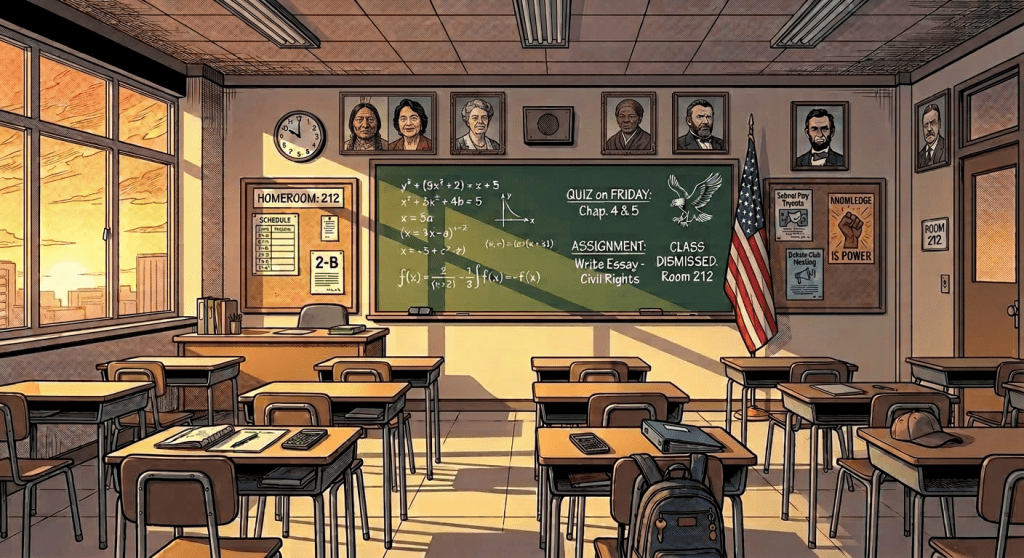
I teach American history to high school students in Lexington, Kentucky, which means I teach it to young people who will spend their entire adult lives as citizens of this republic, participants in its democracy, and inheritors of both its achievements and its unfinished business. Teaching them this history honestly means teaching them the full story: the founding’s ambitions and its compromises, the Civil War’s destruction and Reconstruction’s democratic promise, the Gilded Age’s exploitation and the Progressive Era’s reform, the Great Depression’s devastation and the New Deal’s invention of federal responsibility, the Civil Rights Movement’s courage and the ongoing struggle to honor what that courage won. It means teaching them that American history is not a story of inevitable progress but a story of contested choices, made by real people under real pressure, whose consequences were never predetermined. It means teaching them that the choices their generation makes matter in exactly the same way.
What I find, year after year, is that students can handle that story. They are not fragile; they are hungry for history that takes them seriously, that gives them real primary sources and real questions and trusts them to think. They rise to the challenge of the Declaration of Independence read alongside the Dred Scott decision, and they come away not cynical but determined. They read the Civil War Amendments alongside the story of Reconstruction’s defeat, and they come away not despairing but clearheaded about what democratic commitment actually requires. They study the Civil Rights Movement not as a feel-good story with a happy ending but as a sustained, difficult, costly campaign by ordinary people who changed the country through moral courage and strategic intelligence; and they come away inspired in the deepest sense, inspired by what human beings can accomplish when they refuse to accept that the gap between America’s stated ideals and its actual practice is permanent or acceptable.
That is the spirit in which this year of publishing at BFWClassroom.com is being launched.
Starting in August, I am releasing a year-long series of blog posts organized around a newly rebuilt US History Final Review document that my students will use in the 2026–2027 school year. The document covers American history from the Pre-Columbian period through the present in sixteen narrative sections, with appendices on the Constitution, political party systems, cultural humanities, and a standalone section on the civil rights experiences of African Americans, Native Americans, Hispanic and Latino Americans, and Asian Americans and Pacific Islanders; because those stories are not supplementary to American history but central to it, and because the republic at 250 cannot fully understand itself without understanding the experiences of the communities whose labor, sacrifice, and advocacy have shaped it as surely as any founding document. Running alongside the review series beginning in September is the Civil War series I have been developing for the past several months: six posts plus an annual April 1865 Special, addressing the war, its commanders, its politicians, its overlooked participants, and the Reconstruction that followed; because the Civil War and Reconstruction are the hinge on which American history turns, and the promises written into the Constitution in their aftermath are the promises a new generation is being called to honor.
The America 250 celebration is, at its heart, a national conversation about what this country has been and what it can be. I want to contribute to that conversation with the tools I have: primary sources and historical thinking skills, rigorous narrative and honest essential questions, a document built to help students understand not just what happened but why it matters and what it demands of them. Abraham Lincoln, standing at Gettysburg in 1863, called for a new birth of freedom; not a restoration of something lost but a genuine renewal of something the republic had never fully achieved. That call did not belong only to his generation. It belongs to every generation that inherits the republic and faces the question of whether they will do the work of moving it closer to what its founding documents promised.
I still hold these truths to be self-evident. I still believe in a government of the people, by the people, and for the people. I believe it because the history says it is worth believing; because the people who built this country, amended its Constitution, marched across its bridges, and refused to give up on its promises were right to believe it, and because the students sitting in classrooms across this country right now are exactly the people Lincoln was talking about when he asked whether a nation conceived in liberty and dedicated to the proposition that all men are created equal could long endure. It can. It has. And the history we teach them is part of how it will.
The first post in the US History Review Series goes up August 12. The Civil War Series launches September 10. There has never been a better time to teach American history well, and I am genuinely glad to be doing it alongside you.
Bryan F. Wilson teaches social studies and English language arts in Lexington, Kentucky. BFWClassroom.com publishes resources for educators. Opinions expressed in this blog do not represent those of my employer.
BFWClassroom.com | This work is licensed under CC BY-SA 4.0.


You must be logged in to post a comment.