
The Canal Street coup, the death of Rodolphe Lucien Desdunes, and the case that might never have reached the Supreme Court
Historical Grounding
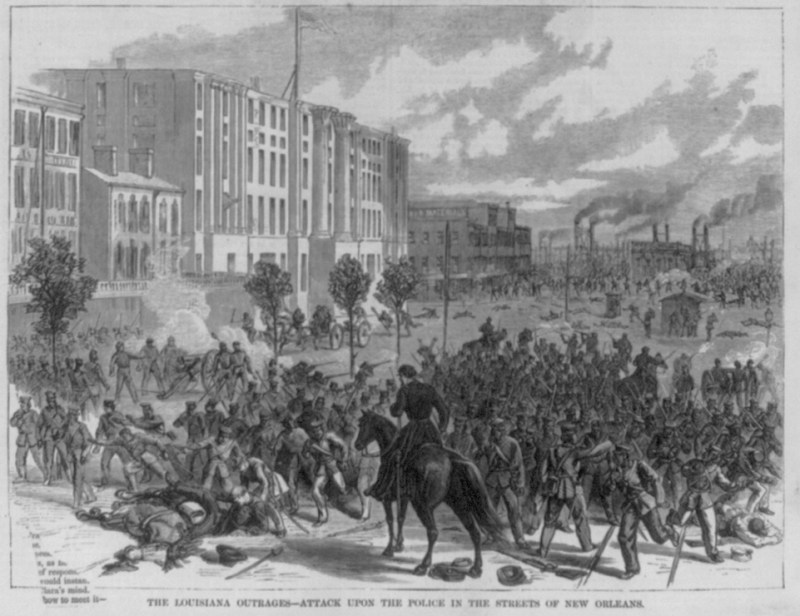
On September 14, 1874, a paramilitary force of somewhere between three and five thousand White League fighters staged an open insurrection in the streets of New Orleans. Their objective was direct and undisguised: to overthrow the Reconstruction government of Governor William Pitt Kellogg by force, seize the instruments of state power, and return Louisiana to Democratic rule built on the suppression of Black political participation. They very nearly succeeded permanently. For three days, the White League held the statehouse, city hall, and the state arsenal before federal troops arrived and compelled them to stand down.
What prevented the battle from becoming a complete catastrophe for the Reconstruction side was, as recent scholarship has established, largely James Longstreet. As the de facto military commander of the Metropolitan Police and the Black state militia, Longstreet had spent years building the organizational and personal relationships that gave the government’s forces what coherence they managed to demonstrate on that morning. He had also spent those years warning Governor Kellogg and Militia General William Badger that the White League was arming itself systematically and preparing for open violence. Those warnings were largely ignored. When the battle came, Longstreet worked within the constraints of a deployment he had not designed and would not have chosen, and he managed — barely — to keep the government’s resistance from collapsing entirely before federal authority could reassert itself.
That he was present at all on September 14th was not automatic. Longstreet held the position of Surveyor of Customs for the Port of New Orleans, a role that involved regular inspection duties along the city’s extensive waterfront. The port was the commercial heart of the lower Mississippi valley; the customs work was real, demanding, and not easily delegated. On any given morning, Longstreet’s official obligations could have placed him miles from Canal Street at the moment the White League chose to act.
Rodolphe Lucien Desdunes was twenty-five years old in September 1874. Born in New Orleans in 1849 to a Cuban father and a woman of African descent, he had grown up in the city’s Creole of color community — a community with its own deeply rooted institutions, its own French-language press, its own traditions of free Black intellectual and civic life that predated the Civil War and had survived it. He was already a customs house worker and an active figure in the political circles of Black New Orleans; he would go on to become one of the most important journalists, historians, and civil rights organizers in Louisiana history. His 1911 work, Nos Hommes et Notre Histoire (Our People and Our History), remains an indispensable document of Afro-Creole life and thought. But his most consequential contribution to American history came in the early 1890s, when he helped conceive, organize, and execute the legal test case that became Plessy v. Ferguson.
Plessy v. Ferguson (1896) is one of the most consequential Supreme Court decisions in American history, and not in a way its organizers intended. The case arose from the Louisiana Separate Car Act of 1890, which mandated racially segregated railway cars. The Comité des Citoyens (Citizens’ Committee), a New Orleans organization of Creole and Black activists, decided to challenge the law through a deliberately engineered test case. Their strategy was careful and legalistic: they chose their plaintiff, Homer Plessy, partly because his appearance (he was, in the language of the era, one-eighth Black) would dramatize the arbitrariness of racial classification. They engaged Albion Tourgée, one of the most capable civil rights attorneys in the country, as lead counsel. And they were confident — not unreasonably, given the legal landscape of the early 1890s — that the Supreme Court might be persuaded to strike down forced segregation.
They were wrong. The Court upheld the Separate Car Act seven to one, with Justice John Marshall Harlan writing a thundering dissent that would echo through American constitutional history for decades. The majority’s ruling established the ‘separate but equal’ doctrine, providing the legal foundation for the entire apparatus of Jim Crow segregation. It would stand, catastrophically, until Brown v. Board of Education in 1954.
Desdunes was central to every stage of the Comité des Citoyens’ organizing effort. His journalism gave the campaign its public voice; his organizational work and his relationships within the Creole of color community provided the network through which the committee recruited, deliberated, and acted. His son, Daniel Desdunes, was the first person arrested in a coordinated test, on February 24, 1892, for occupying a whites-only car on an interstate train. (That charge was eventually dismissed on the grounds that the Separate Car Act did not apply to interstate commerce, which is why a second test case — Homer Plessy’s — was necessary.) Without Rodolphe Desdunes, it is genuinely difficult to imagine the Comité des Citoyens functioning as it did, or the Plessy test case taking the form it did.
Without Rodolphe Desdunes, it is genuinely difficult to imagine the Comité des Citoyens functioning as it did, or the Plessy test case taking the form it took.
Point of Departure
Suppose that on the morning of September 14, 1874, Longstreet’s customs inspection duties take him downriver from the city center before news of the White League’s advance reaches him. The communications available to him are inadequate; the river work has pulled him south of easy recall. By the time a courier finds him and he can begin making his way back toward Canal Street, Kellogg and Badger have already deployed the Metropolitan Police and the state militia in the configuration they chose — the configuration Longstreet had argued against, with forces strung too thin along the riverfront, command authority unclear, and officers whose loyalties or competence he had reason to doubt placed in critical positions.
Longstreet arrives as the White League is already pressing forward. He cannot reorganize a deployment in the minutes available to him. What he could have done, had he been present from the beginning — corrected the positioning of units, established cleaner lines of command, placed his most reliable officers where the pressure would be heaviest — he cannot do now. The government forces engage and they break, not in the partial, contested way they broke in actual history, but more completely and more quickly. The organized resistance collapses within minutes, and the White League, meeting less opposition than its own commanders expected, moves beyond its original military objectives.
This is the point where historical contingency opens into something darker. A White League that achieves total military victory in fifteen minutes, rather than a costly and contested one, has energy and momentum and rage left over — and a leadership that has just discovered the government cannot stop them.
An Alternate Chain of Events
The White League seizes the statehouse, city hall, and the arsenal as it did in actual history; those are its primary objectives and it accomplishes them quickly. But unlike in the actual battle, where the contested nature of the fighting and the partial coherence of Longstreet’s defense created a kind of exhaustion and boundary on both sides, here the victory is so swift and so total that the paramilitary forces do not simply occupy government buildings and wait for federal response. They begin to move through the city.
New Orleans in 1874 is a city of layered neighborhoods, and the lower districts closest to the waterfront — the Tremé, the Faubourg Marigny, the streets between Canal and Esplanade — are home to the densest concentrations of the city’s Creole of color and Black population. These are not disorganized communities; they have churches, newspapers, fraternal organizations, and political clubs. Many of the men in them are veterans of the United States Colored Troops or of the state militia that just collapsed. They are also, in the absence of an organized government defense, entirely exposed.
What begins as the political overthrow of a Reconstruction government becomes, in its edges and aftermath, something resembling a pogrom. White League fighters and the organized and disorganized mob that follows in their wake move through streets where Black Louisianans live and work, and the violence that was instrumental in seizing the government becomes retributive and terroristic in its extension. Property burns. Men are beaten or killed. The particular geography of Canal Street — the literal dividing line between the old French Quarter and the American sector, the symbolic axis of New Orleans civic life — becomes the boundary across which racial violence spreads outward in both directions.
Rodolphe Desdunes, on the afternoon of September 14, 1874, is in the wrong place at the wrong time in the wrong city. He is twenty-five, recognizably a man of color in a community under assault, and the customs house where he works is no protection against street violence whose perpetrators have just demonstrated that the government cannot stop them. The exact circumstances of his death in this scenario are, as with all historical speculation, unknowable; what is historically grounded is the character of the violence the White League and its allied mobs were capable of directing against Black New Orleanians, and the fact that a young Black man in the Tremé or the waterfront district on that afternoon would have been at genuine risk of his life.
The customs house where he works is no protection against street violence whose perpetrators have just demonstrated, with complete clarity, that the government cannot stop them.
Federal troops still arrive within days, as they did in actual history. Grant still compels the White League to stand down, still restores Kellogg’s nominal authority. But the dead do not come back, and the political landscape of Black New Orleans is altered in ways that cannot be undone by a military restoration. The Creole of color community has lost one of its most capable young activists at the moment when Reconstruction’s vulnerability is most fully exposed. The message delivered by the three-day coup — that the federal government’s protection is conditional and revocable — is now accompanied by evidence that the White League will kill, not merely govern.
The community regroups over the following years, as it historically did. Louis Martinet, Desdunes’ contemporary and collaborator in the actual timeline, is still alive; he still founds The Crusader newspaper in 1889, still becomes a physician and attorney, still cares deeply about civil rights. But the Comité des Citoyens that Martinet and Desdunes built together in our actual history is a product of two people’s particular intelligence, network, and strategic sensibility working in concert. Martinet without Desdunes is a capable man working alone where there were two.
The Separate Car Act passes in Louisiana in 1890, as it did in actual history. The question of whether to challenge it through a deliberate test case still arises; the injustice is too blatant and the Creole of color community’s tradition of legal resistance too deep for it not to. But the specific architecture of the challenge — the patient construction of a test case designed to maximize legal impact, the choice of plaintiff, the engagement of Albion Tourgée, the careful sequencing of Daniel Desdunes’ interstate challenge followed by Homer Plessy’s intrastate one — requires the kind of sustained organizational intelligence that Desdunes specifically provided. Without him, the challenge either does not materialize in organized form, or it materializes differently: less carefully constructed, less strategically sequenced, perhaps legally premature.
If no organized challenge to the Separate Car Act reaches the Supreme Court before the political window closes, the legal landscape of American segregation develops without a ‘separate but equal’ precedent. This is not straightforwardly good news; the absence of a precedent does not mean the absence of segregation, which proceeds through local ordinance, custom, and terror regardless of what the Supreme Court says or doesn’t say. But the specific constitutional architecture of Jim Crow — the doctrine that gave Southern states a Supreme Court imprimatur for sixty years of legally enforced separation — is not erected in the same form. Future challenges to segregation do not have to argue against a controlling precedent that the Court itself had blessed.
There is a painful irony buried here that any serious treatment of this counterfactual must acknowledge. Plessy v. Ferguson, which the Comité des Citoyens organized hoping to win, became one of the most damaging legal decisions in American history. The ‘separate but equal’ doctrine it enshrined gave judicial legitimacy to the entire structure of Jim Crow, and it took Brown v. Board of Education in 1954 — nearly sixty years — to partially dismantle it. In a narrow and cruel sense, one could argue that Desdunes’ death in our alternate 1874 prevented the legal catastrophe of 1896. But this framing is morally wrong in a way worth naming directly: it would ask us to find a silver lining in the death of a man and the destruction of a community, and it would credit the White League’s violence with a consequence it did not intend and does not deserve. The right way to read this is not that Desdunes’ death was fortunate, but that his survival and his work led to a legal defeat that should not have been a defeat — that the Supreme Court of 1896 failed the Constitution as completely as the White League failed democracy in 1874, and that both failures trace to the same unwillingness to protect Black American citizenship.
Long-Term Consequences
The most immediate long-term consequence of a more violent Battle of Liberty Place is the acceleration and deepening of the terror that defined the post-Reconstruction Gulf South. A White League that kills with impunity in September 1874 has demonstrated something to every similar organization from Mississippi to Georgia: that the federal government’s protection has a floor below which it will not go, and that floor is higher than the lives of Black New Orleanians in the streets. The Thibodaux Massacre of 1887, in which sugar workers striking for better wages were killed by a White League-connected militia, is in some respects the downstream consequence of exactly this dynamic in actual history; in our alternate timeline, the violence begins earlier and cuts deeper.
The loss of Desdunes as an intellectual and organizational figure extends beyond the specific legal question of Plessy. He was, in actual history, one of the people who gave the Creole of color community’s resistance its historical memory; Nos Hommes et Notre Histoire was an act of preservation as much as argument, a record of a community’s humanity and capability set against a society that was attempting to deny both. Without that record, the institutional memory of what Black New Orleans had been and might be is thinner, more vulnerable to the erasure that Jim Crow and its successors worked systematically to achieve.
The constitutional question that Plessy v. Ferguson answered — and answered disastrously — does not simply disappear in this alternate timeline. It waits. Segregation continues through ordinance and custom and violence, as it did even in the actual timeline during the decades the Plessy precedent stood. The legal challenge, when it eventually comes in a different form from different organizers, faces a different landscape: no controlling precedent to argue against, but also no established framework of constitutional argument that the Plessy litigation and its aftermath had developed. The NAACP that forms in 1909, the legal strategies that Charles Hamilton Houston and Thurgood Marshall develop in the 1930s and 1940s — all of this proceeds differently, not necessarily worse in its ultimate direction, but through a different terrain.
The life of Daniel Desdunes — Rodolphe’s son, who in actual history was arrested in the first coordinated test case in February 1892 — takes an entirely different shape. He is not born without his father; but he grows up without the specific intellectual and activist formation that his father’s life and work would have provided. Whether he finds his way to civil rights work through other channels, whether the specific moral and political inheritance Rodolphe Desdunes intended to pass down to him survives in some altered form, is one of the more genuinely open questions this counterfactual raises.
The constitutional question that Plessy v. Ferguson answered — and answered disastrously — does not simply disappear. It waits, for different organizers, in a different legal landscape, without the framework that the Plessy litigation had developed.
And there is this: in the actual history, the Plessy case produced a dissent by Justice John Marshall Harlan that became one of the foundational texts of American civil rights constitutionalism. ‘Our Constitution is color-blind,’ Harlan wrote, ‘and neither knows nor tolerates classes among citizens.’ That dissent was read, cited, and argued from for decades; it shaped the moral and legal vocabulary of the civil rights movement in ways that are difficult to fully measure. Without Plessy, there is no Harlan dissent; without the Harlan dissent, the constitutional argument for equality lacks one of its most powerful formulations. Desdunes and his colleagues did not intend to produce a magnificent dissent and a catastrophic majority opinion. They intended to win. The fact that their loss gave future generations a weapon is cold comfort for what it cost.
Discussion Questions
1. Rodolphe Desdunes and the Comité des Citoyens organized the Plessy test case expecting to win, and instead helped create a precedent that entrenched Jim Crow for nearly sixty years. How should historians evaluate strategic decisions that were reasonable at the time but produced terrible outcomes? Does the quality of a decision depend on its results, or on what was knowable and reasonable when it was made?
2. Justice Harlan’s dissent in Plessy v. Ferguson is often celebrated as a moment of moral clarity, but it only exists because the majority opinion was written. What does it mean that one of the most important constitutional arguments for racial equality emerged as a minority position in a case organized by Black activists who fully expected to prevail? What does this suggest about how marginalized communities have had to use the legal system even when that system was working against them?
3. This post argues that the death of a single individual (Desdunes) could have altered the course of a major Supreme Court case. Is this kind of individual-level contingency a persuasive way to teach about historical causation, or does it risk overstating the role of individuals at the expense of structural forces? How might a teacher use this counterfactual to help students think about both individual agency and structural constraint?
Suggested Reading
Desdunes, Rodolphe Lucien. Our People and Our History: Fifty Creole Portraits. Translated and edited by Sister Dorothea Olga McCants. Baton Rouge: Louisiana State University Press, 1973 (originally published in French, 1911). Desdunes’ own account of the Creole of color community in New Orleans; essential primary source material for understanding the intellectual and civic world he inhabited and helped create.
Medley, Keith Weldon. We as Freemen: Plessy v. Ferguson. Gretna, LA: Pelican Publishing, 2003. The most accessible narrative account of the Comité des Citoyens and the Plessy case; Medley reconstructs the organizing process in detail and gives Desdunes, Martinet, and the other committee members their proper place in the story.
Elliott, Mark. Color-Blind Justice: Albion Tourgée and the Quest for Racial Equality from the Civil War to Plessy v. Ferguson. New York: Oxford University Press, 2006. A biography of the lead attorney in Plessy that illuminates the legal strategy and the political calculation behind the test case; essential context for understanding what the committee believed it could win.
Foner, Eric. Reconstruction: America’s Unfinished Revolution, 1863-1877. Updated edition. New York: Harper Perennial, 2014. The foundational account of Reconstruction; Foner’s treatment of Louisiana, the White League, and the Battle of Liberty Place provides the essential structural context for understanding what the September 1874 violence meant politically.
Lofgren, Charles A. The Plessy Case: A Legal-Historical Interpretation. New York: Oxford University Press, 1987. A close legal and historical analysis of the case and the ‘separate but equal’ doctrine; particularly useful for teachers who want to help students understand how the majority opinion constructed its argument and what Harlan’s dissent was responding to.
Scott, Rebecca J. Degrees of Freedom: Louisiana and Cuba After Slavery. Cambridge: Belknap Press of Harvard University Press, 2005. Traces the parallel and intersecting histories of freed people in Louisiana and Cuba in the post-emancipation decades; Scott’s account of the Creole of color community’s political strategies and the structures of freedom and constraint they navigated is both deeply researched and beautifully written.


You must be logged in to post a comment.